


26 Sep Karnataka Rejects Kasturirangan Report: Implications for Western Ghats ESAs
✎ The Kasturirangan Report proposes a nuanced ESA framework for the Western Ghats, balancing conservation with sustainable development, but Karnataka’s rejection of the framework highlights the federal challenge of reconciling…
Subject Relevance — Where This Topic Fits
- GS Paper II — Functions and Responsibilities of the Union and the States, Issues and Challenges Pertaining to the Federal Structure | GS Paper III — Conservation, Environmental Pollution and Degradation, Environmental Impact Assessment
- Prelims: Western Ghats, Ecologically Sensitive Areas (ESAs), Kasturirangan Report, Gadgil Report, Ground-truthing, Remote Sensing, Satellite Data, Biodiversity Hotspots, Forest Rights Act 2006, National Green Tribunal (NGT), Compensatory Afforestation Fund Management and Planning Authority (CAMPA)
- Essay: Balancing economic development and environmental conservation: A case study of the Western Ghats, Federalism in environmental governance: The challenge of balancing local aspirations with national priorities
Quick Revision: The Kasturirangan Report proposes a nuanced ESA framework for the Western Ghats, balancing conservation with sustainable development, but Karnataka’s rejection of the framework highlights the federal challenge of reconciling local livelihood concerns with national ecological priorities.
Why is this in the news?
The Karnataka Assembly’s unanimous resolution rejecting the Kasturirangan Report’s framework for Ecologically Sensitive Areas (ESAs) in the Western Ghats has reignited the long-standing debate over balancing conservation imperatives with developmental aspirations. The State’s resistance, rooted in concerns over livelihood impacts and data accuracy, contrasts with the Centre’s directive for ground-truthing and the progress made by other Western Ghats States, creating a policy impasse with broader implications for federal environmental governance in India.
Background
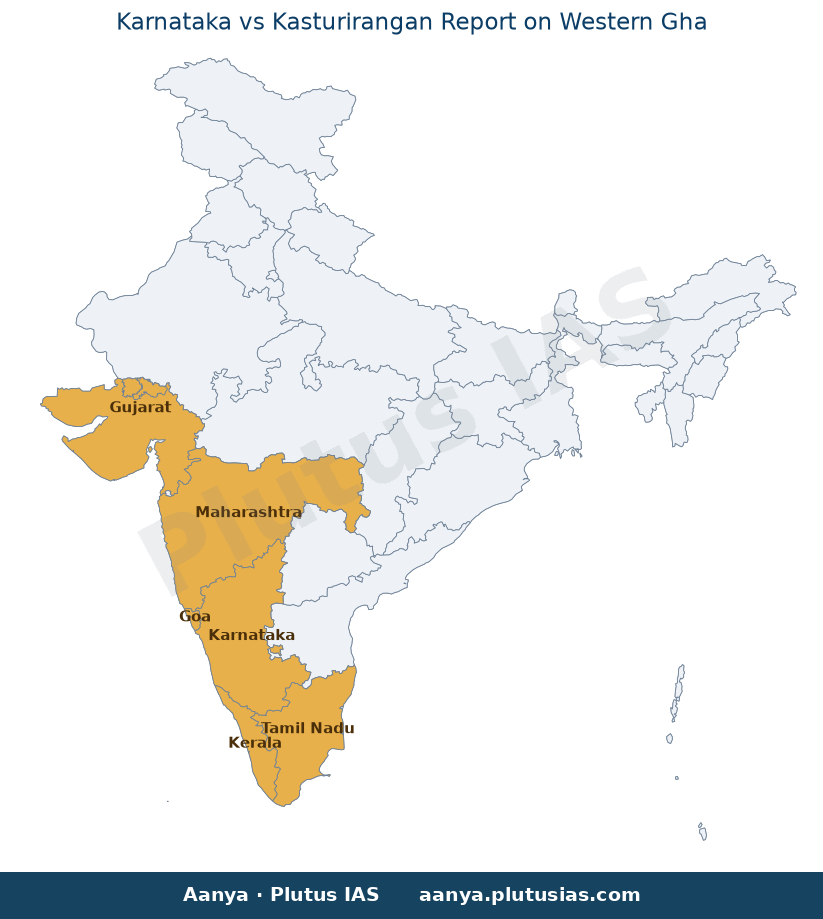
- The Western Ghats, a UNESCO World Heritage Site and one of the world’s eight biodiversity hotspots, spans six States: Gujarat, Maharashtra, Goa, Karnataka, Kerala, and Tamil Nadu, covering approximately 1,60,000 square kilometres.
- The Gadgil Committee (2011) and Kasturirangan Committee (2013) were constituted by the Union Ministry of Environment, Forest and Climate Change (MoEFCC) to recommend measures for the conservation and sustainable development of the Western Ghats, following the 2010 floods in Karnataka and Kerala.
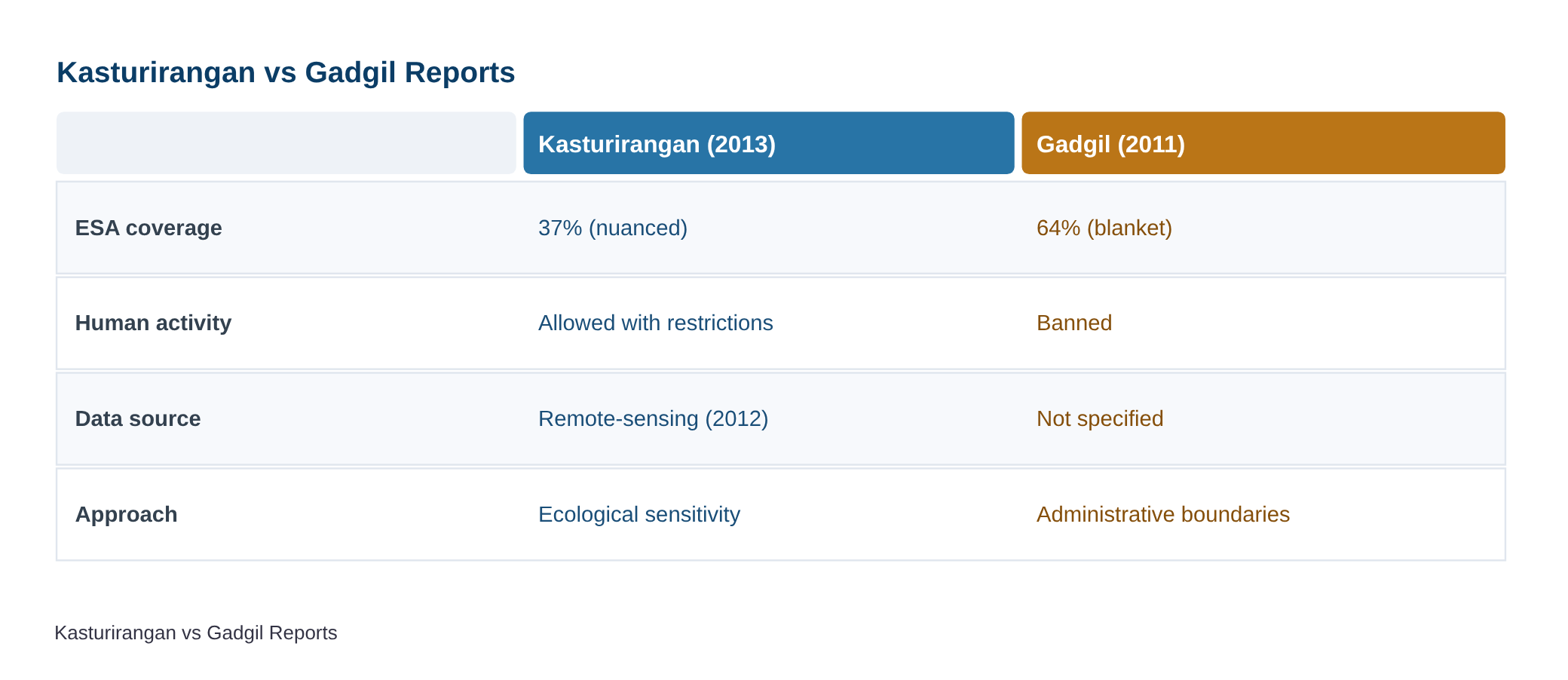
- The Gadgil Report recommended a blanket ban on developmental activities in 64% of the Western Ghats, while the Kasturirangan Report proposed a more nuanced approach, allowing certain human activities in ESAs while restricting ecologically harmful ones.
- The Kasturirangan Report utilised remote-sensing and satellite data from 2012 to delineate ESAs, identifying areas requiring enhanced protection based on ecological sensitivity rather than administrative boundaries.
- In 2013-14, the Centre directed States to conduct ground-truthing of the Kasturirangan Report’s recommendations, leading to varied responses from States due to differing local socio-economic and ecological priorities.
- The National Green Tribunal (NGT) and the Supreme Court have, in several judgments, underscored the need for balanced environmental governance, often intervening in disputes between States and the Centre over developmental projects in ecologically sensitive regions.
What is the Kasturirangan Report and the Ecologically Sensitive Areas (ESA) Framework?
- The Kasturirangan Report was submitted in 2013 by the high-level working group chaired by Dr. K. Kasturirangan, then Member of Parliament (Rajya Sabha) and former ISRO Chairman.
- The Report proposed the delineation of Ecologically Sensitive Areas (ESAs) across the Western Ghats, covering approximately 37% of the region, to balance conservation with sustainable development by regulating human activities based on ecological sensitivity.
- ESAs are defined as regions where human activities are restricted or regulated to prevent ecological degradation, with specific guidelines for permissible and prohibited activities such as mining, industrialisation, and large-scale construction.
- The Report recommended that an entire revenue village be designated as an ESA if at least 20% of its area is ecologically sensitive, a criterion that has been contested by States like Karnataka over concerns of disproportionate impact on livelihoods.
- The framework allows for a range of economic activities in ESAs, including agriculture, horticulture, and small-scale industries, provided they adhere to sustainable practices and avoid ecologically harmful practices.
- The Report utilised remote-sensing and satellite imagery to map ecological sensitivity, a method that has been criticised for potential inaccuracies in distinguishing between natural and human-dominated landscapes.
- The ESA framework is not legally binding but serves as a guiding document for States to align their conservation policies with national priorities, with the Centre retaining the authority to notify ESAs under the Environment Protection Act, 1986.
- The Kasturirangan Report was a response to the Gadgil Report (2011), which had recommended stricter conservation measures, including a blanket ban on developmental activities in 64% of the Western Ghats, leading to widespread opposition from State governments and local communities.
Key Features
| Feature | Significance |
|---|---|
| Kasturirangan Report (2013) | Provides a balanced framework for demarcating Ecologically Sensitive Areas (ESAs) in the Western Ghats, allowing regulated human activity while prioritising conservation. |
| ESA Framework | Aims to protect critical ecological zones while permitting sustainable livelihoods, using remote-sensing and ground-truthing to delineate boundaries. |
| Remote-Sensing Data (2012) | Basis for identifying sensitive and human-dominated landscapes; Karnataka raised concerns over its accuracy and granularity. |
| Revenue Village Criterion (20% threshold) | Proposes entire villages to be declared ESAs if 20% of their area is ecologically sensitive, potentially impacting farmland and settlements. |
| State-by-State Notification (2024) | Allows individual States to notify ESAs within their jurisdiction, reducing uniformity but increasing flexibility in implementation. |
Why it Matters
Ecological Conservation
- The Western Ghats, a UNESCO World Heritage Site, host critical biodiversity hotspots, including endemic flora and fauna, and act as a water tower for peninsular India.
- ESAs under the Kasturirangan framework aim to mitigate fragmentation of habitats, reduce human-wildlife conflict, and safeguard catchment areas for major rivers.
- Conservation of the Ghats is vital for India’s climate resilience, as they influence monsoon patterns and mitigate soil erosion in downstream regions.
Economic Development
- The Western Ghats support agriculture, plantation industries (e.g., coffee, tea, spices), and tourism, which are economically significant for multiple States.
- Regulated economic activities within ESAs (e.g., agroforestry, eco-tourism) can balance conservation with livelihood security, avoiding blanket restrictions.
- Uncertainty in ESA demarcation delays infrastructure projects, investment decisions, and land-use planning, impacting State revenues and employment.
Federalism and Governance
- The Centre’s directive to States to ground-truth the Kasturirangan Report underscores the principle of cooperative federalism in environmental governance.
- State-level resistance to ESA frameworks highlights tensions between national conservation goals and regional development priorities.
- The 2024 decision to allow State-by-State notification of ESAs introduces flexibility but risks inconsistent protection levels across the Ghats.
Technological and Methodological Aspects
- Remote-sensing and satellite data (e.g., from 2012) enable large-scale ecological mapping but require validation through ground-truthing to address local concerns.
- The 20% revenue village criterion simplifies ESA delineation but may lead to over-inclusion, disproportionately affecting rural communities.
- Advances in geospatial technology (e.g., LiDAR, high-resolution imagery) could refine ESA boundaries, but adoption requires capacity-building in State agencies.
Challenges
1. Data Accuracy and Ground-Truthing
- Concerns over the reliability of 2012 remote-sensing data used to demarcate ESAs, particularly in distinguishing natural from human-dominated landscapes.
- Inadequate ground-truthing in Karnataka may have led to misclassification of ecologically sensitive zones, affecting livelihoods and land-use rights.
- Need for modern geospatial tools and participatory mapping to validate ESA boundaries and address local grievances.
UPSC Link: GS-III: Environment & Ecology
2. Balancing Conservation and Development
- Tension between conservation objectives and economic activities (e.g., mining, agriculture) in potential ESAs, leading to bipartisan opposition in Karnataka.
- Risk of livelihood displacement for farmers, plantation workers, and tribal communities if ESAs are over-extended or poorly implemented.
- Pressure to reconcile national conservation goals with State-level development aspirations, particularly in agrarian economies.
UPSC Link: GS-III: Economic Development
3. Federalism and Policy Implementation
- Divergent State responses to the ESA framework (e.g., Gujarat’s progress vs. Karnataka’s rejection) create asymmetries in conservation outcomes.
- Centre’s 2024 decision to allow State-by-State notification of ESAs may dilute uniform protection standards across the Western Ghats.
- Lack of a legally binding mechanism to ensure consistency in ESA implementation, leading to policy uncertainty and delayed projects.
UPSC Link: GS-II: Federalism
4. Stakeholder Engagement and Political Economy
- Allegations of vested interests (e.g., mining lobbies) influencing opposition to ESA frameworks, complicating evidence-based policymaking.
- Bipartisan political opposition in Karnataka reflects broader societal apprehensions about displacement and loss of economic opportunities.
- Need for transparent, participatory processes to build consensus on ESA boundaries and mitigate resistance from affected communities.
UPSC Link: GS-IV: Ethics & Governance
5. Institutional Capacity and Coordination
- Limited technical and financial capacity in State agencies to conduct ground-truthing and implement ESA frameworks effectively.
- Poor coordination between the Centre, States, and local bodies may hinder the timely resolution of ESA-related disputes.
- Need for institutional mechanisms to streamline data sharing, capacity-building, and dispute resolution in environmental governance.
UPSC Link: GS-II: Government Policies
Challenges — UPSC Perspective
| Issue | Concern |
|---|---|
| Accuracy of Remote-Sensing Data | Potential misclassification of ecologically sensitive zones due to outdated or imprecise satellite imagery. |
| 20% Revenue Village Criterion | Risk of over-inclusion of farmland and settlements in ESAs, disproportionately affecting rural livelihoods. |
| State-by-State Notification | Inconsistent protection levels across the Western Ghats, undermining uniform conservation goals. |
| Stakeholder Opposition | Political and economic resistance from vested interests, complicating policy implementation. |
| Institutional Capacity | Limited technical and financial resources in State agencies to conduct ground-truthing and enforce ESA frameworks. |
| Policy Uncertainty | Delayed infrastructure projects and investment decisions due to unresolved ESA demarcation issues. |
Way Forward
- Karnataka should initiate a participatory process involving farmers, tribal communities, and experts to review the Kasturirangan Report’s recommendations and ground-truthing data.
- Leverage modern geospatial technologies (e.g., LiDAR, high-resolution satellite imagery) to refine ESA boundaries and address local concerns about accuracy.
- Develop a State-specific action plan that balances conservation with sustainable livelihoods, incorporating agroforestry, eco-tourism, and regulated plantation activities within ESAs.
- Strengthen inter-State coordination with neighbouring States (e.g., Kerala, Tamil Nadu) to harmonise ESA frameworks and ensure ecological continuity across the Western Ghats.
- Establish a State-level nodal agency for environmental governance, equipped with technical and financial resources to implement ESA frameworks effectively.
- Engage with the Centre to seek clarity on the 2024 State-by-State notification policy and explore incentives for States that adopt progressive ESA implementation.
- Promote awareness campaigns to educate stakeholders about the benefits of ESAs, including long-term ecological resilience and economic opportunities in sustainable sectors.
- Conduct periodic reviews of ESA implementation to assess its impact on livelihoods and biodiversity, adjusting boundaries and regulations as necessary.
UPSC Value Addition
Keywords for Mains Answer-Writing
Kasturirangan Report · Ecologically Sensitive Areas (ESAs) · Western Ghats · Ground-truthing · Environmental governance · State-versus-Centre federalism · Sustainable development · Biodiversity conservation · Remote sensing and satellite data · Revenue village demarcation · Livelihood security · Eco-sensitive zones (ESZs) · Forest Rights Act, 2006 · National Board for Wildlife (NBWL) · Inter-state coordination in environmental policy
Constitutional & Policy Linkages
- [‘Article 252: Power of Parliament to legislate for States with consent’, ‘Allows Centre to frame laws for environmental protection in States.’]
- [‘Article 253: Legislation for implementing international agreements’, ‘Relevant for India’s commitments under the UNESCO World Heritage Convention.’]
- [‘Article 256: Duty of States to ensure compliance with laws’, ‘States must implement environmental laws framed by the Centre.’]
- [‘Seventh Schedule: Concurrent List (Entry 17A)’, ‘Covers forests and protection of wild animals and birds, enabling Centre-State coordination.’]
Concept Flow
Remote-sensing and satellite data (2012) used to demarcate ecologically sensitive areas (ESAs) in the Western Ghats. → Karnataka Assembly rejects Kasturirangan Report due to concerns over data accuracy, livelihood impacts, and the 20% revenue village criterion. → Centre’s 2013 directive to States to ground-truth the report, leading to bipartisan opposition in Karnataka. → Centre’s 2024 decision to allow State-by-State notification of ESAs, increasing pressure on Karnataka to reconsider its stance. → Potential delays in infrastructure projects and investment decisions due to unresolved ESA demarcation issues. → Need for Karnataka to reconcile conservation goals with developmental aspirations through participatory and evidence-based policymaking. → Long-term outcome hinges on balancing ecological protection with sustainable livelihoods and inter-State cooperation.
Prelims Practice Questions
Q1. Consider the following statements regarding the Kasturirangan Report on the Western Ghats:
1. The Report recommends that an entire revenue village be declared an Ecologically Sensitive Area (ESA) if at least 20% of its area is ecologically sensitive.
2. The Report was prepared by the Gadgil Committee.
3. The Report allows human occupation and a range of economic activities in the Western Ghats.
4. The Report has been universally accepted by all States in the Western Ghats region.
How many of the above statements are correct?
- Only one
- Only two
- Only three
- All four
Answer: Only three — Statements 1 and 3 are correct. Statement 2 is incorrect as the Kasturirangan Report was prepared by the High-Level Working Group chaired by Dr. K. Kasturirangan, not the Gadgil Committee. Statement 4 is incorrect as States like Karnataka have repudiated the Report’s recommendations.
Q2. Assertion (A): The Kasturirangan Report uses remote sensing and satellite data from 2012 to demarcate ecologically sensitive areas in the Western Ghats.
Reason (R): The Report aims to balance biodiversity conservation with sustainable development by allowing limited economic activities in identified ESAs.
In the context of the above two statements, which one of the following is correct?
- Both A and R are true, and R is the correct explanation of A
- Both A and R are true, but R is not the correct explanation of A
- A is true, but R is false
- A is false, but R is true
Answer: A is true, but R is false — Assertion (A) is true as the Report indeed utilised 2012 satellite data. Reason (R) is also true, but it does not explain the assertion, as the use of satellite data is a methodological choice, not a consequence of the Report’s developmental stance.
Q3. Match the following States with their respective positions on the Kasturirangan Report’s recommendations:
Column I (State) Column II (Position)
A. Karnataka 1. Close to an agreement with the Centre
B. Tamil Nadu 2. No substantive disagreement
C. Kerala 3. Wants to reduce ESAs from 9,993 sq. km to 8,805 sq. km
D. Gujarat 4. Wants 378 villages omitted
E. Maharashtra 5. Unanimously repudiated the recommendations
Answer: ? — A-5, B-2, C-3, D-1, E-4
Mains Practice Question
✍ The Kasturirangan Report’s framework for Ecologically Sensitive Areas (ESAs) in the Western Ghats seeks to reconcile biodiversity conservation with sustainable development. Critically examine the report’s recommendations in light of the constitutional division of environmental governance between the Centre and the States. Also, analyse the challenges faced by States like Karnataka in implementing the framework. (15 Marks)
Approach: MODEL-ANSWER SKELETON:
1. **Introduction (2 Marks)**
– Briefly introduce the Kasturirangan Report (2013) and its objective: to balance conservation of the Western Ghats with sustainable development.
– Mention the constitutional framework: Entry 17 (Forest) and Entry 19 (Conservation of flora and fauna) in the Concurrent List (Article 246), which empowers both the Centre and States to legislate on environmental matters.
2. **Key Recommendations of the Report (3 Marks)**
– Use of remote sensing and satellite data (2012) to demarcate ESAs.
– Recommendation to declare an entire revenue village as an ESA if ≥20% of its area is ecologically sensitive.
– Pro-development stance: allows human occupation and limited economic activities in ESAs.
– Ground-truthing directive to States (2013-14) to verify satellite data.
3. **Constitutional and Federal Challenges (4 Marks)**
– **Federalism Tension**: States like Karnataka argue that the Report infringes upon their autonomy in land-use planning (State List Entry 18: Land).
– **Livelihood Concerns**: Farmers and workers fear displacement due to broad ESA demarcations.
– **Centre’s Directive**: The Centre’s interim directions (2013) preserve some protection, creating uncertainty for States and businesses.
– **State-Level Resistance**: Karnataka’s Assembly unanimously repudiated the Report, while other States (e.g., Gujarat, Tamil Nadu) negotiated or accepted it.
4. **Challenges in Implementation (3 Marks)**
– **Data Accuracy**: Concerns over the reliability of 2012 satellite data in distinguishing natural from human-dominated landscapes.
– **Economic Impact**: Potential loss of livelihoods in agriculture, mining, and other sectors.
– **Alternative Mapping**: Karnataka’s proposal to create an alternative map, but lack of progress due to political and technical challenges.
– **Inter-State Coordination**: The Western Ghats span six States; unilateral rejection by Karnataka complicates regional conservation efforts.
5. **Way Forward (3 Marks)**
– **Balanced Approach**: States must reconcile conservation goals with livelihood security, possibly through participatory ground-truthing and local stakeholder consultations.
– **Legal and Policy Reforms**: Strengthen the Forest Rights Act, 2006, to recognise community rights in ESAs.
– **Centre-State Collaboration**: The Centre’s 2024 decision to notify ESAs State-by-State can reduce friction but requires transparent and evidence-based demarcation.
– **Scientific Rigour**: Use updated satellite data and advanced GIS tools to refine ESA boundaries.
**Balanced View**: Acknowledge the Report’s intent to balance conservation and development, but highlight the need for flexibility, transparency, and State-level ownership to ensure effective implementation.
Source: The Hindu
Karnataka PCS (KPSC) — State PCS Practice
Prelims: The Kasturirangan Report, which recommended restrictions on developmental activities in the Western Ghats, has been a subject of debate in Karnataka. Which of the following statements best reflects Karnataka’s stance on the report?
- A. Karnataka fully supports the Kasturirangan Report without any modifications.
- B. Karnataka has rejected the report outright and refused to implement its recommendations.
- C. Karnataka has sought modifications to the report to balance conservation with developmental needs of the state.
- D. Karnataka has not taken any position on the report and remains neutral.
Answer: C. Karnataka has sought modifications to the report to balance conservation with developmental needs of the state. — Karnataka has sought modifications to the Kasturirangan Report to address concerns over livelihoods and developmental priorities while ensuring conservation.
Mains: Critically analyze the impact of the Kasturirangan Report on Karnataka’s socio-economic landscape. How can the state reconcile conservation goals with the developmental aspirations of its people?
Generated by AanyaAi for educational purpose.
Related guides on our sites
- Current affairs for upsc 2026
- Best PSIR optional coaching for upsc
- Best economics optional coaching for upsc
- Best PSIR optional teacher for upsc

- Karnataka Rejects Kasturirangan Report: Implications for Western Ghats ESAs - September 26, 2026
- अल्पसंख्यक कार्य मंत्रालय ने IISc बेंगलुरु में प्रमुख संस्थानों के साथ साझेदारी की - September 26, 2026
- UPSC Alert: Minority Ministry ties up with IISc, IITs for skill & infra development by 2026 - September 26, 2026

No Comments