


26 Sep Odisha Launches E-Portal for Lord Jagannath Land Settlement: UPSC Exam Focus
✎ The e-portal for Lord Jagannath’s land settlement exemplifies the integration of digital governance in land administration, aiming to enhance transparency, reduce disputes, and modernise temple land management through a…
Subject Relevance — Where This Topic Fits
- GS Paper II — Governance, Transparency and Accountability | GS Paper III — Land Reforms and Digital Governance
- Prelims: Land Settlement, Digital Land Records, E-Governance, Revenue Administration, Temple Land Management
- Essay: E-governance as a tool for administrative efficiency and transparency, Balancing tradition and modernity in heritage resource management
Quick Revision: The e-portal for Lord Jagannath’s land settlement exemplifies the integration of digital governance in land administration, aiming to enhance transparency, reduce disputes, and modernise temple land management through a centralised, user-friendly digital platform.
Why is this in the news?
The Odisha government’s decision to develop an e-portal for the settlement of Lord Jagannath’s land marks a significant step toward digitising land administration, enhancing transparency, and streamlining the process of granting land rights to occupants, including servitors and non-servitors. This initiative, reviewed by the Law Minister, underscores the state’s commitment to modernising land governance while addressing long-standing administrative challenges in temple land management.
Background
- Lord Jagannath’s lands, historically managed under the Shree Jagannath Temple Administration (SJTA), constitute a substantial portion of temple properties in Odisha.
- Land settlement in temple properties often involves complex claims by servitors (traditional temple functionaries) and non-servitors (long-term occupants), leading to disputes and inefficiencies in the absence of a centralised digital record.
- Odisha’s land administration has been progressively digitised under the Digital India Land Records Modernisation Programme (DILRMP), aiming to reduce litigation and improve transparency in land records.
- The Shree Jagannath Temple is a major cultural and religious institution in India, with its lands spread across Puri and other districts, necessitating a systematic approach to land management.
- E-governance initiatives in land administration have been prioritised by the Union Government under the National Land Records Modernisation Programme (NLRMP), with states adopting state-specific digital solutions.
- The move aligns with broader efforts to integrate Information and Communication Technology (ICT) in governance, as envisaged under the Digital India programme.
What is the proposed e-portal for Lord Jagannath’s land settlement?
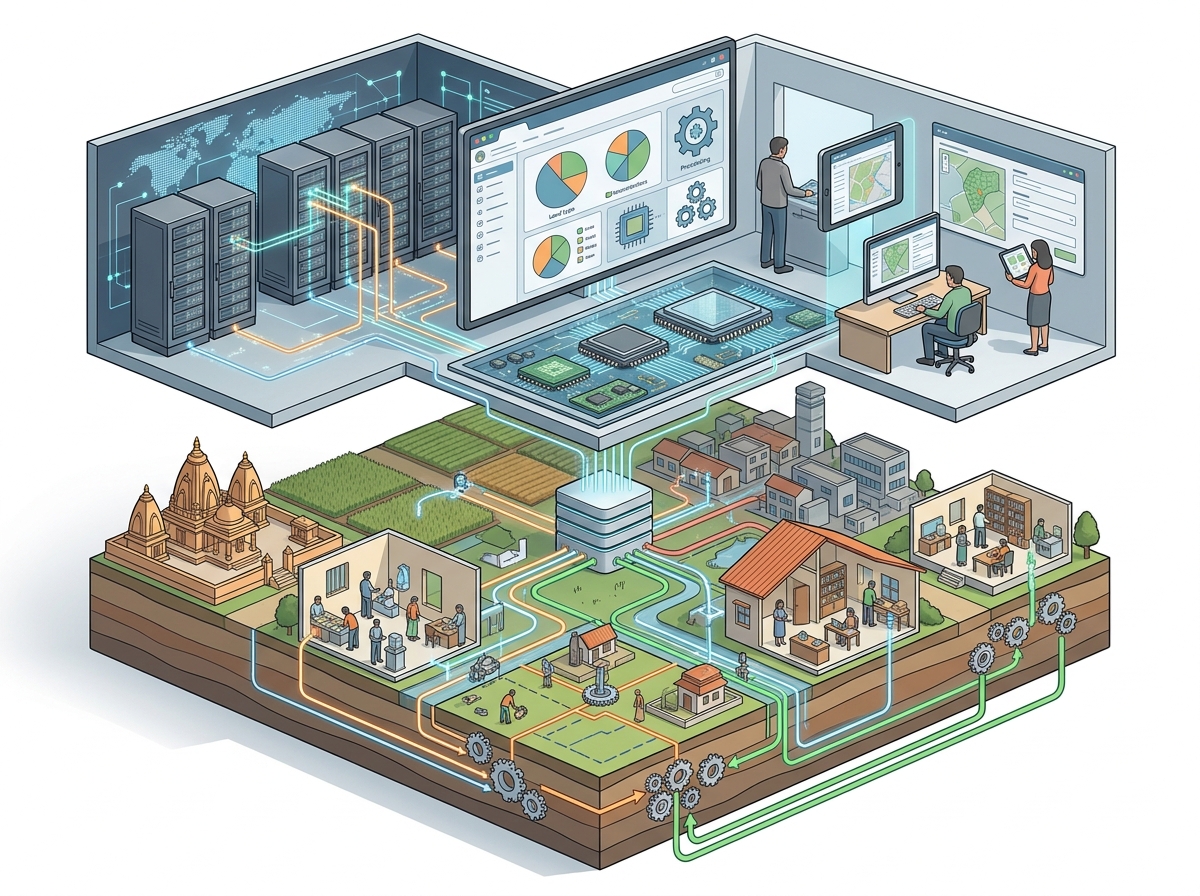
- The e-portal is a digital platform designed to facilitate the systematic settlement of land rights for occupants of Lord Jagannath’s lands, including servitors and non-servitors, by enabling online submission of claims and verification of records.
- It aims to create a comprehensive, centralised database of all land occupants, ensuring transparency, reducing procedural delays, and minimising disputes through digitised records and real-time updates.
- The e-portal will streamline the verification process by enabling cross-referencing with temple records, revenue department data, and historical land documents, thereby reducing manual errors and corruption risks.
- Stakeholders involved include the Revenue Department, Electronics and Information Technology Department, Shree Jagannath Temple Administration (SJTA), and district collectors, with the Law Department overseeing legal compliance.
UPSC Value Addition
Keywords for Mains Answer-Writing
Land reforms in India · Temple land management · E-governance in land records · Digital Public Infrastructure · Temple administration under state law · Land settlement mechanisms · Right to Property (Article 300A) · Temple lands and constitutional provisions · Transparency in land governance · Servitors and non-servitors rights · Odisha Revenue and Disaster Management Department · Temple Administration Acts · Land records digitisation · Public trust doctrine · Institutional governance of religious institutions
Prelims Practice Questions
Q1. Consider the following statements regarding land settlement mechanisms in India:
1. Land settlement in India is governed exclusively by the central government under the Land Acquisition Act, 1894.
2. The Right to Property is a fundamental right under the Indian Constitution.
3. State governments have the authority to settle disputes over temple lands under their jurisdiction.
4. The proposed e-portal for Lord Jagannath’s land settlement in Odisha is an example of digital public infrastructure.
How many of the above statements are correct?
- Only one
- Only two
- Only three
- All four
Answer: Only three — Statements 3 and 4 are correct. Statement 1 is incorrect as land settlement is primarily a state subject under the Constitution. Statement 2 is incorrect as the Right to Property was removed from the Fundamental Rights in 1978 and is now a constitutional right under Article 300A.
Q2. Assertion (A): The Right to Property is a fundamental right under the Indian Constitution.
Reason (R): The Constitution (Forty-Fourth Amendment) Act, 1978 removed the Right to Property from the list of Fundamental Rights and placed it under Article 300A as a constitutional right.
- Both A and R are true, and R is the correct explanation of A
- Both A and R are true, but R is NOT the correct explanation of A
- A is true but R is false
- A is false but R is true
Answer: ? — Assertion (A) is false. The Right to Property is no longer a fundamental right; it is a constitutional right under Article 300A. Reason (R) is true and correctly explains the status of the Right to Property.
Q3. Match the following pairs related to land governance in India:
Column I (Institution/Act) Column II (Function)
A. State Revenue Department 1. Maintains land records and settlement
B. Article 300A 2. Constitutional right to property
C. Digital India Land Records Modernization Programme 3. Digitisation of land records
D. Right to Fair Compensation and Transparency in Land Acquisition Act, 2013 4. Regulates land acquisition
Select the correct match:
- A-1, B-2, C-3, D-4
- A-2, B-1, C-4, D-3
- A-3, B-4, C-1, D-2
- A-4, B-3, C-2, D-1
Answer: A-1, B-2, C-3, D-4 — Correct matches: A-1 (State Revenue Department maintains land records), B-2 (Article 300A provides constitutional right to property), C-3 (Digital India Land Records Modernization Programme focuses on digitisation), D-4 (RFCTLARR Act, 2013 regulates land acquisition).
Mains Practice Question
✍ The digitisation of land records and the use of e-governance portals for land settlement processes represent a significant shift in the governance of temple lands in India. Critically examine the legal and administrative challenges in the management of temple lands, with particular reference to the proposed e-portal for Lord Jagannath’s land in Odisha. (15 Marks)
Approach: MODEL-ANSWER SKELETON:
1. **Introduction (2 marks)**
– Define temple lands and their significance in India’s socio-religious fabric.
– Highlight the constitutional and legal framework governing temple lands (e.g., Article 26, Article 29(1), state-specific Temple Acts, and the Right to Property under Article 300A).
– Mention the role of state governments in managing temple lands under the Constitution (State List, Entry 18 and 46).
2. **Legal and Administrative Challenges (5 marks)**
– **Historical encroachments and disputes**: Cite the issue of long-standing encroachments by servitors and non-servitors, as highlighted in the Odisha case.
– **Lack of transparent records**: Discuss the absence of digitised land records and the prevalence of manual, error-prone systems.
– **Constitutional and statutory ambiguities**: Explain conflicts between temple administration acts and general land laws (e.g., Odisha Hindu Religious Institutions and Charitable Endowments Act, 1951).
– **Right to Property vs. Public Trust Doctrine**: Analyse how the Right to Property (Article 300A) interacts with the public trust doctrine in managing temple lands.
– **Jurisdictional overlaps**: Discuss the division of responsibilities between temple authorities (e.g., Shree Jagannath Temple Administration) and state revenue departments.
3. **E-governance and Digital Public Infrastructure (4 marks)**
– **Benefits of the e-portal**: Explain how digitisation can enhance transparency, reduce disputes, and streamline settlement processes (reference the Odisha e-portal initiative).
– **Challenges in implementation**: Discuss issues such as digital divide, data privacy, and resistance from vested interests.
– **Comparative examples**: Cite successful e-governance models in land records (e.g., Bhu-Naksha in Karnataka, Dharani in Telangana).
4. **Way Forward and Policy Recommendations (4 marks)**
– **Strengthening legal frameworks**: Suggest amendments to temple administration acts to align with modern land governance practices.
– **Capacity building**: Emphasise the need for training officials and stakeholders in using digital platforms.
– **Grievance redressal mechanisms**: Propose a multi-tiered system for dispute resolution.
– **Public participation**: Highlight the role of local communities in validating land records and resolving disputes.
**Balanced conclusion**: Acknowledge the transformative potential of e-governance while cautioning against over-reliance on technology without addressing underlying legal and administrative gaps.
Source: orissapost.com
Odisha PCS (OPSC (OAS)) — State PCS Practice
Prelims: Which of the following is the primary objective of Odisha’s initiative to develop an e-portal for the settlement of Lord Jagannath land?
- A. To digitize land records for revenue collection efficiency
- B. To streamline the process of land settlement and disputes related to Lord Jagannath properties
- C. To promote commercialization of temple lands for economic development
- D. To facilitate foreign investment in temple-adjacent lands
Answer: B. To streamline the process of land settlement and disputes related to Lord Jagannath properties — The e-portal aims to resolve land disputes and streamline settlement processes for lands dedicated to Lord Jagannath, ensuring transparency and efficiency.
Mains: Discuss the significance of digitizing land records and dispute resolution mechanisms for the management of religious endowments in Odisha, with special reference to Lord Jagannath properties. Highlight the challenges and suggest measures for effective implementation.
Generated by AanyaAi for educational purpose.
Related guides on our sites
- Current affairs for upsc 2026
- Best PSIR optional coaching for upsc
- Best PSIR optional teacher for upsc
- Best teacher of PSIR optional for upsc

- Odisha Launches E-Portal for Lord Jagannath Land Settlement: UPSC Exam Focus - September 26, 2026
- कर्नाटक और कस्तूरीरंगन रिपोर्ट: विकास बनाम पर्यावरण का संतुलन - September 26, 2026
- Karnataka Rejects Kasturirangan Report: Implications for Western Ghats ESAs - September 26, 2026

No Comments