


26 Sep Odisha’s Cultural Heritage in PM Smriti Chinha E-Auction 2026: Key Artifacts & Significance for UPSC
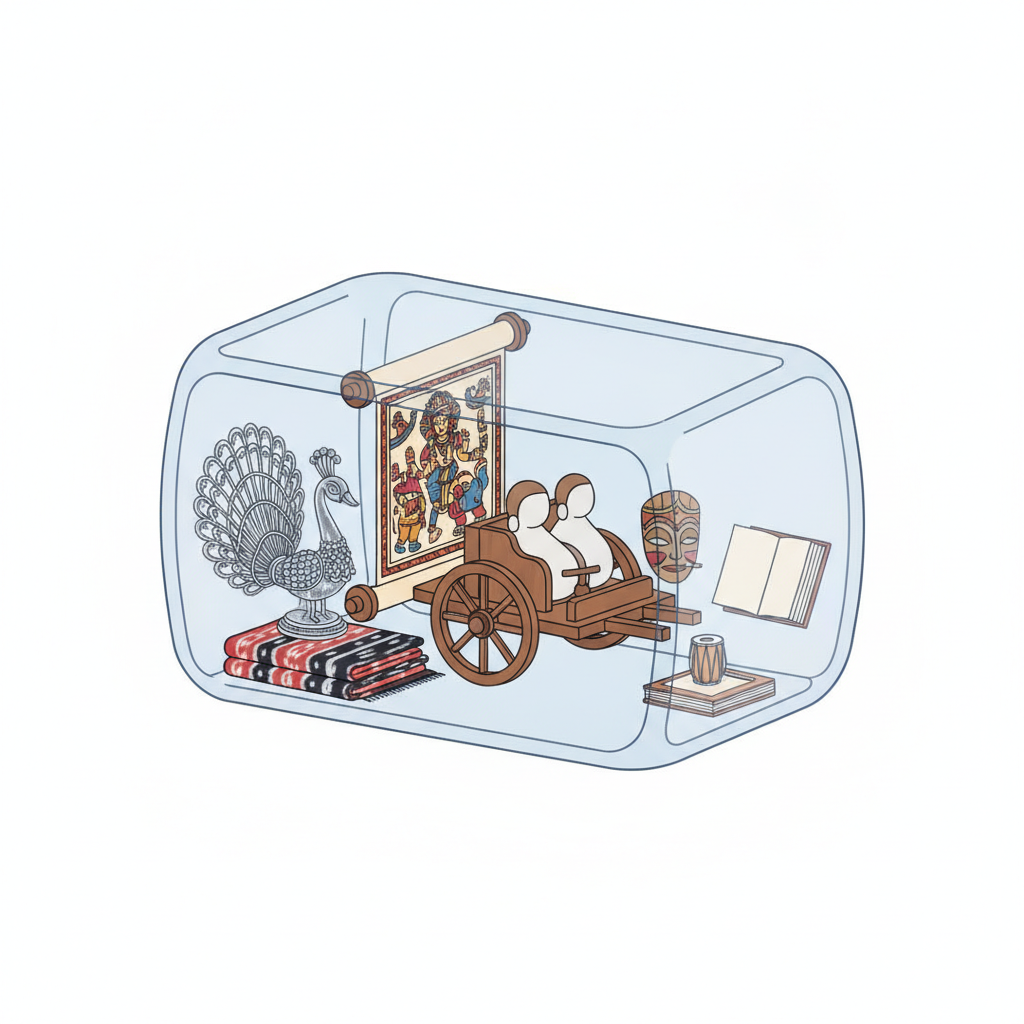
✎ The PM Smriti Chinha E-Auction 2026 showcases Odisha’s cultural diversity through 62 curated artifacts, including Pattachitra, Tarakashi, Sambalpuri Ikat, and representations of the Jagannath cult and regional festivals…
Subject Relevance — Where This Topic Fits
- GS Paper I — Indian Heritage and Culture | GS Paper I — Indian Art Forms, Literature and Architecture
- Prelims: Pattachitra, Tarakashi, Sambalpuri Ikat, Rath Yatra, Jagannath Cult, Chilika Lake Festival, PM Smriti Chinha E-Auction
- Essay: The role of cultural heritage in national identity and soft power, Preservation of traditional art forms in the digital age
Quick Revision: The PM Smriti Chinha E-Auction 2026 showcases Odisha’s cultural diversity through 62 curated artifacts, including Pattachitra, Tarakashi, Sambalpuri Ikat, and representations of the Jagannath cult and regional festivals, promoting indigenous crafts and digital preservation of heritage.
Why is this in the news?
The Ministry of Culture’s Press Information Bureau (PIB) has highlighted the inclusion of Odisha’s diverse cultural artifacts in the PM Smriti Chinha E-Auction 2026, scheduled to conclude on 2 October 2026. This auction features 62 curated items representing Odisha’s spiritual, artistic, and literary traditions, including representations of the Jagannath cult, Pattachitra paintings, Tarakashi (silver filigree), Sambalpuri Ikat textiles, and regional festivals. The initiative underscores the government’s efforts to digitize and monetize cultural heritage while promoting indigenous crafts on a national platform.
Background
- Odisha’s cultural heritage is deeply rooted in its religious traditions, particularly the Jagannath cult centered in Puri, which includes the annual Rath Yatra.
- The state is renowned for its indigenous art forms such as Pattachitra (scroll painting), Tarakashi (silver filigree work), and Sambalpuri Ikat textiles.
- The PM Smriti Chinha E-Auction is an annual initiative by the Ministry of Culture to showcase and auction replicas of cultural artifacts, with proceeds often directed towards welfare schemes.
- The 2026 edition marks the eighth iteration of the auction, expanding its focus to include regional festivals like the Panchu Dola Mela and Chilika Lake celebrations.
- The auction aligns with the ‘Digital India’ initiative, leveraging e-commerce platforms to enhance accessibility and reach for traditional artisans.
- Odisha’s cultural landscape is further enriched by its tribal communities, whose art, music, and festivals contribute to the state’s intangible cultural heritage.
What is the PM Smriti Chinha E-Auction?
- The PM Smriti Chinha E-Auction is an annual digital auction platform organized by the Ministry of Culture to showcase replicas of India’s cultural artifacts, including sculptures, paintings, textiles, and manuscripts.
- The auction aims to promote indigenous crafts, support artisans, and generate funds for cultural preservation and welfare initiatives.
- Each edition features curated collections from a specific state or theme, providing a platform for regional art forms to gain national and international visibility.
- The 2026 edition focuses exclusively on Odisha, highlighting its religious, artistic, and literary traditions through 62 curated items.
- Artifacts include representations of the Jagannath cult (e.g., Rath Yatra scenes), Pattachitra paintings, Tarakashi silver filigree, Sambalpuri Ikat textiles, and depictions of regional festivals like Panchu Dola Mela.
- The auction employs digital technology to ensure transparency, accessibility, and global participation, with bidding conducted through the official portal (pmmentos.gov.in).
- Proceeds from the auction are typically directed towards welfare programs for artisans.
- The initiative aligns with constitutional provisions under Article 49 (protection of monuments and places of artistic or historic interest), which emphasizes the preservation and promotion of cultural heritage.
Key Features
| Feature | Significance |
|---|---|
| Jagannath Triad Sculptures | Represents the core religious and cultural symbolism of Odisha, central to the state’s Vaishnavite traditions and the annual Rath Yatra festival. |
| Pattachitra Paintings | Showcases the unique Odia scroll painting tradition, blending mythology, devotion, and intricate artistry, often used in religious narratives. |
| Tarakashi (Silver Filigree) | Highlights Odisha’s heritage of delicate metalwork, particularly from Cuttack, reflecting traditional craftsmanship and aesthetic sensibilities. |
| Sambalpuri Ikat Textiles | Demonstrates the iconic handloom tradition of Odisha, including the bandha technique, symbolizing the state’s textile heritage. |
| Regional Festivals Depiction | Captures the diversity of Odisha’s festival culture, such as Punchu Dola Mela, emphasizing communal and spiritual practices. |
Why it Matters
Cultural Preservation
- The e-auction serves as a platform to showcase and monetarily valorise Odisha’s intangible cultural heritage, ensuring its visibility and economic sustenance for artisans.
- By featuring a wide range of art forms—sculpture, painting, textiles, and festivals—the initiative promotes a holistic understanding of Odisha’s cultural identity.
- It aligns with national efforts under the Ministry of Culture to document, preserve, and promote India’s diverse cultural expressions through digital and market-based mechanisms.
Economic Impact
- The e-auction creates a direct market linkage for traditional artisans, enabling them to access national and international buyers, thereby enhancing livelihoods.
- Revenue generated can be reinvested into local art communities, supporting training, innovation, and the continuity of traditional crafts.
- Promotes cultural tourism, as highlighted artifacts may attract collectors and enthusiasts, indirectly boosting local economies.
Policy and Governance
- Demonstrates the role of government in cultural diplomacy and soft power, using digital platforms to project India’s cultural diversity globally.
- Reflects the implementation of policies aimed at integrating cultural heritage into mainstream economic and social frameworks.
- Showcases the effectiveness of e-governance in cultural administration, particularly in outreach and accessibility.
Challenges
1. Artisan Livelihood Sustainability
- Traditional artisans often face challenges in accessing modern markets, leading to economic marginalisation despite their cultural contributions.
- Dependence on intermediaries in the supply chain can reduce earnings for artisans, necessitating direct market access mechanisms like e-auctions.
UPSC Link: GS Paper 1: Indian Art & Culture
2. Cultural Heritage Commercialisation Risks
- Over-commercialisation may dilute the authenticity and spiritual essence of cultural artifacts, particularly religious icons like Jagannath Triad sculptures.
- Intellectual property concerns arise when traditional designs are replicated without attribution or compensation to originating communities.
UPSC Link: GS Paper 1: Cultural Heritage
3. Digital Divide and Accessibility
- Limited digital literacy among artisans, especially in rural Odisha, may hinder their participation in e-auctions.
- Ensuring equitable access to technology and training is essential to prevent exclusion of smaller art communities.
UPSC Link: GS Paper 2: Governance & Technology
4. Preservation vs. Monetisation Balance
- There is a need to balance the monetisation of cultural heritage with its preservation, ensuring that economic incentives do not lead to over-exploitation.
- Sustainable practices must be integrated into cultural production to prevent degradation of traditional techniques.
UPSC Link: GS Paper 1: Conservation of Cultural Heritage
Challenges — UPSC Perspective
| Issue | Concern |
|---|---|
| Market Access for Artisans | Limited reach to global buyers due to lack of digital infrastructure and intermediaries. |
| Authenticity and Attribution | Risk of cultural appropriation or misrepresentation in commercial reproductions. |
| Digital Literacy Gaps | Low participation from rural artisans due to technological barriers. |
| Balancing Commercialisation and Preservation | Potential erosion of traditional practices for short-term economic gains. |
| Intellectual Property Rights | Absence of formal protection for traditional designs and craftsmanship. |
Way Forward
- Strengthen digital infrastructure in rural Odisha to enhance artisan participation in e-auctions, including training programs on online bidding and platform navigation.
- Develop certification mechanisms to authenticate traditional artifacts, ensuring transparency and protecting intellectual property rights of artisans.
- Promote public-private partnerships to create dedicated marketplaces for traditional crafts, linking artisans directly with collectors and institutions.
- Integrate cultural heritage education into school curricula to foster appreciation and demand for traditional art forms from an early age.
- Establish regional cultural hubs to provide artisans with space for training, innovation, and collaboration while preserving local techniques.
- Encourage research and documentation of traditional crafts to create archives that can guide future preservation and commercialisation efforts.
- Facilitate cross-cultural exchanges and exhibitions to showcase Odisha’s heritage globally, enhancing its cultural diplomacy and tourism potential.
UPSC Value Addition
Keywords for Mains Answer-Writing
Cultural Heritage Conservation · Intangible Cultural Heritage (ICH) · PM Smriti Chinh e-Auction 2026 · Pattachitra · Tarakashi · Sambalpuri Ikat · Jagannath Culture · Rath Yatra · Odisha Handicrafts · Digital Archiving of Cultural Artifacts · Ministry of Culture Initiatives · Cultural Diplomacy · Art as Soft Power · UNESCO Cultural Conventions · Auction as Cultural Preservation Tool
Constitutional & Policy Linkages
- Article 49: Protection of monuments and places of national importance (indirectly supports preservation of cultural heritage).
- Article 51A(f): Fundamental duty to value and preserve the rich heritage of our composite culture.
Concept Flow
Odisha’s rich cultural heritage → Government-led e-auction initiative (PM Smriti Chinh) → Digital platform for showcasing and monetising artifacts → Economic empowerment of artisans → Preservation and promotion of intangible cultural traditions → Enhanced cultural tourism and national integration.
Prelims Practice Questions
Q1. Consider the following statements about the PM Smriti Chinh e-Auction 2026:
1. The collection exclusively features artifacts from the Mughal period.
2. The auction includes Pattachitra paintings and Tarakashi silver filigree works.
3. The e-auction is organized by the Ministry of Culture, Government of India.
4. The auction features only modern artworks created after 2000.
How many of the above statements are correct?
- Only one
- Only two
- Only three
- All
Answer: Only three — Statements 2 and 3 are correct. Statement 1 is incorrect as the collection features Odisha’s cultural heritage, not Mughal artifacts. Statement 4 is incorrect as the auction includes traditional and historical artworks, not exclusively modern ones.
Q2. Assertion (A): The PM Smriti Chinh e-Auction 2026 is a digital initiative aimed at preserving and promoting India’s intangible cultural heritage.
Reason (R): The auction includes artifacts from Odisha’s Jagannath culture, Pattachitra, Tarakashi, and Sambalpuri Ikat, which are recognized as part of India’s cultural identity.
Options:
A. Both A and R are true, and R is the correct explanation of A.
B. Both A and R are true, but R is not the correct explanation of A.
C. A is true, but R is false.
D. A is false, but R is true.
Answer: ? — Both Assertion (A) and Reason (R) are true. The auction is indeed a digital initiative for preserving cultural heritage (A), and the inclusion of Odisha’s traditional art forms (R) exemplifies this purpose. R correctly explains A.
Q3. Match the following traditional art forms of Odisha with their descriptions:
Column I (Art Form)
A. Pattachitra
B. Tarakashi
C. Sambalpuri Ikat
D. Chhau Dance
Column II (Description)
1. A form of silver filigree work using fine silver wires.
2. A cloth-dyeing technique using the resist method to create patterns.
3. A scroll painting tradition depicting mythological and religious themes.
4. A tribal martial dance form with masks and vigorous movements.
Options:
A – 3, B – 1, C – 2, D – 4
A – 2, B – 1, C – 3, D – 4
A – 4, B – 2, C – 1, D – 3
A – 1, B – 3, C – 2, D – 4
Answer: ? — A – Pattachitra (3) is a scroll painting tradition. B – Tarakashi (1) is silver filigree work. C – Sambalpuri Ikat (2) is a resist-dyeing technique for textiles. D – Chhau Dance (4) is a martial dance form with masks. The correct match is A-3, B-1, C-2, D-4.
Mains Practice Question
✍ Critically examine the significance of the PM Smriti Chinh e-Auction 2026 in the context of preserving India’s intangible cultural heritage. How does this initiative align with the objectives of the UNESCO 2003 Convention for the Safeguarding of the Intangible Cultural Heritage? Also, discuss the potential challenges in digitizing and auctioning cultural artifacts for preservation. (15 Marks)
Approach: MODEL-ANSWER SKELETON:
1. **Introduction (2 Marks)**
– Define intangible cultural heritage (ICH) as per UNESCO 2003 Convention: practices, representations, expressions, knowledge, and skills communities recognize as part of their cultural heritage.
– Briefly introduce the PM Smriti Chinh e-Auction 2026 as a digital platform for showcasing and auctioning cultural artifacts, emphasizing its role in preservation and promotion.
2. **Significance of the Initiative (4 Marks)**
– **Preservation and Promotion**: Highlight how the auction digitizes and archives Odisha’s cultural artifacts (e.g., Pattachitra, Tarakashi, Sambalpuri Ikat, Jagannath culture), making them accessible globally.
– **Cultural Diplomacy and Soft Power**: Explain how such initiatives project India’s cultural diversity as a form of soft power, aligning with India’s foreign policy objectives.
– **Economic Sustainability**: Discuss how auctioning cultural artifacts can generate revenue for artisans and communities, ensuring economic viability of traditional crafts.
– **UNESCO Alignment**: Link the initiative to the UNESCO 2003 Convention’s objectives: safeguarding ICH, raising awareness, and promoting community participation.
3. **Challenges in Digitization and Auctioning (5 Marks)**
– **Authenticity and Provenance**: Address concerns about the authenticity of artifacts, potential forgeries, and the need for rigorous documentation.
– **Cultural Appropriation**: Discuss risks of commercial exploitation without equitable benefit-sharing with originating communities.
– **Digital Divide**: Highlight disparities in access to digital platforms, particularly for rural artisans.
– **Ethical Concerns**: Examine issues of repatriation of artifacts, especially those acquired under colonial or exploitative conditions.
– **Sustainability of Artisan Livelihoods**: Critique whether auction-based models can sustain livelihoods or if they risk commodifying culture without long-term benefits.
4. **Comparative Perspective (2 Marks)**
– Compare India’s approach with global models (e.g., France’s *Musée des Confluences* or Japan’s *Mingeikan*), emphasizing the balance between preservation, promotion, and commercialization.
5. **Conclusion (2 Marks)**
– Summarize the dual role of the initiative: as a tool for preservation and as a mechanism for economic empowerment.
– Suggest measures to address challenges, such as strengthening legal frameworks, community-led governance, and partnerships with cultural institutions.
**Key Terms to Include**: UNESCO 2003 Convention, ICH, cultural soft power, provenance, digital archiving, community participation, ethical auctioning, repatriation.
Source: PIB (Press Information Bureau)
Odisha PCS (OPSC (OAS)) — State PCS Practice
Prelims: Which of the following initiatives launched by the Government of India aims to showcase Odisha’s rich cultural heritage through digital auctions of memorabilia starting in 2026?
- A. PM Svanidhi Yojana
- B. PM Smriti Chinh E-Auction 2026
- C. Digital India Awards
- D. Swachh Bharat Mission
Answer: B. PM Smriti Chinh E-Auction 2026 — The ‘PM Smriti Chinh E-Auction 2026’ is a government initiative to digitally auction memorabilia, highlighting Odisha’s cultural heritage.
Mains: Discuss the significance of the ‘PM Smriti Chinh E-Auction 2026’ initiative in promoting Odisha’s cultural heritage and its potential socio-economic impact on local artisans and communities. Suggest measures to ensure the sustainability of this initiative.
Generated by AanyaAi for educational purpose.
Related guides on our sites
- Current affairs for upsc 2026
- UPSC History optional
- Is history a good optional for upsc exam
- Best history optional teacher for UPSC

- Odisha’s Cultural Heritage in PM Smriti Chinha E-Auction 2026: Key Artifacts & Significance for UPSC - September 26, 2026
- ओडिशा में भगवान जगन्नाथ भूमि के निपटान के लिए ई-पोर्टल विकसित करेगी सरकार - September 26, 2026
- Odisha Launches E-Portal for Lord Jagannath Land Settlement: UPSC Exam Focus - September 26, 2026

No Comments