


26 Sep UPSC 2026: Heavy Industries Ministry’s Special Campaign 6 for Cleaner Governance
✎ Special Campaign 6 by the Ministry of Heavy Industries focuses on sanitation, record digitisation, and e-waste management in CPSEs and autonomous bodies from 15 September to 31 October 2026, under the E-waste (Management) Rules…
Subject Relevance — Where This Topic Fits
- GS Paper III — Environment and Pollution Control | GS Paper III — Government Policies and Interventions for Development in Various Sectors | GS Paper III — E-Governance Applications | GS Paper IV — Ethics in Governance: Accountability and Transparency
- Prelims: Special Campaign 6.0, E-waste (Management) Rules, 2022, CPSEs under Ministry of Heavy Industries, Record Management Rules, Swachh Bharat Mission, Digital India Mission
- Essay: Role of Public Sector Enterprises in India’s Sustainable Development, Technology and Governance: Balancing Innovation with Environmental Responsibility
Quick Revision: Special Campaign 6 by the Ministry of Heavy Industries focuses on sanitation, record digitisation, and e-waste management in CPSEs and autonomous bodies from 15 September to 31 October 2026, under the E-waste (Management) Rules, 2022.
Why is this in the news?
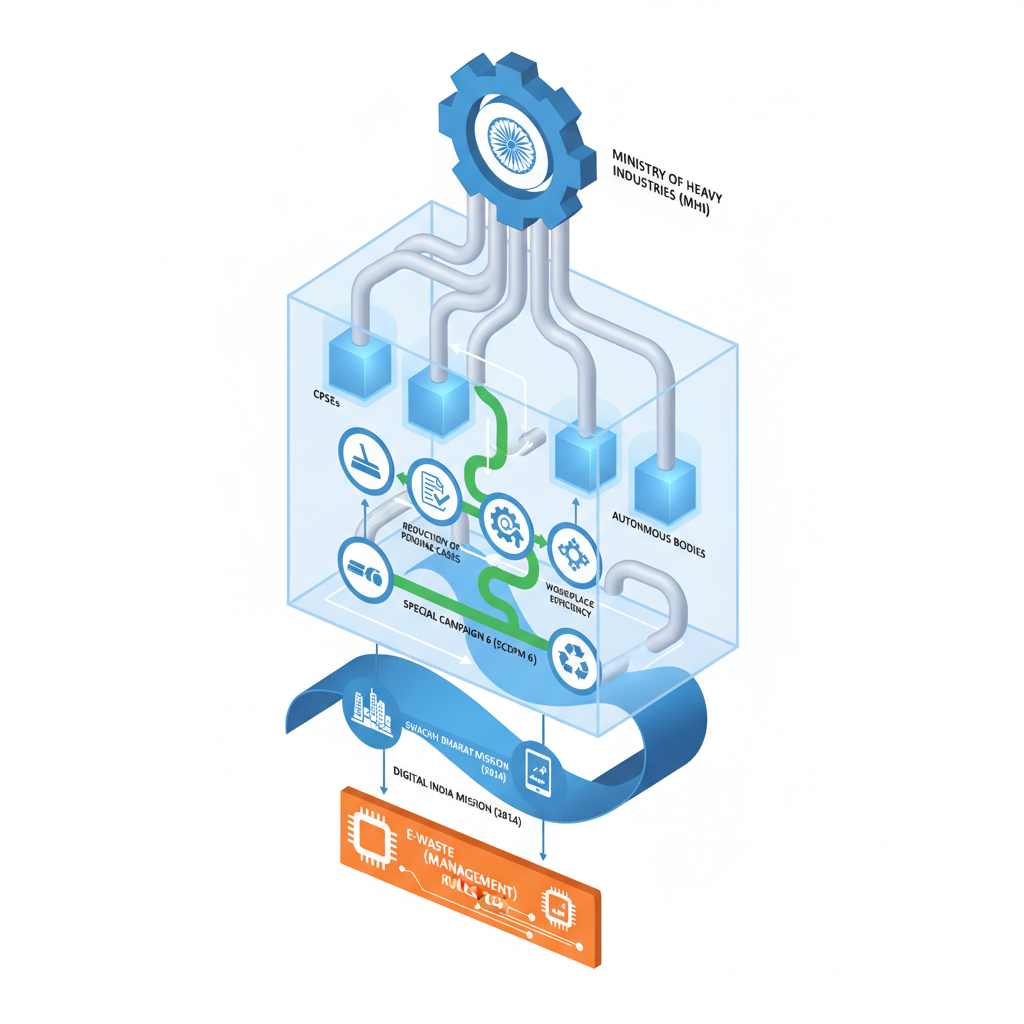
The Ministry of Heavy Industries (MHI) has initiated preparatory activities for Special Campaign 6 (SCDPM 6) from 15 September to 30 September 2026, focusing on sanitation, reduction of pending cases, workplace efficiency, and enhanced e-waste management across its Central Public Sector Enterprises (CPSEs) and autonomous bodies. This campaign aligns with the broader national objectives of cleanliness, digitisation of records, and responsible waste management, as outlined in the E-waste (Management) Rules, 2022.
Background
- The Government of India has consistently emphasised cleanliness and efficient record management through initiatives like the Swachh Bharat Mission (2014) and the Digital India Mission (2015), which aim to transform public offices into model workspaces.
- The E-waste (Management) Rules, 2022, notified under the Environment (Protection) Act, 1986, mandate systematic collection, segregation, and disposal of e-waste to mitigate environmental and health hazards.
- Central Public Sector Enterprises (CPSEs) and autonomous bodies under the Ministry of Heavy Industries contribute significantly to industrial output and employment, necessitating robust governance and compliance frameworks.
- Special Campaigns (SCDPM) are periodic, time-bound drives launched by the Department of Administrative Reforms and Public Grievances (DARPG) to address pendency, improve record management, and enhance workplace efficiency across government offices.
- The Ministry of Heavy Industries oversees CPSEs such as Bharat Heavy Electricals Limited (BHEL), which are critical to India’s industrial and energy infrastructure.
- Sustainable waste management, including e-waste, is a key component of India’s commitments under international agreements like the Basel Convention and the Paris Agreement.
What is Special Campaign 6 (SCDPM 6)?
- A time-bound, mission-mode initiative launched by the Ministry of Heavy Industries to cleanse, digitise, and streamline operations within its CPSEs and autonomous bodies.
- The campaign is divided into two phases: (a) preparatory phase (15 September–30 September 2026) for planning, identification of waste, and record review, and (b) implementation phase (2 October–31 October 2026) for execution of cleanliness drives and waste disposal.
- Primary objectives include reducing physical and digital pendency, freeing up office space, improving workplace hygiene, and ensuring compliance with the E-waste (Management) Rules, 2022.
- E-waste management is a focal theme of SCDPM 6, with emphasis on identification, segregation, and environmentally sound disposal of e-waste generated in offices and industrial units.
- The campaign mandates systematic review of physical and electronic files, closure of redundant records, and digitisation of archival material to enhance transparency and accessibility.
- CPSEs and autonomous bodies are required to maintain daily logs of activities related to file review, sanitation, scrap disposal, and e-waste management, ensuring accountability and traceability.
- The Ministry conducts regular review meetings with nodal officers and senior officials to monitor progress, address bottlenecks, and ensure adherence to campaign guidelines.
- SCDPM 6 aligns with the broader national agenda of ‘Minimum Government, Maximum Governance’ by promoting efficiency, accountability, and citizen-centric service delivery in public sector entities.
Key Features
| Feature | Significance |
|---|---|
| Special Campaign 6.0 (SCDPM 6) | A time-bound, mission-mode initiative by the Ministry of Heavy Industries (MHI) to expedite disposal of pending matters, enhance workplace efficiency, and institutionalise responsible waste management across its CPSEs and autonomous bodies. |
| E-waste Management Focus (E-waste (Management) Rules, 2022) | Mandates systematic identification, segregation, collection, and disposal of e-waste in MHI’s offices and industrial units, aligning with India’s circular economy and environmental sustainability goals. |
| Physical & Digital File Review | Systematic audit of redundant physical and electronic records to declutter office spaces, improve record-keeping, and transition towards digital governance. |
| Space Reclamation | Liberation of 18,22,374 sq. ft. of office space by removing unused materials, enhancing operational efficiency and cost optimisation in CPSEs. |
| Monitoring Mechanism | Regular review meetings with nodal officers and senior CPSE/AB officials to track progress, ensure accountability, and address bottlenecks in real time. |
Why it Matters
Governance & Efficiency
- Demonstrates the Union Government’s commitment to administrative reforms through Special Campaigns, reducing bureaucratic delays and improving service delivery in public sector enterprises.
- Promotes a culture of accountability, transparency, and proactive waste management within government institutions, setting benchmarks for other ministries.
- Enhances operational efficiency by reclaiming physical space and digitising records, reducing costs and improving workflow in CPSEs.
Environmental Sustainability
- Advances India’s obligations under the E-waste (Management) Rules, 2022, contributing to the reduction of hazardous e-waste in landfills and promoting safe disposal practices.
- Aligns with the National Environment Policy (2006) and Sustainable Development Goals (SDG 12: Responsible Consumption and Production) by institutionalising circular economy principles.
- Supports the Swachh Bharat Mission’s broader objectives of cleanliness and waste management in government establishments.
Economic & Strategic
- Strengthens the financial health of CPSEs by optimising asset utilisation and reducing expenditure on redundant storage and maintenance.
- Enhances the public image of CPSEs as responsible corporate entities, fostering trust among stakeholders and investors.
- Contributes to India’s self-reliance (Atmanirbhar Bharat) by ensuring efficient resource utilisation and minimising waste in industrial operations.
Challenges
1. Implementation Bottlenecks in CPSEs
- Resistance to change among employees accustomed to traditional record-keeping and waste disposal practices.
- Inadequate infrastructure for e-waste segregation and disposal in some industrial units, requiring investment in specialised facilities.
- Coordination challenges between multiple CPSEs and autonomous bodies under MHI, necessitating robust monitoring and inter-departmental collaboration.
UPSC Link: L1/Public Administration/Administrative Reforms
2. Compliance with E-waste Rules
- Ensuring strict adherence to the E-waste (Management) Rules, 2022 across diverse industrial units with varying scales of operations.
- Training and sensitisation of staff on e-waste handling protocols to prevent illegal dumping or improper disposal.
- Monitoring the supply chain to track e-waste from generation to disposal, avoiding leakage into informal sectors.
UPSC Link: L2/Environmental Governance/E-waste Management
3. Digital Transformation Hurdles
- Overcoming legacy systems and resistance to digitisation in older CPSEs with outdated IT infrastructure.
- Ensuring data security and privacy during the transition from physical to digital records.
- Standardising digital record-keeping practices across multiple autonomous bodies to ensure interoperability.
UPSC Link: L1/E-Governance/Digital India
4. Resource Allocation & Capacity Building
- Limited financial and human resources in some CPSEs to execute large-scale cleanliness and waste management drives.
- Need for specialised training programmes for staff on waste segregation, record management, and digital tools.
- Balancing immediate operational needs with long-term sustainability goals in resource-constrained environments.
UPSC Link: L1/Public Administration/Resource Management
Challenges — UPSC Perspective
| Issue | Concern |
|---|---|
| Legacy Record Systems | High volume of outdated physical and digital files complicating audit and digitisation efforts. |
| E-waste Infrastructure Gaps | Lack of dedicated facilities for segregation and disposal in certain industrial units. |
| Employee Resistance | Cultural inertia and lack of awareness hindering adoption of new waste management practices. |
| Inter-agency Coordination | Fragmented efforts among CPSEs and autonomous bodies leading to duplication or gaps. |
| Regulatory Compliance Risks | Potential lapses in adhering to E-waste Rules due to inadequate monitoring mechanisms. |
Way Forward
- Conduct mandatory training programmes for CPSE/AB staff on e-waste segregation, digital record-keeping, and cleanliness protocols.
- Establish dedicated e-waste collection centres in all major industrial units under MHI, equipped with certified disposal facilities.
- Implement a phased digitisation roadmap for physical records, prioritising high-value and frequently accessed files.
- Introduce incentive mechanisms (e.g., performance-linked bonuses) for CPSEs achieving exemplary cleanliness and waste management standards.
- Strengthen inter-departmental coordination through regular cross-CPSE review meetings and shared best practices.
- Develop a real-time dashboard for tracking progress on file review, space reclamation, and e-waste disposal across all entities.
- Partner with academic institutions and NGOs for technical support in waste management and digital transformation initiatives.
- Incorporate sustainability metrics in the annual performance appraisals of CPSE executives to institutionalise accountability.
UPSC Value Addition
Keywords for Mains Answer-Writing
Special Campaign 6.0 · Ministry of Heavy Industries · CPSEs · E-waste Management Rules 2022 · Public Sector Undertakings · Waste Management · Office Space Optimization · Digital Record Management · Swachhata Abhiyan · Sustainable Development · Government of India Initiatives · Efficient Governance · Environmental Compliance · Public Sector Efficiency
Concept Flow
Administrative inefficiency in CPSEs → Accumulation of pending matters and redundant records → Initiation of Special Campaign 6.0 by MHI → Special Campaign 6.0 → Focus on cleanliness, space reclamation, and digital record-keeping → Identification of gaps in waste management → E-waste (Management) Rules, 2022 → Mandates systematic segregation and disposal of e-waste → Integration into MHI’s campaign objectives → Implementation phase (Oct 2026) → Execution of cleanliness drives and e-waste collection → Monitoring and review mechanisms → Outcome → Improved operational efficiency, reduced environmental footprint, and enhanced governance standards in CPSEs → Long-term impact → Institutionalisation of sustainable practices → Alignment with national environmental and digital governance goals
Prelims Practice Questions
Q1. Consider the following statements regarding the Special Campaign 6.0 launched by the Ministry of Heavy Industries:
1. The campaign focuses solely on physical file management and does not address digital records.
2. E-waste management is a key component under the campaign, governed by the E-waste (Management) Rules, 2022.
3. The campaign aims to reduce pending cases and improve workplace efficiency.
How many of the above statements are correct?
- Only one
- Only two
- Only three
- None
Answer: Only two — Statement 1 is incorrect because the campaign addresses both physical and digital records. Statements 2 and 3 are correct as the campaign emphasizes e-waste management under the E-waste (Management) Rules, 2022 and aims to reduce pending cases and improve efficiency.
Q2. Assertion (A): The E-waste (Management) Rules, 2022 mandate the segregation and disposal of e-waste by Central Public Sector Enterprises (CPSEs).
Reason (R): The rules aim to promote responsible waste management practices and reduce environmental pollution.
Options:
A. Both A and R are true, and R is the correct explanation of A.
B. Both A and R are true, but R is not the correct explanation of A.
C. A is true but R is false.
D. A is false but R is true.
Answer: ? — Both Assertion (A) and Reason (R) are true. The E-waste (Management) Rules, 2022 do mandate segregation and disposal of e-waste by CPSEs, and the rules are designed to promote responsible waste management and reduce environmental pollution. R correctly explains A.
Q3. Match the following initiatives under Special Campaign 6.0 with their respective objectives:
Column I (Initiative)
A. Swachhata Abhiyan
B. Digital Record Management
C. E-waste Management
D. Space Optimization
Column II (Objective)
1. To reduce pending cases and improve record-keeping efficiency
2. To promote clean and organized workplaces
3. To ensure responsible disposal of electronic waste
4. To free up office space by removing unused materials
Options:
A. A-2, B-1, C-3, D-4
B. A-1, B-2, C-3, D-4
C. A-3, B-4, C-1, D-2
D. A-4, B-3, C-2, D-1
Answer: ? — The correct match is: A (Swachhata Abhiyan) with 2 (promote clean and organized workplaces), B (Digital Record Management) with 1 (reduce pending cases and improve record-keeping efficiency), C (E-waste Management) with 3 (ensure responsible disposal of electronic waste), and D (Space Optimization) with 4 (free up office space by removing unused materials).
Mains Practice Question
✍ ‘The Special Campaign 6.0 of the Ministry of Heavy Industries exemplifies a multi-dimensional governance approach aimed at enhancing administrative efficiency and environmental sustainability.’ Critically examine this statement with reference to the campaign’s objectives, institutional mechanisms, and compliance frameworks. Also, assess the potential challenges in its implementation and suggest measures to ensure its success. (15 Marks)
Approach: MODEL-ANSWER SKELETON:
1. **Introduction (2 Marks)**
– Brief context: Launch of Special Campaign 6.0 by the Ministry of Heavy Industries (MHI) on 15 September 2026.
– Core objectives: Reduction of pending cases, improvement in workplace efficiency, and promotion of responsible waste management, with a special focus on e-waste under the E-waste (Management) Rules, 2022.
2. **Multi-dimensional Governance Approach (4 Marks)**
– **Administrative Efficiency**:
– Reduction of pending cases through file review and digital record management (4,003 physical files and 51,582 e-files identified for closure).
– Space optimization by removing unused materials (18,22,374 sq. ft. space freed).
– **Environmental Sustainability**:
– E-waste management: Identification and segregation of 439 e-waste items for proper disposal under the E-waste (Management) Rules, 2022.
– Promotion of clean and organized workplaces through Swachhata Abhiyan (272 sites identified).
– **Institutional Mechanisms**:
– Role of CPSEs (e.g., BHEL) and autonomous bodies under MHI in implementing the campaign.
– Regular review meetings with nodal officers and senior officials to monitor progress.
3. **Compliance Frameworks (4 Marks)**
– **E-waste (Management) Rules, 2022**: Mandates segregation, collection, and disposal of e-waste by CPSEs.
– **Record Management**: Compliance with archival rules for physical and digital records.
– **Swachh Bharat Mission**: Alignment with broader national cleanliness initiatives.
4. **Challenges in Implementation (3 Marks)**
– **Operational Challenges**:
– Resistance to change in administrative processes, especially in digital transformation.
– Logistical hurdles in e-waste collection and disposal.
– **Institutional Challenges**:
– Ensuring coordination among multiple CPSEs and autonomous bodies.
– Capacity-building for staff in e-waste management and digital record-keeping.
– **Sustainability Challenges**:
– Long-term adherence to waste management practices beyond the campaign period.
– Monitoring and evaluation mechanisms to ensure compliance.
5. **Measures for Success (2 Marks)**
– **Capacity Building**: Training programs for staff on e-waste management and digital tools.
– **Technology Integration**: Use of AI and automation for digital record management and waste tracking.
– **Incentivization**: Recognition and rewards for CPSEs achieving significant milestones.
– **Public-Private Partnerships**: Collaboration with private sector entities for e-waste recycling and disposal.
– **Awareness Campaigns**: Sensitization drives to promote a culture of responsible waste management.
6. **Conclusion (1 Mark)**
– Reiterate the significance of Special Campaign 6.0 as a model for integrating administrative efficiency, environmental sustainability, and institutional compliance in governance.
Source: PIB (Press Information Bureau)
Generated by AanyaAi for educational purpose.
Related guides on our sites
- Best PSIR optional coaching for upsc
- Best PSIR optional teacher for upsc
- Best teacher of PSIR optional for upsc
- Best PSIR optional coaching in delhi for UPSC

- Himachal CM Sukhu: All Doctor Vacancies to be Filled by March - September 27, 2026
- कैसे पुलिस की AI तकनीक पहचान कर रही है अस्पष्ट शवों को - September 27, 2026
- Jai Jyoti: 106 km Bisalpur Pipeline to End Jaipur Water Crisis - September 27, 2026

No Comments