


26 Sep UPSC Exam Alert: My Health My Pride Campaign on Drug-Free Youth Initiative
✎ The ‘Mera Swasthya, Mera Gaurav’ campaign under the ‘Nasha Mukt Yuva Abhiyaan’ is a community-driven initiative promoting preventive health, nutrition awareness, and substance abuse prevention among youth, conducted through the…
Subject Relevance — Where This Topic Fits
- GS Paper II — Governance, Government Policies and Interventions for Development in various sectors and issues arising out of their design and implementation | GS Paper III — Human Development, Health and Nutrition
- Prelims: National Service Scheme (NSS), National Youth Policy 2021, National Programme for Prevention and Control of Cancer, Diabetes, Cardiovascular Diseases and Stroke (NPCDCS), Rashtriya Kishor Swasthya Karyakram (RKSK), District Health Action Plans (DHAP), BMI (Body Mass Index), Substance Abuse Prevention
- Essay: Youth Empowerment through Health and Wellness Initiatives, The Role of Community Participation in National Development
Quick Revision: The ‘Mera Swasthya, Mera Gaurav’ campaign under the ‘Nasha Mukt Yuva Abhiyaan’ is a community-driven initiative promoting preventive health, nutrition awareness, and substance abuse prevention among youth, conducted through the National Service Scheme (NSS) and aligned with Rashtriya Kishor Swasthya Karyakram (RKSK).
Why is this in the news?
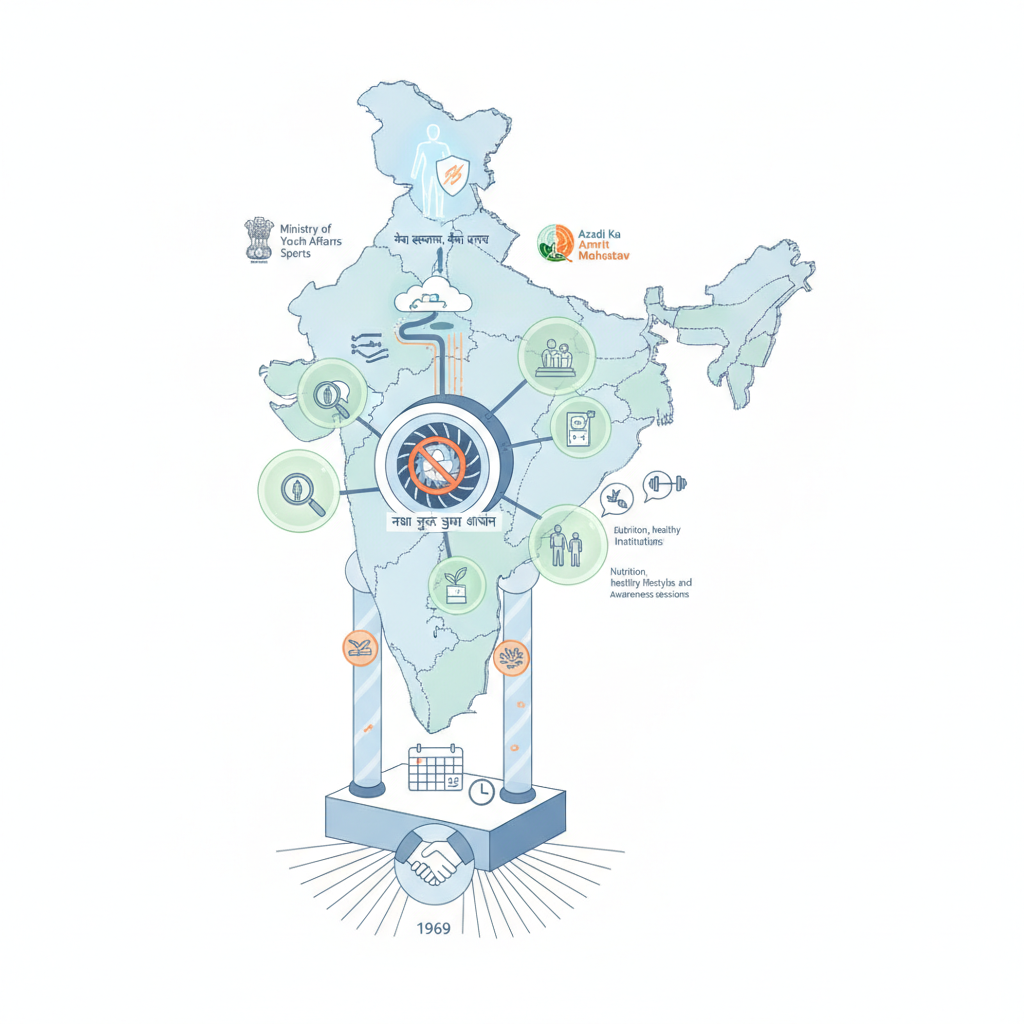
On 25 September 2026, the Ministry of Youth Affairs and Sports, through the National Service Scheme (NSS), launched nationwide ‘Mera Swasthya, Mera Gaurav’ activities under the ‘Nasha Mukt Yuva Abhiyaan’ as part of the ‘Azadi Ka Amrit Mahotsav’ initiative. The campaign mobilised over 1.75 lakh participants across 167 educational institutions, conducting health screenings for 48,556 youth and organising awareness sessions on nutrition, healthy lifestyles, and the harmful effects of substance abuse. This initiative underscores the government’s commitment to preventive healthcare and youth welfare through community-driven interventions.
Background
- The National Service Scheme (NSS) was launched in 1969 under the Ministry of Youth Affairs and Sports to develop a sense of participation among students in nation-building activities through community service.
- The ‘Nasha Mukt Yuva Abhiyaan’ (Drug-Free Youth Campaign) is a 100-week initiative to promote a drug-free society by fostering awareness, prevention, and rehabilitation among youth.
- The Rashtriya Kishor Swasthya Karyakram (RKSK) under the Ministry of Health and Family Welfare focuses on adolescent health, including nutrition, mental health, and substance abuse prevention.
- District Health Action Plans (DHAP) are localised health strategies developed by district authorities to address specific health challenges, including substance abuse and non-communicable diseases.
- The campaign’s integration with local governance structures, including district health authorities and educational institutions, reflects the ‘Health in All Policies’ approach.
What is the ‘Mera Swasthya, Mera Gaurav’ Campaign?
- The ‘Mera Swasthya, Mera Gaurav’ campaign is a sub-component of the ‘Nasha Mukt Yuva Abhiyaan’, designed to promote preventive health measures, nutrition awareness, and substance abuse prevention among youth.
- The campaign was organised across 167 educational institutions and their adopted villages, engaging 1,75,368 participants, including 53% young women, highlighting gender-inclusive participation.
- Health screenings were conducted for 48,556 youth aged 15–18 years, including BMI assessments, in coordination with district health authorities and national child health program (RBSK) under medical officers.
- Two key awareness sessions were held: one on ‘Nutrition and the Importance of Good Health’ (attended by 64,938 participants) and another on ‘The Impact of Substance Abuse on Health’ (attended by 61,874 participants), led by medical experts.
- The campaign included a pledge-taking component, with approximately 62,000 youth taking an oath against substance abuse, reinforcing preventive behaviour and community responsibility.
- The initiative is structured under the four pillars of the ‘Nasha Mukt Yuva Abhiyaan’: Prevention, Protection, Recovery, and Leadership, ensuring a holistic approach to youth welfare.
- The campaign’s adaptability was demonstrated through regional adjustments, such as postponing activities due to local festivals and adverse weather conditions.
Key Features
| Feature | Significance |
|---|---|
| Multi-institutional participation | Engages 167 educational institutions and their adopted villages, ensuring grassroots-level reach across diverse geographies. |
| Comprehensive health screening | Conducted BMI assessments and health checks for 48,556 youth aged 15–18, aligned with the Rashtriya Bal Swasthya Karyakram (RBSK). |
| Expert-led awareness sessions | Two structured sessions on nutrition (64,938 participants) and the impact of substance abuse (61,874 participants), leveraging medical professionals. |
| Preventive oath-taking | 62,000 youth took a pledge against substance abuse, reinforcing behavioral change through collective commitment. |
| Gender-inclusive participation | Female participation rates of 53.0% in nutrition sessions and 52.6% in substance-abuse sessions, reflecting equitable outreach. |
Why it Matters
Public Health
- Demonstrates an integrated approach to preventive healthcare by combining health screenings with awareness campaigns, addressing both immediate and long-term health risks.
- Aligns with the National Health Policy 2017’s emphasis on preventive and promotive health measures, particularly for adolescents and youth.
- Leverages the Rashtriya Bal Swasthya Karyakram (RBSK) framework to identify early-stage health anomalies in school-going populations.
Youth Empowerment
- Promotes life skills and informed decision-making among youth, fostering a culture of self-awareness and resilience against substance abuse.
- Encourages community-based participation through the National Service Scheme (NSS), reinforcing civic engagement and social responsibility.
- Targets the 15–18 age cohort, a critical phase for habit formation and behavioral conditioning.
Policy Implementation
- Illustrates the operationalization of the ‘Nasha Mukt Bharat Abhiyaan’ (NMBA) under the Ministry of Youth Affairs and Sports, demonstrating multi-stakeholder coordination.
- Showcases the role of district health authorities and local governance in executing health interventions at the grassroots level.
- Highlights adaptive implementation strategies to overcome regional constraints (e.g., weather disruptions, local festivals).
Social Equity
- Achieves near-parity in female participation, addressing gender-specific health and awareness gaps in adolescent populations.
- Ensures inclusivity by extending activities to adopted villages under NSS, bridging urban-rural divides in health outreach.
Challenges
1. Regional Disruptions and Logistical Constraints
- Adverse weather conditions (e.g., cyclones in Andhra Pradesh) and local festivals (e.g., Ganesh Visarjan in Maharashtra) necessitated temporary postponements, requiring adaptive rescheduling.
- Ensuring equitable participation across diverse geographical and socio-economic contexts remains a persistent challenge.
UPSC Link: GS-II: Governance, GS-III: Disaster Management
2. Behavioral Change Sustainability
- Sustaining the momentum of behavioral change beyond the campaign period requires continuous reinforcement through community networks and institutional support.
- Addressing the root causes of substance abuse (e.g., peer pressure, socio-economic stressors) demands long-term, multi-sectoral interventions.
UPSC Link: GS-IV: Ethics, GS-II: Social Justice
3. Healthcare Infrastructure Gaps
- Scaling up health screenings and follow-up care for identified health anomalies requires strengthening primary healthcare systems at the district level.
- Ensuring timely referrals and treatment for detected health issues necessitates coordination between health authorities and educational institutions.
UPSC Link: GS-II: Health, GS-III: Infrastructure
4. Awareness Campaign Effectiveness
- Measuring the long-term impact of awareness sessions on reducing substance abuse rates requires robust monitoring and evaluation mechanisms.
- Tailoring messaging to resonate with diverse cultural and linguistic groups while avoiding misinformation remains a challenge.
UPSC Link: GS-IV: Ethics, GS-II: Governance
5. Resource Allocation and Scalability
- Balancing the scale of operations with resource constraints (e.g., medical personnel, funding) is critical for replicating such initiatives nationwide.
- Ensuring the sustainability of the campaign’s components (e.g., health screenings, expert sessions) post-100-week framework requires institutionalization.
UPSC Link: GS-III: Economy, GS-II: Governance
Challenges — UPSC Perspective
| Issue | Concern |
|---|---|
| Regional Disruptions | Logistical challenges due to weather and local festivals may hinder consistent implementation. |
| Behavioral Sustainability | Risk of relapse into substance use post-campaign due to lack of continuous reinforcement. |
| Healthcare Access | Limited primary healthcare infrastructure may impede follow-up care for detected health anomalies. |
| Awareness Reach | Ensuring culturally sensitive and effective messaging across diverse populations. |
| Resource Constraints | Scalability challenges due to limited medical personnel and funding for large-scale interventions. |
Government Initiatives — Must-Memorise for Prelims
- Nasha Mukt Bharat Abhiyaan (NMBA)
- Rashtriya Bal Swasthya Karyakram (RBSK)
- National Service Scheme (NSS)
Way Forward
- Strengthen district-level health infrastructure to support large-scale health screenings and follow-up care under RBSK.
- Develop a monitoring and evaluation framework to assess the long-term impact of awareness campaigns on substance abuse rates.
- Institutionalize the ‘Mera Swasthya, Mera Gaurav’ model within NSS activities for year-round engagement.
- Enhance collaboration between educational institutions, local health authorities, and community leaders for sustained behavioral change.
- Expand the scope of health screenings to include mental health assessments, addressing co-occurring disorders.
- Design region-specific awareness modules to align with local cultural contexts and linguistic diversity.
- Leverage digital platforms for continuous engagement, including webinars, e-learning modules, and helplines.
- Establish a feedback mechanism to incorporate participant suggestions and improve campaign effectiveness.
UPSC Value Addition
Keywords for Mains Answer-Writing
National Service Scheme (NSS) · Nasha Mukt Yuva Abhiyan · Yuva Swasthya Abhiyan · Preventive health interventions · Substance abuse prevention · District Health Authorities · Rashtriya Bal Swasthya Karyakram (RBSK) · BMI assessment · Community-based health awareness · Youth empowerment · Health education · Nutrition and health · Life skills education · Public health governance · Multi-stakeholder participation · Preventive health screening · Adolescent health · National Youth Policy · Health promotion · Sustainable Development Goals (SDG 3)
Concept Flow
Youth vulnerability to substance abuse → Policy response via NMBA → Implementation through NSS and RBSK → Grassroots health screenings and awareness sessions → Behavioral change through pledges and expert sessions → Long-term health and social outcomes.
Prelims Practice Questions
Q1. Consider the following statements regarding the ‘Nasha Mukt Yuva Abhiyan’ launched by the Ministry of Youth Affairs and Sports:
1. The campaign is implemented through the National Service Scheme (NSS).
2. The ‘Mera Swasthya, Mera Gaurav’ initiative includes health screening and BMI assessment for adolescents aged 15–18 years.
3. The campaign is structured around four pillars: Prevention, Protection, Recovery, and Leadership.
4. The initiative is solely focused on creating awareness about substance abuse without any health screening component.
How many of the above statements are correct?
- Only one
- Only two
- Only three
- All four
Answer: Only three — Statements 1, 2, and 3 are correct. Statement 4 is incorrect as the campaign includes both awareness creation and health screening components.
Q2. Assertion (A): The ‘Nasha Mukt Yuva Abhiyan’ is aligned with the Sustainable Development Goal 3 (SDG 3) of the United Nations.
Reason (R): SDG 3 aims to ensure healthy lives and promote well-being for all at all ages, which includes reducing substance abuse among youth.
Options:
A. Both A and R are true, and R is the correct explanation of A.
B. Both A and R are true, but R is not the correct explanation of A.
C. A is true but R is false.
D. A is false but R is true.
Answer: ? — Both the assertion and reason are true. The campaign’s objectives of promoting health, preventing substance abuse, and ensuring well-being among youth directly align with SDG 3.
Q3. Match the following initiatives with their respective objectives:
Column I (Initiative)
1. Mera Swasthya, Mera Gaurav
2. Rashtriya Bal Swasthya Karyakram (RBSK)
3. District Health Authorities
4. National Service Scheme (NSS)
Column II (Objective)
A. Conducting health screenings and BMI assessments for adolescents
B. Implementing community-based health awareness and preventive interventions
C. Coordinating health interventions at the district level
D. Engaging youth in community service and health promotion activities
Options:
A. 1-A, 2-B, 3-C, 4-D
B. 1-B, 2-A, 3-C, 4-D
C. 1-D, 2-A, 3-B, 4-C
D. 1-B, 2-C, 3-A, 4-D
Answer: ? — 1-B: ‘Mera Swasthya, Mera Gaurav’ aims to promote health awareness and preventive interventions. 2-A: RBSK conducts health screenings and BMI assessments for adolescents. 3-C: District Health Authorities coordinate health interventions at the district level. 4-D: NSS engages youth in community service and health promotion activities.
Mains Practice Question
✍ ‘Preventive health interventions and community-based awareness campaigns are essential for addressing substance abuse among youth in India.’ Critically examine the role of the ‘Nasha Mukt Yuva Abhiyan’ in achieving this objective. Also, discuss the institutional mechanisms that underpin its implementation. (15 Marks)
Approach: MODEL-ANSWER SKELETON:
1. **Introduction (2 Marks)**
– Define ‘Nasha Mukt Yuva Abhiyan’ and its alignment with national and global health goals (SDG 3, National Youth Policy 2021).
– State the objective: reducing substance abuse among youth through preventive health interventions and awareness campaigns.
2. **Role of the Campaign in Preventive Health and Awareness (5 Marks)**
– **Health Screening and BMI Assessment**: Explain the inclusion of health screenings (48,556 adolescents) and BMI assessment under RBSK and District Health Authorities.
– **Awareness Campaigns**: Highlight the two key sessions—’Nutrition and Good Health’ (64,938 participants) and ‘Impact of Substance Abuse on Health’ (61,874 participants).
– **Community Participation**: Emphasise the role of NSS volunteers, local leaders, and medical professionals in mobilising 1,75,368 participants across 167 institutions.
– **Preventive Focus**: Discuss the campaign’s emphasis on ‘Prevention’ as one of its four pillars (Prevention, Protection, Recovery, Leadership).
3. **Institutional Mechanisms (5 Marks)**
– **National Service Scheme (NSS)**: Role as the implementing agency under the Ministry of Youth Affairs and Sports.
– **District Health Authorities**: Coordination with RBSK for health screenings and data collection.
– **Rashtriya Bal Swasthya Karyakram (RBSK)**: Integration of adolescent health assessments under the Ayushman Bharat initiative.
– **Multi-Stakeholder Participation**: Involvement of medical experts, local leaders, and educational institutions in programme delivery.
4. **Critical Examination (3 Marks)**
– **Strengths**: High participation rates, integration of health screening with awareness, and alignment with SDG 3.
– **Challenges**: Scalability to rural areas, ensuring sustained engagement, and addressing regional disparities (e.g., postponements due to local festivals or adverse weather).
– **Way Forward**: Propose measures such as leveraging digital platforms for wider reach, strengthening inter-departmental coordination, and incorporating life skills education in school curricula.
Source: PIB (Press Information Bureau)
Generated by AanyaAi for educational purpose.
Related guides on our sites
- Best PSIR optional coaching for upsc
- Best PSIR optional teacher for upsc
- Best teacher of PSIR optional for upsc
- Best PSIR optional coaching in delhi for UPSC

- डीसीपीसी का विशेष अभियान 6.0: ई-कचरा प्रबंधन और कार्यस्थल दक्षता पर नया फोकस - September 26, 2026
- Special Campaign 6.0: DCP&C to Focus on E-Waste, Cleanliness & Workplace Efficiency - September 26, 2026
- यूपी में हाइब्रिड सोलर सिस्टम: पीएम सूर्यघर योजना में बिजली कटौती से मुक्ति का विकल्प - September 26, 2026

No Comments