


26 Sep UPSC Exam: PM’s Scientific Advisor Reviews RUTAG 2.0 Projects at IIT Roorkee
✎ RUTAG 2.0 is a government-led initiative under the Principal Scientific Adviser’s Office to develop, validate, and scale science and technology solutions for rural India through multi-institutional collaboration, with emphasis on…
Subject Relevance — Where This Topic Fits
- GS Paper III — Science and Technology (S&T) in Rural Development | GS Paper III — Technology Missions and Innovation Ecosystems | GS Paper III — Role of Institutions in Development
- Prelims: RUTAG, Prime Minister’s Scientific Advisory Council (PM-SAC), Office of the Principal Scientific Adviser (OPSA), NABARD-AMRIT platform, IITs in rural technology, Technology validation and commercialisation, Scalability in development programmes
- Essay: The Role of Science and Technology in Achieving Inclusive Rural Development, Institutional Synergy for Sustainable Development: Bridging Academia, Industry, and Government
Quick Revision: RUTAG 2.0 is a government-led initiative under the Principal Scientific Adviser’s Office to develop, validate, and scale science and technology solutions for rural India through multi-institutional collaboration, with emphasis on affordability, scalability, and sustainability.
Why is this in the news?
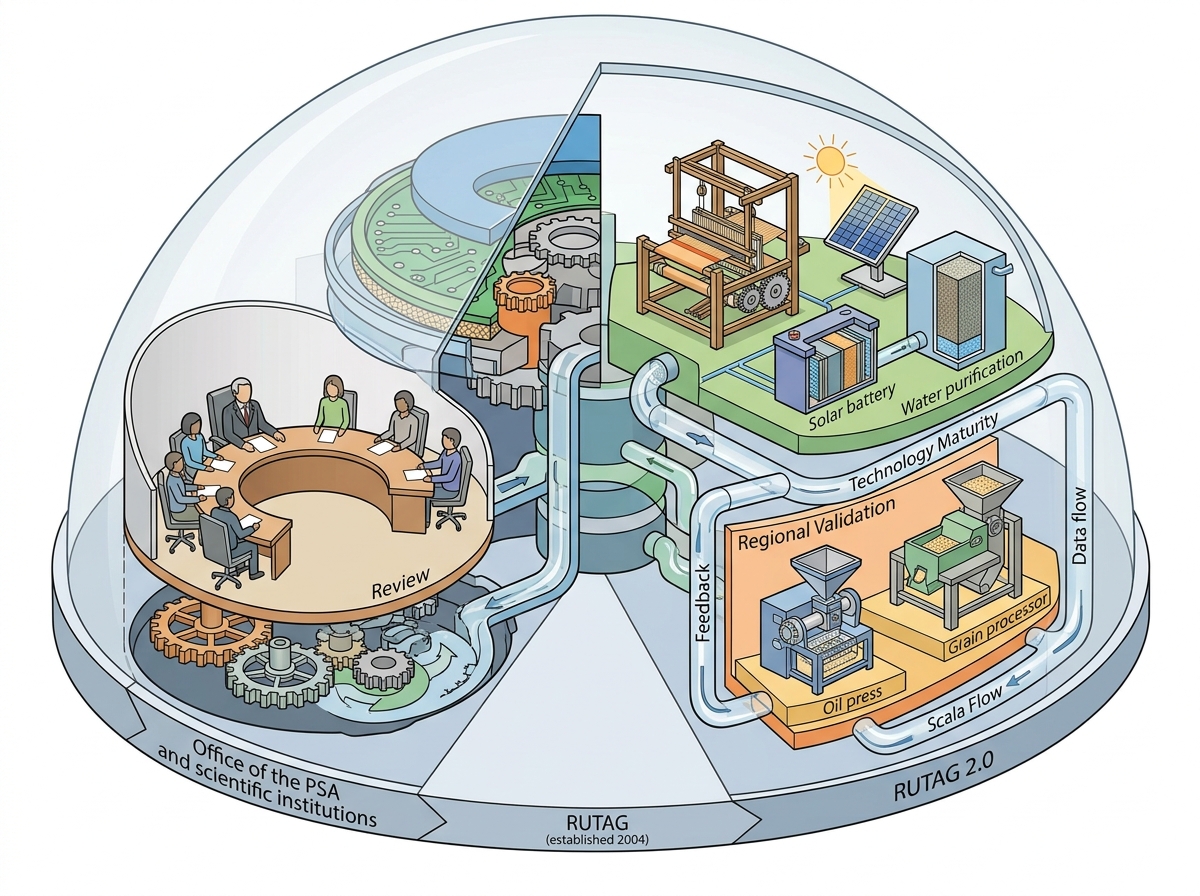
The third annual review meeting of the Rural Technology Action Group (RUTAG) 2.0, chaired by the Principal Scientific Adviser (PSA) to the Government of India, was held at IIT Roorkee on 24–25 September 2026. The meeting assessed cumulative progress under RUTAG 2.0, focusing on technology maturity, regional validation, scalability, and pathways for broader adoption. The event underscored the need for deeper integration of technology solutions into rural value chains and livelihood systems, with emphasis on affordability, reliability, and sustainability.
Background
- RUTAG was conceptualised in 2003–04 and formally established by the Office of the Principal Scientific Adviser (OPSA) in 2004 to bridge scientific and technical institutions with rural technology needs.
- RUTAG 2.0, launched in 2023, expands the scope of the original programme by prioritising regional engagement, technology validation, commercialisation, scaling, and widespread adoption.
- The programme operates through seven RUTAG centres across premier technical institutions, fostering multi-disciplinary collaboration between academia, industry, and local stakeholders.
What is the Rural Technology Action Group (RUTAG) 2.0?
- RUTAG 2.0 is a national-level initiative under the Office of the Principal Scientific Adviser (OPSA) to accelerate the development and deployment of science and technology solutions tailored for rural India.
- It builds on the original RUTAG framework by integrating technology validation, commercialisation, and scaling into a cohesive ecosystem, moving beyond pilot projects to sustainable impact.
- The programme operates through seven RUTAG centres located in premier technical institutions, including IITs, NITs, and other research hubs, each focusing on region-specific challenges.
- RUTAG 2.0 emphasises the entire innovation value chain: from problem identification and technology development to field validation, commercialisation, and large-scale adoption.
- Key focus areas include sustainable agriculture, rural livelihoods, water resource management, local manufacturing, and entrepreneurship, with a strong emphasis on affordability, reliability, and scalability.
- The initiative promotes multi-stakeholder collaboration among academic institutions, industry, financial institutions, state governments, and local communities to ensure contextual relevance and sustainability.
- Technology solutions under RUTAG 2.0 are evaluated for maturity, field readiness, and potential for integration into rural value chains, ensuring that interventions are both technically sound and socially acceptable.
- The NABARD-AMRIT platform, developed in partnership with OPSA, serves as a digital enabler for technology discovery, validation, and collaboration, facilitating faster translation of research into rural applications.
Key Features
| Feature | Significance |
|---|---|
| RUTAG 2.0 Framework | A structured initiative under the Office of the Principal Scientific Adviser (OPSA) to align scientific and technological capabilities of institutions with rural technology needs, emphasizing scalability, commercialization, and field validation. |
| Annual Review Mechanism | A systematic evaluation process to assess cumulative progress, technological maturity, and scalability of rural interventions, ensuring alignment with real-world adoption pathways. |
| Multi-Institutional Collaboration | Involvement of seven RUTAG centres across India, fostering interdisciplinary research and knowledge exchange to address diverse rural challenges. |
| Technology Maturity Assessment | Focus on validating technologies at different stages of readiness (TRL 4-9) to ensure field applicability, reliability, and sustainability in rural contexts. |
| Stakeholder Engagement | Inclusion of scientists, engineers, policymakers, financial institutions, and local fabricators to bridge the gap between technology development and grassroots implementation. |
| RSVC-AMRIT Platform | A collaborative framework developed by NABARD and OPSA to support technology discovery, validation, deployment, and scaling-up of rural innovations through structured partnerships. |
Why it Matters
Scientific and Technological Advancement
- Facilitates the translation of laboratory-based research into field-ready solutions, addressing critical gaps in rural infrastructure and livelihood systems.
- Promotes indigenous innovation by leveraging the expertise of premier institutions like IITs, IISc, and state universities in rural technology development.
- Encourages the adoption of low-cost, high-impact technologies that are scalable, sustainable, and aligned with the needs of marginalized communities.
Economic and Livelihood Impact
- Enhances rural productivity and income-generation opportunities through technology-driven interventions in agriculture, water management, and local manufacturing.
- Strengthens rural value chains by integrating scientific solutions with traditional livelihood practices, thereby improving economic resilience.
- Supports the growth of micro, small, and medium enterprises (MSMEs) in rural areas through technology adoption and entrepreneurship.
Policy and Governance Implications
- Demonstrates the role of scientific advisory mechanisms in shaping evidence-based policies for rural development and technology dissemination.
- Highlights the importance of multi-stakeholder governance models in bridging the urban-rural divide through collaborative innovation.
- Provides a replicable model for integrating scientific institutions with grassroots development programs, ensuring long-term sustainability.
Sustainability and Climate Resilience
- Focuses on technologies that are resource-efficient, environmentally sustainable, and resilient to climate variability, aligning with national and global sustainability goals.
- Promotes circular economy principles by encouraging local manufacturing, repair, and recycling of rural technologies.
Institutional Capacity Building
- Strengthens the capacity of scientific institutions to address real-world problems through field-oriented research and development.
- Encourages interdisciplinary collaboration among engineers, social scientists, and policymakers to develop holistic rural solutions.
Challenges
1. Technology Adoption and Scalability
- Low awareness among rural communities about available technologies and their benefits, leading to slow adoption rates.
- Challenges in scaling up technologies due to financial constraints, lack of local manufacturing capacity, and resistance to change in traditional practices.
- Need for robust field validation to ensure technologies are adaptable to diverse agro-climatic and socio-economic conditions.
UPSC Link: GS3: Technology Missions
2. Funding and Resource Mobilization
- Limited financial resources for sustained research, validation, and commercialization of rural technologies.
- Dependency on government funding without adequate private sector or community investment, affecting long-term viability.
- Need for innovative financing models, such as public-private partnerships (PPPs) and impact investments, to support rural innovation ecosystems.
UPSC Link: GS3: Resource Mobilization
3. Inter-Institutional Coordination
- Fragmented efforts among scientific institutions, leading to duplication of work and inefficiencies in technology development.
- Lack of standardized protocols for technology validation, adoption, and scaling, hindering collaborative progress.
- Need for a centralized platform to streamline knowledge sharing, resource allocation, and monitoring of rural technology initiatives.
UPSC Link: GS2: Cooperative Federalism
4. Local Capacity and Entrepreneurship
- Insufficient local technical expertise to operate, maintain, and repair rural technologies, leading to premature obsolescence.
- Limited entrepreneurial ecosystem in rural areas to commercialize and disseminate technologies developed by institutions.
- Need for skill development programs and incubation centers to nurture rural innovators and fabricators.
UPSC Link: GS3: Skill Development
5. Policy and Regulatory Barriers
- Complex regulatory frameworks for technology deployment, especially in sectors like water, energy, and agriculture.
- Lack of incentives for private sector participation in rural technology development and commercialization.
- Need for policy reforms to simplify approval processes, provide tax incentives, and ensure intellectual property protection for rural innovations.
UPSC Link: GS2: Governance
6. Climate and Environmental Constraints
- Increasing climate variability affecting the performance and reliability of rural technologies, particularly in agriculture and water management.
- Need for technologies that are resilient to extreme weather events and resource scarcity, aligning with climate adaptation strategies.
UPSC Link: GS3: Climate Change
Challenges — UPSC Perspective
| Issue | Concern |
|---|---|
| Technology Readiness | Technologies often remain at laboratory stage (TRL 1-3) without adequate field validation or commercialization pathways. |
| Financial Sustainability | Projects face funding gaps post-pilot phase, limiting their transition from demonstration to widespread adoption. |
| Stakeholder Alignment | Misalignment between technology developers, end-users, and policymakers leads to poor uptake and scalability. |
| Regulatory Hurdles | Cumbersome approval processes for deploying technologies in rural areas, especially in water, energy, and waste management sectors. |
| Local Fabrication Capacity | Rural areas lack technical infrastructure and skilled workforce to manufacture, repair, or customize technologies. |
| Climate Resilience | Technologies must adapt to changing climatic conditions, requiring continuous innovation and testing. |
Government Initiatives — Must-Memorise for Prelims
- RUTAG (Rural Technology Action Group) 2.0
Way Forward
- Strengthen field validation protocols to ensure technologies are adaptable to diverse rural conditions, with a focus on TRL 7-9 technologies.
- Expand public-private partnerships to mobilize additional funding and expertise for scaling rural innovations.
- Develop standardized guidelines for technology adoption, maintenance, and repair to enhance local capacity and sustainability.
- Establish a centralized knowledge-sharing platform to facilitate inter-institutional collaboration and reduce duplication of efforts.
- Promote entrepreneurship in rural areas through skill development programs, incubation centers, and access to micro-finance.
- Integrate climate resilience into technology design, ensuring solutions are robust against environmental variability.
- Encourage state governments to align RUTAG technologies with existing rural development schemes for integrated impact.
- Leverage the RSVC-AMRIT platform to streamline technology validation, deployment, and commercialization pathways.
UPSC Value Addition
Keywords for Mains Answer-Writing
RUTAG 2.0 · Prime Scientific Advisor (PSA) · Office of the Principal Scientific Advisor (OPSA) · rural technology · technology transfer · scalable solutions · technology validation · NABARD · RSVC-AMRIT platform · sustainable livelihoods · IIT Roorkee · rural innovation ecosystem · technology adoption · multi-stakeholder collaboration
Concept Flow
Identification of Rural Challenges → Scientific Research and Development (R&D) → Technology Validation and Field Testing → Stakeholder Engagement and Capacity Building → Scalability and Commercialization → Policy Integration and Governance Support → Sustainable Adoption and Impact Assessment
Prelims Practice Questions
Q1. Consider the following statements about the Rural Technology Action Group (RUTAG) 2.0:
1. RUTAG 2.0 was launched in 2023 with a focus on regional engagement, technology validation, and commercialisation.
2. The Office of the Principal Scientific Advisor (OPSA) is the nodal agency for RUTAG 2.0.
3. NABARD’s RSVC-AMRIT platform is exclusively used for funding RUTAG 2.0 projects.
4. RUTAG 2.0 operates through seven centres across India.
How many of the above statements are correct?
- Only one
- Only two
- Only three
- All
Answer: All — Statements 1, 2, and 4 are correct. Statement 3 is incorrect as the RSVC-AMRIT platform supports technology validation and adoption but is not exclusively for funding RUTAG 2.0 projects.
Q2. Assertion (A): The Prime Scientific Advisor (PSA) chairs the annual review meetings of RUTAG 2.0 projects.
Reason (R): The PSA’s role includes overseeing the implementation of technology-driven solutions for rural challenges.
Options:
A. Both A and R are true, and R is the correct explanation of A.
B. Both A and R are true, but R is not the correct explanation of A.
C. A is true, but R is false.
D. A is false, but R is true.
Answer: ? — Both the assertion and reason are true. The PSA chairs the annual review meetings of RUTAG 2.0 projects, and the PSA’s role includes overseeing technology-driven solutions for rural challenges, making R the correct explanation of A.
Q3. Match the following initiatives with their respective objectives:
Column I (Initiative) | Column II (Objective)
———————————————–|———————————————–
A. RUTAG 2.0 | 1. To promote sustainable agriculture in rural areas
B. RSVC-AMRIT platform | 2. To facilitate technology validation and adoption
C. OPSA | 3. To provide scientific advice to the Government of India
D. NABARD | 4. To support rural development through financial inclusion
Options:
A – 2, B – 1, C – 3, D – 4
A – 3, B – 2, C – 1, D – 4
A – 1, B – 2, C – 3, D – 4
A – 2, B – 3, C – 1, D – 4
Answer: ? — RUTAG 2.0 focuses on technology validation and adoption (A-2). The RSVC-AMRIT platform supports technology validation and adoption (B-2). The OPSA provides scientific advice to the Government of India (C-3). NABARD supports rural development through financial inclusion (D-4).
Mains Practice Question
✍ The Rural Technology Action Group (RUTAG) 2.0 represents a paradigm shift in India’s approach to rural development by leveraging science, technology, and multi-stakeholder collaboration. Critically examine the institutional architecture, technological interventions, and challenges in scaling up RUTAG 2.0’s impact for sustainable rural livelihoods. (15 Marks)
Approach: MODEL-ANSWER SKELETON:
1. **Institutional Architecture (4 marks)**
– Role of the Office of the Principal Scientific Advisor (OPSA) as the nodal agency.
– RUTAG 2.0’s seven-centre model (e.g., IIT Roorkee as a key hub) and its governance structure.
– Collaboration with NABARD’s RSVC-AMRIT platform for technology validation and adoption.
– Multi-stakeholder engagement: state governments, financial institutions, industry, and local fabricators.
2. **Technological Interventions (5 marks)**
– Focus on scalable, affordable, and sustainable technologies (e.g., water management, renewable energy, agricultural innovations).
– Emphasis on technology validation, field testing, and commercialisation pathways.
– Integration of local knowledge and grassroots innovation.
– Case studies: Examples of technologies validated under RUTAG 2.0 (e.g., low-cost water purification, solar-powered agricultural tools).
3. **Challenges in Scaling Impact (4 marks)**
– Barriers to technology adoption: affordability, awareness, and resistance to change.
– Institutional fragmentation: coordination gaps between central agencies, state governments, and local bodies.
– Funding constraints and the need for sustainable financing models.
– Ensuring inclusivity: reaching marginalised communities and addressing gender disparities.
4. **Way Forward (2 marks)**
– Strengthening multi-stakeholder partnerships for technology diffusion.
– Leveraging digital platforms for monitoring, evaluation, and knowledge sharing.
– Policy measures: incentives for private sector participation and state-level adoption frameworks.
Source: PIB (Press Information Bureau)
Generated by AanyaAi for educational purpose.
Related guides on our sites
- Best PSIR optional coaching for upsc
- Best PSIR optional teacher for upsc
- Best teacher of PSIR optional for upsc
- Best PSIR optional coaching in delhi for UPSC

- UPSC Exam: PM’s Scientific Advisor Reviews RUTAG 2.0 Projects at IIT Roorkee - September 26, 2026
- यूपीएससी के लिए: ‘मेरा स्वास्थ्य, मेरा गौरव’ अभियान से जानें युवाओं में नशामुक्ति का महत्व - September 26, 2026
- UPSC Exam Alert: My Health My Pride Campaign on Drug-Free Youth Initiative - September 26, 2026

No Comments