


26 Sep UPSC Alert: Hybrid Solar Systems in PM Surya Ghar Scheme for Power Backup
✎ Hybrid solar systems combine solar power, battery storage, and grid connectivity to provide uninterrupted electricity during outages, aligning with PM Surya Ghar Yojana’s objective of enhancing energy resilience and reducing grid…
Subject Relevance — Where This Topic Fits
- GS Paper III — Environment, Conservation, Environmental Pollution and Degradation, Environmental Impact Assessment
- Prelims: Hybrid Solar System, PM Surya Ghar Yojana, Grid Stability, Renewable Energy Integration, Battery Storage, Net Metering, Inverter Technology
Quick Revision: Hybrid solar systems combine solar power, battery storage, and grid connectivity to provide uninterrupted electricity during outages, aligning with PM Surya Ghar Yojana’s objective of enhancing energy resilience and reducing grid dependency.
Why is this in the news?
The renewed focus on hybrid solar systems under the PM Surya Ghar Yojana (Phase 2.0) stems from the need to address grid instability caused by frequent power outages, particularly in rural and semi-urban areas. Traditional on-grid solar systems without battery backup cease operation during grid failures, exacerbating electricity supply deficits. Hybrid systems, which combine solar power with battery storage and grid connectivity, ensure continuous power supply, aligning with the scheme’s objective of enhancing energy resilience and reducing dependency on conventional grid electricity.
Background
- Initial implementations predominantly featured on-grid solar systems without battery storage, which are cost-effective but inoperative during grid failures, leaving households vulnerable to power cuts.
- India’s renewable energy capacity has grown significantly, reaching 190 GW as of 2024, but grid instability due to intermittent solar power and inadequate storage infrastructure remains a critical challenge.
- The Ministry of New and Renewable Energy (MNRE) has emphasized the integration of battery storage solutions to enhance the reliability of solar power, particularly in regions prone to frequent power disruptions.
- State-level agencies such as the Uttar Pradesh New and Renewable Energy Development Agency (NEDA) and Dakshinanchal Vidyut Vitran Nigam Limited (DVVNL) are actively promoting hybrid solar systems to mitigate power supply vulnerabilities.
What is a Hybrid Solar System?
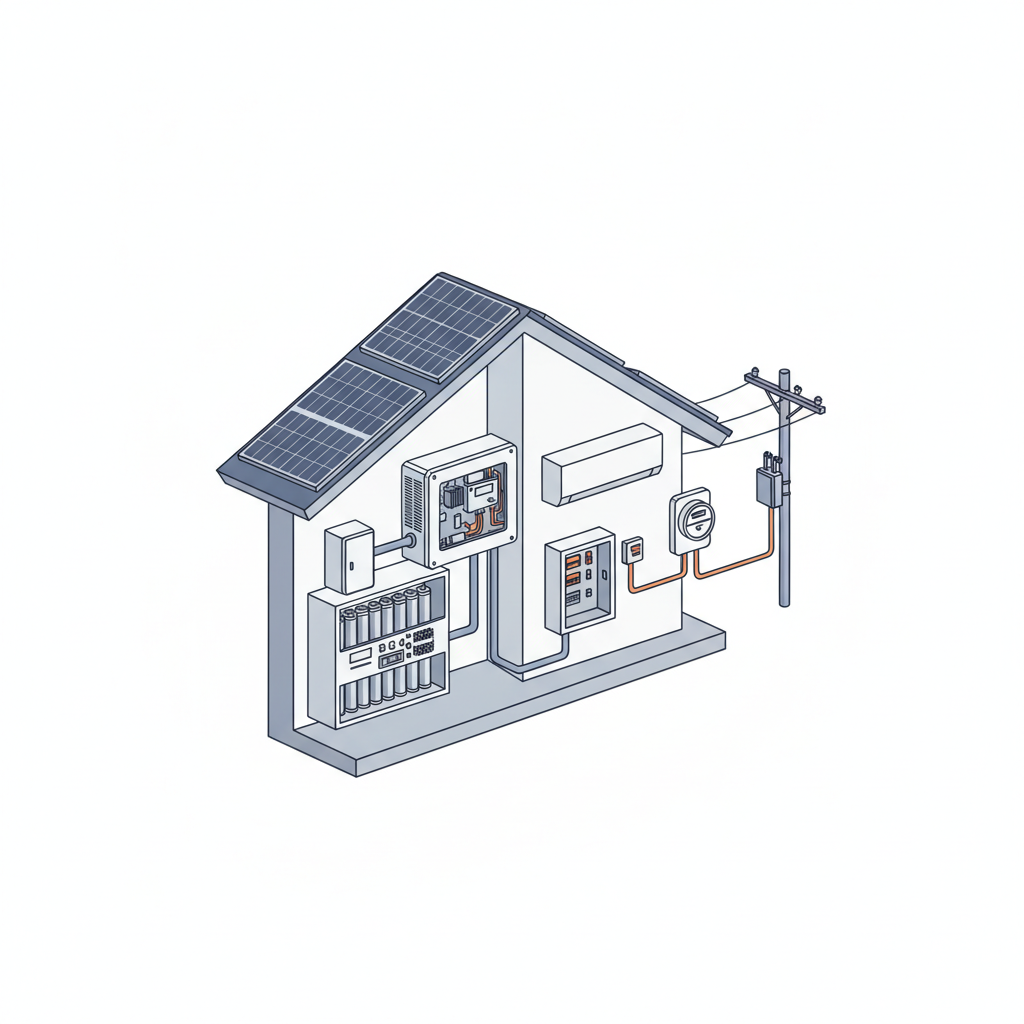
- A hybrid solar system integrates solar photovoltaic (PV) panels with battery storage and grid connectivity, enabling the storage of excess solar energy for use during non-sunlight hours or power outages.
- Unlike traditional on-grid systems, hybrid systems operate independently of the grid during outages, providing uninterrupted power supply to critical loads such as air conditioners, refrigerators, and lighting.
- The system comprises three key components: solar panels (to generate electricity), a hybrid inverter (to manage power flow between solar, batteries, and grid), and a battery bank (for energy storage).
- Hybrid inverters are programmable to prioritize solar power, battery discharge, or grid electricity based on availability and user-defined settings, optimizing energy efficiency.
- These systems support net metering, allowing excess solar power to be fed back into the grid for credits, while also drawing power from the grid when solar and battery resources are insufficient.
- Hybrid solar systems are particularly advantageous in regions with unreliable grid supply, as they ensure energy security and reduce dependency on diesel generators or other fossil fuel-based backup solutions.
- The cost of hybrid systems is higher than on-grid systems due to battery storage requirements, but government subsidies under schemes like PM Surya Ghar Yojana can significantly offset expenses.
- Technological advancements, such as lithium-ion batteries and smart inverters, have improved the efficiency, lifespan, and scalability of hybrid solar systems, making them a viable long-term solution.
Key Features
| Feature | Significance |
|---|---|
| Hybrid Solar System | Integrates solar PV generation with battery storage and grid connectivity, enabling uninterrupted power supply during grid outages. |
| Battery Backup | Stores excess solar energy for use during periods of low solar irradiance or grid failure, ensuring continuous operation of appliances such as air conditioners. |
| Hybrid Inverter | Manages power flow between solar panels, battery storage, and the grid, optimizing energy use and ensuring seamless transition during outages. |
| On-Grid Solar System (without battery) | Directly supplies solar power to the grid during generation hours but ceases operation during grid failures, increasing grid dependency. |
| PM Surya Ghar Muft Bijli Yojana 2.0 | Government scheme promoting rooftop solar adoption with provisions for battery-backed systems to enhance energy security and reduce grid load. |
Why it Matters
Energy Security and Reliability
- Enhances resilience against grid outages by providing uninterrupted power supply through integrated battery storage.
- Reduces dependency on conventional grid power, particularly in regions prone to frequent electricity disruptions.
- Supports the integration of renewable energy into the grid while maintaining stability during supply fluctuations.
Economic Viability
- Lowers long-term electricity costs by leveraging solar energy and reducing reliance on grid-supplied power.
- Government subsidies under PM Surya Ghar Yojana 2.0 improve affordability and accessibility for households.
- Potential for net metering and energy trading under hybrid systems, enabling consumers to earn revenue from excess energy.
Environmental Sustainability
- Promotes the adoption of clean energy sources, reducing carbon emissions and dependence on fossil fuels.
- Aligns with India’s commitments under international climate agreements (e.g., Paris Agreement) and national renewable energy targets.
- Supports the transition to a low-carbon energy ecosystem by decentralizing power generation.
Grid Stability and Load Management
- Alleviates stress on the grid by reducing peak demand and balancing supply-demand dynamics through distributed solar generation.
- Hybrid systems can feed excess solar power back into the grid during peak generation hours, enhancing grid efficiency.
- Mitigates the impact of grid failures on critical infrastructure and residential consumers.
Challenges
1. High Initial Capital Cost
- Hybrid solar systems require significant upfront investment for solar panels, batteries, and hybrid inverters.
- Limited affordability for low-income households despite government subsidies, necessitating innovative financing models.
- Cost of lithium-ion batteries remains a barrier to widespread adoption.
UPSC Link: GS-III: Energy
2. Technical and Operational Constraints
- Limited battery lifespan and degradation over time, requiring periodic replacement and maintenance.
- Complexity in system design and installation, necessitating skilled technicians and standardized protocols.
- Intermittency of solar power requires robust energy management systems to ensure reliability.
UPSC Link: GS-III: Science & Tech
3. Policy and Regulatory Hurdles
- Inconsistent state-level policies for net metering, energy trading, and grid connectivity for hybrid systems.
- Lack of standardized certification and quality control for solar equipment and installation practices.
- Delays in approvals and clearances for rooftop solar installations in urban and rural areas.
UPSC Link: GS-II: Governance
4. Awareness and Adoption Barriers
- Limited awareness among consumers about the benefits and operational aspects of hybrid solar systems.
- Skepticism regarding the reliability and economic viability of solar-plus-storage systems.
- Cultural and behavioral resistance to adopting new technologies in traditional energy markets.
UPSC Link: GS-III: Infrastructure
5. Supply Chain and Logistics Issues
- Dependence on imported components (e.g., batteries, inverters) for high-quality hybrid systems.
- Logistical challenges in transporting and installing systems in remote or hilly regions.
- Shortages of skilled labor for installation, maintenance, and repair of hybrid solar systems.
UPSC Link: GS-III: Economy
Challenges — UPSC Perspective
| Issue | Concern |
|---|---|
| Capital Cost | High upfront investment limits accessibility despite subsidies. |
| Battery Degradation | Reduces system efficiency and increases long-term maintenance costs. |
| Policy Inconsistency | Lack of uniform regulations hinders seamless adoption across states. |
| Technical Complexity | Requires skilled labor and standardized installation protocols. |
| Supply Chain Dependence | Reliance on imports for critical components increases costs and delays. |
| Consumer Awareness | Limited understanding of hybrid systems reduces adoption rates. |
Government Initiatives — Must-Memorise for Prelims
- PM Surya Ghar Muft Bijli Yojana 2.0
Way Forward
- Enhance consumer awareness campaigns to educate households on the benefits and operational aspects of hybrid solar systems.
- Expand government subsidies and low-interest financing schemes to improve affordability for low-income households.
- Develop standardized certification and quality control protocols for solar equipment and installation practices.
- Strengthen state-level policies for net metering, energy trading, and grid connectivity to ensure consistency and reliability.
- Invest in research and development to improve battery technology, reduce costs, and extend system lifespans.
- Promote skill development programs to train technicians in the installation, maintenance, and repair of hybrid solar systems.
- Encourage public-private partnerships to streamline supply chains and reduce dependency on imported components.
- Integrate hybrid solar systems into urban and rural planning policies to facilitate seamless adoption and grid integration.
UPSC Value Addition
Keywords for Mains Answer-Writing
Hybrid Solar Systems · PM Surya Ghar Muft Bijli Yojana · Renewable Energy Integration · Grid Stability · Battery Backup Systems · On-Grid Solar Systems · Hybrid Inverters · Distributed Solar Power · Energy Transition · Solar Energy Policy · Power Backup Resilience · Grid-Independent Solar Systems · DISCOMs and Renewable Energy · Energy Storage Solutions · Solar Rooftop Subsidy Scheme
Concept Flow
Grid instability and frequent power outages → Increased demand for reliable energy solutions → Adoption of hybrid solar systems with battery backup. → Government promotion of rooftop solar under PM Surya Ghar Yojana 2.0 → Incentives for battery-backed systems → Enhanced energy security. → Technological integration of solar PV, batteries, and hybrid inverters → Seamless power supply during outages → Reduced grid dependency. → Policy and regulatory support → Standardization of systems and installation practices → Improved consumer confidence and adoption. → Economic viability through subsidies and net metering → Lower long-term electricity costs → Wider acceptance of hybrid solar systems. → Environmental benefits of reduced carbon emissions → Alignment with national renewable energy targets → Contribution to climate goals.
Prelims Practice Questions
Q1. Consider the following statements regarding hybrid solar systems:
1. Hybrid solar systems operate independently of the grid during power outages.
2. They require battery storage to function.
3. Hybrid inverters are mandatory under the PM Surya Ghar Muft Bijli Yojana 2.0.
How many of the above statements are correct?
- Only one
- Only two
- Only three
- None
Answer: Only three — Statements 1 and 2 are correct as hybrid solar systems integrate grid power with battery storage to ensure continuous supply during outages. Statement 3 is incorrect because the PM Surya Ghar scheme does not mandate hybrid inverters but encourages battery-backed systems for resilience.
Q2. Assertion (A): On-grid solar systems without battery backup are more cost-effective and environmentally sustainable than hybrid solar systems.
Reason (R): On-grid systems reduce grid load and eliminate the need for energy storage, thereby lowering carbon emissions.
Codes:
A. Both A and R are true, and R is the correct explanation of A.
B. Both A and R are true, but R is NOT the correct explanation of A.
C. A is true, but R is false.
D. A is false, but R is true.
- A
- B
- C
- D
Answer: B — Both Assertion (A) and Reason (R) are true. On-grid systems are cost-effective and reduce grid load, while hybrid systems require batteries, increasing cost and complexity. However, R correctly explains A as it highlights the sustainability advantage of on-grid systems.
Q3. Match the following components of solar energy systems with their primary functions:
Column I (Component)
1. Hybrid Inverter
2. On-Grid Inverter
3. Battery Storage
4. Solar Panel
Column II (Function)
A. Converts DC from solar panels to AC for grid use
B. Manages power flow between grid, solar, and batteries
C. Stores excess solar energy for later use
D. Generates electricity from sunlight using photovoltaic cells
Options:
1-A, 2-B, 3-C, 4-D
1-B, 2-A, 3-C, 4-D
1-C, 2-B, 3-A, 4-D
1-D, 2-A, 3-B, 4-C
- 1-A, 2-B, 3-C, 4-D
- 1-B, 2-A, 3-C, 4-D
- 1-C, 2-B, 3-A, 4-D
- 1-D, 2-A, 3-B, 4-C
Answer: 1-B, 2-A, 3-C, 4-D — The correct pairing is: Hybrid Inverter (1-B) manages power flow between grid, solar, and batteries; On-Grid Inverter (2-A) converts DC to AC for grid use; Battery Storage (3-C) stores excess energy; Solar Panel (4-D) generates electricity from sunlight.
Mains Practice Question
✍ The transition to renewable energy in India necessitates a balance between grid stability and energy resilience. In this context, critically examine the role of hybrid solar systems as a solution to power outages, with reference to the PM Surya Ghar Muft Bijli Yojana 2.0. Also, discuss the challenges associated with their large-scale adoption. (15 Marks)
Approach: MODEL-ANSWER SKELETON:
1. **Introduction (2 Marks)**
– Define hybrid solar systems: integration of on-grid solar power with battery storage and hybrid inverters for seamless energy transition.
– Context: PM Surya Ghar Muft Bijli Yojana 2.0 aims to promote rooftop solar adoption with incentives for battery-backed systems to address power outages.
2. **Role of Hybrid Solar Systems (6 Marks)**
– **Energy Resilience**: Hybrid systems ensure continuous power supply during grid failures by utilizing stored battery energy, addressing reliability concerns in rural and urban areas.
– **Grid Stability**: By reducing dependence on the grid during peak demand or outages, hybrid systems alleviate pressure on DISCOMs and enhance distributed energy generation.
– **Policy Support**: The PM Surya Ghar scheme incentivizes battery-backed systems, aligning with India’s goal of achieving 500 GW renewable energy capacity by 2030.
– **Technological Advancements**: Hybrid inverters enable bidirectional power flow, optimizing energy use and reducing wastage.
3. **Challenges in Adoption (5 Marks)**
– **Cost Barriers**: High upfront costs of batteries and hybrid inverters limit accessibility for low-income households despite subsidies.
– **Technical Constraints**: Battery degradation, maintenance requirements, and limited lifespan pose operational challenges.
– **Policy and Regulatory Gaps**: Inconsistent state-level policies, net metering regulations, and DISCOM resistance to decentralized energy generation hinder adoption.
– **Awareness and Skilling**: Lack of technical expertise among installers and consumers delays widespread implementation.
4. **Conclusion (2 Marks)**
– Hybrid solar systems represent a viable solution to India’s energy resilience challenges but require targeted policy interventions, financial incentives, and capacity-building to overcome adoption barriers. Their integration into the PM Surya Ghar scheme marks a progressive step toward sustainable and reliable energy access.
Source: amarujala.com
Generated by AanyaAi for educational purpose.
Related guides on our sites
- Current affairs for upsc 2026
- Best PSIR optional coaching for upsc
- Best PSIR optional teacher for upsc
- Best teacher of PSIR optional for upsc

- UPSC Alert: Hybrid Solar Systems in PM Surya Ghar Scheme for Power Backup - September 26, 2026
- गैर-लाभकारी संगठनों में डिजिटल परिपक्वता और एआई अपनाने में कमी: रिपोर्ट 2026 - September 26, 2026
- Indian Non-Profits Trail in Digital Maturity and AI Adoption: 2026 Report - September 26, 2026

No Comments