


26 Sep EC clarifies SIR decisions unanimous, denies policy disputes in UPSC exam context
✎ The Special Intensive Revision (SIR) is a legally mandated, unanimously approved process by the Election Commission of India to update electoral rolls, with its decisions upheld by the Supreme Court, ensuring electoral integrity…
Subject Relevance — Where This Topic Fits
- GS Paper II — Constitutional, Statutory, Regulatory and Various Quasi-Judicial Bodies | GS Paper II — Structure, Organisation and Functioning of the Executive and the Judiciary
- Prelims: Special Intensive Revision (SIR), Form 6 (Electoral Rolls), Election Commission of India (ECI), Registration of Electors Rules, 1960, Chief Election Commissioner (CEC), Election Commissioners, Supreme Court of India, Chief Electoral Officer (CEO), Block Level Officers (BLOs), Electoral Rolls (ERs)
- Essay: The Role of Constitutional Institutions in Upholding Democratic Values, Balancing Efficiency and Transparency in Electoral Processes
Quick Revision: The Special Intensive Revision (SIR) is a legally mandated, unanimously approved process by the Election Commission of India to update electoral rolls, with its decisions upheld by the Supreme Court, ensuring electoral integrity and inclusivity.
Why is this in the news?
The Election Commission of India (ECI) issued a detailed statement clarifying the unanimous nature of decisions related to the Special Intensive Revision (SIR) process, the legal validity of Form 6 modifications, and the procedural integrity of its functioning. This follows reports of dissent among Election Commissioners regarding the SIR process and the issuance of letters by two Commissioners to the Cabinet Secretary. The clarification underscores the ECI’s commitment to transparency, judicial compliance, and institutional cohesion in electoral governance.
Background
- The Special Intensive Revision (SIR) is a periodic exercise conducted by the Election Commission of India (ECI) to update and purify electoral rolls by removing outdated entries and including new eligible voters.
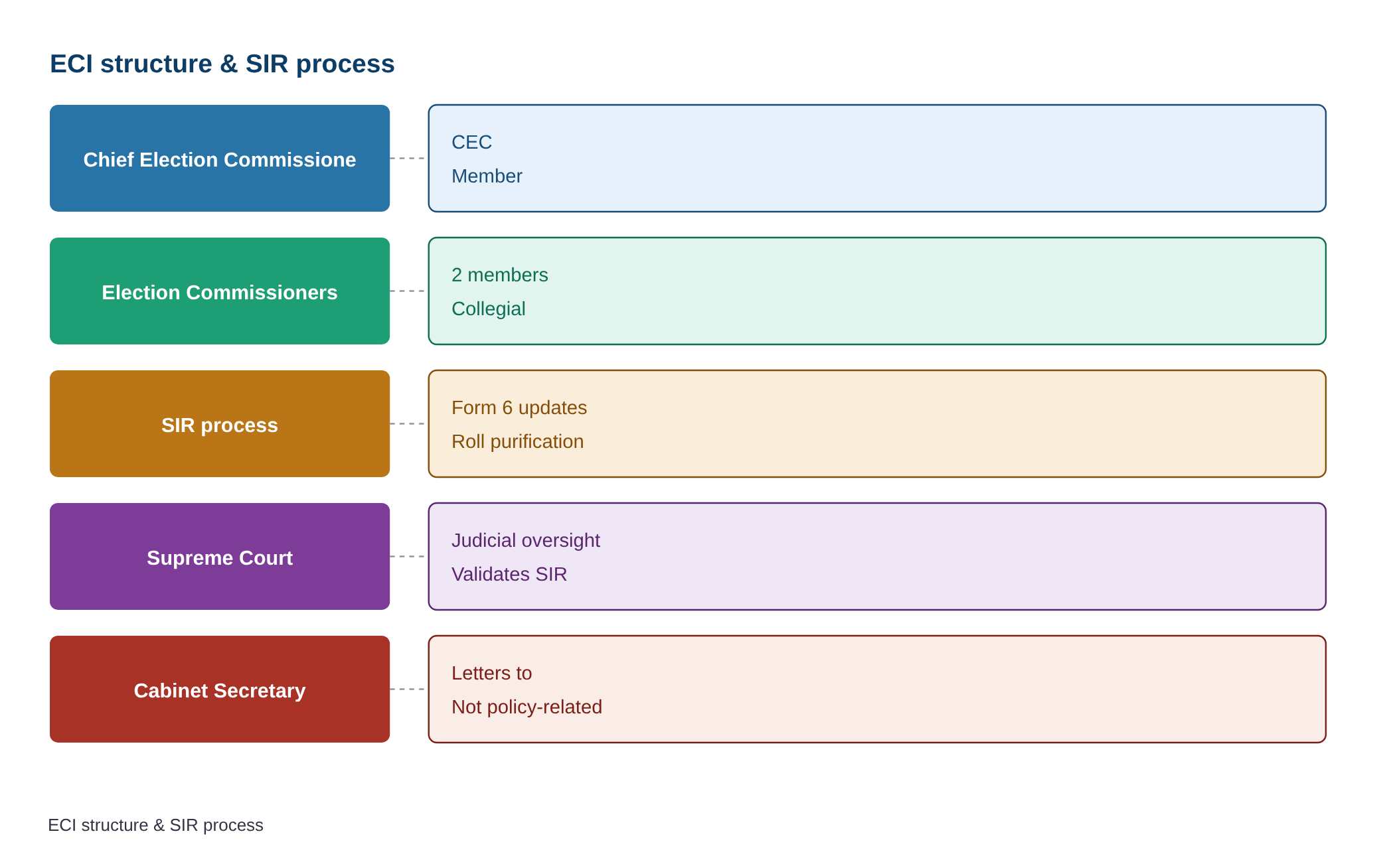
- The ECI operates as a three-member constitutional body comprising the Chief Election Commissioner (CEC) and two Election Commissioners, all of whom must concur on major decisions.
- The Registration of Electors Rules, 1960, govern the preparation and maintenance of electoral rolls in India, including the process for inclusion of names via Form 6.
- The Supreme Court of India has, in multiple judgments, upheld the ECI’s authority to conduct SIR and has validated the use of Form 6 for voter registration and updates.
- Recent reports highlighted dissent among ECI members regarding the implementation of SIR, leading to public scrutiny and demands for greater transparency in the Commission’s functioning.
- The ECI’s statement seeks to address these concerns by reaffirming the unanimity of its decisions and the legal sanctity of its processes.
What is the Special Intensive Revision (SIR)?
- The SIR is a systematic process undertaken by the Election Commission of India (ECI) to revise and update electoral rolls, ensuring accuracy and inclusivity in voter lists.
- It involves the identification and removal of names of deceased, shifted, or otherwise ineligible voters, as well as the inclusion of new eligible voters who have attained the age of 18 or have relocated to a new constituency.
- The SIR process is conducted periodically in phases across states and Union Territories, with the ECI issuing schedules and guidelines for each phase.
- The process is governed by the Registration of Electors Rules, 1960, which provide the legal framework for electoral roll management.
- The ECI’s decisions on SIR are taken with the unanimous approval of all three Election Commissioners, ensuring collegial governance and institutional checks.
- The SIR process includes public notices, house-to-house verification by Block Level Officers (BLOs), and opportunities for voters to correct or update their details.
- The final electoral rolls are published after the completion of the SIR process, and any disputes are addressed through prescribed legal remedies.
Key Features
| Feature | Significance |
|---|---|
| Unanimous approval of SIR decisions | Ensures transparency and collective responsibility in electoral roll revision, reinforcing the Commission’s constitutional mandate under Article 324. |
| Supreme Court upholding SIR orders | Validates the legal and procedural correctness of the Commission’s actions, enhancing public trust in electoral processes. |
| Letters to Cabinet Secretary | Clarifies the nature of intra-institutional communications, distinguishing administrative concerns from policy matters. |
| House-to-house visits by BLOs | Facilitates inclusive voter registration, particularly for left-out electors, aligning with the Commission’s voter outreach objectives. |
| Exemption from personal hearings | Streamlines the SIR process, reducing procedural delays while maintaining fairness in exceptional cases. |
Why it Matters
Institutional Integrity
- The unanimity of SIR decisions underscores the collegial functioning of the Election Commission, a constitutional body under Article 324, which is critical for maintaining electoral credibility.
- The Supreme Court’s endorsement of SIR orders reinforces the judiciary’s role in safeguarding electoral processes, ensuring checks and balances within the constitutional framework.
- The clarification regarding letters to the Cabinet Secretary highlights the distinction between administrative oversight and policy formulation, preserving the Commission’s functional autonomy.
Electoral Governance
- The Special Intensive Revision (SIR) process is a statutory mechanism under the Registration of Electors Rules, 1960, aimed at updating the electoral rolls to reflect demographic changes.
- The phased implementation of SIR across states/UTs ensures systematic and inclusive voter registration, reducing discrepancies and enhancing electoral participation.
- The use of Form 6 for inclusion and Form 7 for deletion aligns with the Commission’s mandate to maintain accurate and updated electoral rolls.
Judicial-Executive Interface
- The Supreme Court’s intervention in upholding SIR orders demonstrates the judiciary’s role in resolving disputes related to electoral processes, ensuring compliance with constitutional and statutory provisions.
- The Commission’s adherence to judicial directives reinforces the principle of judicial review in electoral governance, balancing executive authority with constitutional safeguards.
Challenges
1. Intra-institutional Coordination
- Differences among Election Commissioners on procedural or administrative matters can undermine public confidence in the Commission’s functioning.
- Ensuring unanimity in decisions, while respecting individual viewpoints, is essential for maintaining institutional cohesion and credibility.
UPSC Link: GS-II: Constitutional bodies
2. Voter Outreach and Inclusion
- Identifying and reaching out to left-out voters, particularly in remote or marginalised areas, remains a persistent challenge in electoral roll revision.
- Balancing efficiency with inclusivity in voter registration processes requires sustained administrative effort and resource allocation.
UPSC Link: GS-II: Electoral reforms
3. Procedural Delays and Transparency
- Procedural complexities, such as personal hearings, can lead to delays in the SIR process, potentially disenfranchising eligible voters.
- Ensuring transparency in decision-making and communication is critical to prevent misinformation and maintain public trust.
UPSC Link: GS-II: Election Commission
4. Judicial Scrutiny and Compliance
- While judicial endorsement strengthens the Commission’s actions, over-reliance on judicial intervention can create perceptions of judicial overreach in executive functions.
- Ensuring timely compliance with judicial directives without compromising procedural fairness is a key governance challenge.
UPSC Link: GS-II: Judiciary and executive
Challenges — UPSC Perspective
| Issue | Concern |
|---|---|
| Divergent views among Commissioners | Potential erosion of institutional credibility and public trust in electoral processes. |
| Left-out voters in remote areas | Risk of disenfranchisement due to inadequate voter outreach and registration efforts. |
| Procedural delays in SIR | Possible exclusion of eligible voters due to prolonged revision processes. |
| Judicial intervention in executive decisions | Perception of judicial overreach, though intended to safeguard electoral integrity. |
| Communication gaps with stakeholders | Risk of misinformation and erosion of trust in the Commission’s transparency. |
Way Forward
- Strengthen intra-institutional communication protocols to minimise procedural ambiguities and ensure unanimity in decision-making.
- Enhance voter outreach mechanisms, particularly in remote and marginalised areas, to improve inclusion in the electoral rolls.
- Streamline the SIR process by leveraging technology for efficient data collection, verification, and publication of electoral rolls.
- Institutionalise pre-emptive judicial consultations to align executive actions with judicial expectations, reducing post facto interventions.
- Conduct periodic audits of the SIR process to identify bottlenecks and implement corrective measures for timely completion.
- Promote transparency by publishing agendas, minutes, and decisions of the Election Commission to foster public trust.
- Train and sensitise officials, including Block Level Officers (BLOs), on the importance of voter inclusion and procedural fairness.
- Explore legislative amendments to simplify procedural requirements, such as personal hearings, without compromising due process.
UPSC Value Addition
Keywords for Mains Answer-Writing
Election Commission of India · Special Intensive Revision (SIR) · Electoral Rolls · Form 6 · Registration of Electors Rules 1960 · Election Commissioners · Supreme Court of India · Chief Election Commissioner · Constitutional provisions · Electoral Reforms · Voter Enrolment · Electoral Disputes · Constitutional Bodies · Electoral Integrity · Electoral Processes
Constitutional & Policy Linkages
- {‘Article 324’: ‘Superintendence, direction and control of elections’}
- {‘Article 325’: ‘No person to be ineligible for inclusion in electoral roll on grounds of religion, race, caste or sex’}
- {‘Article 326’: ‘Elections to the House of the People and to the Legislative Assemblies of States to be on the basis of adult suffrage’}
Concept Flow
Constitutional mandate under Article 324 → Election Commission’s authority to revise electoral rolls (Registration of Electors Rules, 1960) → Implementation of Special Intensive Revision (SIR) process → Unanimous approval of SIR decisions → Supreme Court’s validation of SIR orders → Public trust in electoral integrity → Differences among Election Commissioners → Clarification on administrative vs. policy matters → Letters to Cabinet Secretary → Reaffirmation of Commission’s functional autonomy → Preservation of institutional credibility → House-to-house visits by BLOs → Identification of left-out voters → Inclusion in electoral rolls via Form 6 → Enhanced voter participation → Strengthened democratic processes → Procedural complexities in SIR → Potential delays in voter registration → Risk of disenfranchisement → Streamlining processes → Reduced procedural burdens while maintaining fairness → Judicial scrutiny of SIR orders → Supreme Court’s endorsement → Reinforcement of electoral governance → Balancing executive authority with judicial oversight → Transparency in Commission’s functioning → Publication of agendas and minutes → Public trust and accountability → Prevention of misinformation and erosion of credibility
Prelims Practice Questions
Q1. Consider the following statements regarding the Special Intensive Revision (SIR) of electoral rolls in India:
1. The SIR is conducted under the provisions of the Registration of Electors Rules, 1960.
2. The Supreme Court of India has upheld the declaration attached to Form 6 for SIR.
3. The SIR schedule for all states/UTs is issued by the Election Commission without prior consultation with the Supreme Court.
How many of the above statements are correct?
- Only one
- Only two
- All three
- None
Answer: Only two — Statement 1 is correct as SIR is conducted under the Registration of Electors Rules, 1960. Statement 2 is correct as the Supreme Court upheld the declaration attached to Form 6 for SIR. Statement 3 is incorrect as the Supreme Court’s approval is required for such schedules.
Q2. Assertion (A): The Election Commission of India is a constitutional body with quasi-judicial powers.
Reason (R): The Election Commission derives its powers from Article 324 of the Constitution of India.
Options:
A. Both A and R are true, and R is the correct explanation of A.
B. Both A and R are true, but R is NOT the correct explanation of A.
C. A is true but R is false.
D. A is false but R is true.
Answer: ? — Both the Assertion and Reason are true. Article 324 of the Constitution of India vests the superintendence, direction, and control of the preparation of the electoral rolls and the conduct of elections in the Election Commission, which grants it quasi-judicial powers.
Q3. Match the following electoral processes with their respective forms or rules:
Column I
1. Inclusion of names in electoral rolls
2. Special Intensive Revision (SIR)
3. Objections to entries in electoral rolls
Column II
A. Form 6
B. Form 7
C. Registration of Electors Rules, 1960
Options:
1-A, 2-C, 3-B
1-B, 2-A, 3-C
1-C, 2-B, 3-A
1-A, 2-B, 3-C
Answer: ? — Form 6 is used for the inclusion of names in electoral rolls. Form 7 is used for objections to entries in electoral rolls. The Special Intensive Revision (SIR) is conducted under the Registration of Electors Rules, 1960.
Mains Practice Question
✍ The Special Intensive Revision (SIR) of electoral rolls is a critical process for maintaining the integrity of the electoral rolls in India. Critically examine the constitutional and legal framework governing the SIR, including the role of the Election Commission of India and the Supreme Court’s oversight. Also, discuss the significance of Form 6 in this process and the implications of the Supreme Court’s recent judgment upholding the SIR declaration. (15 Marks)
Approach: MODEL-ANSWER SKELETON:
1. Constitutional Framework: Article 324 of the Constitution of India – role of the Election Commission (EC) in superintendence, direction, and control of elections.
2. Legal Framework: Registration of Electors Rules, 1960 – provisions governing SIR and Form 6.
3. Process of SIR: Steps involved, including house-to-house verification, objections, and final publication.
4. Role of Supreme Court: Recent judgment upholding the SIR declaration attached to Form 6 (May 27, 2026), citing judicial review and electoral integrity.
5. Significance of Form 6: Purpose, usage, and legal sanctity in voter enrolment.
6. Implications: Ensuring electoral rolls’ accuracy, transparency, and public trust; challenges in implementation.
7. Balance of Views: Arguments for SIR as a tool for electoral purity vs. concerns over procedural delays or exclusions.
Expected Points:
– Constitutional mandate under Article 324.
– Legal basis in Registration of Electors Rules, 1960.
– Supreme Court’s role in upholding electoral processes.
– Form 6 as a critical document for voter inclusion.
– Contemporary relevance: Recent Supreme Court judgment (May 27, 2026) and its impact on SIR.
– Critical analysis: Strengths and limitations of SIR in maintaining electoral integrity.
Source: orissapost.com
Generated by AanyaAi for educational purpose.
Related guides on our sites
- Best PSIR optional coaching for upsc
- Best PSIR optional teacher for upsc
- Best teacher of PSIR optional for upsc
- Best PSIR optional coaching in delhi for UPSC

- EC clarifies SIR decisions unanimous, denies policy disputes in UPSC exam context - September 26, 2026
- डीसीपीसी का विशेष अभियान 6.0: ई-कचरा प्रबंधन और कार्यस्थल दक्षता पर नया फोकस - September 26, 2026
- Special Campaign 6.0: DCP&C to Focus on E-Waste, Cleanliness & Workplace Efficiency - September 26, 2026

No Comments