


27 Sep CBN’s Mission Yuva Raksha: Drug Awareness Drive in MP’s Jawara for UPSC Aspirants
✎ The Central Bureau of Narcotics (CBN) enforces the NDPS Act, 1985, to regulate narcotic drugs, curb illicit trafficking, and promote preventive awareness under the 'Nasha Mukt Bharat Abhiyaan'.
Subject Relevance — Where This Topic Fits
- GS Paper II — Governance, Transparency and Accountability in Administration | GS Paper III — Challenges to Internal Security and Role of Institutions
- Prelims: Narcotic Drugs and Psychotropic Substances (NDPS) Act, 1985, Central Bureau of Narcotics (CBN), Mission Yuva Raksha, Drug-Free India Campaign, Opium cultivation in India, Narcotics Control Bureau (NCB)
- Essay: Role of institutions in combating social vices: A case study of drug abuse prevention, Youth empowerment as a tool for national development and social transformation
Quick Revision: The Central Bureau of Narcotics (CBN) enforces the NDPS Act, 1985, to regulate narcotic drugs, curb illicit trafficking, and promote preventive awareness under the ‘Nasha Mukt Bharat Abhiyaan’.
Why is this in the news?
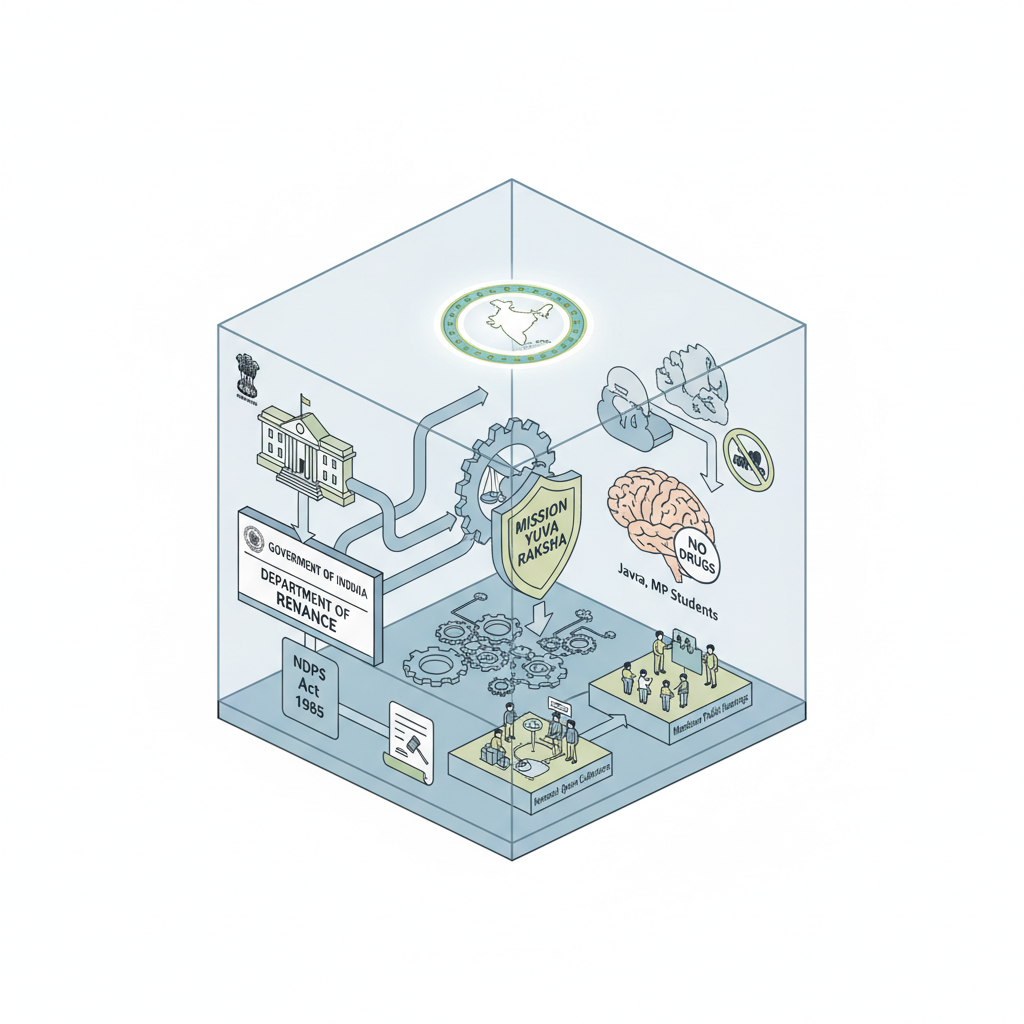
The Central Bureau of Narcotics (CBN), under the aegis of Mission Yuva Raksha, recently organised anti-drug awareness programmes for students in Javra, Madhya Pradesh, and conducted public hearings in Neemuch and Mandsaur districts to address grievances of opium cultivators. These initiatives underscore the dual approach of enforcement and preventive awareness in combating drug abuse and illicit narcotics trafficking, aligning with the national objective of a ‘Drug-Free India’.
Background
- The NDPS Act, 1985, is the primary legislation governing narcotic drugs and psychotropic substances in India, criminalising their production, sale, and consumption beyond regulated limits.
- The Central Bureau of Narcotics (CBN) functions under the Department of Revenue, Ministry of Finance, to enforce drug control laws and prevent illicit trafficking.
- India is a signatory to the Single Convention on Narcotic Drugs, 1961, and the Convention on Psychotropic Substances, 1971, committing to global narcotics control standards.
- Opium cultivation in India is regulated under the NDPS Act, with licences issued for medicinal and scientific purposes only; illicit cultivation is a punishable offence.
- The ‘Nasha Mukt Bharat Abhiyaan’ (Drug-Free India Campaign) was launched in 2020 to combat drug abuse through awareness, education, and community engagement, particularly targeting youth.
- Mission Yuva Raksha is an initiative under the Nasha Mukt Bharat Abhiyaan aimed at sensitising and engaging youth in drug prevention efforts through awareness programmes and direct outreach.
What is the Central Bureau of Narcotics (CBN)?
- The CBN enforces drug control laws in India.
- It operates under the Department of Revenue, Ministry of Finance, and functions as the nodal agency for narcotics control in the country.
- The CBN is responsible for licensing and regulating the cultivation, production, and distribution of opium and other narcotic drugs for medicinal and scientific purposes.
- It conducts regular inspections, raids, and seizures to curb illicit drug trafficking and prevent the diversion of licit drugs into illegal markets.
- The CBN collaborates with state agencies, international organisations, and civil society to strengthen drug control mechanisms and promote preventive awareness.
- The Bureau organises awareness programmes in educational institutions and communities.
- It also addresses grievances of opium cultivators, ensuring transparency and accessibility in dispute resolution to prevent illicit cultivation.
- The CBN’s enforcement and preventive measures are aligned with India’s commitments under international drug control treaties.
Key Features
| Feature | Significance |
|---|---|
| Mishan Yuva Raksha under Nasha Mukt Bharat Abhiyaan | A targeted youth-centric initiative integrating preventive education, community engagement, and institutional partnerships to curb substance abuse among adolescents and young adults. |
| Awareness programmes in educational institutions | Direct engagement with students through presentations, interactive videos, and quizzes to foster informed decision-making and peer-led advocacy against drug abuse. |
| Grievance redressal through Jan Sunwai in opium-growing districts | Institutional mechanism for expeditious resolution of grievances of opium cultivators, ensuring transparency, accessibility, and trust in governance. |
| MoU with Brahma Kumaris for community outreach | Leveraging spiritual and social organisations to amplify reach and impact of anti-drug campaigns through structured awareness sessions and collective pledges. |
| Multi-stakeholder collaboration (CBN, educators, cultivators, spiritual organisations) | Synchronised efforts across government, civil society, and local communities to address supply, demand, and rehabilitation aspects of substance abuse holistically. |
Why it Matters
Public Health
- Reduces the burden of substance-use disorders on healthcare systems by preventing initiation and promoting early intervention.
- Targets adolescents—a critical demographic for long-term behavioural change and intergenerational health impact.
- Aligns with WHO’s global strategy on drug prevention and the Sustainable Development Goal target 3.5 on substance abuse reduction.
Governance and Institutional Strengthening
- Demonstrates a multi-pronged governance approach combining enforcement, grievance redressal, and preventive education.
- Enhances trust in state institutions through transparent, accessible, and citizen-centric mechanisms like Jan Sunwai.
- Showcases inter-departmental and inter-sectoral coordination under the aegis of the Narcotics Control Bureau.
Rural and Agricultural Socio-Economics
- Addresses grievances of opium cultivators, reducing incentives for illicit trade and supporting livelihood diversification.
- Promotes awareness of legal alternatives and state support systems to mitigate economic dependence on opium cultivation.
- Contributes to rural stability by mitigating drug-related social disorders that disrupt agricultural productivity.
Youth Empowerment and Social Cohesion
- Empowers youth as agents of change through education, peer networks, and community pledges against substance abuse.
- Fosters social cohesion by uniting diverse stakeholders—students, cultivators, officials, and spiritual leaders—in a shared public health goal.
- Encourages civic participation and responsibility among young citizens in nation-building activities.
Challenges
1. Socio-Cultural Normalisation of Substance Use
- Deep-rooted cultural acceptance of certain substances (e.g., alcohol, tobacco) complicates prevention messaging and enforcement.
- Peer pressure and social rituals often normalise experimentation with drugs among adolescents.
- Limited awareness of the legal and health consequences among marginalised communities exacerbates vulnerability.
UPSC Link: GS2 Social Justice
2. Economic Incentives for Illicit Cultivation
- Opium cultivation in certain regions is driven by economic necessity, requiring viable alternative livelihoods to reduce dependency.
- Profit margins in illicit drug trade often outweigh penalties, incentivising continued cultivation and trafficking.
- Lack of awareness among cultivators about government schemes and legal pathways to exit opium farming.
UPSC Link: GS3 Agriculture
3. Institutional Capacity and Coordination Gaps
- Ensuring seamless coordination between central agencies (CBN), state governments, and local bodies for sustained implementation.
- Training and sensitisation of frontline workers (e.g., teachers, police, health workers) to deliver effective prevention programmes.
- Monitoring and evaluation mechanisms to assess the impact of awareness campaigns and grievance redressal systems.
UPSC Link: GS2 Governance
4. Stigma and Access Barriers to Rehabilitation
- Social stigma associated with substance use disorders deters individuals from seeking help or disclosing abuse.
- Limited availability of de-addiction centres and trained counsellors in rural and remote areas.
- Inadequate integration of mental health services with substance abuse prevention programmes.
UPSC Link: GS2 Health
5. Cross-Border Drug Trafficking and Supply Networks
- India’s geographical position makes it vulnerable to transnational drug trafficking routes, requiring international cooperation.
- Sophisticated networks exploit porous borders and digital platforms for drug distribution and money laundering.
- Need for enhanced intelligence-sharing and technological tools to disrupt supply chains.
UPSC Link: GS3 Internal Security
Challenges — UPSC Perspective
| Issue | Concern |
|---|---|
| Cultural normalisation of substance use | Difficulty in shifting societal attitudes towards drugs despite legal prohibitions. |
| Economic dependence on opium cultivation | Limited alternatives for cultivators in regions where opium is a primary income source. |
| Stigma and lack of rehabilitation infrastructure | Barriers to seeking help due to social ostracisation and inadequate treatment facilities. |
| Cross-border drug trafficking | Challenges in intercepting sophisticated supply chains originating from neighbouring countries. |
| Institutional coordination gaps | Need for synchronised action between central, state, and local agencies for effective implementation. |
| Digital proliferation of drug trade | Emerging threats from online platforms facilitating drug sales and misinformation. |
Way Forward
- Strengthen school-based prevention programmes by integrating life-skills education and peer counselling mechanisms.
- Expand grievance redressal mechanisms to cover all opium-growing districts with dedicated helplines and mobile units.
- Launch livelihood diversification schemes for opium cultivators, including skill development and market linkages for alternative crops.
- Enhance inter-state and international cooperation to disrupt drug trafficking networks and share best practices.
- Develop a national digital platform for real-time monitoring of substance abuse trends and rehabilitation services.
- Increase investment in de-addiction centres and mental health services, particularly in rural and underserved areas.
- Conduct periodic impact assessments of awareness campaigns to refine messaging and outreach strategies.
- Foster public-private partnerships with NGOs and spiritual organisations to amplify reach and community engagement.
UPSC Value Addition
Keywords for Mains Answer-Writing
Central Bureau of Narcotics (CBN) · Mission Yuva Raksha · Nasha Mukt Bharat Abhiyaan · Drug abuse prevention · Awareness programmes · Opium cultivation · Public hearings · Narcotic Drugs and Psychotropic Substances (NDPS) Act · Preventive drug control · Youth engagement in social governance · Narcotics law enforcement · Community participation in drug de-addiction
Concept Flow
Cultural and economic factors → Normalisation of substance use and illicit cultivation → Increased youth vulnerability and rural instability → Collaborative governance interventions (CBN initiatives) → Preventive education, grievance redressal, and enforcement → Reduction in substance abuse and social cohesion → Long-term public health and socio-economic benefits
Prelims Practice Questions
Q1. Consider the following statements regarding the Central Bureau of Narcotics (CBN):
1. The CBN operates under the Ministry of Finance, Government of India.
2. It is mandated to enforce the Narcotic Drugs and Psychotropic Substances (NDPS) Act, 1985.
3. The CBN conducts public hearings exclusively for opium cultivators to address their grievances.
4. The CBN is responsible for the implementation of the Nasha Mukt Bharat Abhiyaan.
How many of the above statements are correct?
- Only one
- Only two
- Only three
- All
Answer: Only three — Statements 1, 2, and 4 are correct. The CBN functions under the Department of Revenue, Ministry of Finance, enforces the NDPS Act, and is involved in the Nasha Mukt Bharat Abhiyaan. Statement 3 is incorrect as public hearings are not exclusive to opium cultivators but include other stakeholders as well.
Q2. Assertion (A): The Nasha Mukt Bharat Abhiyaan is a government initiative aimed at creating awareness about the harmful effects of drug abuse among youth.
Reason (R): The Central Bureau of Narcotics (CBN) conducts awareness programmes under this initiative to engage students and other stakeholders in preventive drug control measures.
Options:
A. Both A and R are true, and R is the correct explanation of A.
B. Both A and R are true, but R is NOT the correct explanation of A.
C. A is true, but R is false.
D. A is false, but R is true.
Answer: ? — Both Assertion (A) and Reason (R) are true, and Reason (R) correctly explains Assertion (A). The Nasha Mukt Bharat Abhiyaan is indeed a government initiative focused on drug abuse prevention, and the CBN actively conducts awareness programmes as part of this initiative.
Q3. Match the following initiatives with their respective objectives:
Column I
1. Mission Yuva Raksha
2. Nasha Mukt Bharat Abhiyaan
3. Public Hearings by CBN
4. NDPS Act enforcement
Column II
A. Creating awareness about drug abuse among youth
B. Ensuring compliance with narcotics laws
C. Addressing grievances of opium cultivators
D. Promoting a drug-free society through preventive measures
Options:
A. 1-A, 2-D, 3-C, 4-B
B. 1-B, 2-A, 3-D, 4-C
C. 1-C, 2-B, 3-A, 4-D
D. 1-D, 2-C, 3-B, 4-A
Answer: ? — The correct matching is: 1-A (Mission Yuva Raksha focuses on youth awareness), 2-D (Nasha Mukt Bharat Abhiyaan promotes a drug-free society), 3-C (Public Hearings address grievances of opium cultivators), and 4-B (NDPS Act enforcement ensures compliance with narcotics laws).
Mains Practice Question
✍ The Central Bureau of Narcotics (CBN) has intensified its preventive and enforcement measures under the Nasha Mukt Bharat Abhiyaan by conducting awareness programmes and public hearings. Critically examine the role of the CBN in combating drug abuse in India, with reference to its institutional mandate, recent initiatives, and the challenges it faces. (15 Marks)
Approach: MODEL-ANSWER SKELETON:
1. **Institutional Mandate of CBN**:
– Constitutional/statutory basis: Department of Revenue, Ministry of Finance; enforcement of the Narcotic Drugs and Psychotropic Substances (NDPS) Act, 1985.
– Role in drug control: Supply reduction, demand reduction, and harm reduction.
2. **Recent Initiatives and Programmes**:
– **Mission Yuva Raksha**: Awareness programmes in educational institutions (e.g., GT Polytechnic College, Jawara) targeting youth.
– **Public Hearings**: Conducted in Neemuch and Mandsaur for opium cultivators to address grievances and ensure transparency.
– **MoU with Brahma Kumaris**: Leveraging spiritual and community networks for awareness campaigns.
– **Nasha Mukt Bharat Abhiyaan**: Aligns with national goals of creating a drug-free society through preventive measures.
3. **Challenges Faced by CBN**:
– **Enforcement vs. Prevention**: Balancing strict enforcement (e.g., disrupting supply networks) with preventive measures (e.g., awareness programmes).
– **Stakeholder Engagement**: Ensuring participation from diverse groups, including opium cultivators, youth, and local communities.
– **Geographical and Socioeconomic Factors**: Addressing drug abuse in regions with high opium cultivation (e.g., Madhya Pradesh) and socio-economic vulnerabilities.
– **Legal and Procedural Hurdles**: Ensuring timely resolution of grievances and compliance with NDPS Act provisions.
4. **Comparative Perspective**:
– **Demand Reduction Strategies**: Contrast CBN’s approach with other national programmes (e.g., Nasha Mukt Bharat Abhiyaan’s multi-stakeholder engagement) and international models (e.g., Portugal’s decriminalization policy).
– **Institutional Coordination**: Role of CBN in collaboration with state agencies, NGOs, and international bodies (e.g., UNODC).
5. **Way Forward**:
– Strengthening preventive measures through sustained awareness campaigns.
– Enhancing transparency and accessibility in public hearings.
– Leveraging technology for real-time grievance redressal and data-driven enforcement.
– Promoting community-based rehabilitation programmes.
Balance of Views:
– Critics argue that enforcement-centric approaches may not address root causes of drug abuse.
– Supporters highlight the need for a balanced strategy combining enforcement, prevention, and rehabilitation.
Source: PIB (Press Information Bureau)
Madhya Pradesh PCS (MPPSC) — State PCS Practice
Prelims: Under the ‘Mission Yuva Raksha’ initiative of ‘Nasha Mukt Bharat Abhiyaan’, a drug awareness program was recently organized in Javra, Madhya Pradesh. Which of the following departments/agencies is primarily responsible for implementing this initiative in the state?
- A. Ministry of Social Justice and Empowerment, Government of India
- B. Narcotics Control Bureau (NCB)
- C. Madhya Pradesh State Narcotics Control Bureau (MPSNCB)
- D. National Commission for Protection of Child Rights (NCPCR)
Answer: B. Narcotics Control Bureau (NCB) — The ‘Nasha Mukt Bharat Abhiyaan’ is implemented by the Narcotics Control Bureau (NCB), Government of India, under the Ministry of Social Justice and Empowerment.
Mains: Examine the role of ‘Mission Yuva Raksha’ under the ‘Nasha Mukt Bharat Abhiyaan’ in addressing drug abuse among youth in Madhya Pradesh. Discuss the significance of such initiatives for tribal and rural communities in the state, with a focus on Javra region.
Generated by AanyaAi for educational purpose.
Related guides on our sites
- Best PSIR optional coaching for upsc
- Best PSIR optional teacher for upsc
- Best teacher of PSIR optional for upsc
- Best PSIR optional coaching in delhi for UPSC

- यूक्रेन का रोबोट सेना अभियान: युद्ध में मानव हानि कम करने की रणनीति - September 27, 2026
- Ukraine’s ‘Army of Robots’: A Game-Changer for UPSC Mains 2026 Polity & Governance - September 27, 2026
- रूस ने भारत-ब्राजील को दिया UNSC स्थायी सदस्यता का समर्थन, जर्मनी-जापान विरोध में - September 27, 2026

No Comments