


27 Sep AI in UPSC Prep: Does AI-Assisted Learning Still Count as Your Own?
✎ AI-assisted learning must prioritise active student engagement in cognitive processes over passive output generation to ensure meaningful learning and uphold intellectual ownership.
Subject Relevance — Where This Topic Fits
- GS Paper II — Governance, Transparency and Accountability | GS Paper III — Science and Technology — Developments and their Applications and Effects in Everyday Life | GS Paper IV — Ethics and Integrity in Governance
- Prelims: Intellectual Property Rights (IPR), AI ethics, academic integrity, plagiarism detection, National Education Policy 2020, UGC guidelines on AI in education
- Essay: The intersection of technology and ethics: Navigating the moral dimensions of AI in education, Knowledge creation in the digital age: Balancing innovation with intellectual integrity
Quick Revision: AI-assisted learning must prioritise active student engagement in cognitive processes over passive output generation to ensure meaningful learning and uphold intellectual ownership.
Why is this in the news?
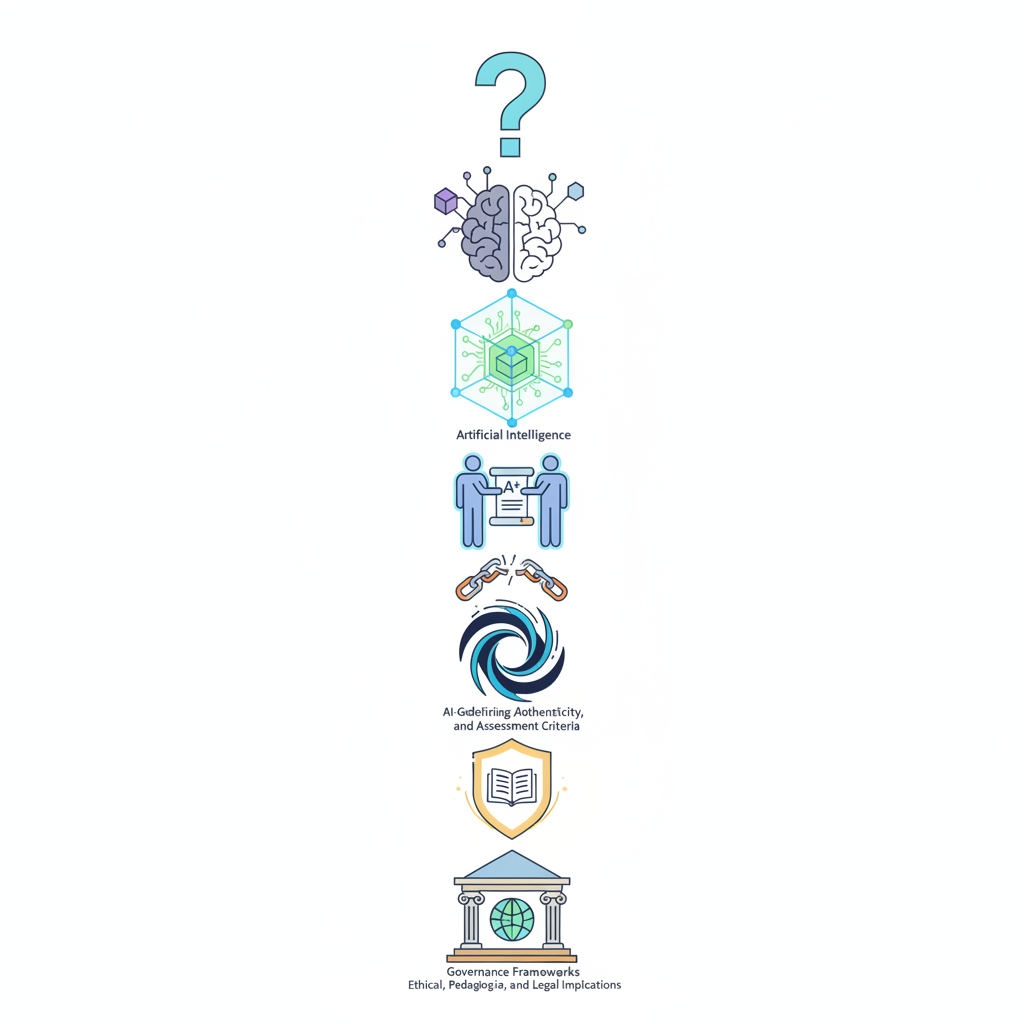
The article examines the evolving debate on whether AI-assisted academic work can be considered original learning or mere output replication, highlighting the need for institutions to redefine authenticity, ownership, and assessment criteria in educational settings. This discussion is pertinent as AI tools become ubiquitous in higher education, prompting governance frameworks to address ethical, pedagogical, and legal implications.
Background
- Artificial Intelligence (AI) has increasingly permeated educational ecosystems, transforming learning, research, and assessment methodologies in higher education institutions globally.
- Traditional academic frameworks have historically prioritised individual authorship and intellectual ownership, which are now being challenged by AI-generated content.
- The rise of generative AI tools (e.g., large language models, image generators) has blurred the lines between human creativity and machine assistance, necessitating a re-evaluation of originality standards.
- Global debates on AI ethics, including those by UNESCO and the European Union, have underscored the need for governance frameworks to address intellectual property and academic integrity in AI-assisted learning.
What is AI-Assisted Learning and its Implications for Intellectual Ownership?
- AI-assisted learning refers to the use of artificial intelligence tools to augment educational processes, including content generation, idea brainstorming, data analysis, and language refinement.
- Intellectual ownership in this context pertains to the legal and ethical recognition of authorship and originality when AI contributes to academic work, raising questions about the authenticity of student submissions.
- The core pedagogical concern is whether AI usage fosters meaningful learning or merely facilitates the replication of pre-existing knowledge without active engagement or critical thinking.
- Educational institutions are grappling with redefining assessment criteria to distinguish between AI-assisted work and plagiarised or unauthentic submissions.
- The concept of ‘meaningful learning’ in AI-assisted contexts hinges on the student’s active participation in the cognitive processes of analysis, evaluation, and synthesis, rather than passive consumption of AI-generated outputs.
- Intellectual property rights (IPR) frameworks, including copyright laws, are being tested by AI-generated content, as traditional definitions of authorship do not account for machine contributions.
- The ethical dimension involves ensuring that AI tools are used responsibly to enhance learning rather than replace it, aligning with principles of academic integrity and intellectual honesty.
- Governance mechanisms, such as institutional policies, AI ethics committees, and regulatory guidelines, are essential to address the challenges posed by AI in education while safeguarding learning integrity.
Key Features
| Feature | Significance |
|---|---|
| AI-assisted learning tools | Enhances accessibility, speed, and efficiency in knowledge acquisition and synthesis, enabling students to engage with complex concepts more effectively. |
| Student-AI interaction models | Facilitates active learning when used for brainstorming, idea generation, and structured analysis, provided the student remains the primary evaluator of output. |
| Academic integrity frameworks | Necessitates redefinition of originality, authorship, and authenticity in assessments to accommodate AI-assisted work while preserving learning outcomes. |
| Intellectual ownership norms | Raises questions about the attribution of contributions in AI-assisted work, requiring clear guidelines on responsibility and credit. |
| Institutional adaptation strategies | Demands policy revisions in evaluation methods to focus on the learning process rather than solely on the final submission. |
Why it Matters
Pedagogical
- Reinforces the distinction between rote learning and meaningful engagement, where AI serves as a catalyst rather than a substitute for cognitive processes.
- Encourages a shift from outcome-based to process-based assessment, aligning with modern educational theories like constructivism and experiential learning.
- Highlights the need for metacognitive skills—self-regulation, critical evaluation, and reflection—to ensure AI enhances rather than undermines learning.
- Promotes the development of higher-order thinking skills (analysis, synthesis, evaluation) as AI handles routine tasks, freeing cognitive resources for deeper inquiry.
Ethical
- Exposes the tension between technological advancement and academic integrity, necessitating ethical guidelines for AI use in education.
- Raises questions about the commodification of knowledge, where AI-generated content may blur the boundaries between original thought and automated output.
- Demands transparency in AI-assisted work to prevent misrepresentation of student effort and to uphold the principles of academic honesty.
- Requires institutions to balance innovation with accountability, ensuring AI tools do not erode the moral and intellectual foundations of education.
Institutional
- Forces educational bodies to rethink assessment models, moving beyond plagiarism detection to evaluate the authenticity of the learning journey.
- Necessitates faculty training in AI literacy to design assignments that leverage AI tools while preserving pedagogical objectives.
- Encourages the integration of AI ethics into curricula, fostering a culture of responsible innovation among students and educators.
- May lead to the development of new accreditation standards that account for AI-assisted learning environments.
Challenges
1. Redefinition of Authorship and Originality
- AI-assisted work complicates the attribution of intellectual contributions, challenging traditional notions of originality and authorship in academic submissions.
- Students may struggle to distinguish between their own ideas and AI-generated content, leading to unintentional plagiarism or misrepresentation.
- Institutions face the dilemma of how to assess ‘original thought’ when AI tools are integral to the creation process.
UPSC Link: GS2: Education – Policy and Governance
2. Risk of Superficial Learning
- Over-reliance on AI for content generation may reduce opportunities for students to engage in deep cognitive processing, such as analysis, synthesis, and reflection.
- Students may prioritize speed and efficiency over understanding, leading to a decline in critical thinking and problem-solving skills.
- Long-term academic outcomes may suffer if learning is outsourced to AI without active student participation.
UPSC Link: GS1: Human Development – Learning Outcomes
3. Equity and Accessibility Concerns
- AI tools may exacerbate digital divides, where students with access to advanced AI resources gain an unfair advantage over those without.
- Institutions in resource-constrained settings may struggle to provide equitable access to AI-assisted learning tools, widening existing educational inequalities.
- The cost of AI tools and training could create barriers for students from marginalized backgrounds.
UPSC Link: GS2: Education – Inclusive Development
4. Ethical and Legal Ambiguities
- The legal framework governing intellectual property and ownership of AI-generated content remains unclear, posing risks for students and institutions.
- AI tools trained on copyrighted material may inadvertently expose users to legal liabilities related to plagiarism or data misuse.
- Institutions must navigate complex ethical dilemmas, such as whether AI-generated content can be cited or referenced in academic work.
UPSC Link: GS2: Governance – Legal Frameworks
5. Faculty Adaptation and Training
- Educators may lack the training or resources to effectively integrate AI tools into pedagogy while maintaining academic rigor.
- Resistance to change among faculty could hinder the adoption of AI-assisted learning models, particularly in traditional institutions.
- Institutions must invest in continuous professional development to ensure faculty can leverage AI tools responsibly.
UPSC Link: GS2: Education – Teacher Training
Challenges — UPSC Perspective
| Issue | Concern |
|---|---|
| Authorship ambiguity | Difficulty in distinguishing between student-generated and AI-generated content in academic submissions. |
| Superficial engagement | Risk of reduced cognitive processing due to over-reliance on AI for content creation. |
| Digital divide | Unequal access to AI tools exacerbating educational inequalities among students. |
| Legal risks | Unclear intellectual property rights and potential liabilities for AI-assisted work. |
| Faculty preparedness | Lack of training among educators to effectively integrate AI into teaching and assessment. |
| Assessment validity | Challenges in designing assessments that accurately measure learning in AI-assisted environments. |
Way Forward
- Develop institutional policies that clearly define the permissible and impermissible uses of AI in academic work, balancing innovation with integrity.
- Integrate AI literacy into school and university curricula, teaching students to use AI tools responsibly and critically.
- Revise assessment frameworks to focus on the learning process—such as drafts, reflections, and iterative improvements—rather than solely on final submissions.
- Invest in faculty training programs to equip educators with the skills to design AI-integrated assignments and evaluate student work fairly.
- Establish ethics committees in educational institutions to address emerging dilemmas related to AI use in academia.
- Promote open-source AI tools and subsidized access programs to mitigate digital divides in AI-assisted learning.
- Encourage collaborative research between educators and technologists to develop AI tools that enhance, rather than replace, human learning.
- Conduct periodic reviews of AI policies in education to adapt to technological advancements and evolving ethical standards.
UPSC Value Addition
Keywords for Mains Answer-Writing
Artificial Intelligence in Education · Academic Integrity · Intellectual Property Rights in AI-generated Content · Bloom’s Taxonomy of Learning · Constructivist Learning Theory · Assessment Reforms in Higher Education · AI and Student Agency · Ethics of AI in Academia · Originality and Authorship in AI-assisted Work · Cognitive Load Theory and AI Tools
Concept Flow
AI tools become integral to academic work → Questions arise about the ownership of AI-assisted content → Institutions grapple with redefining authorship and originality → Students face risks of superficial learning due to over-reliance on AI → Faculty adaptation becomes critical to maintain pedagogical rigor → Policy reforms are introduced to balance innovation with academic integrity → Ethical and legal frameworks evolve to address emerging challenges → A new model of AI-integrated education emerges, prioritizing meaningful learning over mere output.
Prelims Practice Questions
Q1. Consider the following statements regarding the use of Artificial Intelligence (AI) in higher education:
1. AI tools can assist students in brainstorming ideas and improving the structure of academic work.
2. Relying solely on AI outputs without reflection may reduce opportunities for deeper learning.
3. AI-generated academic work is universally recognised as the intellectual property of the student.
4. Educational institutions are increasingly evaluating students based on their final submissions alone.
How many of the above statements are correct?
- Only one
- Only two
- Only three
- All
Answer: Only three — Statements 1 and 2 are correct as they align with the discussion on responsible AI use in education. Statement 3 is incorrect because intellectual property ownership of AI-assisted work remains a debated issue. Statement 4 is incorrect as institutions are reconsidering assessment methods to focus on the learning process rather than final submissions.
Q2. Assertion (A): The increasing use of AI in academic work necessitates a re-evaluation of traditional assessment methods.
Reason (R): AI tools can generate accurate and well-structured content, which may not reflect the student’s genuine learning or intellectual contribution.
- Both A and R are true, and R is the correct explanation of A
- Both A and R are true, but R is not the correct explanation of A
- A is true, but R is false
- A is false, but R is true
Answer: Both A and R are true, and R is the correct explanation of A — Both the assertion and reason are true. The assertion highlights the need for revised assessment methods due to AI’s role in academic work. The reason correctly explains why such re-evaluation is necessary—AI-generated content may not reflect authentic learning.
Q3. Match the following concepts related to AI in education with their correct descriptions:
| Column I (Concept) | Column II (Description) |
|———————————-|————————————————————-|
| 1. Constructivist Learning Theory| A. A framework that categorises learning into cognitive, affective, and psychomotor domains.|
| 2. Bloom’s Taxonomy | B. A learning theory that emphasises active engagement and knowledge construction by learners.|
| 3. Cognitive Load Theory | C. A theory that explains how the human brain processes and retains information, particularly in learning contexts.|
| 4. Intellectual Property Rights | D. Legal rights that protect creations of the mind, including AI-assisted academic work.
- 1-B, 2-A, 3-C, 4-D
- 1-A, 2-B, 3-C, 4-D
- 1-C, 2-A, 3-B, 4-D
- 1-D, 2-C, 3-A, 4-B
Answer: 1-B, 2-A, 3-C, 4-D — 1-B: Constructivist Learning Theory emphasises active engagement and knowledge construction. 2-A: Bloom’s Taxonomy categorises learning into cognitive, affective, and psychomotor domains. 3-C: Cognitive Load Theory explains how the brain processes information during learning. 4-D: Intellectual Property Rights protect creations of the mind, including AI-assisted work.
Mains Practice Question
✍ The integration of Artificial Intelligence (AI) in higher education challenges traditional notions of learning, authorship, and assessment. Critically examine the implications of AI-assisted academic work for student learning and the future of educational assessment. (15 Marks)
Approach: MODEL-ANSWER SKELETON:
1. **Introduction**: Define AI in education and its growing role in academic tasks (e.g., idea generation, content creation, problem-solving).
2. **Impact on Learning**:
– **Positive**: AI as a tool for scaffolding learning (Vygotsky’s Zone of Proximal Development), reducing cognitive load (Cognitive Load Theory), and enhancing accessibility.
– **Negative**: Over-reliance on AI may lead to superficial learning, reduced critical thinking, and diminished intellectual ownership (Bloom’s Taxonomy levels: analysis, evaluation, and creation vs. mere recall).
3. **Authorship and Intellectual Property**:
– Discuss the ambiguity in ownership of AI-generated content (e.g., whether the student, AI developer, or institution holds rights).
– Reference existing legal frameworks (e.g., Copyright Act, 1957; WIPO’s stance on AI-generated works).
4. **Assessment Reforms**:
– Shift from product-based to process-based evaluation (e.g., evaluating the student’s journey: research, reflection, and decision-making).
– Role of formative assessments, viva voce, and project-based learning to ensure authentic contributions.
5. **Ethical and Pedagogical Considerations**:
– Need for institutional policies on AI use (e.g., disclosure of AI assistance in submissions).
– Balancing innovation with academic integrity (e.g., UGC’s guidelines on plagiarism and AI tools).
6. **Conclusion**: Argue for a balanced approach where AI is a tool for augmentation, not replacement, of human learning. Emphasise the role of educators in fostering critical engagement with AI outputs.
Source: The Hindu
Generated by AanyaAi for educational purpose.
Related guides on our sites
- How to prepare for GS paper 1 for UPSC CSE mains exam
- Best UPSC coaching for IFOS exam
- Best mentorship programme for upsc
- UPSC+BA degree

- यूक्रेन का रोबोट सेना अभियान: युद्ध में मानव हानि कम करने की रणनीति - September 27, 2026
- Ukraine’s ‘Army of Robots’: A Game-Changer for UPSC Mains 2026 Polity & Governance - September 27, 2026
- रूस ने भारत-ब्राजील को दिया UNSC स्थायी सदस्यता का समर्थन, जर्मनी-जापान विरोध में - September 27, 2026

No Comments