


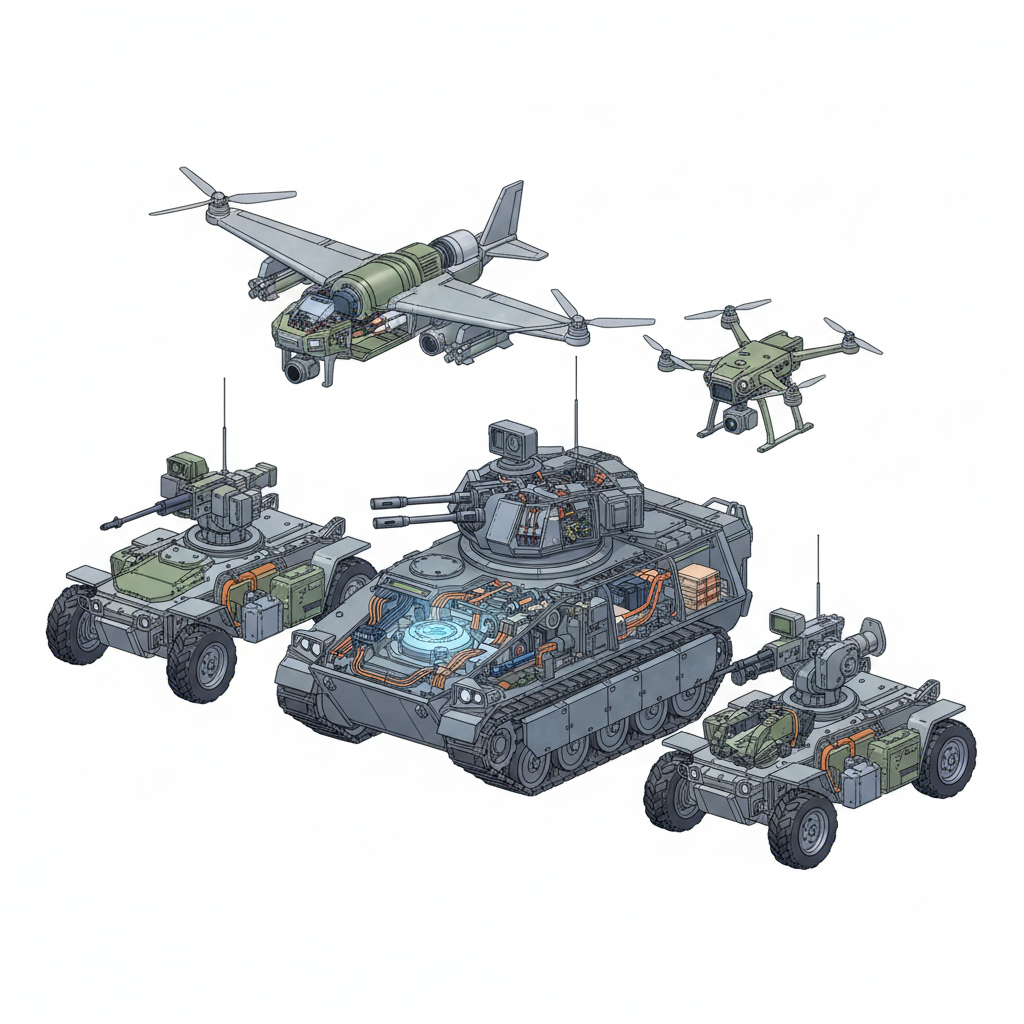
27 Sep Ukraine’s ‘Army of Robots’: A Game-Changer for UPSC Mains 2026 Polity & Governance
✎ Autonomous military systems, such as Ukraine’s ‘Army of Robots’, are transforming warfare by reducing human casualties in high-risk missions through the deployment of unmanned ground vehicles and robotic platforms integrated with…
Subject Relevance — Where This Topic Fits
- GS Paper III — Science and Technology — Developments and their Applications and Effects in Everyday Life | GS Paper III — Internal Security — Challenges related to Terrorism and Insurgency | GS Paper III — Security — Role of External State and Non-State Actors in Creating Internal Security Challenges | GS Paper II — International Relations — Bilateral, Regional and Global Groupings and Agreements involving India and/or affecting India’s interests
- Prelims: Unmanned Ground Vehicles (UGVs), Autonomous Systems, Drones, Artificial Intelligence in Defence, Ministry of Defence (India), Defence Research and Development Organisation (DRDO), Integrated Guided Missile Development Programme (IGMDP), Defence Procurement Procedure (DPP), Remote Sensing, Electronic Warfare
- Essay: The role of technology in shaping national security paradigms, Ethics of autonomous warfare: balancing human agency and machine autonomy
Quick Revision: Autonomous military systems, such as Ukraine’s ‘Army of Robots’, are transforming warfare by reducing human casualties in high-risk missions through the deployment of unmanned ground vehicles and robotic platforms integrated with AI and sensor technologies.
Why is this in the news?
The deployment of unmanned ground vehicles (UGVs) and robotic systems by Ukraine in large-scale military operations underscores a paradigm shift in modern warfare, where autonomous systems are increasingly tasked with high-risk missions such as logistics, evacuation, and combat support. This development highlights the strategic imperative of reducing human casualties while enhancing operational efficiency, and raises critical questions about the future of autonomous warfare, its ethical implications, and the technological capabilities required to sustain such systems in prolonged conflicts.
Background
- The use of unmanned systems in warfare has evolved significantly since the early 21st century, with drones becoming integral to military operations during conflicts such as those in Afghanistan, Iraq, and Syria.
- Ukraine’s adoption of unmanned aerial vehicles (UAVs), particularly during the ongoing conflict with Russia, demonstrated the strategic value of autonomous systems in reconnaissance, surveillance, and precision strikes.
- The increasing lethality of modern battlefields, characterised by precision-guided munitions, electronic warfare, and cyber threats, has necessitated the deployment of systems that can operate in high-risk environments without exposing human personnel.
- The integration of artificial intelligence (AI) and machine learning in military applications has enabled the development of autonomous platforms capable of performing complex tasks such as navigation, target identification, and adaptive decision-making.
- International frameworks, such as the United Nations Convention on Certain Conventional Weapons (CCW), are grappling with the ethical and legal implications of autonomous weapons systems, including accountability and compliance with international humanitarian law.
What is the ‘Army of Robots’ Initiative?
- A defence-tech ecosystem launched by Ukraine to accelerate the development, testing, and deployment of robotic systems for military use, expanding unmanned warfare from aerial to ground domains.
- The initiative builds on the ‘Army of Drones’ programme, which successfully integrated UAVs into Ukraine’s military strategy, particularly for reconnaissance and strike missions.
- The programme focuses on the deployment of unmanned ground vehicles (UGVs) for high-risk tasks such as logistics, ammunition delivery, casualty evacuation, mine clearance, and defensive operations.
- Humanoid robots are being developed to perform basic battlefield tasks, including reconnaissance, logistics support, and combat operations, in coordination with aerial drones.
- The initiative aims to minimise human exposure to danger by utilising robots in areas where deploying soldiers would carry significant risk, thereby enhancing survivability and operational effectiveness.
- Ukraine’s Defence Procurement Agency reported the contracting of over 22,000 UGVs in 2026 by July, nearly double the number procured in 2025, indicating rapid scaling of autonomous systems in military operations.
- The programme includes the development of platforms for engineering tasks such as laying and clearing mines, as well as reconnaissance-strike missions, integrating robotic systems into all phases of military operations.
- The initiative reflects a broader trend in modern militaries towards the adoption of autonomous systems, driven by advancements in AI, robotics, and sensor technologies.
Key Features
| Feature | Significance |
|---|---|
| Unmanned Ground Vehicles (UGVs) | Enable logistics, evacuation, and combat support without direct human exposure to high-risk zones, reducing casualties while maintaining operational continuity. |
| Humanoid Robots | Designed for basic battlefield tasks such as reconnaissance, mine clearance, and casualty evacuation, enhancing flexibility in dynamic combat environments. |
| Autonomous Mine-Laying and Clearance Systems | Reduce human risk in explosive ordnance disposal and facilitate rapid battlefield adaptation to changing tactical requirements. |
| Reconnaissance-Strike Integration | UGVs and drones operate in tandem to provide real-time intelligence, target acquisition, and precision strikes, improving battlefield awareness and lethality. |
| Defense-Tech Ecosystem | A structured framework for development, testing, and deployment of robotic systems, fostering indigenous innovation and reducing reliance on external military hardware. |
Why it Matters
Military Strategy and Doctrine
- Shifts the operational paradigm from human-centric warfare to a hybrid model combining manned and unmanned assets, aligning with modern military doctrines emphasizing force protection and precision engagement.
- Enhances the survivability of frontline troops by delegating high-risk missions—such as ammunition delivery, casualty evacuation, and mine clearance—to robotic platforms, thereby preserving combat strength.
- Facilitates rapid adaptation to evolving battlefield conditions, including contested logistics routes and contested airspace, through modular and scalable robotic deployments.
Technological and Industrial Impact
- Accelerates the development of indigenous defense technologies, reducing dependence on foreign military hardware and fostering self-reliance in critical defense sectors (Atmanirbhar Bharat in defense context).
- Stimulates investment in robotics, artificial intelligence, and autonomous systems, creating a new industrial vertical within the defense manufacturing ecosystem.
- Promotes collaboration between defense research institutions, private sector entities, and academia to develop dual-use technologies with civilian and military applications.
Operational Logistics and Force Multiplication
- Improves the efficiency of logistics chains by enabling 24/7 supply operations in high-risk areas, reducing delays and ensuring sustained combat readiness.
- Enhances the speed and precision of casualty evacuation, potentially reducing mortality rates among wounded personnel through timely medical intervention.
- Expands the operational reach of small units by deploying robotic assets for reconnaissance and strike missions, thereby increasing the effective combat power of deployed forces.
Ethical and Legal Considerations
- Raises questions regarding the delegation of lethal force to autonomous systems, necessitating clear legal frameworks and ethical guidelines to govern their deployment.
- Requires robust command-and-control protocols to ensure accountability and prevent unintended escalation in conflict scenarios involving robotic platforms.
Challenges
1. Technological Limitations and Reliability
- Autonomous systems remain vulnerable to electronic warfare, cyber-attacks, and environmental disruptions (e.g., terrain complexity, weather conditions), which can impair functionality.
- The integration of AI-driven decision-making in combat scenarios raises concerns about unpredictability and the potential for unintended consequences in dynamic environments.
UPSC Link: GS3: Science & Tech
2. Operational and Tactical Constraints
- Robotic platforms may lack the adaptability of human soldiers in complex, unstructured combat environments, particularly in urban or densely vegetated terrains.
- Dependence on robotic systems for critical missions introduces single points of failure; mechanical breakdowns or power depletion can compromise mission success.
UPSC Link: GS3: Security
3. Ethical and Legal Dilemmas
- The use of autonomous systems in lethal operations challenges existing international humanitarian law (IHL) frameworks, particularly regarding proportionality and distinction in targeting.
- The lack of global consensus on the regulation of autonomous weapons systems (AWS) creates risks of misalignment with international norms and potential diplomatic friction.
UPSC Link: GS2: International Relations
4. Economic and Human Resource Challenges
- High initial capital and maintenance costs for robotic systems may strain defense budgets, particularly for developing nations seeking to adopt similar capabilities.
- The shift toward automation could reduce demand for certain military roles, necessitating reskilling and redeployment of personnel within defense establishments.
UPSC Link: GS3: Economy
5. Cybersecurity and Electronic Warfare Threats
- Robotic platforms are susceptible to hacking, spoofing, or jamming of their communication links, which could lead to loss of control or misdirection of assets.
- The proliferation of autonomous systems may incentivize adversaries to develop countermeasures, leading to an arms race in electronic warfare capabilities.
UPSC Link: GS3: Security
6. Public Perception and Societal Impact
- The deployment of robotic systems in warfare may evoke public concerns regarding the dehumanization of conflict and the potential for reduced accountability in lethal operations.
- Media portrayal of autonomous warfare could influence global public opinion, shaping international discourse on the acceptability of such technologies.
UPSC Link: GS4: Ethics
Challenges — UPSC Perspective
| Issue | Concern |
|---|---|
| Autonomy in Lethal Decisions | Risk of unintended escalation due to AI-driven decision-making in combat scenarios without human oversight. |
| Cyber Vulnerabilities | Exposure to hacking, jamming, or spoofing of robotic systems, compromising mission integrity. |
| Logistical Dependence | Over-reliance on robotic platforms for critical missions may lead to operational paralysis in case of system failures. |
| Ethical Accountability Gaps | Lack of clear legal frameworks to assign responsibility for actions taken by autonomous systems. |
| Cost and Scalability | High development and deployment costs may limit equitable access to robotic warfare capabilities across military units. |
| Environmental Limitations | Terrain complexity, weather conditions, and electromagnetic interference may degrade robotic performance. |
Way Forward
- Establish a multi-stakeholder task force comprising defense experts, technologists, and legal scholars to draft national guidelines for the ethical deployment of autonomous systems in warfare.
- Invest in indigenous research and development of robotic platforms, focusing on modularity, redundancy, and resilience to electronic warfare threats.
- Develop standardized protocols for the integration of robotic systems with existing military command-and-control structures to ensure interoperability and operational coherence.
- Enhance cybersecurity frameworks for defense networks to protect robotic assets from hacking, jamming, and data breaches, including real-time monitoring and response mechanisms.
- Promote international collaboration on the regulation of autonomous weapons systems to align national policies with global norms and prevent an unchecked arms race.
- Conduct regular joint military exercises to evaluate the performance of robotic platforms in simulated combat environments, identifying strengths and addressing limitations.
- Implement a phased deployment strategy for robotic systems, starting with non-lethal roles (e.g., logistics, reconnaissance) before expanding to combat applications.
- Strengthen public diplomacy efforts to address societal concerns and foster transparency regarding the use of robotic systems in defense operations.
UPSC Value Addition
Keywords for Mains Answer-Writing
Unmanned Ground Vehicles (UGVs) · autonomous warfare systems · military robotics · defence technology · Artificial Intelligence in warfare · casualty evacuation systems · logistics automation in military · unmanned combat systems · defence procurement reforms · battlefield automation · human-machine teaming in defence · defence innovation ecosystem
Concept Flow
Escalation of conventional warfare → Increased human casualties in high-risk missions → Recognition of the need for force protection and operational efficiency → Development of unmanned ground vehicles (UGVs) and robotic systems → Integration of robotic platforms into military doctrine → Expansion of autonomous capabilities to include reconnaissance, logistics, and combat support → Establishment of a defense-tech ecosystem for indigenous innovation → Addressing ethical, legal, and technological challenges → Formulation of national and international regulatory frameworks.
Prelims Practice Questions
Q1. Consider the following statements regarding Unmanned Ground Vehicles (UGVs) in modern warfare:
1. UGVs are primarily used for aerial reconnaissance and strike missions.
2. UGVs can be deployed for logistics, ammunition delivery, and casualty evacuation.
3. UGVs reduce the exposure of human soldiers to high-risk battlefield zones.
4. The deployment of UGVs is governed by the Geneva Conventions and the Additional Protocols.
How many of the above statements are correct?
- Only one
- Only two
- Only three
- All four
Answer: Only three — Statements 2 and 3 are correct as UGVs are used for logistics, ammunition delivery, and casualty evacuation while reducing human exposure to danger. Statements 1 and 4 are incorrect as UGVs operate on ground, not air, and their deployment is not explicitly governed by the Geneva Conventions.
Q2. Assertion (A): The integration of Artificial Intelligence (AI) in military robotics enhances operational efficiency by enabling autonomous decision-making on the battlefield.
Reason (R): AI-driven systems can process vast amounts of data in real-time, reducing human error and improving response times in dynamic combat environments.
Options:
A. Both A and R are true, and R is the correct explanation of A.
B. Both A and R are true, but R is NOT the correct explanation of A.
C. A is true, but R is false.
D. A is false, but R is true.
Answer: ? — Both Assertion (A) and Reason (R) are true. AI integration in military robotics does enhance operational efficiency through autonomous decision-making. Reason (R) correctly explains how AI processes real-time data to reduce human error and improve response times.
Q3. Match the following military robotic systems with their primary functions:
Column I (System Type) Column II (Primary Function)
1. Unmanned Ground Vehicle (UGV) A. Aerial reconnaissance and strike
2. Unmanned Aerial Vehicle (UAV) B. Ground-based logistics and evacuation
3. Unmanned Surface Vehicle (USV) C. Maritime surveillance and mine countermeasures
4. Unmanned Underwater Vehicle (UUV) D. Underwater surveillance and reconnaissance
Options:
A. 1-B, 2-A, 3-C, 4-D
B. 1-A, 2-B, 3-C, 4-D
C. 1-D, 2-A, 3-B, 4-C
D. 1-C, 2-B, 3-A, 4-D
- A
- B
- C
- D
Answer: A — The correct matching is: 1-B (UGV for ground-based logistics and evacuation), 2-A (UAV for aerial reconnaissance and strike), 3-C (USV for maritime surveillance and mine countermeasures), and 4-D (UUV for underwater surveillance and reconnaissance).
Mains Practice Question
✍ The integration of autonomous robotic systems in warfare represents a transformative shift in military strategy, reducing human casualties while enhancing operational capabilities. Critically examine the implications of such technological advancements for modern defence doctrines, with particular reference to India’s preparedness in leveraging unmanned systems. (15 Marks)
Approach: MODEL-ANSWER SKELETON:
1. **Introduction (2 marks)**: Define autonomous robotic systems in warfare and their categorisation (UGVs, UAVs, USVs, UUVs). Highlight the global trend towards battlefield automation, citing Ukraine’s ‘Army of Robots’ initiative as a contemporary example.
2. **Operational Advantages (3 marks)**:
– Reduction in human casualties and exposure to high-risk zones.
– Enhanced logistics (ammunition delivery, casualty evacuation, supply chain automation).
– Real-time data processing and autonomous decision-making through AI.
– Increased operational flexibility and persistence in contested environments.
– Cost-effectiveness in long-term deployment compared to human-centric operations.
3. **Strategic and Ethical Implications (4 marks)**:
– **Strategic**: Shift from attrition-based warfare to precision and efficiency; potential for asymmetric advantage; integration with existing command-and-control structures.
– **Ethical**: Compliance with International Humanitarian Law (IHL) and the Geneva Conventions; accountability for autonomous systems’ actions; risks of unintended escalation.
– **Doctrinal**: Need for revised military doctrines to incorporate human-machine teaming; training and doctrinal gaps in handling autonomous systems.
– **Geopolitical**: Arms race dynamics and proliferation risks; export controls and ethical governance frameworks (e.g., Campaign to Stop Killer Robots).
4. **India’s Preparedness (3 marks)**:
– **Institutional Framework**: Role of DRDO (Defence Research and Development Organisation) in developing indigenous UGVs and UAVs (e.g., DRDO’s ‘Nag’ and ‘Rustom’ programmes).
– **Policy Initiatives**: Defence Procurement Procedure (DPP) 2020’s emphasis on ‘Make in India’ and indigenous defence production; establishment of Defence Innovation Organisation (DIO).
– **Challenges**: Technological gaps in AI/ML integration; limited indigenous production of high-end robotic systems; reliance on foreign technology; need for robust testing and certification frameworks.
– **Opportunities**: Leveraging start-up ecosystems (e.g., DRDO’s iDEX programme); collaboration with allied nations for technology transfer; focus on niche areas like mine clearance and logistics.
5. **Conclusion (3 marks)**:
– Autonomous robotic systems are inevitable in future warfare but require a balanced approach integrating technological advancement with ethical, legal, and strategic considerations.
– India must prioritise indigenous development, robust governance frameworks, and international cooperation to harness this transformation while mitigating risks.
– Emphasise the need for a ‘human-in-the-loop’ approach to ensure accountability and compliance with IHL.
Source: Times of India
Generated by AanyaAi for educational purpose.
Related guides on our sites
- Best PSIR optional coaching for upsc
- Best PSIR optional teacher for upsc
- Best teacher of PSIR optional for upsc
- Best PSIR optional coaching in delhi for UPSC

- यूक्रेन का रोबोट सेना अभियान: युद्ध में मानव हानि कम करने की रणनीति - September 27, 2026
- Ukraine’s ‘Army of Robots’: A Game-Changer for UPSC Mains 2026 Polity & Governance - September 27, 2026
- रूस ने भारत-ब्राजील को दिया UNSC स्थायी सदस्यता का समर्थन, जर्मनी-जापान विरोध में - September 27, 2026

No Comments