


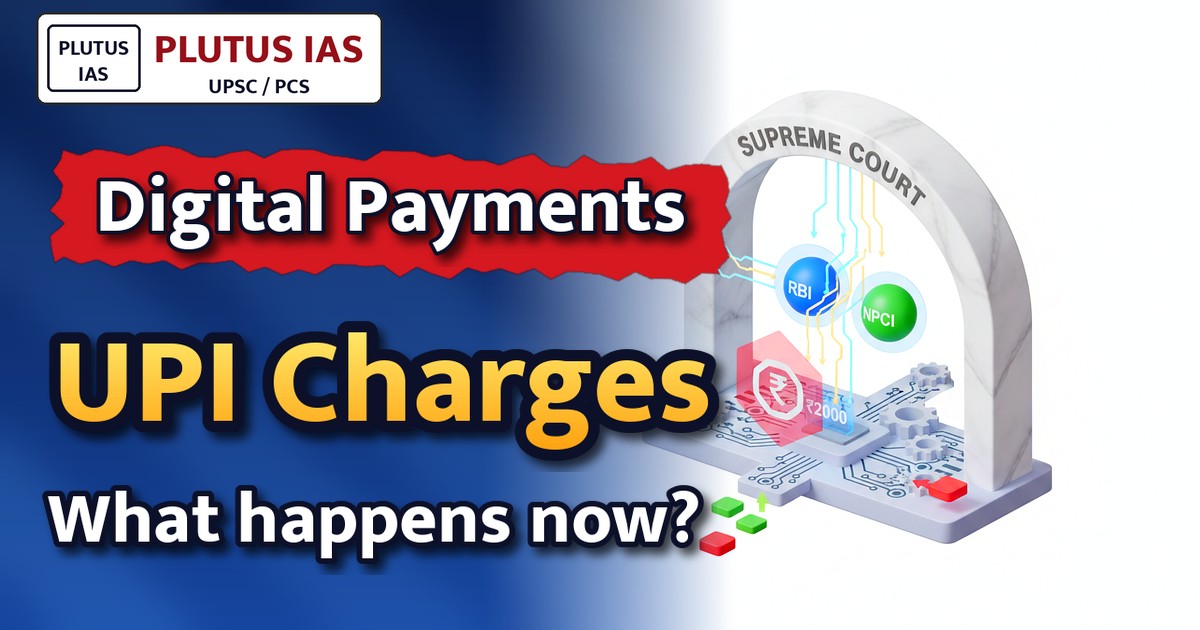
28 Sep Supreme Court Questions UPI Charges: Will MDR on UPI Payments Be Halted?
✎ The Supreme Court’s notice to RBI and NPCI on UPI MDR challenges the proportionality of a 0.4% fee on transactions above ₹2,000, raising questions about its impact on digital payment inclusivity and the legal basis for its…
Subject Relevance — Where This Topic Fits
- GS Paper III — Indian Economy: Digital Payments, Financial Inclusion, and Regulatory Frameworks | GS Paper II — Judiciary and Constitutional Governance: Judicial Review of Economic Policies
- Prelims: UPI, NPCI, MDR, Digital Payment Ecosystem, Financial Inclusion, RBI Guidelines, Supreme Court Jurisdiction, Payment Aggregators, Merchant Discount Rate
- Essay: The Interplay of Technology, Regulation, and Public Welfare: Case Study of UPI and MDR, Judicial Activism in Economic Governance: Balancing Innovation and Consumer Protection
Quick Revision: The Supreme Court’s notice to RBI and NPCI on UPI MDR challenges the proportionality of a 0.4% fee on transactions above ₹2,000, raising questions about its impact on digital payment inclusivity and the legal basis for its imposition within the UPI ecosystem.
Why is this in the news?
The Supreme Court of India, on 28 September 2026, issued a notice to the Reserve Bank of India (RBI) and the National Payments Corporation of India (NPCI) in response to a public interest litigation challenging the imposition of Merchant Discount Rate (MDR) on select UPI merchant transactions exceeding ₹2,000. The petition seeks judicial review of the newly notified MDR framework, scheduled to take effect from 15 October 2026, on grounds of its potential impact on digital payment accessibility, consumer welfare, and the integrity of the UPI ecosystem. The Court has sought responses from the Union Government, RBI, and NPCI within four weeks, while deferring any interim stay on the framework’s implementation.
Background
- The UPI ecosystem, launched in 2016 by NPCI under RBI’s regulatory oversight, has revolutionised digital payments in India, enabling over 120 billion transactions annually with near-zero cost to end-users for Person-to-Person (P2P) transfers.
- The RBI and NPCI notified a revised MDR framework for Person-to-Merchant (P2M) UPI transactions, introducing a 0.4% charge on transactions above ₹2,000, capped at ₹300 for transactions exceeding ₹75,000, effective from 15 October 2026.
- The MDR framework is distinct from a tax; it is a fee levied within the payment ecosystem and distributed among stakeholders including banks, payment service providers, and NPCI, aimed at sustaining infrastructure, security, and innovation.
- The Union Government has asserted that 96% of P2M UPI transactions will remain unaffected, as they fall below the ₹2,000 threshold or are exempt under the zero-MDR regime for small merchants.
- The petition challenges the necessity and proportionality of the MDR framework, arguing that it may disproportionately burden small merchants and undermine the affordability and inclusivity of digital payments.
What is the Merchant Discount Rate (MDR) in the UPI Ecosystem?
- MDR is a transaction fee levied on merchants by payment service providers for facilitating digital payments, including UPI transactions, and is distinct from taxes or government levies.
- In the UPI framework, MDR is not charged directly to consumers but is embedded within the payment ecosystem and distributed among banks, payment app providers, and NPCI to cover operational costs, security, and innovation.
- The revised MDR framework introduces a 0.4% charge on UPI P2M transactions exceeding ₹2,000, with a cap of ₹300 for transactions above ₹75,000, effective from 15 October 2026.
- The framework exempts P2P UPI transactions entirely, as well as P2M transactions below ₹2,000 and those involving small merchants under the zero-MDR regime, ensuring minimal disruption to low-value transactions.
- The Union Government has clarified that MDR is not a government tax and will not be collected by RBI or NPCI; instead, it will be retained within the payment ecosystem to fund infrastructure upgrades, security enhancements, and innovation.
- The MDR framework is part of a broader effort to ensure the financial viability of the UPI ecosystem, which has become the backbone of India’s digital payment infrastructure, processing over 120 billion transactions annually.
Key Features
| Feature | Significance |
|---|---|
| MDR (Merchant Discount Rate) on UPI transactions above ₹2,000 | Introduces a capped fee (0.4% or ₹300 max) on select merchant transactions to fund UPI ecosystem sustainability and innovation. |
| Exclusion of P2P and small merchant transactions (≤₹2,000) | Ensures 96% of person-to-merchant (P2M) transactions remain free, protecting retail consumers and small businesses. |
| Sector-specific flat MDR (₹5) for essential services | Applies to sectors like rail, telecom, insurance, fuel, and agriculture inputs to balance affordability and ecosystem viability. |
| Prohibition of MDR burden on end-users | Government directive ensures banks and payment apps absorb MDR costs without passing them to customers. |
| Legal challenge via Supreme Court petition | Questions the necessity of MDR imposition and seeks judicial review of its technical and policy rationale. |
Why it Matters
Economic
- Balances consumer affordability with the need to sustain UPI’s infrastructure, security, and innovation through a targeted revenue model.
- Aims to prevent over-reliance on public subsidies for digital payment ecosystems while ensuring equitable cost distribution among stakeholders.
- Potential to enhance financial inclusion by maintaining low-cost access to digital payments for marginalised users.
Strategic
- Supports India’s digital public infrastructure (DPI) vision by ensuring the viability of UPI, a globally recognised payment system.
- Strengthens the resilience of the payments ecosystem against cyber threats and operational disruptions through funded upgrades.
- Aligns with the G20’s focus on inclusive digital public infrastructure, positioning India as a leader in scalable fintech solutions.
Legal & Governance
- Highlights the role of judicial oversight in reviewing executive decisions impacting digital governance and public welfare.
- Demonstrates the interplay between regulatory bodies (RBI, NPCI) and the judiciary in shaping policy implementation.
- Raises questions on the transparency and necessity of MDR imposition, reinforcing accountability in policy formulation.
Challenges
1. Implementation Complexity
- Ensuring MDR costs are not passed to consumers requires strict enforcement by RBI and NPCI, given the decentralised nature of UPI transactions.
- Sector-specific exemptions (e.g., agriculture inputs) may create administrative bottlenecks and compliance challenges for businesses.
- Risk of unintended exclusion of small merchants if MDR thresholds are not calibrated to local economic realities.
UPSC Link: GS3: Digital Payments & Financial Inclusion
2. Consumer Protection & Trust
- Perception of hidden charges could erode trust in UPI, despite government assurances of no direct burden on users.
- Potential for payment apps to introduce alternative fee structures (e.g., platform fees) to circumvent MDR restrictions.
- Need for robust grievance redressal mechanisms to address disputes arising from MDR-related discrepancies.
UPSC Link: GS3: Consumer Rights & Digital Economy
3. Policy Coherence & Judicial Scrutiny
- Supreme Court’s intervention underscores the need for evidence-based policymaking to justify MDR imposition.
- Risk of policy paralysis if judicial stays or modifications delay the implementation of critical digital infrastructure upgrades.
- Challenge of balancing innovation incentives with affordability, especially for emerging fintech models.
UPSC Link: GS2: Judiciary & Policy Implementation
Challenges — UPSC Perspective
| Issue | Concern |
|---|---|
| Enforcement of MDR absorption by banks/apps | Risk of circumvention through hidden charges or reduced service quality. |
| Sector-specific MDR exemptions | Administrative complexity in verifying eligibility and preventing misuse. |
| Judicial review of MDR necessity | Potential delays in implementation or policy revisions based on court directives. |
| Consumer awareness and perception | Misinterpretation of MDR as a direct tax could undermine UPI adoption. |
| Cybersecurity funding sustainability | MDR’s role in financing security upgrades must align with evolving threat landscapes. |
Way Forward
- RBI and NPCI must issue detailed guidelines to banks and payment apps on MDR absorption mechanisms, with penalties for non-compliance.
- Conduct stakeholder consultations with merchant associations, fintech firms, and consumer groups to refine MDR thresholds and exemptions.
- Publish quarterly reports on MDR revenue utilisation for ecosystem upgrades, ensuring transparency and accountability.
- Strengthen digital literacy campaigns to educate users on MDR’s indirect benefits and prevent misinformation.
- Develop a grievance redressal portal for MDR-related disputes, integrating with the RBI’s Integrated Ombudsman Scheme.
- Explore dynamic MDR calibration based on transaction volumes or seasonal demand to balance affordability and sustainability.
- Ensure alignment with global fintech standards (e.g., ISO 20022) to future-proof UPI’s interoperability and security.
UPSC Value Addition
Keywords for Mains Answer-Writing
Digital Payment Ecosystem · Unified Payments Interface (UPI) · Merchant Discount Rate (MDR) · Supreme Court of India · Reserve Bank of India (RBI) · National Payments Corporation of India (NPCI) · Payment Aggregators · Financial Inclusion · Digital Public Infrastructure · Regulatory Governance · Economic Policy · Judicial Review of Policy · Fintech Innovation · Consumer Protection in Digital Payments
Constitutional & Policy Linkages
- [‘Article 286: Restrictions on taxing interstate trade (relevance to MDR as a fee, not a tax)’, ‘Examines the constitutional limits on levying fees on digital transactions.’]
Concept Flow
Digital Payment Ecosystem Growth → Need for Sustainable Funding → Government Proposes MDR → Legal Challenge via Supreme Court → Judicial Review of Necessity → Policy Refinement → Implementation with Safeguards → Enhanced Consumer Trust & Ecosystem Resilience
Prelims Practice Questions
Q1. Consider the following statements regarding the Unified Payments Interface (UPI) and the Merchant Discount Rate (MDR):
1. UPI transactions above ₹2,000 are subject to a 0.4% MDR as per the new framework notified by the RBI.
2. The MDR is a tax levied by the Government of India on UPI transactions.
3. The MDR is distributed among banks, payment app providers, and other stakeholders in the payment ecosystem.
4. Person-to-person (P2P) UPI transactions are exempt from MDR charges.
How many of the above statements are correct?
- Only one
- Only two
- Only three
- All
Answer: All — Statements 1, 3, and 4 are correct. Statement 2 is incorrect because MDR is not a tax levied by the government but a fee distributed among ecosystem participants.
Q2. Assertion (A): The Supreme Court of India has the power to stay the implementation of a regulatory policy pending judicial review.
Reason (R): The Supreme Court can issue notices to government agencies and regulatory bodies to seek their response on policy matters under Article 32 of the Constitution.
Options:
A. Both A and R are true, and R is the correct explanation of A.
B. Both A and R are true, but R is NOT the correct explanation of A.
C. A is true, but R is false.
D. A is false, but R is true.
Answer: ? — Both the assertion and reason are correct. The Supreme Court can issue notices and stay policies under Article 32, and the reason correctly explains the assertion.
Q3. Match the following columns related to digital payment systems in India:
Column I (Institution/Body)
1. Reserve Bank of India (RBI)
2. National Payments Corporation of India (NPCI)
3. Payment Aggregators
4. Supreme Court of India
Column II (Role/Function)
A. Regulates and supervises payment systems in India
B. Operates the UPI platform
C. Facilitates merchant acceptance of digital payments
D. Adjudicates disputes and reviews policy through judicial process
Select the correct match:
- 1-A, 2-B, 3-C, 4-D
- 1-B, 2-A, 3-C, 4-D
- 1-A, 2-C, 3-B, 4-D
- 1-D, 2-B, 3-A, 4-C
Answer: 1-A, 2-B, 3-C, 4-D — 1-A (RBI regulates payment systems), 2-B (NPCI operates UPI), 3-C (Payment aggregators facilitate merchant acceptance), 4-D (Supreme Court adjudicates disputes).
Mains Practice Question
✍ Critically examine the rationale behind the introduction of Merchant Discount Rate (MDR) on select UPI transactions exceeding ₹2,000. How does the Supreme Court’s intervention in this matter reflect the evolving role of judicial review in economic policymaking? (15 Marks)
Approach: MODEL-ANSWER SKELETON:
1. **Introduction to UPI and MDR** (2 Marks):
– Brief explanation of UPI as a digital public infrastructure enabling seamless transactions.
– Define MDR: a fee charged to merchants for accepting digital payments, distinct from a tax.
2. **Rationale for MDR on UPI Transactions > ₹2,000** (5 Marks):
– **Sustainability of UPI Ecosystem**: Cost recovery for infrastructure maintenance, security upgrades, and innovation (citing NPCI’s role as operator of UPI).
– **Incentivizing Adoption**: Encouraging merchants to adopt digital payments by sharing costs (reference to the government’s argument of strengthening the ecosystem).
– **Cross-subsidization**: Targeted charges on higher-value transactions to subsidize zero-MDR for small merchants and P2P transfers.
– **Comparison with Global Practices**: Cite examples from other jurisdictions (e.g., Brazil’s Pix system, EU’s PSD2) where similar fee structures exist for high-value digital payments.
3. **Judicial Review and Economic Policymaking** (5 Marks):
– **Supreme Court’s Role**: Under Article 32, the Court can issue notices to RBI and NPCI to review policy decisions (reference to the recent notice issued in this case).
– **Separation of Powers**: Balance between executive policymaking (RBI’s regulatory authority under Payment and Settlement Systems Act, 2007) and judicial oversight.
– **Technical vs. Legal Nature**: The Court’s observation that the matter is more technical than legal highlights the need for expert consultation (e.g., TRAI-like regulatory bodies) in such cases.
– **Precedents**: Cite cases like *Common Cause v. Union of India* (2018) on judicial review of economic policies.
4. **Critique and Challenges** (3 Marks):
– **Consumer Impact**: Potential burden on merchants and indirect effects on consumers (though government claims no direct burden on users).
– **Regulatory Arbitrage**: Risk of MDR being passed on to consumers despite government assurances (reference to past instances of hidden charges).
– **Alternative Models**: Explore zero-MDR models (e.g., Singapore’s PayNow) or government-funded subsidies to ensure inclusivity.
Source: amarujala.com
Generated by AanyaAi for educational purpose.
Related guides on our sites
- Current affairs for upsc 2026
- Best PSIR optional coaching for upsc
- Best PSIR optional teacher for upsc
- Best teacher of PSIR optional for upsc

- एलपीयू हिंसा मामले में हाईकोर्ट ने सरकार से पूछा- अब तक क्या किया? - September 30, 2026
- झारखंड में मिला तांबे का विशाल भंडार: गिरिडीह में खनन की तैयारी शुरू - September 30, 2026
- भारत खनन सप्ताह 2026: 19 देशों के राजनयिकों का बड़ा जमावड़ा - September 30, 2026

No Comments