


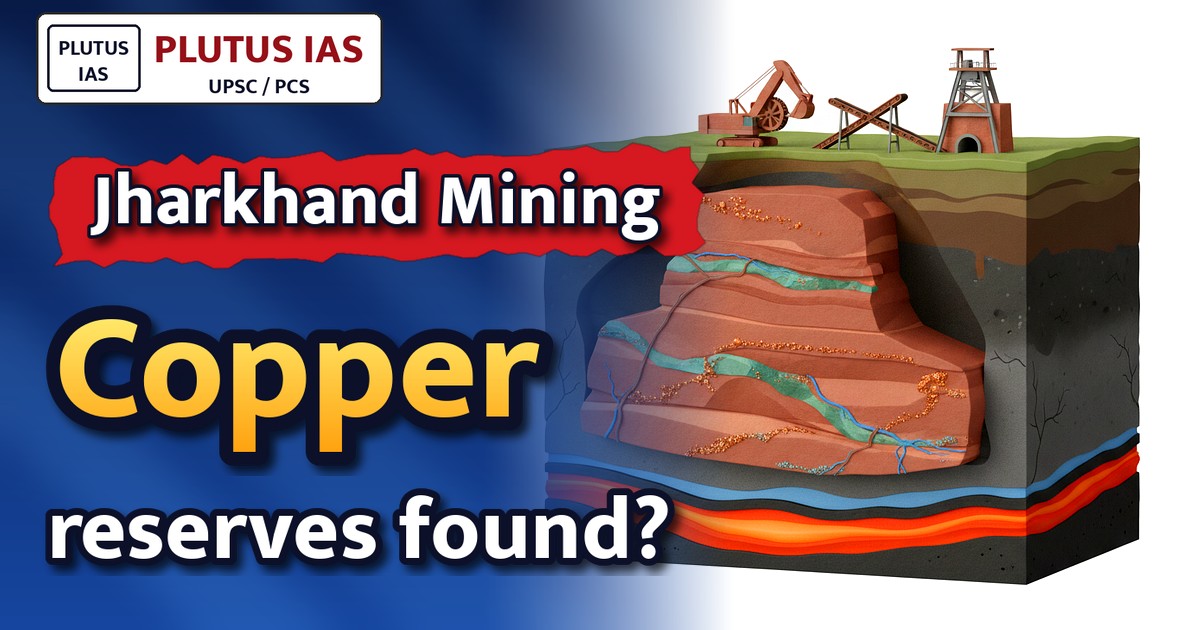
30 Sep झारखंड में मिला तांबे का विशाल भंडार: गिरिडीह में खनन की तैयारी शुरू
✎ Copper, classified as a critical mineral in India’s National Mineral Policy 2019, is essential for green technologies; the Giridih discovery, confirmed via G2-level exploration by MECL, could reduce import dependency and support…
Subject Relevance — Where This Topic Fits
- GS Paper II — Government Policies and Interventions for Development in various sectors and Issues arising out of their Design and Implementation | GS Paper III — Indian Economy and issues relating to Planning, Mobilisation of Resources, Growth, Development and Employment | GS Paper III — Science and Technology- Developments and their Applications and Effects in Everyday Life | GS Paper III — Conservation, Environmental Pollution and Degradation, Environmental Impact Assessment
- Prelims: National Mineral Exploration Policy (NMEP), 2016, Geological Survey of India (GSI), Mineral Exploration Corporation Limited (MECL), National Mineral Policy, 2019, Critical Minerals, Mining Lease Rules, 2015, District Mineral Foundation (DMF), MMDR Act, 1957 (amended 2015), Critical Mineral Strategy, Copper as a strategic mineral
- Essay: India’s quest for self-reliance in critical minerals: Challenges and opportunities, Balancing economic growth with environmental sustainability in mineral resource management
Quick Revision: Copper, classified as a critical mineral in India’s National Mineral Policy 2019, is essential for green technologies; the Giridih discovery, confirmed via G2-level exploration by MECL, could reduce import dependency and support Atmanirbhar Bharat goals.
Why is this in the news?
The discovery of substantial copper reserves in the Giridih district of Jharkhand, confirmed through a G2-level geological exploration by the Mineral Exploration Corporation Limited (MECL) and submitted to the state government, has brought India’s mineral security and indigenous resource potential into sharp focus. This development assumes significance in the context of rising global demand for copper, driven by renewable energy transitions, electric vehicle manufacturing, and digital infrastructure expansion, all of which are critical for India’s sustainable development goals and Atmanirbhar Bharat initiatives.
Background
- India’s mineral exploration and mining sector is governed by the Mines and Minerals (Development and Regulation) Act, 1957, as amended in 2015, which provides the legal framework for mineral concession, regulation, and sustainable development.
- The National Mineral Exploration Policy (NMEP), 2016, aims to accelerate mineral exploration in the country by leveraging public-private partnerships, advanced geophysical surveys, and data analytics to identify mineral resources in unexplored and semi-explored areas.
- The Mineral Exploration Corporation Limited (MECL), a Government of India undertaking under the Ministry of Mines, is mandated to conduct detailed mineral exploration and resource assessment across the country.
- Historically, copper mining in India has been concentrated in regions such as Singhbhum (Jharkhand), Balaghat (Madhya Pradesh), and Khetri (Rajasthan), with Hindustan Copper Limited (HCL) being the principal public sector enterprise engaged in copper mining and processing.
- The discovery in Giridih follows preliminary indications in 2018, when surface sampling in the Dumri block revealed traces of copper, zinc, and lead, prompting deeper drilling and subsequent detailed exploration.
- The global demand for copper has surged due to its critical role in green technologies, including electric vehicles, renewable energy infrastructure, and data centres, with the International Copper Association projecting a 30% increase in demand by 2030.
What is Copper and Why is its Discovery in Giridih Significant?
- Copper is a non-ferrous metal with high thermal and electrical conductivity, making it indispensable for electrical wiring, electronics, renewable energy systems, and transportation infrastructure.
- India is currently a net importer of copper, with domestic production meeting only about 30% of demand, necessitating imports from countries like Chile, Peru, and Australia to bridge the supply gap.
- The Giridih discovery, located in the Barganda area of Dumri block, has been confirmed through G2-level exploration, which involves detailed geological mapping, geophysical surveys, and drilling to assess the quantity and quality of mineral deposits.
- The Baraganda Copper Block is expected to enhance India’s mineral resource base, reducing import dependency and supporting the ‘Make in India’ initiative by providing a domestic source for a critical industrial input.
- The discovery aligns with India’s Critical Mineral Strategy, which identifies copper as a key mineral for achieving net-zero emissions and transitioning to a green economy, as outlined in the National Mineral Policy, 2019.
- The development underscores the importance of state-led mineral exploration initiatives, particularly in mineral-rich states like Jharkhand, which contributes significantly to India’s mineral production but faces challenges in sustainable mining practices.
- The next phase involves environmental impact assessments, land acquisition, and mining lease formalities under the MMDR Act, 1957, before commercial extraction can commence.
Key Features
| Feature | Significance |
|---|---|
| Discovery of copper reserves in Giridih (Jharkhand) | Identifies a new mineral resource in India, enhancing domestic supply potential for a critical industrial metal. |
| G-2 level exploration by MECL | Represents a systematic geological assessment confirming resource size, grade, and feasibility for extraction. |
| State government’s receipt of survey report | Initiates the administrative process for policy formulation and regulatory approvals for mining. |
| Historical context of copper mining in India | Provides comparative perspective on India’s copper mining heritage and its revival in modern exploration. |
| Global demand surge for copper (AI, EVs) | Links domestic resource discovery to international market dynamics, highlighting strategic relevance. |
Why it Matters
Economic Implications
- Potential to reduce India’s import dependence for copper, a critical input for manufacturing, construction, and energy sectors.
- Creation of employment opportunities in mining, processing, and ancillary industries in Jharkhand.
- Revenue generation for the state exchequer through royalties, taxes, and lease premiums from mining operations.
- Boost to local economies in Giridih through backward and forward linkages in the mineral value chain.
Strategic and Industrial Relevance
- Copper is essential for renewable energy technologies, electric vehicles (EVs), and digital infrastructure, aligning with India’s green transition and technological advancement goals.
- Supports India’s Atmanirbhar Bharat initiative by strengthening domestic raw material security for strategic industries.
- Enhances India’s position in global mineral markets, particularly in the context of critical mineral supply chains.
Geological and Scientific Contribution
- Advances India’s mineral exploration capabilities through systematic geological surveys and advanced drilling techniques.
- Provides data for future resource mapping and exploration in similar geological terrains across the country.
- Contributes to India’s self-reliance in mineral resource assessment and management.
Challenges
1. Environmental and Ecological Concerns
- Risk of soil degradation and water pollution due to mining activities, necessitating stringent environmental safeguards.
- Potential disruption to local biodiversity and ecosystems in Giridih’s ecologically sensitive zones.
- Need for comprehensive Environmental Impact Assessment (EIA) and adherence to the Forest (Conservation) Act, 1980.
UPSC Link: GS3: Environmental Pollution & Degradation
2. Regulatory and Compliance Challenges
- Complexity of obtaining multiple clearances under the Mines and Minerals (Development and Regulation) Act, 1957, and other environmental laws.
- Coordination between central and state authorities for seamless approval processes.
- Ensuring compliance with the National Mineral Policy, 2019, and Sustainable Development Framework for mining.
UPSC Link: GS2: Government Policies & Interventions
3. Technological and Infrastructure Gaps
- Requirement for advanced mining technology and infrastructure to extract copper efficiently and sustainably.
- Need for skilled manpower and training programs to support mining operations and value addition.
- Development of transportation and logistics networks for the movement of ore and processed minerals.
UPSC Link: GS3: Science & Technology
4. Social and Community Challenges
- Addressing land acquisition and rehabilitation issues to ensure fair compensation and resettlement for affected communities.
- Managing local expectations and ensuring inclusive development through Corporate Social Responsibility (CSR) initiatives.
- Mitigating potential conflicts over resource ownership and usage rights.
UPSC Link: GS2: Welfare Schemes & Social Justice
5. Market and Economic Viability
- Fluctuations in global copper prices may impact the economic feasibility of mining operations.
- Need for long-term contracts and price hedging strategies to ensure stable revenue streams.
- Balancing domestic production with import requirements to meet industrial demand.
UPSC Link: GS3: Indian Economy & Issues Relating to Planning
Challenges — UPSC Perspective
| Issue | Concern |
|---|---|
| Environmental degradation | Risk of soil erosion, water contamination, and biodiversity loss due to mining activities. |
| Regulatory delays | Complex clearance processes under multiple laws may hinder timely project implementation. |
| Infrastructure deficits | Inadequate transportation and power supply may impede mining and processing operations. |
| Community resistance | Potential opposition from local communities over land use and livelihood impacts. |
| Global price volatility | Dependence on international copper prices may affect project profitability. |
| Skill gaps | Shortage of trained personnel for advanced mining and metallurgical operations. |
Way Forward
- Conduct a detailed Environmental Impact Assessment (EIA) in compliance with the Environment Protection Act, 1986, and Forest (Conservation) Act, 1980.
- Formulate a state-specific mineral policy for copper mining, aligning with the National Mineral Policy, 2019, and Sustainable Development Framework.
- Establish a multi-stakeholder task force comprising central and state agencies, industry experts, and local representatives for coordinated project execution.
- Invest in skill development programs to train local youth in mining, metallurgy, and environmental management.
- Develop robust transportation and logistics infrastructure, including rail and road connectivity, to facilitate ore movement.
- Explore public-private partnerships (PPP) for technology transfer and investment in mining and processing units.
- Ensure transparent land acquisition and rehabilitation processes, adhering to the Right to Fair Compensation and Transparency in Land Acquisition, Rehabilitation and Resettlement Act, 2013.
- Monitor global copper prices and adopt hedging strategies to mitigate market risks for long-term project viability.
UPSC Value Addition
Keywords for Mains Answer-Writing
Critical minerals security · Geological Survey of India · Mineral Exploration Corporation Limited · National Mineral Policy 2019 · Resource nationalism · Sustainable mining · Strategic mineral reserves · Public sector undertakings in mining · Mineral auction regime · Environmental safeguards in mining · Jharkhand mineral resources · Copper reserves in India
Constitutional & Policy Linkages
- Article 297: Vests ownership of minerals in the State, subject to central regulation under Entry 54, List I (Union List).
- Article 246: Distinguishes legislative competence between Parliament and State Legislatures for mining-related laws.
Concept Flow
Geological surveys identify copper potential in Giridih → G-2 level exploration by MECL confirms resource size and grade → State government receives survey report → Policy formulation and regulatory approvals initiated → Environmental Impact Assessment conducted → Mining operations commence → Ore extraction and processing → Revenue generation and industrial utilization → Contribution to national mineral security and economic growth.
Prelims Practice Questions
Q1. Consider the following statements regarding the Mineral Exploration Corporation Limited (MECL):
1. MECL is a Government of India undertaking under the Ministry of Mines.
2. MECL conducts mineral exploration and resource assessment across India.
3. MECL is responsible for the auction of mineral blocks to private entities.
4. MECL has recently submitted a G2-level exploration report for copper reserves in Giridih, Jharkhand.
How many of the above statements are correct?
- Only one
- Only two
- Only three
- All
Answer: All — Statements 1, 2, and 4 are correct. Statement 3 is incorrect as MECL does not conduct auctions; the auction is handled by state governments or the Ministry of Mines.
Q2. Assertion (A): The National Mineral Policy 2019 emphasizes the need for sustainable mining practices and resource efficiency.
Reason (R): The policy aims to reduce India’s dependence on imports of critical minerals like copper by promoting domestic exploration and mining.
In the context of the above statements, which of the following is correct?
- Both A and R are true, and R is the correct explanation of A
- Both A and R are true, but R is NOT the correct explanation of A
- A is true, but R is false
- A is false, but R is true
Answer: Both A and R are true, but R is NOT the correct explanation of A — Both the assertion and reason are true, and the reason correctly explains the assertion as the policy explicitly promotes sustainable mining and domestic exploration to address critical mineral shortages.
Q3. Match the following mineral resources with their primary producing states in India:
Column I (Mineral) | Column II (State)
——————-|——————
A. Copper | 1. Odisha
B. Bauxite | 2. Jharkhand
C. Manganese | 3. Rajasthan
D. Lead & Zinc | 4. Madhya Pradesh
Select the correct match:
- A-2, B-1, C-4, D-3
- A-3, B-2, C-1, D-4
- A-2, B-3, C-1, D-4
- A-4, B-1, C-3, D-2
Answer: A-2, B-1, C-4, D-3 — Copper is primarily produced in Jharkhand (A-2), Bauxite in Odisha (B-1), Manganese in Madhya Pradesh (C-4), and Lead & Zinc in Rajasthan (D-3).
Mains Practice Question
✍ The discovery of substantial copper reserves in Giridih, Jharkhand, underscores the strategic importance of critical minerals for India’s industrial and technological self-reliance. Critically examine the policy and institutional framework governing mineral exploration and mining in India, with particular reference to the role of public sector undertakings like the Mineral Exploration Corporation Limited (MECL). Also, analyse the challenges in balancing resource nationalism with environmental sustainability in the context of such discoveries. (15 Marks)
Approach: MODEL-ANSWER SKELETON:
1. **Strategic Importance of Critical Minerals**
– Define critical minerals and their role in green energy, AI infrastructure, and defense (e.g., copper for AI data centers, electric vehicles).
– Highlight India’s import dependence and the need for domestic exploration (e.g., copper imports ~$1.2 billion in 2023-24).
2. **Policy Framework**
– National Mineral Policy 2019: Objectives, provisions for sustainable mining, and emphasis on resource efficiency.
– Mineral Auction Regime (MMDR Act, 2015): Transition from concession to auction-based regime, objectives, and outcomes.
– Role of state governments in mineral exploration and mining (e.g., Jharkhand’s mineral policy).
3. **Institutional Framework**
– Role of MECL: Functions, G2-level exploration reports, and collaboration with state geological surveys.
– Other PSUs: Hindustan Copper Limited (HCL) and its historical role in copper mining (e.g., Musabani mines).
– Geological Survey of India (GSI): Primary agency for mineral resource assessment.
4. **Challenges in Balancing Resource Nationalism and Sustainability**
– Resource nationalism: State control vs. private participation (e.g., restrictions on 100% FDI in mining).
– Environmental safeguards: Forest Rights Act, 2006; Environmental Impact Assessment (EIA) 2006; challenges in obtaining clearances.
– Social impacts: Land acquisition, displacement, and tribal rights (e.g., Fifth Schedule areas in Jharkhand).
– Technological and financial constraints: High capital costs, lack of advanced exploration technology.
5. **Way Forward**
– Strengthening PSUs like MECL and HCL with modern exploration technologies (e.g., AI, remote sensing).
– Public-private partnerships for sustainable mining (e.g., NITI Aayog’s strategy for critical minerals).
– Streamlining regulatory processes for faster clearances while ensuring compliance with environmental laws.
– Capacity building in state geological departments for independent resource assessment.
6. **Conclusion**
– Synthesis: The Giridih discovery is a step toward reducing import dependence but requires a balanced approach to sustainability and equity.
Source: amarujala.com
Jharkhand PCS (JPSC) — State PCS Practice
Prelims: Recently, a large copper deposit was discovered in Giridih district of Jharkhand. Which of the following agencies conducted the survey to assess this mineral resource?
- Geological Survey of India (GSI)
- Indian Bureau of Mines (IBM)
- Jharkhand State Mineral Development Corporation (JSMDC)
- National Mineral Exploration Trust (NMET)
Answer: Geological Survey of India (GSI) — The survey to assess the copper deposit in Giridih was conducted by the Geological Survey of India (GSI), which submitted its report to the state government.
Mains: Discuss the significance of the discovery of a large copper deposit in Giridih district for Jharkhand’s economy and industrial development. Highlight the challenges in its exploitation and suggest measures to ensure sustainable mining practices.
Generated by AanyaAi for educational purpose.
Related guides on our sites
- Best economics services coaching
- Anthropology VS PSIR
- Best PSIR optional coaching
- Best PSIR optional coaching online

- पेट्रोलियम (संशोधन) विधेयक 2026: हितधारकों से सुझाव आमंत्रित - September 30, 2026
- UERC imposes 67 paise/unit surcharge on open access power in Uttarakhand - September 30, 2026
- एलपीयू हिंसा मामले में हाईकोर्ट ने सरकार से पूछा- अब तक क्या किया? - September 30, 2026

No Comments