


28 Sep Supreme Court directs CBSE to exempt Class 6 from three-language policy
✎ The Supreme Court’s directive to extend the exemption to Class 6 students underscores the interplay between judicial oversight, administrative feasibility, and constitutional obligations in the implementation of the CBSE…
Subject Relevance — Where This Topic Fits
- GS Paper II — Constitutional and Non-Constitutional Bodies (Supreme Court, CBSE)
- Prelims: Three-language formula, CBSE, constitutional provisions on education, Article 21A, NEP 2020, National Curriculum Framework 2023
- Essay: Language policy and national integration, Judicial activism in educational governance
Quick Revision: The Supreme Court’s directive to extend the exemption to Class 6 students underscores the interplay between judicial oversight, administrative feasibility, and constitutional obligations in the implementation of the CBSE three-language policy.
Why is this in the news?
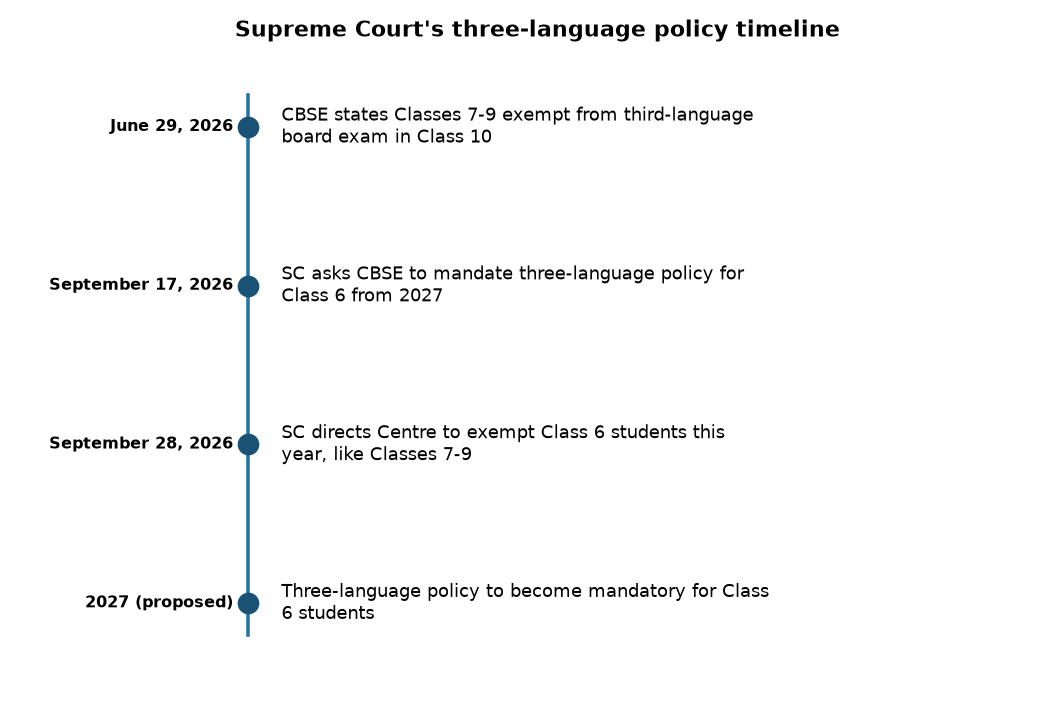
On 28 September 2026, the Supreme Court, in a consideration of the implementation of the CBSE three-language policy, directed the Centre and CBSE to extend the exemption granted to Classes 7, 8, and 9 students to Class 6 students for the academic year 2026–27. The order underscores the judicial role in balancing educational policy implementation with ground-level administrative feasibility, while highlighting constitutional obligations under Article 21A and the Right to Education Act, 2009.
Background
- The CBSE three-language policy, introduced under the National Education Policy (NEP) 2020 and aligned with the National Curriculum Framework (NCF) 2023, mandates the study of three languages in schools, including at least two Indian languages, to foster multilingualism and cultural integration.
- On 17 September 2026, the Supreme Court had directed the CBSE to enforce the three-language policy for Class 6 students from the academic session 2027–28, reflecting its commitment to uniform educational standards.
- On 29 June 2026, the CBSE issued a statement clarifying that students in Classes 7, 8, and 9 would not be required to appear for a board examination in the third language when they progress to Class 10, with internal school-based assessment for the third language.
- The Centre, represented by the Solicitor General, argued that 99% of CBSE-affiliated schools had already adopted the three-language framework and were equipped to implement it, with only 1.2% facing implementation challenges.
- The Supreme Court’s intervention reflects its role in ensuring that policy directives do not impose undue burdens on students or institutions, particularly in transitional phases of educational reform.
What is the CBSE Three-Language Policy?
- The three-language policy is a pedagogical framework introduced under the National Education Policy (NEP) 2020 and operationalised through the National Curriculum Framework (NCF) 2023, aimed at promoting multilingualism and national integration in Indian education.
- Under this policy, students are required to study three languages: one must be Hindi or English (the medium of instruction), and the other two must include at least one Indian language, ensuring exposure to regional linguistic diversity.
- The policy is designed to align with the constitutional objective of preserving and promoting India’s linguistic heritage while facilitating inter-state mobility and cultural exchange.
- Implementation is staggered: the CBSE has indicated that the policy will be fully enforced from the academic session 2027–28 for Class 6 students, with phased adoption for higher classes.
- The policy includes provisions for internal assessment of the third language in Classes 9 and 10, with no mandatory board examination for the third language, as clarified by the CBSE in June 2026.
- The policy also reflects the recommendations of the Kothari Commission (1964–66) and the National Policy on Education (1986), which advocated for a balanced approach to language education in India.
UPSC Value Addition
Keywords for Mains Answer-Writing
Three-language formula · CBSE curriculum policy · Constitutional provisions on education · Supreme Court directives on education policy · Language policy in India · Right to Education Act, 2009 · National Education Policy 2020 · Federalism in education governance · Judicial review of executive policies · Curriculum flexibility in school education
Prelims Practice Questions
Q1. Consider the following statements regarding the three-language formula in India’s education system:
1. The three-language formula was recommended by the Kothari Commission (1964-66).
2. The formula mandates the study of Hindi, English, and a modern Indian language.
3. The Right to Education Act, 2009, makes the three-language formula legally binding.
4. The National Education Policy 2020 recommends replacing the three-language formula with a two-language approach.
How many of the above statements are correct?
- Only one
- Only two
- Only three
- All four
Answer: Only two — Only statement 1 is correct. The Kothari Commission (1964-66) recommended the three-language formula. Statement 2 is incorrect as the formula does not mandate Hindi; it allows flexibility in choosing languages. Statement 3 is incorrect as the RTE Act does not make the formula legally binding. Statement 4 is incorrect as the NEP 2020 retains the three-language formula with greater flexibility.
Q2. Assertion (A): The Supreme Court of India has the power to issue directives to the executive on matters of education policy.
Reason (R): The Constitution of India vests the Supreme Court with the power of judicial review under Article 32 and Article 226.
In the context of the above two statements, which of the following is correct?
- Both A and R are true, and R is the correct explanation of A
- Both A and R are true, but R is NOT the correct explanation of A
- A is true, but R is false
- A is false, but R is true
Answer: Both A and R are true, and R is the correct explanation of A — Both A and R are true. The Supreme Court can issue directives to the executive on education policy under its judicial review powers (Article 32 and Article 226). However, R is not the correct explanation of A, as the Supreme Court’s power to issue such directives is broader than just the reason stated.
Q3. Match the following committees/reports with their recommendations on India’s language policy:
Column I
A. Kothari Commission (1964-66)
B. National Education Policy 2020
C. Radhakrishnan Commission (1948-49)
D. NEP Drafting Committee (2019)
Column II
1. Recommended a three-language formula
2. Advocated for mother-tongue medium instruction
3. Suggested flexibility in language choices
4. Proposed regional language as the primary medium
Select the correct match:
- A-1, B-3, C-2, D-4
- A-1, B-4, C-2, D-3
- A-2, B-3, C-1, D-4
- A-3, B-1, C-4, D-2
Answer: A-1, B-3, C-2, D-4 — A-1: Kothari Commission recommended the three-language formula. B-3: NEP 2020 suggests flexibility in language choices. C-2: Radhakrishnan Commission advocated for mother-tongue medium instruction. D-4: The NEP Drafting Committee (2019) proposed regional language as the primary medium.
Mains Practice Question
✍ Critically examine the constitutional and policy dimensions of the three-language formula in India’s education system, with particular reference to the recent Supreme Court directive exempting Class 6 students from its strict implementation this year. (15 Marks)
Approach: MODEL-ANSWER SKELETON:
1. **Constitutional Basis**: Art. 29(2) (rights of minorities to conserve language), Art. 350A (facilities for instruction in mother tongue), and Art. 351 (development of Hindi) — explain how these provisions interact with the three-language formula.
2. **Policy Evolution**: Kothari Commission (1964-66) recommendation; NEP 2020’s emphasis on flexibility; RTE Act 2009’s silence on the formula.
3. **Judicial Review**: Supreme Court’s power under Art. 32/226 to issue directives (e.g., Unnikrishnan vs State of Andhra Pradesh, 1993; T.M.A. Pai Foundation vs State of Karnataka, 2002).
4. **Federalism Angle**: Distribution of subjects (Education in Concurrent List, Entry 25) and role of states in language policy.
5. **Recent Directive**: Supreme Court’s order (Sept 2026) — exempting Class 6 students from strict implementation; reasons cited (implementation challenges in 1.2% schools).
6. **Critique**: Arguments for flexibility (mother-tongue instruction, regional diversity) vs. arguments for uniformity (national integration, Hindi promotion).
7. **Conclusion**: Balance between constitutional rights, policy flexibility, and judicial intervention — suggest a middle path.
Source: The Hindu
Generated by AanyaAi for educational purpose.
Related guides on our sites
- Best PSIR optional coaching for upsc
- Best PSIR optional teacher for upsc
- Best teacher of PSIR optional for upsc
- Best PSIR optional coaching in delhi for UPSC

- एलपीयू हिंसा मामले में हाईकोर्ट ने सरकार से पूछा- अब तक क्या किया? - September 30, 2026
- झारखंड में मिला तांबे का विशाल भंडार: गिरिडीह में खनन की तैयारी शुरू - September 30, 2026
- भारत खनन सप्ताह 2026: 19 देशों के राजनयिकों का बड़ा जमावड़ा - September 30, 2026

No Comments