


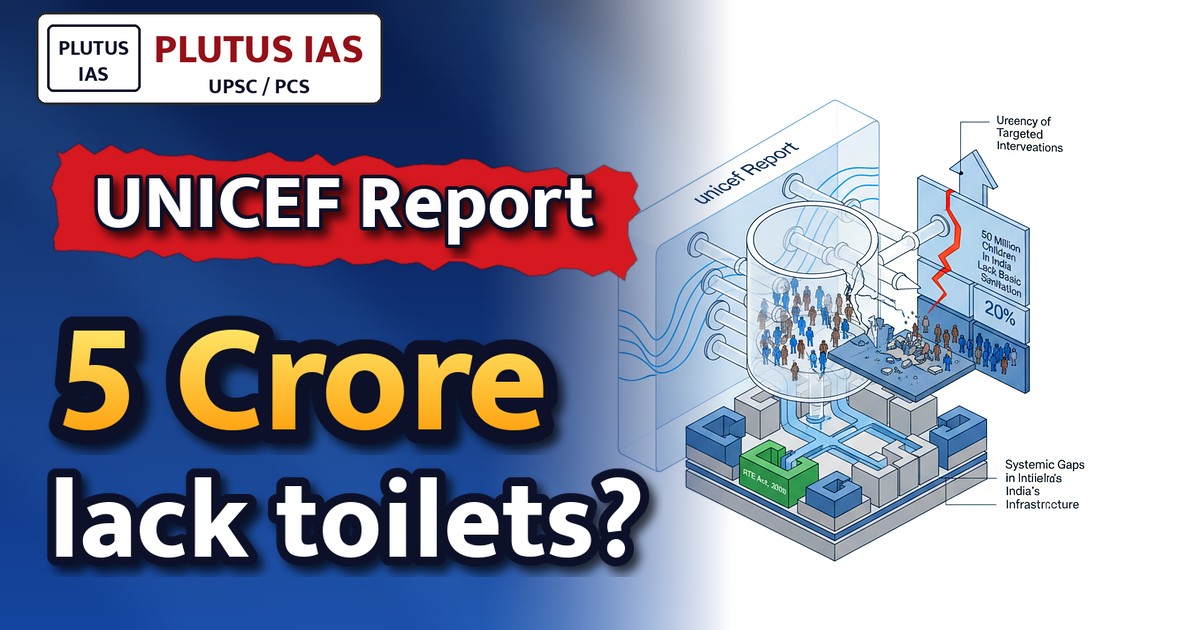
29 Sep UNICEF Report: 5 Crore Indian Students Lack School Sanitation Facilities
✎ The Swachh Vidyalaya Abhiyan, launched in 2014, aimed to ensure universal access to functional toilets in all schools by 2017, but persistent deficits highlight the need for sustained monitoring, community-driven maintenance, and…
Subject Relevance — Where This Topic Fits
- GS Paper II — Social Justice: Issues relating to Health, Education, and Human Resources | GS Paper IV — Ethics and Governance: Public Service Values and Challenges
- Prelims: Swachh Vidyalaya Abhiyan, Right to Education (RTE) Act, 2009, Sustainable Development Goal (SDG) 4, Sustainable Development Goal (SDG) 6, Mid-Day Meal Scheme, School Health Programme (SHP), National Rural Health Mission (NRHM)
- Essay: The interplay between public health infrastructure and educational equity in India, Sustainable development as a framework for national progress
Quick Revision: The Swachh Vidyalaya Abhiyan, launched in 2014, aimed to ensure universal access to functional toilets in all schools by 2017, but persistent deficits highlight the need for sustained monitoring, community-driven maintenance, and convergence with health and education programmes.
Why is this in the news?
A joint WHO-UNICEF report titled *Progress on drinking water, sanitation and hygiene in schools: 2015–2025* highlights that approximately 50 million children in India lack basic sanitation facilities in schools, accounting for nearly one-fifth of the global total of 244 million children deprived of such essential amenities. This revelation underscores persistent systemic gaps in India’s education and public health infrastructure despite policy interventions and underscores the urgency of targeted interventions to ensure universal access to safe sanitation in educational institutions.
Background
- The Right to Education (RTE) Act, 2009, mandates free and compulsory education for children aged 6–14 years and includes provisions for adequate infrastructure, including sanitation facilities, in schools.
- The Swachh Vidyalaya Abhiyan (2014), a national campaign under the Swachh Bharat Mission, aimed to construct 4,17,796 school toilets across India to address sanitation deficits in educational institutions.
- Sustainable Development Goal (SDG) 4 (Quality Education) and SDG 6 (Clean Water and Sanitation) explicitly call for universal access to safe and inclusive sanitation facilities in schools by 2030.
- The School Health Programme (SHP), launched in 2018 under the Ayushman Bharat initiative, integrates health screening, awareness, and WASH interventions in schools to promote holistic child development.
What constitutes ‘school sanitation’ and why is it critical?
- School sanitation encompasses the availability of functional toilets, urinals, handwashing stations, clean drinking water, and waste management systems within educational premises, ensuring a hygienic environment conducive to learning.
- Inadequate sanitation in schools disproportionately affects girls, leading to higher dropout rates due to lack of privacy, safety concerns, and menstrual hygiene management challenges.
- Poor sanitation contributes to the spread of waterborne diseases such as diarrhoea, cholera, and typhoid, exacerbating absenteeism and reducing academic performance among students.
- The absence of segregated toilets for children with disabilities further marginalises vulnerable groups, violating the principles of inclusive education enshrined in the RTE Act and the UN Convention on the Rights of Persons with Disabilities.
- Sanitation deficits in schools are not merely infrastructure issues but reflect broader governance challenges, including resource allocation, inter-departmental coordination, and community participation.
- The WHO-UNICEF Joint Monitoring Programme (JMP) for Water Supply, Sanitation, and Hygiene (WASH) sets global benchmarks for sanitation in schools, categorising facilities as ‘basic’, ‘limited’, or ‘unimproved’ based on accessibility and usability.
- India’s progress under the Swachh Vidyalaya Abhiyan has been uneven, with rural and tribal regions lagging due to logistical constraints, funding gaps, and low community engagement.
- The integration of WASH interventions with the Mid-Day Meal Scheme and the School Health Programme can amplify impact by addressing both nutritional and sanitation needs of children.
Key Features
| Feature | Significance |
|---|---|
| Lack of sanitation facilities in schools | Undermines the right to safe and hygienic learning environments, directly impacting children’s health and educational outcomes. |
| Disproportionate burden on India | India accounts for nearly one-fifth of the global population of children without sanitation in schools, highlighting systemic gaps in infrastructure. |
| Progress in reduction of uncovered schools | A 14% decline in the number of schools lacking sanitation facilities indicates incremental policy efforts, though insufficient to meet universal standards. |
| Geographical disparity | The issue is concentrated in low-resource settings, with rural and tribal regions facing the highest deficits in basic amenities. |
| Global comparison | India’s figures exceed those of other high-burden countries like Nigeria, Ethiopia, and the Democratic Republic of Congo, underscoring the scale of the challenge. |
Why it Matters
Public Health
- Inadequate sanitation increases the risk of waterborne diseases such as diarrhoea, cholera, and typhoid, particularly among children, leading to higher absenteeism and dropout rates.
- Poor hygiene practices contribute to the spread of infections, exacerbating malnutrition and stunting in vulnerable populations.
- School-based sanitation programmes act as preventive healthcare interventions, reducing the burden on primary healthcare systems.
Education Outcomes
- Access to clean toilets and water is a prerequisite for girls’ continued participation in schooling, especially post-puberty, thereby addressing gender disparities in education.
- Sanitation facilities improve concentration and cognitive performance by reducing health-related absenteeism and discomfort during school hours.
- School sanitation programmes are linked to higher enrolment and retention rates, particularly in marginalised communities.
Social Equity
- The absence of sanitation disproportionately affects children from Scheduled Castes, Scheduled Tribes, and economically weaker sections, reinforcing socio-economic inequalities.
- Improved school sanitation can serve as a catalyst for community-wide behavioural change in hygiene practices, particularly in rural areas.
- Universal access to sanitation aligns with the principle of inclusive development enshrined in the Sustainable Development Goals (SDG 4 and SDG 6).
Governance and Policy
- The report underscores the need for strengthened implementation of existing policies, such as the Swachh Vidyalaya Abhiyan, to ensure equitable distribution of resources.
- Monitoring and evaluation mechanisms must be institutionalised to track progress and identify regions requiring targeted interventions.
- Inter-sectoral coordination between the Ministries of Education, Drinking Water and Sanitation, and Rural Development is essential for sustainable outcomes.
Economic Implications
- Investments in school sanitation yield long-term economic benefits by reducing healthcare costs associated with preventable diseases.
- Improved educational attainment enhances human capital formation, contributing to higher productivity and economic growth.
- Sanitation infrastructure in schools can stimulate local employment opportunities in construction, maintenance, and hygiene education sectors.
Challenges
1. Infrastructure Deficit
- Insufficient allocation of funds for the construction and maintenance of toilets, especially in government-run schools.
- Delayed completion of sanitation projects due to bureaucratic hurdles, land acquisition issues, and contractor inefficiencies.
- Inadequate water supply in schools, rendering sanitation facilities non-functional or underutilised.
UPSC Link: GS-II: Social Sector/Services
2. Behavioural and Cultural Barriers
- Deep-rooted social taboos, particularly around menstrual hygiene, discourage girls from using school toilets.
- Lack of awareness among students, parents, and teachers regarding the importance of sanitation and hygiene practices.
- Resistance to change in traditional practices, especially in rural and tribal communities.
UPSC Link: GS-I: Social Issues
3. Monitoring and Accountability Gaps
- Inadequate data systems to track the status of sanitation facilities in schools, leading to poor targeting of interventions.
- Absence of grievance redressal mechanisms for reporting non-functional or missing facilities.
- Limited community participation in the planning and monitoring of sanitation programmes.
UPSC Link: GS-II: Governance
4. Resource Constraints
- Competing priorities within the education sector, such as teacher recruitment and curriculum development, often overshadow sanitation initiatives.
- Dependence on external funding for sanitation projects, which may be inconsistent or insufficient.
- Limited technical expertise in designing and maintaining gender-sensitive and disability-inclusive sanitation facilities.
UPSC Link: GS-III: Economic Development
5. Climate and Environmental Factors
- Flood-prone and drought-affected regions face additional challenges in ensuring year-round access to clean water and functional toilets.
- Extreme weather events disrupt sanitation infrastructure, necessitating resilient and adaptive designs.
- Over-reliance on groundwater sources, which may be contaminated or insufficient, particularly in arid regions.
UPSC Link: GS-III: Environment
Challenges — UPSC Perspective
| Issue | Concern |
|---|---|
| Insufficient toilet infrastructure | Lack of functional toilets, especially for girls, leading to absenteeism and dropout rates. |
| Water scarcity in schools | Inadequate water supply renders sanitation facilities unusable, defeating their purpose. |
| Cultural taboos around hygiene | Stigma associated with menstrual hygiene discourages girls from using school toilets. |
| Poor maintenance of facilities | Neglect in upkeep results in broken or unhygienic toilets, discouraging usage. |
| Limited community engagement | Absence of awareness campaigns leads to low utilisation and ownership of sanitation programmes. |
| Data gaps in monitoring | Inadequate tracking systems hinder evidence-based policymaking and resource allocation. |
Government Initiatives — Must-Memorise for Prelims
- Swachh Vidyalaya Abhiyan (SVA)
Way Forward
- Strengthen the implementation of the Swachh Vidyalaya Abhiyan with targeted allocations for schools in high-burden districts.
- Integrate sanitation education into school curricula to foster behavioural change and promote hygiene practices among students.
- Establish a robust monitoring system, leveraging technology such as GIS mapping and mobile applications to track the status of facilities in real-time.
- Enhance inter-ministerial coordination to ensure convergence between education, water supply, and sanitation programmes.
- Prioritise gender-sensitive and disability-inclusive designs in toilet construction to address the specific needs of all students.
- Launch community-led awareness campaigns, engaging parents, teachers, and local leaders to destigmatise menstrual hygiene and promote sanitation.
- Invest in climate-resilient sanitation infrastructure to mitigate the impact of extreme weather events on school facilities.
- Encourage public-private partnerships to augment resources and expertise for the construction and maintenance of sanitation facilities.
UPSC Value Addition
Keywords for Mains Answer-Writing
School Sanitation and Hygiene Education (SSHE) · Right to Education Act, 2009 · UNICEF-WHO Joint Monitoring Programme (JMP) · Sustainable Development Goal 6 (SDG 6) · Article 21A of the Constitution of India · Mid-Day Meal Scheme · Swachh Vidyalaya Abhiyan · Universalisation of Elementary Education · Child Health and Nutrition · Public Health Infrastructure in Schools
Constitutional & Policy Linkages
- Article 21A (Right to Education) – Ensuring safe and hygienic learning environments as part of the fundamental right to education.
- Article 45 (Directive Principles of State Policy) – State’s obligation to provide free and compulsory education for children up to 14 years.
- Article 39(e) (Directive Principles) – State’s duty to ensure that health and strength of workers, men and women, and tender age of children are not abused.
Concept Flow
Inadequate sanitation infrastructure in schools → Increased risk of waterborne diseases and infections → Higher absenteeism and dropout rates among students → Reinforcement of gender and socio-economic disparities → Compromised educational outcomes and human capital development. → Policy initiatives (e.g., SVA, RMSA) → Incremental improvements in sanitation coverage → Persistent gaps due to implementation challenges → Need for targeted interventions and behavioural change → Sustainable development through equitable access to hygiene and education. → Global commitments (SDGs 4 & 6) → National frameworks for sanitation in schools → Local governance and community participation → Monitoring and accountability mechanisms → Long-term impact on public health and social equity.
Prelims Practice Questions
Q1. Consider the following statements regarding the Right to Education (RTE) Act, 2009:
1. The RTE Act mandates that all schools must provide separate toilets for boys and girls.
2. The Act requires that schools maintain a pupil-teacher ratio of 30:1 at the primary level.
3. The Act provides for the prohibition of corporal punishment in schools.
4. The Act guarantees free and compulsory education to all children aged 6-14 years.
How many of the above statements are correct?
- Only one
- Only two
- Only three
- All four
Answer: All four — Statements 1, 3, and 4 are correct as per Sections 19 and 17 of the RTE Act. Statement 2 is incorrect; the Act does not prescribe a specific pupil-teacher ratio but mandates norms for infrastructure including toilets.
Q2. Assertion (A): The Swachh Vidyalaya Abhiyan is a centrally sponsored scheme aimed at providing clean drinking water and sanitation facilities in schools.
Reason (R): The scheme is aligned with the Sustainable Development Goal 6 (SDG 6) targets on water and sanitation.
Options:
A. Both A and R are true, and R is the correct explanation of A.
B. Both A and R are true, but R is not the correct explanation of A.
C. A is true, but R is false.
D. A is false, but R is true.
Answer: ? — Assertion (A) is correct as Swachh Vidyalaya Abhiyan (2014) provides WASH (Water, Sanitation, and Hygiene) facilities in schools. Reason (R) is also correct and directly explains the objective of the scheme in line with SDG 6.
Mains Practice Question
✍ The absence of adequate sanitation facilities in schools undermines the constitutional guarantee of the right to education and public health. Critically examine the institutional and policy frameworks in India that address school sanitation, highlighting gaps between policy and implementation. Also analyse the socio-economic consequences of such deficiencies on children’s health, gender parity, and educational outcomes. (15 Marks)
Approach: MODEL-ANSWER SKELETON:
1. **Constitutional and Legal Framework**:
– Article 21A (RTE Act, 2009) and Article 45 (DPSP) mandate free and compulsory education and equitable access to infrastructure.
– RTE Act, 2009: Sections 19 (infrastructure norms), 17 (prohibition of corporal punishment), and 12(1)(c) (admission of disadvantaged groups).
– National Education Policy (NEP) 2020 emphasizes WASH (Water, Sanitation, and Hygiene) in schools.
2. **Policy and Scheme Architecture**:
– Swachh Vidyalaya Abhiyan (2014): Centrally sponsored scheme under the Department of Drinking Water and Sanitation, Ministry of Jal Shakti.
– School Sanitation and Hygiene Education (SSHE) programme (UNICEF-WHO collaboration).
– Mid-Day Meal Scheme (MDMS): Includes provision for clean drinking water and sanitation facilities.
– SDG 6 (Clean Water and Sanitation) and SDG 4 (Quality Education) linkages.
3. **Institutional Mechanisms and Implementation Gaps**:
– Role of State Governments: Decentralised implementation; variability in resource allocation and monitoring.
– Local Governance: Panchayati Raj Institutions (PRIs) and School Management Committees (SMCs) under RTE Act.
– Monitoring by National Council of Educational Research and Training (NCERT) and District Institutes of Education and Training (DIETs).
– Challenges: Inadequate funding, poor maintenance, lack of awareness, and socio-cultural barriers (e.g., menstrual hygiene management).
4. **Socio-Economic Consequences**:
– **Health**: Increased risk of waterborne diseases (diarrhoea, cholera) and malnutrition.
– **Gender Parity**: Lack of separate toilets discourages girl students from attending school, exacerbating dropout rates (UNICEF data).
– **Educational Outcomes**: Poor sanitation leads to absenteeism, reduced concentration, and lower academic performance.
– **Long-term Impact**: Reinforces cycles of poverty and inequality.
5. **Comparative Perspective and Way Forward**:
– Lessons from states with better outcomes (e.g., Kerala, Himachal Pradesh) in WASH infrastructure.
– Need for convergence between Ministries of Education, Health, and Drinking Water and Sanitation.
– Strengthening community participation, behaviour change communication, and gender-sensitive sanitation policies.
– Leveraging technology (e.g., GPS-based monitoring of school toilets) for transparency and accountability.
Source: amarujala.com
Generated by AanyaAi for educational purpose.
Related guides on our sites
- Best PSIR optional coaching for upsc
- Best economics optional coaching for upsc
- Best PSIR optional teacher for upsc
- Best teacher of PSIR optional for upsc

- UNICEF Report: 5 Crore Indian Students Lack School Sanitation Facilities - September 29, 2026
- नवीनतम: Nvidia ने AI एजेंटों को नियंत्रित करने के लिए नया सुरक्षा टूल लॉन्च किया - September 29, 2026
- Anthropic Warns AI Could Pose Existential Risks in IPO Filing - September 29, 2026

No Comments