


29 Sep CAQM Revises GRAP Schedule: Key Updates for UPSC & State PCS
✎ GRAP is a statutory, stage-wise emergency action plan enforced by the CAQM to mitigate air pollution in the NCR, integrating real-time monitoring, source-specific interventions, and multi-stakeholder coordination under the Air…
Subject Relevance — Where This Topic Fits
- GS Paper II — Governance, Transparency and Accountability | GS Paper III — Environment and Disaster Management | GS Paper III — Climate Change and Environmental Pollution
- Prelims: Graded Response Action Plan (GRAP), Commission for Air Quality Management (CAQM), National Clean Air Programme (NCAP), Particulate Matter (PM2.5 and PM10), Air Quality Index (AQI), Environmental Pollution (Prevention and Control) Act, 1986, National Green Tribunal (NGT), Source Apportionment Studies
- Essay: Environmental governance and sustainable development: Balancing growth with ecological integrity, Institutional mechanisms for public health protection: A case study of air quality management in India
Quick Revision: GRAP is a statutory, stage-wise emergency action plan enforced by the CAQM to mitigate air pollution in the NCR, integrating real-time monitoring, source-specific interventions, and multi-stakeholder coordination under the Air (Prevention and Control of Pollution) Act, 1981 and the CAQM Act, 2021.
Why is this in the news?
The Commission for Air Quality Management (CAQM) has approved a revised Graded Response Action Plan (GRAP) to intensify measures for vehicular emissions control, dust mitigation, and pollution abatement during the winter season in the National Capital Region (NCR). This revision reflects an adaptive governance approach to address the persistent challenge of air pollution, particularly in urban agglomerations, and underscores the need for multi-sectoral coordination under the existing statutory framework.
Background
- The National Capital Region (NCR), comprising Delhi and parts of Uttar Pradesh, Haryana, and Rajasthan, experiences severe air pollution during the winter months, primarily due to vehicular emissions, construction dust, industrial activities, and crop residue burning in neighboring states.
- The CAQM was established in 2020 under the Commission for Air Quality Management in National Capital Region and Adjoining Areas Act, 2021, as a statutory body to enforce the GRAP and coordinate air quality management across multiple states and Union Territories.
- The National Clean Air Programme (NCAP), launched in 2019, sets a national target of 20-30% reduction in particulate matter concentrations by 2024, with 132 non-attainment cities identified for focused interventions, including the NCR.
- The Supreme Court of India, through various judgments, has directed the implementation of GRAP and other pollution control measures, emphasizing the right to clean air under Article 21 of the Constitution.
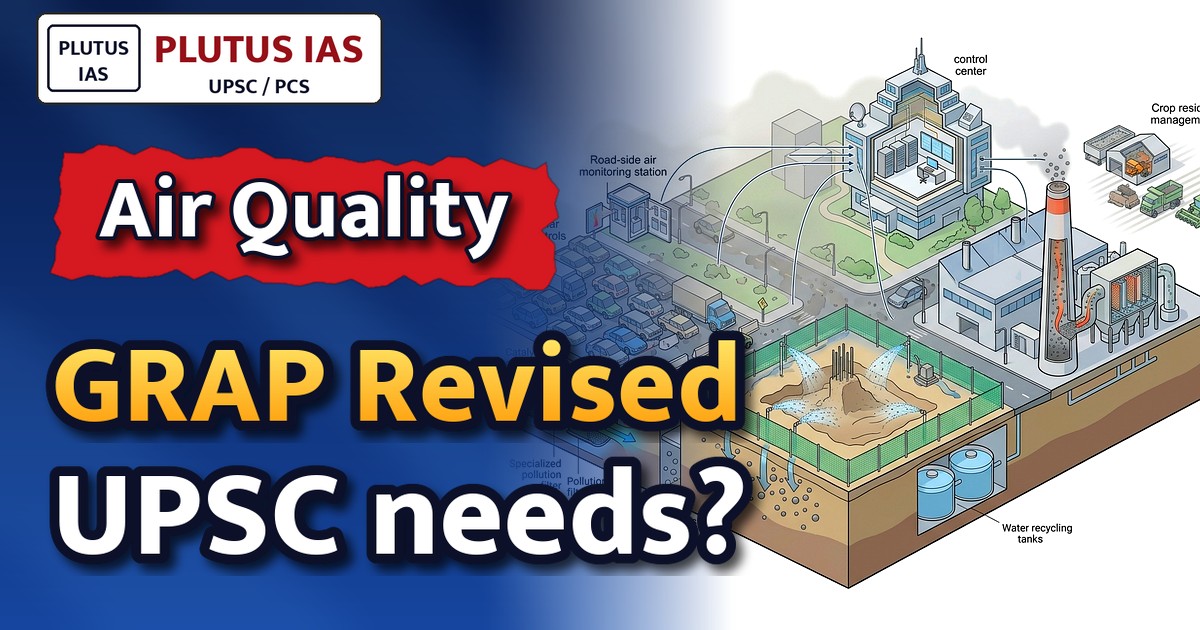
- The revised GRAP integrates real-time air quality data, source apportionment studies, and inter-state coordination to enhance the effectiveness of pollution control measures.
What is the Graded Response Action Plan (GRAP)?
- GRAP is a set of emergency, time-bound actions to be implemented in the NCR based on the severity of air pollution, as measured by the Air Quality Index (AQI), ranging from ‘Poor’ to ‘Severe Plus’ categories.
- The plan is notified under the Air (Prevention and Control of Pollution) Act, 1981, and enforced by the Commission for Air Quality Management (CAQM), a statutory body established under the CAQM Act, 2021.
- GRAP classifies air quality into four stages—Stage I (Poor), Stage II (Very Poor), Stage III (Severe), and Stage IV (Severe Plus)—with progressively stringent measures for each stage, including restrictions on construction activities, vehicular movement, and industrial operations.
- Key measures under GRAP include: (i) banning of diesel generator sets in NCR; (ii) intensification of public transport and promotion of electric vehicles; (iii) enforcement of dust control norms at construction sites; (iv) regulation of industrial emissions; and (v) coordination with state governments for stubble burning control in Punjab, Haryana, and Uttar Pradesh.
- The revised GRAP incorporates real-time monitoring of air quality through a network of 37 Continuous Ambient Air Quality Monitoring Stations (CAAQMS) in the NCR, enabling dynamic decision-making based on hourly data.
- Source apportionment studies, such as those conducted by the Indian Institute of Technology (IIT) Kanpur and The Energy and Resources Institute (TERI), inform the prioritization of pollution sources for targeted interventions under GRAP.
- GRAP is complemented by the National Clean Air Programme (NCAP), which provides a broader framework for long-term air quality improvement through city-specific action plans, capacity building, and public awareness campaigns.
- The enforcement of GRAP is monitored by the CAQM in collaboration with state pollution control boards, district administrations, and municipal corporations, with periodic reviews and compliance audits.
Key Features
| Feature | Significance |
|---|---|
| Revised GRAP Schedule | Introduces a graded, time-bound framework for air-quality management, replacing ad-hoc measures with a structured, predictable system. |
| Tighter Vehicle Emission Norms | Mandates stricter compliance with Bharat Stage VI norms, reducing vehicular contribution to particulate matter (PM) and nitrogen oxides (NOx). |
| Enhanced Dust Control Measures | Expands mechanical sweeping, water sprinkling, and construction-site dust suppression protocols to curb fugitive dust emissions. |
| Industrial Pollution Monitoring | Strengthens real-time emissions tracking for industries, including mandatory installation of continuous emission monitoring systems (CEMS). |
Why it Matters
Environmental Governance
- Establishes a proactive, multi-stakeholder approach to air-quality management, aligning with the National Clean Air Programme (NCAP) objectives.
- Shifts from reactive crisis management to preventive governance, reducing the frequency and severity of ‘severe’ air-quality episodes.
- Enhances inter-state coordination under the Air (Prevention and Control of Pollution) Act, 1981, particularly for the National Capital Region (NCR).
Public Health
- Directly addresses the health burden of air pollution, which contributes to respiratory diseases, cardiovascular disorders, and premature mortality.
- Reduces exposure risks for vulnerable populations, including children, the elderly, and those with pre-existing conditions.
- Supports long-term gains in life expectancy and productivity by lowering PM2.5 and PM10 concentrations.
Institutional Capacity
- Strengthens the role of the Commission for Air Quality Management (CAQM) as a statutory authority with enforcement powers.
- Improves data-driven policymaking through enhanced monitoring networks and predictive air-quality modeling.
- Fosters collaboration between central agencies (CPCB, IMD) and state pollution control boards.
Challenges
1. Implementation Gaps
- Enforcement remains uneven across states due to limited institutional capacity and resource constraints.
- Inter-state disputes over jurisdiction and accountability persist, particularly in the NCR.
- Public compliance with restrictions (e.g., odd-even schemes) is often low, undermining effectiveness.
UPSC Link: GS3: Environmental Pollution
2. Technological and Financial Constraints
- High costs associated with retrofitting industries with CEMS and upgrading vehicular fleets to BS-VI standards.
- Limited availability of alternative fuels (e.g., CNG, electric vehicles) in non-urban areas restricts substitution options.
- Dependence on manual labor for dust control measures (e.g., sweeping) limits scalability and efficiency.
UPSC Link: GS3: Environmental Pollution
3. Climate-Vulnerability Interactions
- Increased temperatures and prolonged dry spells exacerbate dust emissions and wildfire risks, complicating air-quality management.
- Stubble burning in neighboring states (Punjab, Haryana) remains a seasonal challenge, requiring cross-border coordination.
- Urban heat island effects intensify local pollution dispersion patterns, necessitating adaptive strategies.
UPSC Link: GS3: Climate Change
4. Stakeholder Coordination
- Balancing economic growth with environmental protection requires consensus among industries, transport sectors, and urban planners.
- Public awareness campaigns face resistance due to perceived economic burdens (e.g., higher fuel costs, construction delays).
- Media narratives often prioritize short-term political gains over long-term environmental sustainability.
UPSC Link: GS2: Governance
Challenges — UPSC Perspective
| Issue | Concern |
|---|---|
| Enforcement Lacunae | Inadequate penalties and monitoring lead to non-compliance by industries and vehicle owners. |
| Data Reliability | Gaps in real-time emissions data and air-quality monitoring networks undermine policy precision. |
| Public Behavior | Low adherence to advisory measures (e.g., reduced vehicle use, waste burning bans) reduces impact. |
| Seasonal Peaks | Stubble burning and Diwali fireworks create episodic pollution surges that overwhelm mitigation efforts. |
| Economic Trade-offs | Industries and transport sectors resist stricter norms due to cost implications and operational disruptions. |
Way Forward
- Strengthen institutional capacity of state pollution control boards through targeted funding and training programs.
- Expand the use of technology, including AI-driven predictive modeling and IoT-based emissions tracking, for real-time monitoring.
- Launch region-specific pilot projects (e.g., industrial clusters, urban hotspots) to demonstrate cost-effective mitigation strategies.
- Enhance public engagement via localized awareness campaigns, incentivizing behavioral changes through rewards and penalties.
- Formalize cross-state agreements under the Air Act to resolve jurisdictional disputes and streamline enforcement.
- Integrate air-quality management with urban planning, prioritizing green spaces, public transport, and low-emission zones.
- Invest in research to develop indigenous solutions for dust suppression, alternative fuels, and low-cost monitoring devices.
UPSC Value Addition
Keywords for Mains Answer-Writing
Commission for Air Quality Management in National Capital Region and Adjoining Areas · Graded Response Action Plan · air pollution control measures · National Green Tribunal · environmental governance · pollution control mechanisms · urban air quality management · stubble burning regulation · vehicular emission norms · construction and demolition waste management · Environment Protection Act 1986 · National Clean Air Programme · supreme court directives on pollution · public health and air quality · inter-state coordination for pollution control
Constitutional & Policy Linkages
- [‘Article 21: Right to Life and Personal Liberty’, ‘Ensures protection from environmental hazards as part of fundamental rights.’]
- [‘Article 48A: Directive Principles of State Policy’, ‘Directs the state to protect and improve the environment.’]
- [‘Article 51A(g): Fundamental Duties’, ‘Imposes a duty on citizens to protect and improve the natural environment.’]
Concept Flow
Urbanization and industrialization → Increased vehicular emissions and construction dust → Elevated PM2.5/PM10 levels → Health impacts (respiratory diseases, mortality) → Policy response (GRAP implementation) → Gradual reduction in pollution levels → Long-term public health and environmental benefits.
Prelims Practice Questions
Q1. Consider the following statements regarding the Commission for Air Quality Management in National Capital Region and Adjoining Areas (CAQM):
1. The CAQM is a statutory body established under the Environment Protection Act, 1986.
2. It has the power to enforce the Graded Response Action Plan (GRAP) across the National Capital Region.
3. The CAQM can impose penalties on states for non-compliance with air quality standards.
4. The CAQM is chaired by the Prime Minister of India.
How many of the above statements are correct?
- Only one
- Only two
- Only three
- All
Answer: Only three — Statement 1 is correct: The CAQM is a statutory body constituted under Section 3 of the Environment Protection Act, 1986. Statement 2 is correct: The CAQM is empowered to enforce the Graded Response Action Plan (GRAP). Statement 3 is incorrect: The CAQM does not have the power to impose penalties directly; it recommends measures to state governments. Statement 4 is incorrect: The CAQM is chaired by a government-appointed chairperson, not the Prime Minister.
Q2. Which of the following is NOT a measure typically included under the Graded Response Action Plan (GRAP) for air pollution control in the National Capital Region?
- Ban on construction activities during severe air quality episodes
- Restriction on the movement of diesel vehicles older than 10 years
- Mandatory use of public transport with 50% seating capacity
- Closure of brick kilns and hot mix plants
Answer: Mandatory use of public transport with 50% seating capacity — The GRAP does not mandate a 50% seating capacity in public transport; rather, it may include measures such as staggered timings, increased frequency, or temporary suspension of services during severe pollution episodes. Other options are standard GRAP measures.
Q3. Assertion (A): The National Green Tribunal (NGT) has the power to direct state governments to implement measures under the Graded Response Action Plan (GRAP).
Reason (R): The NGT derives its authority from the National Green Tribunal Act, 2010, which empowers it to enforce environmental laws and directions.
Options:
A. Both A and R are true, and R is the correct explanation of A.
B. Both A and R are true, but R is not the correct explanation of A.
C. A is true, but R is false.
D. A is false, but R is true.
Answer: ? — Assertion (A) is true: The NGT has issued multiple directives to state governments for implementing GRAP measures. Reason (R) is true and correctly explains A, as the NGT Act, 2010 empowers it to enforce environmental laws and directions, including those under GRAP.
Mains Practice Question
✍ The Commission for Air Quality Management in National Capital Region and Adjoining Areas (CAQM) has recently revised the Graded Response Action Plan (GRAP) to tighten measures for vehicles, dust, and pollution control. Critically analyse the efficacy of the GRAP in addressing air pollution in the National Capital Region. Also, examine the institutional challenges faced by the CAQM in ensuring compliance and coordination among states. (15 Marks)
Approach: MODEL-ANSWER SKELETON:
1. **Introduction (2 marks)**
– Define GRAP: A set of emergency measures implemented in phases based on air quality index (AQI) levels.
– Context: GRAP is part of the National Clean Air Programme (NCAP) and is enforced by the CAQM.
2. **Efficacy of GRAP (6 marks)**
– **Strengths:**
– Phased response ensures proportionality (e.g., restrictions on construction, vehicular movement, and industrial activities during severe pollution).
– Alignment with Supreme Court directives (e.g., ban on stubble burning, use of PUSA bio-decomposer).
– Integration with state action plans (e.g., Punjab, Haryana, and Uttar Pradesh’s stubble management policies).
– **Limitations:**
– **Implementation gaps:** Delayed enforcement due to inter-state coordination issues.
– **Effectiveness:** Temporary measures; long-term solutions (e.g., public transport expansion, industrial emission controls) remain under-implemented.
– **Public compliance:** Enforcement challenges (e.g., illegal construction, vehicular emissions).
– **Data reliability:** AQI monitoring stations may not capture ground-level pollution accurately.
3. **Institutional Challenges for CAQM (5 marks)**
– **Legal and Constitutional Constraints:**
– CAQM operates under the Environment Protection Act, 1986, but lacks penal powers; relies on state governments for enforcement.
– Conflict with state governments over jurisdiction (e.g., Delhi vs. neighboring states on stubble burning).
– **Coordination Issues:**
– Multi-state governance requires consensus, but political and administrative differences hinder unified action.
– Role of the National Green Tribunal (NGT) in monitoring compliance adds complexity.
– **Resource Constraints:**
– Limited manpower and financial resources for real-time monitoring and enforcement.
– Dependence on state agencies for ground-level implementation.
4. **Way Forward (2 marks)**
– Strengthen inter-state coordination mechanisms (e.g., regular review meetings, shared data platforms).
– Enhance public awareness and community participation in pollution control.
– Invest in long-term solutions (e.g., electric public transport, waste-to-energy plants, afforestation).
– Empower CAQM with statutory powers to impose penalties or direct state actions.
**Balance of Views:**
– Proponents argue GRAP has reduced peak pollution episodes (e.g., AQI improvements in 2023).
– Critics highlight structural flaws, including weak enforcement and lack of accountability.
Source: PIB (Press Information Bureau)
Generated by AanyaAi for educational purpose.
Related guides on our sites
- Current affairs for upsc 2026
- How to prepare for GS paper 1 for UPSC CSE mains exam
- Best UPSC coaching for IFOS exam
- Best geography optional coaching

- महाराष्ट्र मराठवाडा: सूखे से जूझता किसानों का जल संकट, टैंकरों पर निर्भरता बढ़ी - September 30, 2026
- Kerala HC Rejects Transfer Plea in Shuhaib Murder Case: Key Legal Insights - September 30, 2026
- एसिमिलिपाल के पास अवैध पत्थर खनन: एनएचआरसी ने रिपोर्ट मांगी - September 30, 2026

No Comments