


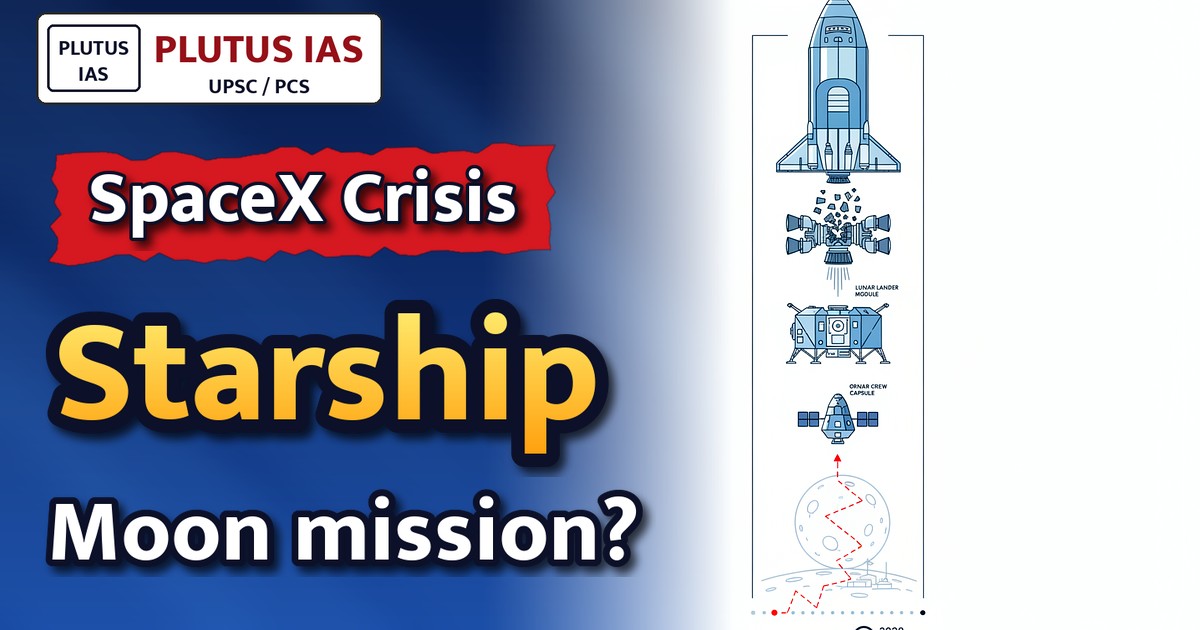
30 Sep Starship Engine Failure: Impact on NASA’s Artemis Moon Mission Plans
✎ The reliability of propulsion systems in reusable launch vehicles like SpaceX’s Starship is a critical determinant of NASA’s Artemis programme timeline, with engine failures directly impacting lunar mission readiness.
Subject Relevance — Where This Topic Fits
- GS Paper III — Science and Technology — Developments and their Applications and Effects in Everyday Life | GS Paper III — Science and Technology — Awareness in the fields of IT, Space, Computers, Robotics, Nano-technology, Bio-technology
- Prelims: Starship, Raptor engine, Artemis programme, lunar lander, propulsion technology, reusable launch vehicle, orbital test flight, Human Landing System, NASA, SpaceX, Blue Origin, lunar surface mission, Earth-orbit test, rendezvous and docking
- Essay: The interplay between private innovation and public space exploration: A case study of NASA’s Artemis programme, The role of engineering reliability in high-stakes technological endeavours: Lessons from space missions
Quick Revision: The reliability of propulsion systems in reusable launch vehicles like SpaceX’s Starship is a critical determinant of NASA’s Artemis programme timeline, with engine failures directly impacting lunar mission readiness.
Why is this in the news?
The recent failure of a Raptor engine on SpaceX’s Starship during its 14th uncrewed test flight has introduced critical uncertainties into the development timeline of NASA’s Artemis programme, which aims to return humans to the lunar surface by 2028. The Starship is designated as one of two lunar landers under the programme, and any delay in its readiness could impact the broader schedule of Artemis missions, including the Earth-orbit rehearsal mission (Artemis III) planned for 2027. This incident underscores the challenges of engineering reliability in reusable launch vehicles and the strategic dependencies between public space agencies and private aerospace entities.
Background
- NASA’s Artemis programme is a multi-national effort to establish sustainable human presence on the Moon, including the lunar south pole, by the end of the decade.
- The programme leverages public-private partnerships, with SpaceX and Blue Origin contracted to develop lunar landers under NASA’s Human Landing System (HLS) initiative.
- SpaceX’s Starship is designed as a fully reusable, super-heavy lift launch vehicle, intended to carry crew and cargo to Earth orbit, the Moon, and potentially Mars.
- The Raptor engine, powered by liquid methane and oxygen, is central to Starship’s propulsion system, enabling both ascent and in-space manoeuvres.
- Previous Starship test flights have encountered engine-related issues, including failed ignitions and in-space engine relights, highlighting the technical complexity of reusable rocket systems.
- China’s lunar ambitions, including a planned crewed mission by 2030, add geopolitical urgency to NASA’s timeline for returning astronauts to the Moon.
What is NASA’s Artemis Programme and SpaceX’s Starship?
- NASA’s Artemis programme is a phased lunar exploration initiative aimed at returning humans to the Moon by 2028, utilising the Space Launch System (SLS) rocket and Orion spacecraft for crewed missions.
- The programme includes Artemis I (uncrewed lunar flyby), Artemis II (crewed lunar flyby), Artemis III (crewed lunar landing), and subsequent missions for lunar habitat construction and resource utilisation.
- SpaceX’s Starship is a two-stage, fully reusable launch vehicle under development, designed to transport up to 100 metric tonnes of payload to low Earth orbit and support deep-space missions.
- The Starship lunar lander variant is being developed under NASA’s HLS contract, which requires it to demonstrate capabilities for lunar descent, ascent, and in-space refuelling.
- Blue Origin’s Blue Moon lander is the other competitor under the HLS programme, employing a more traditional propulsion architecture compared to Starship’s methane-based Raptor engines.
- The Raptor engine utilises a staged-combustion cycle, offering higher efficiency and reusability compared to conventional rocket engines, but also introducing greater engineering complexity.
- The programme’s success hinges on overcoming technical challenges in propulsion, life support, and lunar surface operations, while managing schedule pressures and budgetary constraints.
Key Features
| Feature | Significance |
|---|---|
| Starship lunar lander | Primary vehicle for NASA’s Artemis programme’s crewed lunar landing missions, replacing the Apollo-era Lunar Module. |
| Raptor engine technology | Next-generation methane-fuelled engines critical for in-space manoeuvring and lunar descent/ascent, offering higher efficiency than traditional hypergolic systems. |
| Orbital test flights | Progressive uncrewed tests validating stage separation, orbital insertion, and payload deployment, reducing risks for future crewed missions. |
| Human Landing System (HLS) selection | NASA’s dual-lander strategy (Starship HLS vs Blue Origin’s Blue Moon) to ensure redundancy and competitive timelines for Artemis III. |
| Artemis III rehearsal mission | Earth-orbit test in 2027 to validate rendezvous, docking, and life-support systems before the lunar landing attempt. |
Why it Matters
Scientific and Technological
- Advancement of reusable heavy-lift launch systems, reducing the cost per kilogram of payload to the Moon and enabling sustained lunar exploration.
- Demonstration of in-space refuelling and orbital manoeuvring, essential for future deep-space missions, including Mars landings.
- Validation of methane-based propulsion, a cleaner and more sustainable alternative to traditional hypergolic fuels, aligning with long-term space sustainability goals.
Geopolitical and Strategic
- Competition between the United States and China in lunar exploration, with both nations targeting crewed missions by 2028–2030, underscoring the strategic importance of the Moon as a staging ground for deeper space exploration.
- Reinforcement of the Artemis Accords, a multilateral framework led by NASA to govern civil space cooperation, including resource utilisation and peaceful exploration.
- Potential for private-sector leadership (SpaceX, Blue Origin) to redefine global space governance, shifting focus from state-led to commercially driven lunar missions.
Economic and Industrial
- Stimulation of the commercial space sector, particularly in satellite broadband (Starlink) and lunar infrastructure, creating new economic opportunities beyond Earth orbit.
- Acceleration of supply-chain development for aerospace components, including advanced propulsion systems and life-support technologies.
- Impact on India’s space sector: opportunities for collaboration in lunar science, payload delivery, or technology transfer under international partnerships.
Policy and Institutional
- NASA’s reliance on public-private partnerships (PPP) to achieve Artemis goals, demonstrating a model for future space exploration missions.
- Risk-sharing between NASA and commercial partners, where delays or failures in one system (e.g., Starship) do not derail the entire programme but trigger contingency planning.
- Emphasis on schedule-driven decision-making in space programmes, balancing technical readiness with political timelines and international competition.
Challenges
1. Engine Reliability and Propulsion System Failures
- Recurring issues with Raptor engines, including ignition failures and in-flight malfunctions, raise concerns about the robustness of SpaceX’s propulsion technology.
- Potential need for design modifications or fleet-wide upgrades if the latest failure indicates systemic flaws rather than isolated defects.
- Impact on Artemis III timeline: any delay in Starship’s readiness may force NASA to revise mission schedules or rely solely on Blue Origin’s Blue Moon lander.
UPSC Link: Science & Technology: Space missions and propulsion systems
2. Technical Complexity of Lunar Landing Systems
- Lunar descent and ascent require precise engine throttling and fuel management, posing higher technical challenges than orbital missions.
- Integration of life-support systems, radiation shielding, and crew safety protocols into the lander design adds layers of complexity.
- Need for extensive ground testing and simulation to validate performance in the Moon’s low-gravity and vacuum environment.
UPSC Link: Science & Technology: Lunar mission engineering
3. Schedule Pressure and Mission Timelines
- NASA’s target of 2028 for crewed lunar landing is widely regarded as ambitious, with Artemis III’s Earth-orbit rehearsal scheduled for 2027.
- Delays in Starship’s development could necessitate adjustments to Artemis III’s objectives or reliance on alternative landers, affecting mission architecture.
- International competition with China’s planned 2030 crewed lunar mission adds urgency to NASA’s timeline.
UPSC Link: Science & Technology: Mission planning and timelines
4. Regulatory and Safety Compliance
- Ensuring compliance with NASA’s safety and certification standards for human spaceflight, including failure mode analysis and abort systems.
- Coordination with international partners under the Artemis Accords to align safety protocols and liability frameworks.
- Public accountability for taxpayer-funded programmes, requiring transparent reporting of technical setbacks and mitigation strategies.
UPSC Link: Governance: Regulatory frameworks for space missions
5. Supply Chain and Industrial Readiness
- Dependence on a limited number of suppliers for critical components (e.g., Raptor engines, heat shields) could create bottlenecks in production.
- Scalability challenges in manufacturing reusable spacecraft at the required rate to meet mission demands.
- Potential delays in securing raw materials (e.g., stainless steel, methane) for large-scale production.
UPSC Link: Economy: Supply chain resilience in aerospace
Challenges — UPSC Perspective
| Issue | Concern |
|---|---|
| Engine malfunction during flight | Risk of catastrophic failure during crewed lunar descent or ascent, threatening mission success and astronaut safety. |
| Schedule slippage for Artemis III | Potential misalignment with NASA’s 2028 lunar landing target, necessitating contingency planning or reliance on alternative landers. |
| Technical validation of lunar lander systems | Insufficient ground or in-space testing to confirm reliability of descent/ascent profiles and life-support integration. |
| International competition with China | Pressure to outpace China’s lunar programme, which may influence NASA’s risk tolerance and mission prioritisation. |
| Public-private partnership risks | Misalignment of commercial timelines with NASA’s safety and certification requirements, leading to delays or cost overruns. |
Way Forward
- Accelerate post-flight analysis of the Raptor engine failure to isolate root causes and implement corrective measures without compromising safety.
- Enhance collaboration between NASA and SpaceX to align technical milestones with Artemis III’s rehearsal mission in 2027.
- Expand contingency planning to include alternative lunar landers (e.g., Blue Origin’s Blue Moon) to mitigate risks associated with Starship delays.
- Invest in advanced simulation and testing facilities to validate lunar landing profiles and propulsion systems under realistic conditions.
- Strengthen regulatory frameworks to ensure transparency in reporting technical setbacks while maintaining public trust in space programmes.
- Promote international partnerships under the Artemis Accords to share technical expertise, reduce duplication of effort, and enhance mission resilience.
- Develop scalable supply chains for aerospace components to prevent bottlenecks in production and ensure timely delivery of critical systems.
UPSC Value Addition
Keywords for Mains Answer-Writing
SpaceX Starship · NASA Artemis Programme · Lunar Lander Development · Raptor Engine Failure · Human Landing System · Blue Origin Blue Moon · Space Exploration Policy · Aerospace Propulsion Technology · Artemis III Mission · SpaceX Starlink · SpaceX Raptor Engine · Lunar Surface Landing · Space Transportation System · Commercial Spaceflight · Space Launch System
Concept Flow
SpaceX’s Starship undergoes uncrewed test flight → Raptor engine malfunction occurs post-stage separation → Technical investigation identifies failure mode → Impact on propulsion system reliability is assessed → NASA evaluates Artemis III timeline adjustments → Alternative landers (Blue Moon) are considered as backup → International competition with China intensifies → Public-private partnership model is tested for resilience → Regulatory and safety compliance is revalidated.
Prelims Practice Questions
Q1. Consider the following statements regarding NASA’s Artemis Programme:
1. The Artemis Programme aims to return humans to the Moon by 2028.
2. NASA has contracted two lunar landers for the programme: one by SpaceX and another by Blue Origin.
3. The Artemis III mission is intended to be a crewed lunar landing mission.
4. The programme seeks to land astronauts on the Moon before China, which plans a crewed mission by 2030.
How many of the above statements are correct?
- Only one
- Only two
- Only three
- All
Answer: All — Statements 1, 2, and 4 are correct. Statement 3 is incorrect as Artemis III is an Earth-orbit test mission, not a crewed lunar landing.
Q2. Assertion (A): The Raptor engine used in SpaceX’s Starship is critical for NASA’s Artemis Programme as it is designed to carry astronauts to and from the lunar surface.
Reason (R): The Raptor engine is a next-generation propulsion system developed by SpaceX for its reusable spacecraft, Starship.
Options:
A. Both A and R are true, and R is the correct explanation of A.
B. Both A and R are true, but R is not the correct explanation of A.
C. A is true, but R is false.
D. A is false, but R is true.
Answer: ? — Both Assertion (A) and Reason (R) are true, and R correctly explains A as the Raptor engine’s role in Starship’s propulsion is essential for lunar missions under Artemis.
Q3. Match the following lunar missions with their respective space agencies:
Column I (Mission) | Column II (Space Agency)
——————-|———————-
1. Artemis Programme | A. SpaceX
2. Blue Moon Lander | B. NASA
3. Starship | C. Blue Origin
4. Starlink | D. ISRO
Options:
A. 1-B, 2-C, 3-A, 4-D
B. 1-A, 2-B, 3-C, 4-D
C. 1-B, 2-A, 3-C, 4-D
D. 1-C, 2-B, 3-A, 4-D
Answer: ? — Correct matches: Artemis Programme (NASA), Blue Moon Lander (Blue Origin), Starship (SpaceX), Starlink (SpaceX).
Mains Practice Question
✍ Critically examine the role of commercial spaceflight entities, such as SpaceX and Blue Origin, in advancing NASA’s Artemis Programme. Also, analyse the challenges posed by recent technical failures, such as the Raptor engine malfunction in SpaceX’s Starship, to the programme’s timeline and objectives. (15 Marks)
Approach: MODEL-ANSWER SKELETON:
1. **Introduction (2 marks)**: Define NASA’s Artemis Programme and its objectives (return humans to the Moon, establish sustainable lunar presence). Mention the role of commercial entities (SpaceX, Blue Origin) under the Human Landing System (HLS) contracts.
2. **Commercial Spaceflight in Artemis (5 marks)**:
– Explain the Public-Private Partnership (PPP) model adopted by NASA for lunar lander development (reference NASA’s HLS contracts).
– Discuss SpaceX’s Starship and Blue Origin’s Blue Moon lander as key components of Artemis.
– Highlight the advantages of commercial involvement: cost-efficiency, innovation, and speed of development.
– Cite examples of successful commercial spaceflight collaborations (e.g., SpaceX’s Crew Dragon for ISS missions).
3. **Challenges and Technical Failures (5 marks)**:
– Analyse the impact of the Raptor engine failure in SpaceX’s Starship on Artemis’ timeline (reference NASA’s 2028 target for crewed lunar landing).
– Discuss the broader implications of propulsion system failures on mission safety and reliability.
– Compare with Blue Origin’s Blue Moon lander, which uses a more traditional design (potential advantage in stability).
– Mention the competitive pressure from China’s lunar ambitions (target: 2030).
4. **Conclusion and Way Forward (3 marks)**:
– Emphasise the need for rigorous testing and iterative improvements in propulsion technology.
– Suggest policy measures to balance speed with safety (e.g., phased testing, redundancy in systems).
– Conclude with the importance of international collaboration and sustained funding for long-term space exploration goals.
Source: Times of India
Generated by AanyaAi for educational purpose.
Related guides on our sites
- Anthropology VS PSIR
- Best PSIR optional coaching
- Best PSIR optional coaching online
- Best PSIR optional teacher

- एसिमिलिपाल के पास अवैध पत्थर खनन: एनएचआरसी ने रिपोर्ट मांगी - September 30, 2026
- NRIDA-IIM Kolkata MoU to Study PMGSY-IV & PM-JANMAN Impact for 4 Years - September 30, 2026
- जम्मू-कश्मीर: अनुच्छेद 370 से राज्यत्व तक का संवैधानिक सफर - September 30, 2026

No Comments