


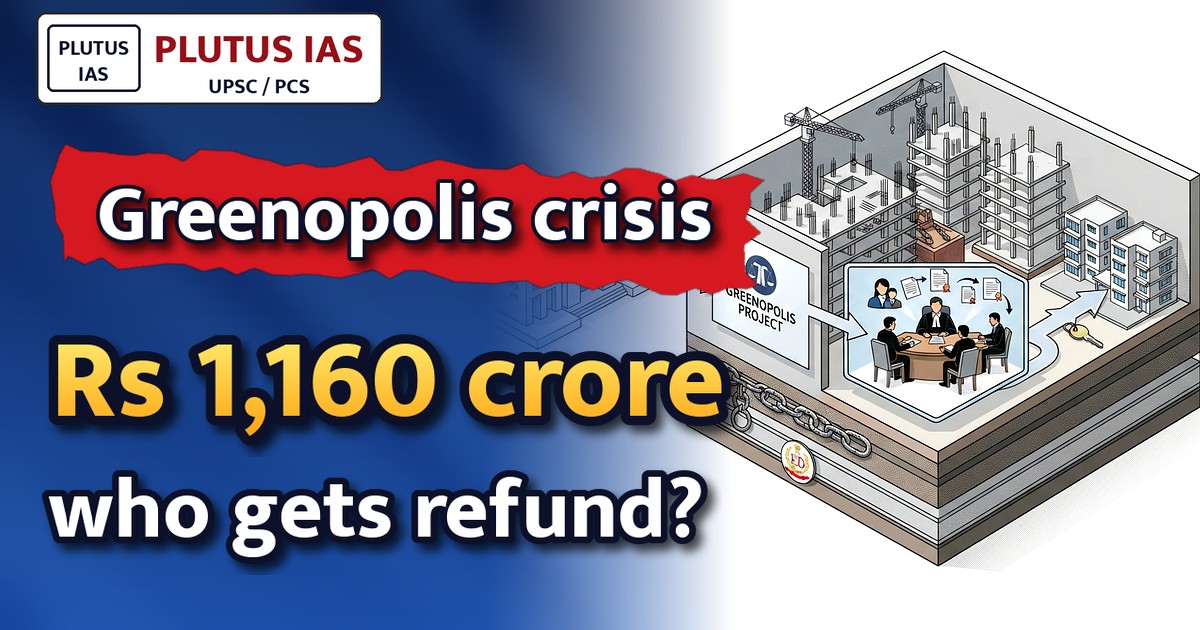
30 Sep Delhi HC forms panel with ex-CJI Khanna to resolve Greenopolis homebuyers’ claims
✎ The Delhi High Court’s monitoring committee for Greenopolis homebuyers exemplifies judicial intervention in real estate disputes, leveraging the PMLA framework to adjudicate claims while ensuring transparency and expeditious…
Subject Relevance — Where This Topic Fits
- GS Paper II — Judiciary and Judicial Review (Role of High Courts) | GS Paper III — Consumer Protection and Regulatory Frameworks in Real Estate
- Prelims: Real Estate (Regulation and Development) Act, 2016 (RERA), Enforcement Directorate (ED), Prevention of Money Laundering Act (PMLA) 2002, Money Laundering, Attachment of Assets, Homebuyer Grievances
- Essay: Judicial Activism and Consumer Rights: Balancing Efficiency and Justice, Regulatory Failures in Real Estate: Causes and Consequences
Quick Revision: The Delhi High Court’s monitoring committee for Greenopolis homebuyers exemplifies judicial intervention in real estate disputes, leveraging the PMLA framework to adjudicate claims while ensuring transparency and expeditious relief for affected homebuyers.
Why is this in the news?
The Delhi High Court has constituted a three-member monitoring committee led by former Chief Justice of India (CJI) Sanjiv Khanna to adjudicate claims of genuine homebuyers in the stalled Greenopolis residential project in Gurugram. This intervention underscores the judiciary’s role in addressing systemic failures in real estate regulation, financial misappropriation, and the protracted grievances of homebuyers, particularly in the context of asset attachment by the Enforcement Directorate (ED) under the Prevention of Money Laundering Act (PMLA). The case highlights the intersection of judicial oversight, regulatory enforcement, and consumer protection in India’s real estate sector.
Background
- The Greenopolis project, launched in 2012 in Sector 89 of Gurugram, was envisaged as a residential development by M/s Three C Shelters Pvt. Ltd. (3C Shelters) and M/s Orris Infrastructure Pvt. Ltd. (Orris).
- Approximately 1,650 units were allotted to homebuyers out of the planned 1,862, with 65% receiving allotment letters from 3C Shelters and 35% from Orris.
- The project was abandoned midway, leading to widespread grievances from homebuyers who alleged financial misappropriation by the developers.
- Between 2016–2017, the Enforcement Directorate (ED) initiated investigations under the Prevention of Money Laundering Act (PMLA) against the developers, culminating in a chargesheet filed in July 2025.
- The ED attached properties and assets of the developers, though the PMLA court subsequently dropped charges against Orris in October–November 2025, a decision later set aside by the Delhi High Court.
- The homebuyers, having collectively invested over ₹1,160 crore (₹776.60 crore to 3C Shelters and ₹383.06 crore to Orris), sought either possession of their units with delay penalties or full refunds with interest.
What is the Greenopolis Monitoring Committee?
- The Delhi High Court constituted a three-member monitoring committee headed by former Chief Justice of India (CJI) Sanjiv Khanna to adjudicate claims of genuine homebuyers in the Greenopolis project.
- The committee includes two former Delhi Higher Judicial Services officers, H.S. Sharma and Ajay Kuhar, tasked with verifying the genuineness of homebuyers and the quantum of payments made.
- The committee will formulate an expeditious and transparent procedure, cross-referencing material provided by the Enforcement Directorate (ED) and the homebuyers to determine eligibility for refunds or possession.
- The committee’s mandate includes adjudicating claims based on the status of asset attachment by the ED, ensuring that only genuine homebuyers are considered for relief.
- The intervention by the Delhi High Court reflects the judiciary’s proactive stance in addressing systemic failures in real estate regulation and financial oversight.
- The case underscores the challenges faced by homebuyers in stalled projects, where regulatory gaps and financial irregularities exacerbate their grievances.
- The monitoring committee’s proceedings will provide a structured mechanism for dispute resolution, balancing the interests of homebuyers, developers, and regulatory authorities.
Key Features
| Feature | Significance |
|---|---|
| Monitoring Committee under former CJI Sanjiv Khanna | Ensures judicial oversight in verifying genuine homebuyers and adjudicating claims, enhancing credibility and transparency in the resolution process. |
| Cross-referencing with ED records | Leverages investigative findings of the Enforcement Directorate to distinguish legitimate claims from potential malfeasance, ensuring evidence-based adjudication. |
| Status of asset attachment by ED | Determines the recoverable quantum for homebuyers by assessing the extent of financial restitution available from attached developer assets. |
| Expeditious and transparent procedure | Addresses delays in redressal by establishing a structured timeline for claim verification and disbursement, mitigating prolonged uncertainty for homebuyers. |
| PMLA court’s role in property restoration | Highlights the legal interplay between anti-money laundering provisions and property rights, influencing the recovery of assets for homebuyers. |
Why it Matters
Economic
- Protects the financial interests of homebuyers by ensuring either possession of units or refunds, thereby safeguarding consumer confidence in the real estate sector.
- Prevents systemic erosion of trust in real estate investments by addressing fraudulent practices through judicial and investigative mechanisms.
- Facilitates the recovery of siphoned funds through asset attachment under PMLA, contributing to the broader fight against financial crimes.
Legal-Judicial
- Demonstrates the judiciary’s proactive role in resolving complex financial disputes involving multiple stakeholders and regulatory agencies.
- Sets a precedent for the use of monitoring committees in real estate disputes to ensure fair and timely redressal.
- Clarifies the jurisdiction and interplay between PMLA courts and civil courts in matters of asset attachment and homebuyer claims.
Governance and Policy
- Underscores the need for robust regulatory frameworks to prevent diversion of homebuyer funds, such as the Real Estate (Regulation and Development) Act, 2016 (RERA).
- Highlights the role of investigative agencies like the ED in tracing and attaching proceeds of crime, reinforcing the effectiveness of anti-money laundering laws.
- Emphasizes the importance of inter-agency coordination between judicial bodies, enforcement agencies, and regulatory authorities in resolving multi-dimensional disputes.
Challenges
1. Verification of genuine homebuyers
- Distinguishing between genuine homebuyers and potential beneficiaries of fraudulent transactions requires meticulous documentation and cross-verification.
- Delays in record-keeping by developers and regulatory agencies can impede the adjudication process.
- Risk of misclassification leading to either exclusion of legitimate claims or inclusion of fraudulent ones.
UPSC Link: GS-II: Consumer Protection & Judicial Reforms
2. Asset recovery under PMLA
- Legal challenges to attachment orders by developers can prolong the recovery process, delaying restitution to homebuyers.
- Complexities in tracing and attaching assets across jurisdictions, especially in cases involving shell companies or benami properties.
- Potential for asset dissipation before attachment, reducing the quantum available for homebuyers.
UPSC Link: GS-III: Money Laundering & Financial Crimes
3. Coordination between agencies
- Ensuring seamless collaboration between the judiciary, ED, RERA authorities, and civil courts to avoid conflicting orders.
- Differing interpretations of legal provisions across agencies may lead to procedural bottlenecks.
- Resource constraints in investigative agencies may delay the attachment and verification processes.
UPSC Link: GS-II: Inter-State Coordination & Governance
4. Delays in project completion
- Prolonged disputes erode homebuyers’ trust in the real estate sector, impacting future investments.
- Financial strain on homebuyers due to blocked funds and uncertainty over possession timelines.
- Potential for secondary litigation by developers or third parties contesting attachment orders.
UPSC Link: GS-III: Real Estate Sector & Consumer Rights
5. Regulatory gaps in fund diversion
- Lack of stringent monitoring of developer finances post-receipt of homebuyer funds, enabling siphoning of amounts.
- Inadequate penalties or deterrents for developers involved in fraudulent practices.
- Need for real-time tracking of fund utilization by regulatory authorities to prevent diversion.
UPSC Link: GS-II: Regulatory Framework for Real Estate
Challenges — UPSC Perspective
| Issue | Concern |
|---|---|
| Documentation gaps | Incomplete or inconsistent records by developers hinder verification of homebuyer claims. |
| Legal delays in attachment | Prolonged litigation over attachment orders reduces the quantum available for restitution. |
| Inter-agency conflicts | Divergent interpretations of laws by courts and agencies create procedural bottlenecks. |
| Asset dissipation | Risk of developers transferring assets before attachment, limiting recovery for homebuyers. |
| Homebuyer financial strain | Prolonged disputes lead to liquidity constraints and psychological stress for affected buyers. |
| Regulatory enforcement gaps | Lack of real-time monitoring of fund utilization by developers enables fraudulent practices. |
Way Forward
- The monitoring committee should establish a standardized protocol for claim verification, incorporating digital verification tools to expedite the process.
- Strengthen coordination between the ED, RERA authorities, and civil courts to synchronize attachment orders and avoid conflicting directives.
- Enhance transparency by publishing periodic updates on the status of claims, asset attachments, and disbursements on a dedicated portal.
- Introduce mandatory real-time tracking of homebuyer funds by regulatory authorities to prevent diversion and ensure accountability.
- Expand the scope of the monitoring committee to include representatives from consumer forums and RERA to ensure holistic redressal.
- Formulate a grievance redressal mechanism for homebuyers to report discrepancies or delays in the verification process.
- Conduct awareness campaigns to educate homebuyers on their rights and the legal recourse available under RERA and PMLA.
- Explore the establishment of a dedicated fund, financed by penalties imposed on errant developers, to compensate homebuyers in cases of insolvency.
UPSC Value Addition
Keywords for Mains Answer-Writing
Greenopolis project · homebuyers’ grievances · Delhi High Court · Enforcement Directorate (ED) · Prevention of Money Laundering Act (PMLA) · monitoring committee · ex-CJI Sanjiv Khanna · attached assets under PMLA · real estate regulatory framework · consumer protection in housing · money laundering investigations · judicial oversight in economic offences · homebuyers’ rights · property attachment orders · judicial remedies for stalled projects
Concept Flow
Homebuyers invest in Greenopolis project → Developers abandon project and allegedly siphon funds → Homebuyers file complaints with Delhi HC → ED initiates PMLA proceedings and attaches assets → PMLA court restores attached properties → Delhi HC forms monitoring committee to verify claims → Committee cross-references ED records and homebuyer payments → Adjudicates genuine claims and determines restitution quantum → Homebuyers receive either possession or refunds with interest
Prelims Practice Questions
Q1. Consider the following statements regarding the Prevention of Money Laundering Act (PMLA), 2002:
1. The PMLA empowers the Enforcement Directorate (ED) to attach properties involved in money laundering.
2. Under PMLA, the attachment of properties can be challenged before the Special Court designated under the Act.
3. The PMLA court has the power to restore attached properties without any conditions.
How many of the above statements are correct?
- Only one
- Only two
- All three
- None
Answer: Only two — Statement 1 is correct as PMLA empowers ED to provisionally attach properties involved in money laundering. Statement 2 is correct as PMLA provides for a Special Court to adjudicate on attachment orders. Statement 3 is incorrect as the PMLA court cannot restore attached properties without conditions; restoration is subject to legal scrutiny.
Q2. Assertion (A): The Prevention of Money Laundering Act (PMLA) is primarily aimed at preventing the conversion of illegal money into legitimate assets.
Reason (R): The PMLA mandates the attachment of properties involved in money laundering to prevent their misuse.
In the context of the two statements above, choose the correct option:
- Both A and R are true and R is the correct explanation of A
- Both A and R are true but R is not the correct explanation of A
- A is true but R is false
- A is false but R is true
Answer: Both A and R are true and R is the correct explanation of A — Assertion (A) is true as PMLA’s primary objective is to prevent money laundering, i.e., converting illegal money into legitimate assets. Reason (R) is also true as PMLA empowers attachment of properties involved in money laundering. However, R is not the correct explanation of A, as the attachment is a means to achieve the broader objective of preventing money laundering.
Q3. Match the following pairs related to judicial institutions in India:
Column I (Institution) — Column II (Function/Power)
A. Enforcement Directorate (ED) — 1. Adjudicates attachment orders under PMLA
B. Special Court under PMLA — 2. Investigates money laundering cases
C. Delhi High Court — 3. Constitutes monitoring committees for grievance redressal
D. Supreme Court — 4. Highest appellate authority in constitutional matters
Which of the following is the correct match?
- A-2, B-1, C-3, D-4
- A-1, B-2, C-3, D-4
- A-3, B-1, C-2, D-4
- A-2, B-3, C-1, D-4
Answer: A-2, B-1, C-3, D-4 — The correct match is: A (Enforcement Directorate) – 2 (Investigates money laundering cases), B (Special Court under PMLA) – 1 (Adjudicates attachment orders under PMLA), C (Delhi High Court) – 3 (Constitutes monitoring committees for grievance redressal), D (Supreme Court) – 4 (Highest appellate authority in constitutional matters).
Mains Practice Question
✍ The Delhi High Court’s constitution of a monitoring committee headed by former Chief Justice of India Sanjiv Khanna to adjudicate claims of genuine homebuyers in the stalled Greenopolis project underscores the judiciary’s expanding role in addressing economic offences and consumer grievances in the real estate sector. Critically examine the legal and institutional mechanisms available for the protection of homebuyers’ rights in India, with particular reference to the interplay between judicial oversight, regulatory frameworks, and investigative agencies. (15 Marks)
Approach: MODEL-ANSWER SKELETON:
1. **Introduction (2 marks)**: Define the context—stalled real estate projects and homebuyers’ grievances. Highlight the Greenopolis case as a contemporary example.
2. **Legal Framework for Homebuyers’ Protection (4 marks)**:
– **Real Estate (Regulation and Development) Act, 2016 (RERA)**: Role of RERA authorities, registration of projects, and dispute resolution mechanisms.
– **Insolvency and Bankruptcy Code (IBC), 2016**: Treatment of homebuyers as financial creditors under Section 7 of IBC and its implications.
– **Consumer Protection Act, 2019**: Jurisdiction of Consumer Commissions for deficiency in service.
– **Specific Relief Act, 1963**: Remedies for specific performance of contracts.
3. **Judicial Oversight and Monitoring Committees (4 marks)**:
– **Constitutional basis**: Article 226 (High Court writ jurisdiction) and Article 32 (Supreme Court writ jurisdiction) for judicial intervention.
– **Role of monitoring committees**: As seen in Greenopolis case—transparency, expedited adjudication, and coordination with investigative agencies (ED under PMLA).
– **Judicial precedents**: Reference to landmark judgments like Kolkata West International City (2019) and Pioneer Urban Land & Infrastructure Ltd. v. Union of India (2019).
4. **Interplay with Investigative Agencies (3 marks)**:
– **Enforcement Directorate (ED) and PMLA**: Powers of attachment under Section 5 of PMLA and challenges in restoration of properties.
– **Money laundering investigations**: Impact on homebuyers’ claims and the need for coordination between ED and judicial forums.
– **Challenges**: Delay in investigations, multiplicity of forums, and lack of uniform standards for verification of genuine homebuyers.
5. **Critical Evaluation and Way Forward (2 marks)**:
– **Strengths**: Judicial activism in protecting consumer rights, use of monitoring committees for expedited redressal.
– **Limitations**: Overlapping jurisdictions, delays in judicial processes, and lack of comprehensive data on homebuyers’ claims.
– **Suggestions**: Strengthening RERA implementation, expediting IBC proceedings for homebuyers, and creating a centralized database for real estate projects.
Source: The Indian Express
Delhi PCS (DSSSB) — State PCS Practice
Prelims: The Delhi High Court recently constituted a panel headed by former Chief Justice of India Sanjiv Khanna to assess claims of homebuyers in which project?
- A. Unitech Emerald Bay
- B. Greenopolis
- C. Parsvnath Panorama
- D. Jaypee Infratech
Answer: B. Greenopolis — The panel was formed to address the grievances of homebuyers in the Greenopolis project, a residential development in Delhi.
Mains: Discuss the role of the judiciary in safeguarding the rights of homebuyers in Delhi, with special reference to the formation of expert panels by the Delhi High Court. (200 words)
Generated by AanyaAi for educational purpose.
Related guides on our sites
- Best PSIR optional coaching in delhi for UPSC
- Best PSIR optional coaching for upsc
- Best PSIR optional teacher for upsc
- Best teacher of PSIR optional for upsc

- E-Waste Management Workshop by Law Department for UPSC Aspirants - September 30, 2026
- सुप्रीम कोर्ट का बड़ा फैसला: बंद निगमों के कर्मचारियों को मिलेगा एक लाख मुआवजा - September 30, 2026
- West Bengal’s Transport Roadmap: AI Signals, Tram Revival & River Links - September 30, 2026

No Comments