


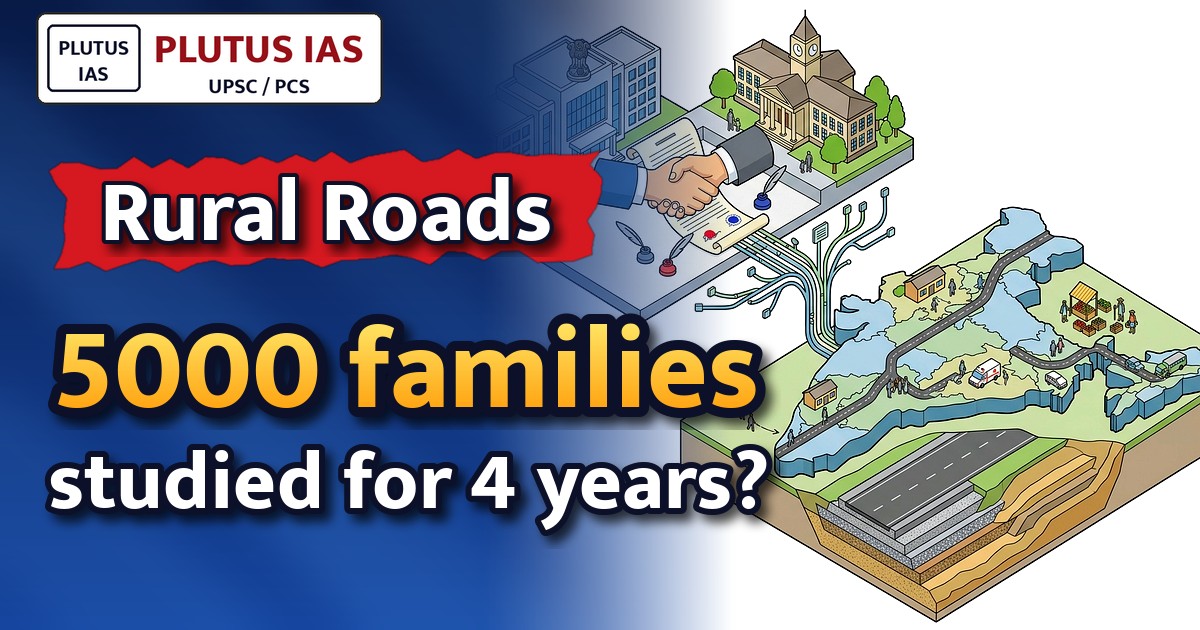
30 Sep NRIDA-IIM Kolkata MoU to Study PMGSY-IV & PM-JANMAN Impact for 4 Years
✎ Longitudinal Impact Assessment of rural road connectivity under PMGSY-IV and PM-JANMAN will evaluate sustained socio-economic benefits, mobility, and access to essential services over four years, covering 10 states and 5,000…
Subject Relevance — Where This Topic Fits
- GS Paper II — Governance, Transparency and Accountability | GS Paper III — Infrastructure: Energy, Ports, Roads, Airports, Railways
- Prelims: PMGSY, PM-JANMAN, NRIDA, Longitudinal Impact Assessment, Rural Connectivity, Baseline Survey, Endline Survey, Convergence, Evidence-based Policy
- Essay: Role of Infrastructure in Rural Development: Bridging the Urban-Rural Divide, Evidence-Based Governance: Transforming Policy through Data and Research
Quick Revision: Longitudinal Impact Assessment of rural road connectivity under PMGSY-IV and PM-JANMAN will evaluate sustained socio-economic benefits, mobility, and access to essential services over four years, covering 10 states and 5,000 households.
Why is this in the news?
The signing of a Memorandum of Understanding (MoU) between the National Rural Infrastructure Development Agency (NRIDA) and the Indian Institute of Management Calcutta (IIM-C) marks a significant governance initiative aimed at conducting a four-year longitudinal impact assessment of rural road connectivity under the Pradhan Mantri Gram Sadak Yojana (PMGSY-IV) and Pradhan Mantri Janjati Adivasi Nyaya Maha Abhiyan (PM-JANMAN). This collaboration underscores the government’s commitment to evidence-based policymaking by evaluating the sustained socio-economic and developmental impacts of rural road infrastructure on marginalised communities across 10 states and Union Territories.
Background
- The Pradhan Mantri Gram Sadak Yojana (PMGSY), launched in 2000, is a flagship rural infrastructure scheme aimed at providing all-weather road connectivity to unconnected habitations as per the Census 2001.
- PMGSY-IV, the latest phase, focuses on the consolidation and upgradation of rural road networks, ensuring durability, climate resilience, and improved accessibility.
- The Pradhan Mantri Janjati Adivasi Nyaya Maka Abhiyan (PM-JANMAN), launched in November 2023, targets the socio-economic development of Particularly Vulnerable Tribal Groups (PVTGs) through targeted interventions, including infrastructure development.
- NRIDA, an autonomous body under the Ministry of Rural Development (MoRD), serves as the nodal agency for implementing rural infrastructure schemes, including PMGSY and PM-JANMAN.
- The longitudinal study aligns with the broader objective of the Sustainable Development Goals (SDG 9: Industry, Innovation, and Infrastructure) and SDG 10 (Reduced Inequalities) by assessing the equitable distribution of developmental benefits.
- Prior impact assessments of rural road connectivity, such as those conducted under PMGSY-I and II, have highlighted improvements in market access, healthcare, and educational outcomes, though long-term sustainability remains a critical area of inquiry.
What is the Longitudinal Impact Assessment of Rural Road Connectivity?
- A four-year longitudinal study to evaluate the sustained socio-economic and developmental impacts of rural road connectivity under PMGSY-IV and PM-JANMAN, covering 10 states/UTs, 50 districts, 150 blocks, and 250 roads.
- The study employs a longitudinal approach, involving baseline surveys (pre-construction) and endline surveys (22 months post-construction), covering approximately 5,000 households.
- Key parameters assessed include changes in mobility, access to essential services (education, healthcare, markets), livelihood opportunities, income diversification, agricultural productivity, and migration patterns.
- The assessment will examine the differential impacts on vulnerable groups, including women, Scheduled Tribes (STs), Scheduled Castes (SCs), and marginalised communities, ensuring inclusivity in policy evaluation.
- The study aims to identify implementation gaps, emerging challenges, and areas requiring policy interventions to enhance the sustainability and equity of rural road connectivity programmes.
- Findings from the study will inform future rural road planning, evidence-based policymaking, and the design of targeted interventions under PMGSY-IV and PM-JANMAN.
- The collaboration between NRIDA and IIM Calcutta leverages academic expertise in econometrics, social sciences, and data analytics to ensure rigorous and unbiased impact assessment.
- The study aligns with the government’s broader agenda of ‘Sabka Saath, Sabka Vikas’ by ensuring that developmental benefits of rural infrastructure reach the most marginalised sections of society.
Key Features
| Feature | Significance |
|---|---|
| Longitudinal Impact Assessment | A four-year longitudinal study to evaluate the sustained socio-economic and developmental outcomes of rural road connectivity under PMGSY-IV and PM-JANMAN, ensuring evidence-based policy formulation. |
| Multi-State Coverage | Inclusion of 10 states/UTs (e.g., Assam, Jharkhand, Rajasthan) across 50 districts, 150 blocks, and 250 roads, ensuring geographic diversity in assessment. |
| Household Survey | Survey of approximately 5,000 households to measure changes in mobility, access, socio-economic conditions, and access to essential services over time. |
| Baseline and Endline Surveys | Conducted over 14 months (baseline) and 22 months (endline) with a 12-month transition period, enabling pre- and post-intervention comparisons. |
| Focus on Vulnerable Groups | Assessment of differential impacts across regions and vulnerable sections to identify disparities and inform targeted interventions. |
Why it Matters
Policy and Governance
- Strengthens evidence-based policymaking by providing empirical data on the long-term impacts of rural road connectivity schemes.
- Enhances the credibility of PMGSY-IV and PM-JANMAN by subjecting them to rigorous, independent evaluation.
- Facilitates data-driven decision-making for future rural infrastructure planning and resource allocation.
Economic Development
- Quantifies the economic benefits of rural road connectivity, including reduced travel time, lower transport costs, and improved market access.
- Assesses the impact on livelihoods, employment, and income diversification in rural areas.
- Evaluates the role of roads in reducing migration pressures by enhancing local economic opportunities.
Social Inclusion
- Examines the influence of rural roads on access to education, healthcare, and essential public services.
- Analyzes the impact on women’s empowerment, safety, and participation in socio-economic activities.
- Identifies barriers to equitable access and informs strategies for inclusive development.
Institutional Collaboration
- Demonstrates the value of inter-institutional partnerships (NRIDA, MORD, IIM Calcutta) in addressing complex developmental challenges.
- Highlights the role of academic institutions in providing rigorous analytical support for government initiatives.
Challenges
1. Data Collection and Survey Fatigue
- Ensuring high response rates and data quality over a four-year period, particularly in remote and conflict-prone regions.
- Mitigating survey fatigue among households to maintain consistency in longitudinal data collection.
UPSC Link: GS-III: Rural Development
2. Geographic and Demographic Diversity
- Addressing the logistical challenges of covering diverse terrains (e.g., hilly regions, tribal areas) and socio-economic groups.
- Ensuring representation of marginalized communities (e.g., Scheduled Tribes, women-headed households) in the survey sample.
UPSC Link: GS-I: Social Issues
3. Policy Translation and Implementation Gaps
- Translating study findings into actionable policy recommendations that address identified gaps in rural road connectivity schemes.
- Ensuring timely integration of evidence into future planning cycles to avoid delays in implementation.
UPSC Link: GS-II: Governance
4. Sustainability of Impact
- Evaluating whether the socio-economic benefits of rural roads are sustained over time or diminish due to external factors (e.g., climate change, economic shocks).
- Assessing the need for periodic maintenance and upgrades to preserve the long-term value of infrastructure investments.
UPSC Link: GS-III: Infrastructure
5. Stakeholder Coordination
- Ensuring seamless coordination among NRIDA, MORD, IIM Calcutta, and state governments to avoid duplication and ensure data consistency.
- Addressing potential conflicts between data collection objectives and local administrative priorities.
UPSC Link: GS-II: Cooperative Federalism
Challenges — UPSC Perspective
| Issue | Concern |
|---|---|
| Logistical Constraints | Difficulty in accessing remote or conflict-affected areas for data collection. |
| Data Quality | Risk of incomplete or inconsistent responses due to survey fatigue or respondent bias. |
| Policy Adoption | Challenges in translating research findings into practical policy interventions within bureaucratic timelines. |
| Sustainability Assessment | Uncertainty in measuring long-term impacts due to unforeseen external disruptions. |
| Inter-Institutional Alignment | Potential misalignment between academic research goals and government operational priorities. |
Government Initiatives — Must-Memorise for Prelims
- Pradhan Mantri Gram Sadak Yojana (PMGSY) Phase-IV
- Pradhan Mantri Janjati Adivasi Nyaya Maha Abhiyaan (PM-JANMAN)
Way Forward
- Establish a robust monitoring framework to track data collection progress and ensure adherence to timelines.
- Develop standardized protocols for household surveys to minimize respondent fatigue and ensure data consistency.
- Conduct periodic reviews with state governments to align survey activities with local administrative capacities.
- Publish interim reports to provide early insights and facilitate evidence-based mid-course corrections.
- Organize stakeholder workshops with policymakers, academics, and community representatives to discuss findings and policy implications.
- Integrate study results into the next cycle of rural road infrastructure planning under PMGSY and PM-JANMAN.
- Explore digital tools (e.g., GIS mapping, mobile data collection) to enhance data accuracy and reduce logistical burdens.
- Document best practices and lessons learned to inform similar longitudinal impact assessments in other sectors.
UPSC Value Addition
Keywords for Mains Answer-Writing
NRIDA · IIM Calcutta · PMGSY-IV · PM-JANMAN · Longitudinal Impact Assessment · Rural Connectivity · Evidence-Based Policy · Rural Infrastructure Development · Baseline and Endline Surveys · Socio-Economic Impact Assessment · Sustainable Development Goals · Multi-State Study · Government-NGO Collaboration · Rural Livelihoods · Access to Essential Services
Concept Flow
Rural road connectivity initiatives (PMGSY-IV, PM-JANMAN) → Implementation of infrastructure projects → Baseline survey to establish pre-intervention conditions → Longitudinal impact assessment over four years → Endline survey to measure post-intervention outcomes → Analysis of socio-economic, mobility, and access changes → Identification of policy gaps and challenges → Formulation of evidence-based recommendations for future planning.
Prelims Practice Questions
Q1. Consider the following statements regarding the National Rural Infrastructure Development Agency (NRIDA):
1. NRIDA operates under the Ministry of Rural Development, Government of India.
2. NRIDA is responsible for the implementation of PMGSY-IV.
3. NRIDA has signed an MoU with IIM Calcutta for a longitudinal impact assessment study of rural roads.
How many of the above statements are correct?
- Only one
- Only two
- Only three
- None
Answer: Only three — Statement 1 and 3 are correct. Statement 2 is incorrect as PMGSY-IV is implemented by the Ministry of Rural Development, but NRIDA’s role is broader and includes infrastructure development and impact assessment.
Q2. Assertion (A): The PM-JANMAN scheme aims to improve rural connectivity in tribal areas.
Reason (R): PM-JANMAN is a sub-scheme under the Pradhan Mantri Gram Sadak Yojana (PMGSY).
- Both A and R are true, and R is the correct explanation of A
- Both A and R are true, but R is NOT the correct explanation of A
- A is true but R is false
- A is false but R is true
Answer: A is true but R is false — Assertion (A) is true as PM-JANMAN targets tribal areas for rural connectivity. Reason (R) is true, but PM-JANMAN is not a sub-scheme under PMGSY; it is a separate initiative with overlapping objectives.
Q3. Match the following schemes with their primary objectives:
Column I (Scheme) | Column II (Primary Objective)
1. PMGSY-IV | A. Improving rural connectivity in tribal areas
2. PM-JANMAN | B. Comprehensive rural road network development
3. NRIDA | C. Evidence-based policy for rural infrastructure
4. IIM Calcutta | D. Academic research and impact assessment
- 1-B, 2-A, 3-C, 4-D; 1-A, 2-B, 3-C, 4-D; 1-C, 2-A, 3-B, 4-D; 1-D, 2-A, 3-C, 4-B
- answer_array_indexes_to_match_pairings_only_in_explain
- answer_explain_array_indexes_to_match_pairings_only_in_explain
Answer: ? — 1-B: PMGSY-IV aims at comprehensive rural road network development. 2-A: PM-JANMAN focuses on improving rural connectivity in tribal areas. 3-C: NRIDA is involved in rural infrastructure development and evidence-based policy. 4-D: IIM Calcutta is engaged in academic research and impact assessment.
Mains Practice Question
✍ Critically examine the significance of the longitudinal impact assessment study being undertaken by NRIDA and IIM Calcutta on rural road connectivity under PMGSY-IV and PM-JANMAN. How far does this study address the gaps in existing rural infrastructure evaluation mechanisms? (15 Marks)
Approach: MODEL-ANSWER SKELETON:
1. **Context and Objectives**:
– Briefly introduce PMGSY-IV and PM-JANMAN, their goals in rural connectivity, and the need for evidence-based policy.
– Highlight the role of NRIDA (National Rural Infrastructure Development Agency) and IIM Calcutta in this MoU.
2. **Significance of Longitudinal Impact Assessment**:
– Explain the concept of longitudinal studies in policy evaluation (baseline vs. endline surveys, multi-year data collection).
– Discuss how this study differs from traditional impact assessments (e.g., cross-sectional surveys, short-term evaluations).
– Emphasize the importance of tracking socio-economic changes over time (e.g., livelihoods, access to services, migration patterns).
3. **Addressing Gaps in Existing Mechanisms**:
– **Temporal Gaps**: Most rural infrastructure evaluations are short-term; this study spans four years, capturing long-term effects.
– **Geographical Scope**: The inclusion of 10 states/UTs, 50 districts, and 250 roads ensures a diverse sample, addressing regional disparities.
– **Multi-Dimensional Impact**: Unlike single-factor evaluations (e.g., only road length or cost), this study assesses access, livelihoods, education, health, and gender empowerment.
– **Data Rigor**: The structured baseline (14 months), transition period (12 months), and endline (22 months) surveys ensure robust, comparable data.
4. **Challenges and Limitations**:
– **Logistical Constraints**: Conducting surveys across 5,000 households in remote areas may face accessibility and reliability issues.
– **Attribution vs. Correlation**: Distinguishing the impact of roads from other concurrent policies (e.g., MGNREGA, digital initiatives).
– **Cost and Time**: Four-year studies are resource-intensive; sustainability of such evaluations post-project completion.
5. **Broader Implications for Policy and Governance**:
– How this study can inform future rural infrastructure policies (e.g., prioritizing tribal areas, gender-sensitive design).
– Role in achieving Sustainable Development Goals (SDG 9: Industry, Innovation, and Infrastructure; SDG 11: Sustainable Cities and Communities).
– Potential to strengthen evidence-based governance and reduce policy myopia.
6. **Conclusion**:
– Summarize the transformative potential of this study in bridging gaps in rural infrastructure evaluation.
– Acknowledge limitations but emphasize its pioneering role in long-term policy impact assessment.
Source: PIB (Press Information Bureau)
West Bengal PCS (WBPSC / WBCS) — State PCS Practice
Prelims: Which of the following institutions signed a Memorandum of Understanding (MoU) with the National Rural Infrastructure Development Agency (NRIDA) to enhance rural infrastructure development in West Bengal?
- A. Indian Institute of Management (IIM) Ahmedabad
- B. Indian Institute of Management (IIM) Calcutta
- C. Indian Institute of Technology (IIT) Kharagpur
- D. Indian Statistical Institute (ISI) Kolkata
Answer: B. Indian Institute of Management (IIM) Calcutta — The MoU was signed between NRIDA and IIM Calcutta to leverage academic expertise for rural infrastructure planning in West Bengal.
Mains: Discuss the significance of the Memorandum of Understanding (MoU) signed between the National Rural Infrastructure Development Agency (NRIDA) and IIM Calcutta for the socio-economic development of rural West Bengal. Highlight the potential areas of collaboration and their expected impact on local governance and livelihoods.
Generated by AanyaAi for educational purpose.

- NRIDA-IIM Kolkata MoU to Study PMGSY-IV & PM-JANMAN Impact for 4 Years - September 30, 2026
- जम्मू-कश्मीर: अनुच्छेद 370 से राज्यत्व तक का संवैधानिक सफर - September 30, 2026
- Supreme Court to Hear Plea Against CEC’s Suspension & SIR Validity - September 30, 2026

No Comments