


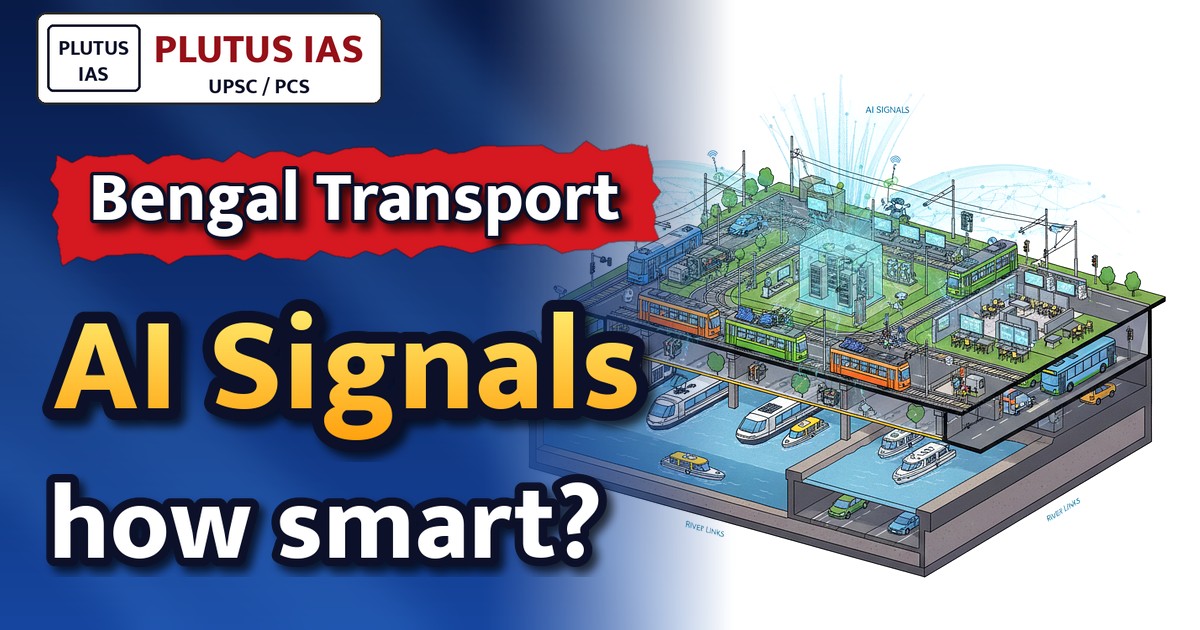
30 Sep West Bengal’s Transport Roadmap: AI Signals, Tram Revival & River Links
✎ The Motor Vehicles Act, 1988, empowers state transport authorities to regulate and enforce transport laws, including registration, licensing, and enforcement against illegal commercial vehicles.
Subject Relevance — Where This Topic Fits
- GS Paper II — Governance, Constitution, Polity, Social Justice and International Relations (Urban Governance, Transport Policy) | GS Paper III — Economy (Infrastructure, PPP Models, E-Mobility, AI in Governance)
- Prelims: Public-Private Partnership (PPP), Automated Number Plate Recognition (ANPR), Gross Cost Contract (GCC), Vehicle Location Tracking Device (VLTD), Public Transport Accessibility
- Essay: Urbanisation and Infrastructure Development in India: Challenges and Opportunities, The Role of Technology in Governance: Balancing Efficiency and Accountability
Quick Revision: The Motor Vehicles Act, 1988, empowers state transport authorities to regulate and enforce transport laws, including registration, licensing, and enforcement against illegal commercial vehicles.
Why is this in the news?
The statement by the West Bengal Transport and Labour Minister outlines a multi-pronged strategy to revitalise the state’s transport sector, including the deployment of AI-powered surveillance systems, revival of tram networks, introduction of water taxis, expansion of e-bus fleets, and institutional reforms to address systemic bottlenecks such as unregistered vehicles, illegal commercial transport, and institutional coordination failures. The announcement underscores the intersection of governance reform, technological adoption, and infrastructure modernisation in addressing urban mobility challenges.
Background
- The transport infrastructure of West Bengal has faced decades of underinvestment and institutional fragmentation, exacerbated by inadequate coordination among agencies such as the Road Transport Office (RTO), Motor Vehicle Department, and urban local bodies.
- The state’s transport ecosystem has been further strained by the proliferation of unregistered vehicles, illegal commercial transport (e.g., e-rickshaws on high-speed roads, autos without permits), and counterfeit registration practices, which undermine road safety and revenue collection.
- Historical neglect of public transport systems, including the near-obsolescence of tram networks and inadequate bus fleet maintenance, has contributed to a modal shift towards private vehicles, increasing congestion and pollution.
- The state’s demographic and economic profile—home to over 11 crore people and a significant jute industry—demands a robust, inclusive, and sustainable transport policy to support livelihoods and economic mobility.
- Institutional capacity constraints, including a shortage of permanent staff, reliance on contractual labour, and outdated technological infrastructure, have impeded effective policy implementation and service delivery.
- Recent high-profile incidents involving fake number plates and illegal transport operations have highlighted systemic vulnerabilities in enforcement and surveillance mechanisms.
What constitutes Integrated Urban Mobility in the context of West Bengal’s transport sector reforms?
- **Institutional Reforms and Governance:** The reforms aim to restore institutional coherence by strengthening the RTOs and Motor Vehicle Inspectors, constructing new district-level RTO buildings, and modernising IT systems to enhance coordination among transport agencies. This aligns with the constitutional framework under the Motor Vehicles Act, 1988, which vests regulatory and enforcement responsibilities with state transport authorities.
- **Technological Interventions:** The deployment of AI-powered Automated Number Plate Recognition (ANPR) systems and Vehicle Location Tracking Devices (VLTD) represents a shift towards data-driven governance. ANPR systems utilise optical character recognition to identify vehicles in real-time, enabling automated detection of fake or swapped number plates, a critical tool for combating crime and ensuring regulatory compliance.
- **Public Transport Modernisation:** The revival of tram networks, introduction of water taxis, and expansion of e-bus fleets under the Gross Cost Contract (GCC) model are part of a broader strategy to diversify modal options and reduce reliance on private vehicles. Tram networks, historically a hallmark of Kolkata’s urban mobility, are being evaluated for phased revival to address last-mile connectivity and reduce congestion.
- **Regulatory Enforcement and Safety:** Addressing the proliferation of unregistered vehicles and illegal commercial transport (e.g., e-rickshaws on arterial roads) requires a multi-pronged approach, including stricter RTO audits, installation of CCTV cameras in buses, and the use of body cameras for conductors to deter misconduct and enhance passenger safety.
- **Revenue Mobilisation and PPP Models:** The adoption of Public-Private Partnership (PPP) models for transport infrastructure development aims to leverage private sector efficiency while addressing fiscal constraints. The Gross Cost Contract (GCC) model, where private operators provide buses and bear operational costs while the government pays a fixed fee, is being utilised to expand bus fleets without immediate capital outlay.
- **Sustainability and Inclusivity:** The focus on e-buses and water taxis aligns with broader national goals of reducing carbon emissions and promoting sustainable urban mobility. Additionally, the housing initiatives for jute mill workers reflect an integrated approach to urban planning, recognising the interdependence of transport and livelihood support systems.
- **Conceptual River Linking Proposal:** The proposal for a river link, still at a conceptual stage, would involve inter-basin water transfer to enhance inland water transport connectivity. While such projects require rigorous feasibility studies, environmental impact assessments, and multi-stakeholder consultations, they represent a long-term vision for integrating waterways into the state’s transport matrix.
- **Data-Driven Decision Making:** The integration of AI signals in traffic management and the use of helplines for grievance redressal exemplify the growing emphasis on leveraging technology to improve service delivery and accountability in public transport systems.
Key Features
| Feature | Significance |
|---|---|
| AI-powered Automated Number Plate Recognition (ANPR) systems | Enhances real-time detection of fake or swapped number plates, improving law enforcement efficiency and public safety by enabling automated tracking of vehicles involved in criminal activities. |
| Gross Cost Contract (GCC) model for bus procurement | Facilitates the addition of new buses to the fleet without immediate capital expenditure for the state, ensuring operational efficiency while managing fiscal constraints. |
| Vehicle Location Tracking Device (VLTD) and CCTV integration | Enables real-time monitoring of public transport vehicles, enhancing passenger safety, reducing misuse, and improving operational oversight. |
| Modernisation of RTO infrastructure and digital systems | Replaces outdated systems with modern technology, improving service delivery, reducing corruption, and streamlining vehicle registration and inspection processes. |
| Water taxis and tram revival initiatives | Expands multi-modal transport options, reducing road congestion and promoting sustainable urban mobility in Kolkata and other riverine urban centres. |
Why it Matters
Urban Mobility and Infrastructure
- Revitalisation of tram networks and introduction of water taxis address congestion and environmental concerns in Kolkata, aligning with sustainable urban transport policies under the National Urban Transport Policy (NUTP) 2014.
- Integration of AI in traffic management and enforcement improves regulatory compliance and reduces accidents linked to unregistered or illegal vehicles.
Economic Governance and Fiscal Management
- Adoption of PPP models for transport infrastructure development leverages private sector efficiency while mitigating fiscal strain on the state exchequer.
- Revenue augmentation through stricter enforcement of vehicle registration and permit norms addresses the challenge of declining tax compliance in the transport sector.
Labour and Social Sector Integration
- Housing initiatives for jute mill workers underscore the state’s commitment to formalising the informal labour sector, improving worker welfare, and enhancing productivity in traditional industries.
- Free bus services for women, coupled with safety measures like body cameras and helplines, reflect gender-responsive governance in public transport.
Technological Modernisation
- Deployment of AI-driven surveillance systems (ANPR) represents a shift toward data-driven governance in law enforcement, reducing manual oversight and improving response times.
- Digital transformation of RTOs and transport departments enhances transparency, reduces corruption, and aligns with the Digital India initiative’s e-governance goals.
Challenges
1. Regulatory Fragmentation and Institutional Decay
- Decades of underinvestment and lack of inter-agency coordination have eroded transport infrastructure and regulatory capacity, necessitating systemic overhaul.
- Shortage of permanent staff and reliance on contractual workers hinder long-term planning and service delivery in the transport sector.
UPSC Link: GS2: Role of Civil Services in Policy Implementation
2. Fiscal Constraints and Revenue Shortfalls
- Limited state funds constrain the addition of new buses and infrastructure upgrades, despite operational demands.
- High prevalence of unregistered and illegal vehicles reduces tax revenue and complicates enforcement.
UPSC Link: GS3: Resource Mobilisation and Taxation
3. Safety and Security Vulnerabilities
- Misuse of free bus services for women and incidents of conductor misconduct highlight gaps in accountability mechanisms.
- Fake number plates and swapped registrations enable criminal activities, including high-profile crimes, underscoring the need for robust surveillance systems.
UPSC Link: GS3: Internal Security and Cyber Security
4. Urban Transport Congestion and Environmental Pressures
- Unregulated growth of e-rickshaws and illegal autos disrupts formal transport systems and exacerbates road congestion.
- Dependence on road transport for urban mobility contributes to pollution and inefficiency in Kolkata’s dense urban fabric.
UPSC Link: GS3: Environmental Pollution and Urbanisation
Challenges — UPSC Perspective
| Issue | Concern |
|---|---|
| Unregistered and illegal vehicles | Erodes tax revenue, complicates law enforcement, and undermines formal transport systems. |
| Shortage of buses, drivers, and conductors | Leads to overcrowding, service disruptions, and reduced accessibility in public transport. |
| Lack of coordination between transport agencies | Delays infrastructure projects, hampers policy implementation, and reduces operational efficiency. |
| Fake number plates and swapped registrations | Enables criminal activities, complicates vehicle tracking, and undermines public safety. |
| Inadequate RTO infrastructure and outdated systems | Delays vehicle registration, increases corruption risks, and reduces service quality. |
Way Forward
- Accelerate the deployment of AI-powered ANPR systems at RTOs and border checkpoints to detect and track fake number plates in real time.
- Expand the GCC model for bus procurement to add new fleets without immediate capital expenditure, prioritising routes with high demand.
- Strengthen RTOs by constructing new buildings in every district and upgrading digital systems to improve service delivery and reduce corruption.
- Implement VLTD and CCTV integration across public transport vehicles to enhance passenger safety and operational oversight.
- Revive tram networks and introduce water taxis in Kolkata to diversify urban transport options and reduce road congestion.
- Enforce stricter penalties and automated enforcement for illegal vehicles, including e-rickshaws operating on high-speed roads.
- Establish dedicated helplines and body cameras for conductors to address misconduct and improve accountability in public transport.
UPSC Value Addition
Keywords for Mains Answer-Writing
Intelligent Transport Systems (ITS) · Public-Private Partnership (PPP) in infrastructure · Automated Number Plate Recognition (ANPR) · Gross Cost Contract (GCC) model · Vehicle Location Tracking Device (VLTD) · Urban transport governance · AI in traffic management · Water-based public transport · Tram revival in Indian cities · Illegal vehicle regulation · Urban mobility challenges · Sustainable transport infrastructure
Concept Flow
Decades of underinvestment and regulatory neglect → Fragmented transport infrastructure and high prevalence of illegal vehicles → Increased congestion, safety risks, and revenue losses. → State government initiates modernisation and AI integration → Deployment of ANPR, VLTD, and digital RTO systems → Improved enforcement, safety, and service delivery. → Adoption of GCC model and PPP frameworks → Addition of new buses and infrastructure upgrades → Enhanced public transport capacity and efficiency. → Revival of trams and introduction of water taxis → Diversification of urban transport modes → Reduced road congestion and environmental impact. → Strengthening of labour welfare initiatives → Formalisation of informal sectors → Improved worker productivity and social security.
Prelims Practice Questions
Q1. Consider the following statements regarding the Gross Cost Contract (GCC) model in public transport:
1. Under GCC, the private operator bears the capital cost of procuring buses.
2. The government pays the operator a fixed fee per kilometre operated.
3. The GCC model is designed to shift the operational risk entirely to the government.
4. The model is commonly used to improve efficiency in public bus services.
How many of the above statements are correct?
- Only one
- Only two
- Only three
- All
Answer: Only three — Statements 2 and 4 are correct. Under GCC, the private operator provides the buses and operates the services, but the government pays a fixed fee per kilometre, transferring operational risk to the operator. Statement 1 is incorrect as the operator does not bear the capital cost of procuring buses; the government typically funds this. Statement 3 is incorrect as the operational risk is borne by the operator, not the government.
Q2. Assertion (A): The Automated Number Plate Recognition (ANPR) system relies on artificial intelligence to detect and track vehicles in real time.
Reason (R): ANPR systems use optical character recognition (OCR) technology to read number plates and integrate with traffic management databases.
In the context of the above two statements, which one of the following is correct?
- Both A and R are true, and R is the correct explanation of A
- Both A and R are true, but R is not the correct explanation of A
- A is true, but R is false
- A is false, but R is true
Answer: Both A and R are true, but R is not the correct explanation of A — Both the assertion and reason are true. ANPR systems indeed utilise AI for real-time vehicle tracking and employ OCR to read number plates, which are then cross-referenced with databases for enforcement and monitoring purposes.
Q3. Match the following transport initiatives with their respective objectives:
Column I (Initiative) | Column II (Objective)
————————————-|————————————-
A. Vehicle Location Tracking Device | 1. To detect counterfeit number plates
B. AI-powered traffic signalling | 2. To reduce traffic congestion
C. Water taxis | 3. To enhance public transport in coastal cities
D. Tram revival | 4. To monitor bus operations in real time
Select the correct match:
- A-4, B-2, C-3, D-1
- A-1, B-3, C-2, D-4
- A-4, B-1, C-3, D-2
- A-2, B-4, C-1, D-3
Answer: A-4, B-2, C-3, D-1 — The correct matches are: A (Vehicle Location Tracking Device) with 4 (to monitor bus operations in real time), B (AI-powered traffic signalling) with 2 (to reduce traffic congestion), C (Water taxis) with 3 (to enhance public transport in coastal cities), and D (Tram revival) with 1 (to detect counterfeit number plates is not directly related; tram revival aims to modernise urban transport infrastructure).
Mains Practice Question
✍ The integration of Intelligent Transport Systems (ITS) and Public-Private Partnership (PPP) models is increasingly being adopted to address urban transport challenges in India. Critically examine the potential of these approaches in improving urban mobility, with reference to recent initiatives such as AI-powered traffic signalling, Automated Number Plate Recognition (ANPR), and the Gross Cost Contract (GCC) model. Also, analyse the challenges in their implementation. (15 Marks)
Approach: MODEL-ANSWER SKELETON:
1. **Introduction to ITS and PPP in Urban Transport**
– Define ITS: Integration of AI, IoT, and data analytics to optimise transport systems.
– Define PPP: Long-term contracts between public and private sectors for infrastructure development and service delivery.
– Mention global examples (e.g., Singapore’s ITS, London’s PPP-based congestion charge) to set context.
2. **Potential of ITS in Urban Mobility**
– **AI-Powered Traffic Signalling**: Reduces congestion, improves traffic flow efficiency, and enhances safety through adaptive signal timing.
– **ANPR Systems**: Enables real-time vehicle tracking, aids in law enforcement (e.g., detecting fake number plates), and supports smart city initiatives.
– **VLTD and CCTV Integration**: Enhances public transport monitoring, improves accountability, and deters misconduct (e.g., in women’s bus services).
– **Data-Driven Decision Making**: Facilitates evidence-based urban planning and policy formulation.
3. **Role of PPP Models in Transport Infrastructure**
– **GCC Model**: Explain how it transfers operational risk to private operators while ensuring service quality and efficiency. Cite West Bengal’s initiative to procure e-buses under GCC.
– **PPP in Tram Revival and Water Taxis**: Discuss how PPP can finance and operationalise non-conventional transport modes, reducing fiscal burden on the state.
– **Revenue Augmentation**: PPP models can generate additional revenue streams (e.g., advertising, station development) to sustain transport services.
4. **Challenges in Implementation**
– **Institutional and Coordination Bottlenecks**: Fragmented governance, lack of inter-agency coordination (e.g., between RTOs, traffic police, and municipal bodies).
– **Technological and Financial Constraints**: High initial costs, need for skilled manpower, and resistance to data-sharing among agencies.
– **Regulatory and Legal Hurdles**: Issues related to data privacy, cybersecurity, and liability in case of system failures.
– **Public Acceptance and Equity Concerns**: Ensuring affordability and accessibility for all socio-economic groups; avoiding elitism in transport solutions.
5. **Way Forward**
– Strengthen institutional frameworks (e.g., unified transport authorities like the Delhi Integrated Multi-Modal Transit System).
– Invest in capacity building for AI/ITS integration and PPP project management.
– Adopt a phased, pilot-based approach to test and scale ITS and PPP models.
– Ensure transparency and accountability in PPP contracts to build public trust.
6. **Conclusion**
– Reiterate that while ITS and PPP offer transformative potential, their success hinges on addressing structural, technological, and governance challenges. Conclude with a balanced view: these are necessary but not sufficient conditions for sustainable urban mobility.
Source: The Indian Express
Generated by AanyaAi for educational purpose.

- सुप्रीम कोर्ट का बड़ा फैसला: बंद निगमों के कर्मचारियों को मिलेगा एक लाख मुआवजा - September 30, 2026
- West Bengal’s Transport Roadmap: AI Signals, Tram Revival & River Links - September 30, 2026
- चुनाव आयोग ने पूरा हुआ राज्यों में विशेष गहन पुनरीक्षण तो फॉर्म 6 से हटाया SIR घोषणा पत्र - September 30, 2026

No Comments