


30 Sep Why Railways Launched LNG Trains Despite Near-Complete Electrification?
✎ LNG-powered DEMUs are a dual-fuel adaptation of existing diesel-electric trainsets, designed to reduce emissions in segments where full electrification or electric locomotive haulage is operationally unfeasible.
Subject Relevance — Where This Topic Fits
- GS Paper III — Environment and Ecology (emission reduction strategies, alternative fuels) | GS Paper III — Science and Technology (energy transition, fuel technology)
- Prelims: DEMU trains, LNG, electrification of railways, carbon emissions, alternative fuels, dual-fuel systems, Indian Railways decarbonisation
- Essay: The role of technology in sustainable development: balancing economic growth with environmental responsibility
Quick Revision: LNG-powered DEMUs are a dual-fuel adaptation of existing diesel-electric trainsets, designed to reduce emissions in segments where full electrification or electric locomotive haulage is operationally unfeasible.
Why is this in the news?
On 27 September 2026, the Indian Railways inaugurated its first Liquefied Natural Gas (LNG)-powered train, a modified diesel-electric multiple unit (DEMU) with dual-fuel capability. This initiative marks a strategic pivot toward reducing carbon emissions in segments of the rail network where full electrification or locomotive-hauled services are operationally or economically unviable. The deployment underscores the Railways’ commitment to decarbonisation while addressing the inherent limitations of DEMU configurations, which cannot be hauled by electric locomotives due to their integrated power-pack design.
Background
- As of 2026, approximately 99.6% of Indian Railways’ broad-gauge network has been electrified, enabling mass transit and long-haul services to transition from diesel to electric traction.
- DEMU (Diesel-Electric Multiple Unit) trainsets, introduced in 1994, are self-propelled units where power generation and traction are integrated into the coaches, eliminating the need for a separate locomotive.
- DEMUs were originally deployed to enhance passenger services on non-electrified routes and low-traffic-density branch lines, offering higher acceleration and flexibility compared to locomotive-hauled trains.
- While electrification has progressed rapidly, certain sections—such as short-haul suburban routes, branch lines, and industrial sidings—remain economically or logistically challenging for full electrification or locomotive-based electric traction.
- The Railways has explored alternative fuels, including hydrogen, to further reduce emissions in DEMU operations, but hydrogen’s handling complexities and infrastructure requirements have limited scalability.
- The LNG conversion initiative aligns with India’s broader decarbonisation goals, including commitments under the Paris Agreement and domestic policies.
What are LNG-Powered DEMU Trains and Why Are They Being Introduced?
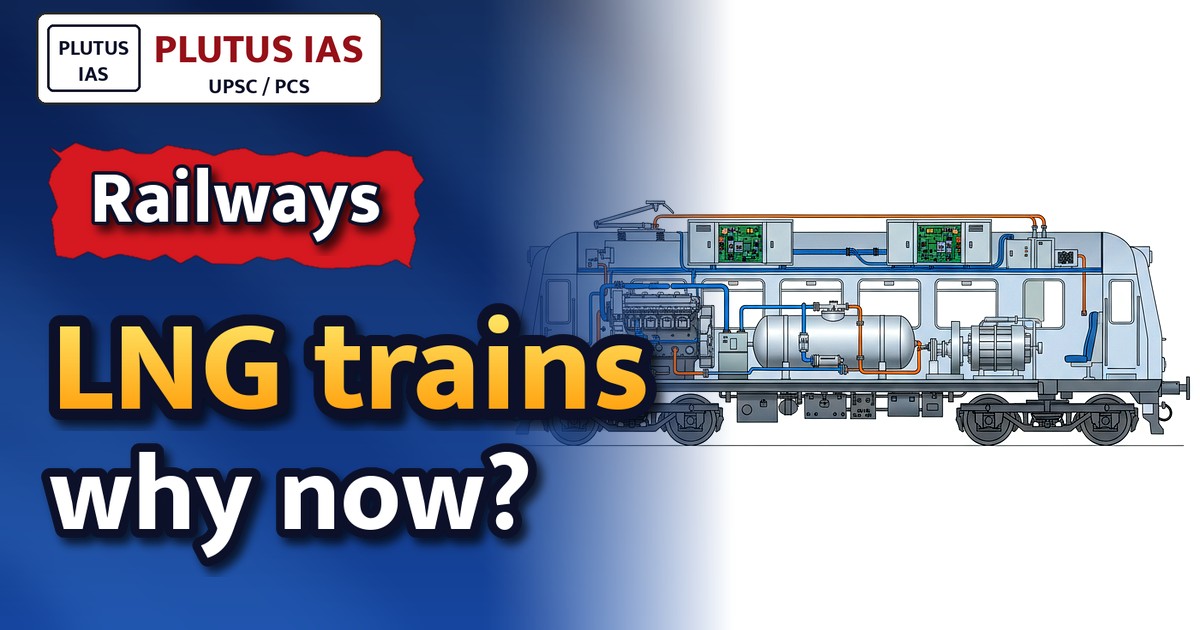
- LNG-Powered DEMU trains are modified diesel-electric multiple units that operate on a dual-fuel system, combining liquefied natural gas (LNG) and diesel to power their integrated traction motors.
- The conversion involves retrofitting the DEMU’s power pack with LNG storage tanks, fuel injection systems, electronic control units, and safety mechanisms such as gas leakage detection and emergency shut-off valves.
- The pilot train, converted at a cost of ₹1.86 crore, operates with a 40% LNG and 60% diesel blend, retaining the flexibility to revert to 100% diesel if required.
- LNG offers a lower carbon footprint than diesel, reducing particulate matter (PM), nitrogen oxides (NOx), and carbon dioxide (CO₂) emissions, thereby contributing to cleaner air and compliance with environmental regulations.
- DEMUs cannot be hauled by electric locomotives due to their integrated design, where power generation and traction are embedded within the coaches (driving power cars), making them unsuitable for external electric haulage.
- The conversion retains the DEMU’s operational advantages, such as high acceleration, lower infrastructure costs for non-electrified routes, and suitability for short-haul and suburban services.
- This initiative complements the Railways’ broader decarbonisation strategy, which includes the adoption of biofuels, hydrogen, and renewable energy integration in traction power.
- The pilot project is expected to pave the way for scaling LNG conversions across DEMU fleets operating on non-electrified or partially electrified routes, particularly in regions with limited overhead electric infrastructure.
Key Features
| Feature | Significance |
|---|---|
| Liquefied Natural Gas (LNG) as dual fuel | Enables DEMU trains to operate on LNG (40%) and diesel (60%), reducing greenhouse gas emissions compared to diesel-only operation. |
| DEMU train configuration (no separate locomotive) | Allows self-propelled operation on non-electrified routes; conversion to dual-fuel systems is feasible without altering train structure. |
| Electronic fuel control and safety systems | Ensures precise fuel mixing, monitors gas leakage, and maintains operational safety during LNG-diesel dual-fuel operation. |
| Retention of diesel-only capability | Provides operational flexibility to revert to diesel in case of LNG supply constraints or technical issues. |
| Cost of conversion (Rs. 1.86 crore per rake) | Demonstrates the economic feasibility of retrofitting existing DEMU trains for lower-emission operations. |
Why it Matters
Environmental Sustainability
- Reduces particulate matter and NOx emissions compared to diesel, aligning with India’s Nationally Determined Contributions (NDCs) under the Paris Agreement.
- Supports India’s commitment to achieving net-zero emissions by 2070, particularly in the transport sector.
- Demonstrates Railways’ incremental approach to decarbonisation beyond electrification.
Operational Efficiency
- Maintains the utility of DEMU trains on non-electrified routes where electric locomotives cannot be deployed.
- Preserves the high acceleration and stop-start efficiency of DEMU trains for suburban and branch-line services.
- Enhances fuel flexibility, reducing dependence on diesel for critical passenger services.
Technological Innovation
- Showcases India’s capability in retrofitting existing rail infrastructure for cleaner energy solutions.
- Provides a transitional technology pathway toward hydrogen-powered trains, which face storage and handling challenges.
- Encourages research and development in dual-fuel systems for rail transport.
Challenges
1. Infrastructure for LNG Supply
- Limited availability of LNG refuelling stations at railway depots, necessitating investment in new infrastructure.
- Dependence on external energy supply chains for LNG, which may be vulnerable to geopolitical or market fluctuations.
UPSC Link: Infrastructure: Energy (GS-III)
2. Safety and Regulatory Compliance
- Handling and storage of LNG pose safety risks, requiring stringent regulatory oversight and training for railway staff.
- Need for compliance with the Petroleum and Natural Gas Regulatory Board (PNGRB) guidelines for LNG storage and transport.
UPSC Link: Disaster Management (GS-III)
3. Economic Viability
- High initial conversion cost (Rs. 1.86 crore per rake) may limit scalability without government subsidies or incentives.
- Long-term cost-benefit analysis required to justify retrofitting over full electrification of remaining non-electrified routes.
UPSC Link: Economic Development (GS-III)
4. Technological Maturity
- LNG-powered DEMUs are a pilot project; scalability depends on proven reliability and performance over extended operations.
- Competition with hydrogen-powered trains, which may offer greater long-term emissions benefits but face technical hurdles.
UPSC Link: Science & Technology (GS-III)
5. Policy and Institutional Coordination
- Requires coordination between Indian Railways, Ministry of Petroleum and Natural Gas, and state governments for LNG infrastructure development.
- Alignment with national energy policies, such as the National Hydrogen Mission, to avoid fragmented approaches.
UPSC Link: Government Policies (GS-II)
Challenges — UPSC Perspective
| Issue | Concern |
|---|---|
| LNG supply chain | Dependence on external suppliers and limited refuelling infrastructure at railway depots. |
| Safety protocols | Risk of gas leakage, fire hazards, and need for specialised training for railway staff. |
| Cost-effectiveness | High retrofitting cost may not be justified for low-traffic branch lines. |
| Regulatory gaps | Lack of standardised guidelines for LNG use in rail transport. |
| Scalability | Pilot project success does not guarantee viability for mass adoption. |
| Competition with hydrogen | Hydrogen trains offer greater emissions benefits but face storage and handling challenges. |
Way Forward
- Expand LNG refuelling infrastructure at key railway depots to support dual-fuel DEMU operations.
- Conduct pilot projects on diverse routes to assess performance, emissions reduction, and cost efficiency.
- Develop standardised safety protocols and training modules for railway staff handling LNG systems.
- Integrate LNG-powered DEMUs into India’s broader decarbonisation strategy for the transport sector.
- Collaborate with the Ministry of Petroleum and Natural Gas to incentivise LNG adoption in rail transport.
- Evaluate the feasibility of retrofitting other diesel-based rail assets (e.g., locomotives) with LNG systems.
- Monitor global best practices in dual-fuel rail systems to inform India’s technological choices.
- Assess the long-term economic viability of LNG retrofitting versus full electrification of remaining non-electrified routes.
UPSC Value Addition
Keywords for Mains Answer-Writing
Indian Railways decarbonisation strategy · Liquefied Natural Gas (LNG) in transport · Diesel-Electric Multiple Unit (DEMU) trains · Railway electrification status · Greenhouse gas emissions from rail transport · Dual-fuel locomotive technology · Non-electrified railway routes · Energy transition in Indian Railways · LNG vs diesel emissions comparison · Railway traction systems
Concept Flow
Electrification of Indian Railways reaches 99.6% coverage, leaving non-electrified routes reliant on diesel-powered DEMU trains. → DEMU trains, being self-propelled with no separate locomotive, cannot utilise electric traction, necessitating alternative low-emission fuels. → Indian Railways explores LNG as a dual-fuel option to reduce emissions from diesel-powered DEMUs without altering train configuration. → Pilot project converts existing DEMU rake to LNG-diesel dual-fuel system, incorporating safety and electronic control mechanisms. → Operational deployment of LNG-powered DEMU trains demonstrates feasibility, paving the way for potential scalability. → Success of pilot project informs future policy decisions on decarbonisation of non-electrified rail routes.
Prelims Practice Questions
Q1. Consider the following statements regarding DEMU trains in Indian Railways:
1. DEMU trains are hauled by separate locomotives.
2. DEMU trains have driving power cars (DPCs) at both ends.
3. DEMU trains can operate on electrified routes using overhead lines.
4. The first DEMU train was introduced in India in 1994.
How many of the above statements are correct?
- Only one
- Only two
- Only three
- All four
Answer: Only three — Statements 2 and 4 are correct. DEMU trains are self-propelled train sets with power cars at both ends (statement 2) and were first introduced in 1994 (statement 4). Statements 1 and 3 are incorrect as DEMUs do not require separate locomotives and cannot utilise overhead electric lines.
Q2. Assertion (A): Liquefied Natural Gas (LNG) is being introduced in Indian Railways primarily to reduce emissions on non-electrified routes.
Reason (R): DEMU trains, which operate on non-electrified routes, cannot be hauled by electric locomotives due to their configuration.
In the context of the above two statements, which of the following is correct?
- Both A and R are true, and R is the correct explanation of A
- Both A and R are true, but R is NOT the correct explanation of A
- A is true, but R is false
- A is false, but R is true
Answer: Both A and R are true, but R is NOT the correct explanation of A — Both the assertion and reason are true. LNG is being introduced to reduce emissions, particularly on non-electrified routes where DEMU trains operate. The reason correctly explains why LNG is being considered, as DEMU trains cannot be hauled by electric locomotives.
Q3. Match the following traction systems in Indian Railways with their operational characteristics:
Column I (Traction System) | Column II (Operational Feature)
1. DEMU | A. Requires overhead electric lines for operation
2. EMU | B. Self-propelled train set with power cars at both ends
3. Locomotive-hauled train | C. Uses diesel engines to generate electricity for traction
4. LNG-powered DEMU | D. Uses dual fuel (LNG + diesel) for reduced emissions
Select the correct match:
- 1-B, 2-A, 3-C, 4-D
- 1-C, 2-A, 3-B, 4-D
- 1-A, 2-B, 3-C, 4-D
- 1-D, 2-A, 3-B, 4-C
Answer: 1-C, 2-A, 3-B, 4-D — The correct match is: DEMU (1) is a self-propelled train set with power cars at both ends (B), EMU (2) requires overhead electric lines (A), locomotive-hauled trains (3) use diesel engines for traction (C), and LNG-powered DEMU (4) uses dual fuel for reduced emissions (D).
Mains Practice Question
✍ Critically examine the rationale behind Indian Railways’ adoption of Liquefied Natural Gas (LNG) as a dual-fuel option for Diesel-Electric Multiple Unit (DEMU) trains, despite the near-complete electrification of its broad-gauge network. Substantiate your arguments with reference to the operational constraints of DEMU trains and the broader decarbonisation objectives of the sector. (15 Marks)
Approach: MODEL-ANSWER SKELETON:
1. **Operational Constraints of DEMU Trains (4 marks)**
– DEMUs are self-propelled train sets with driving power cars (DPCs) at both ends, eliminating the need for separate locomotives.
– DPCs house diesel engines that generate electricity for traction motors; hence, they cannot utilise overhead electric lines.
– Electrification of non-electrified routes is technically and economically challenging, particularly for branch lines and low-traffic-density sections.
– Reference: DEMUs were introduced in 1994 and expanded in 2002 for non-electrified routes to improve connectivity and speed.
2. **Rationale for LNG Adoption (5 marks)**
– **Emission Reduction**: LNG emits 20-30% less CO₂ and significantly lower particulate matter and NOₓ compared to diesel, aligning with India’s decarbonisation commitments (e.g., Net Zero by 2070).
– **Dual-Fuel Flexibility**: LNG-powered DEMUs retain the capability to operate entirely on diesel, ensuring operational reliability during supply disruptions or infrastructure gaps.
– **Cost-Effectiveness**: LNG is cheaper than diesel, reducing operational costs while improving energy security.
– **Technology Readiness**: Dual-fuel systems are a proven intermediate solution compared to hydrogen trains, which face storage and handling challenges.
3. **Broader Decarbonisation Objectives (4 marks)**
– Indian Railways has achieved 99.6% electrification of its broad-gauge network, but non-electrified routes (e.g., branch lines, hilly regions) remain critical for last-mile connectivity.
– The LNG initiative complements other decarbonisation efforts, such as hydrogen trains and solar-powered stations, by addressing emissions in segments where full electrification is impractical.
– Aligns with the Ministry of Railways’ ‘Mission Net Zero Carbon Emission by 2030’ and India’s Nationally Determined Contributions (NDCs).
4. **Critical Evaluation (2 marks)**
– **Limitations**: LNG infrastructure (storage, refuelling) requires significant investment; scalability may be constrained by supply chain logistics.
– **Alternatives**: Full electrification of remaining routes or hydrogen-powered trains could offer long-term solutions, but face technical and economic barriers.
– **Balanced View**: LNG is a pragmatic transitional solution, balancing immediate emission reductions with operational feasibility.
Source: The Indian Express
Generated by AanyaAi for educational purpose.
Related guides on our sites
- Best geography optional coaching
- Best geography optional coaching
- Best geography optional teacher
- Best geography optional teacher

- Why Railways Launched LNG Trains Despite Near-Complete Electrification? - September 30, 2026
- कैबिनेट ने रबी फसलों के लिए एमएसपी 2027-28 को दी मंजूरी - September 30, 2026
- Cabinet Approves ₹13,000 Crore Green Energy Corridor Phase-III Scheme - September 30, 2026

No Comments