


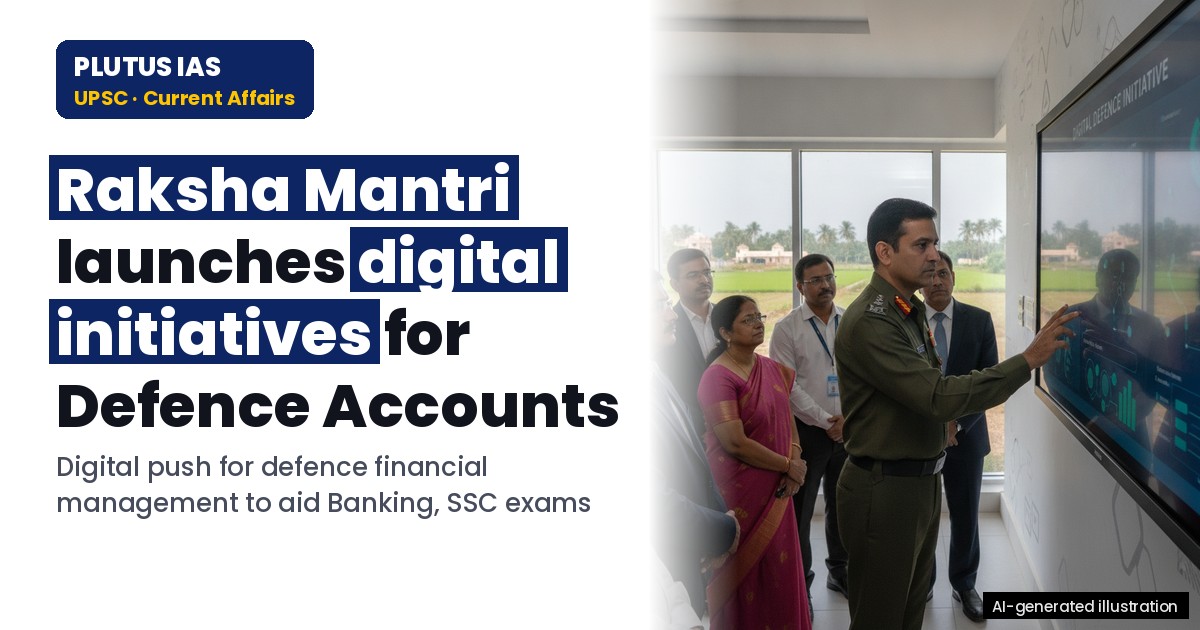
01 Oct Raksha Mantri Launches Digital Initiatives for Defence Accounts Department
✎ The Defence Accounts Department (DAD) has launched digital and financial management initiatives, including PFMS integration, AI-driven audits, blockchain for procurement, and a pensioners’ digital dashboard, to enhance…
Subject Relevance — Where This Topic Fits
- GS Paper III — Economic Development, Defence and Security, Science and Technology
- Prelims: Defence Accounts Department (DAD), Defence Procurement Procedure (DPP), Integrated Financial Management System (IFMS), Digital India, Public Financial Management System (PFMS), Defence Budget, Comptroller and Auditor General (CAG), Financial Management in Defence
- Essay: The Role of Digital Governance in National Security and Economic Efficiency, Financial Transparency and Accountability in Public Expenditure: A Case Study of Defence Sector
Quick Revision: The Defence Accounts Department (DAD) has launched digital and financial management initiatives, including PFMS integration, AI-driven audits, blockchain for procurement, and a pensioners’ digital dashboard, to enhance transparency, efficiency, and accountability in defence financial governance.
Why is this in the news?
The Defence Accounts Department (DAD), a critical institution under the Ministry of Defence responsible for financial management and audit of defence expenditure, launched several digital and financial management initiatives aimed at enhancing transparency, efficiency, and accountability in defence financial governance. These initiatives reflect India’s broader push towards digital transformation in governance, particularly in high-stakes sectors like defence, where fiscal discipline and audit integrity are paramount.
Background
- DAD operates under the administrative control of the Ministry of Defence and functions as the principal accounting authority for the defence services, including the Army, Navy, and Air Force.
- The department plays a crucial role in ensuring compliance with financial rules, conducting audits, and managing the payment and accounting of defence-related expenditures, including salaries, pensions, and procurement.
- India’s defence budget has witnessed significant growth in recent years, with allocations exceeding ₹6.2 lakh crore in 2024-25, underscoring the need for robust financial management systems to prevent leakages and ensure optimal utilisation.
- The Comptroller and Auditor General (CAG) of India has repeatedly highlighted the importance of financial discipline in the defence sector, citing cases of inefficiencies, delays, and procedural lapses in procurement and expenditure tracking.
- The Government of India’s push for ‘Digital India’ and ‘Atmanirbhar Bharat’ has accelerated the adoption of technology in governance, particularly in sectors requiring high levels of transparency and accountability, such as defence.
What are the newly launched digital and financial management initiatives by the Defence Accounts Department?
- **Defence Accounts Department (DAD) Portal Enhancement**: A revamped, user-centric digital portal for DAD stakeholders, including defence personnel, pensioners, and vendors, to streamline financial transactions, grievance redressal, and real-time tracking of payments and audits. This aligns with the broader ‘Digital India’ initiative and aims to reduce bureaucratic delays.
- **Integration with Public Financial Management System (PFMS)**: The DAD has been integrated with the PFMS, a web-based platform under the Ministry of Finance for real-time tracking of government expenditures. This integration ensures end-to-end digital tracking of defence funds, from allocation to utilisation, enhancing financial transparency and auditability.
- **Automated Audit and Compliance Tools**: Deployment of AI-driven tools and data analytics for automated auditing of defence expenditures. These tools will flag anomalies, detect irregularities, and ensure adherence to financial rules, reducing manual errors and improving compliance with the Defence Procurement Procedure (DPP) and other financial regulations.
- **Blockchain for Procurement Transactions**: Pilot implementation of blockchain technology for high-value procurement transactions in the defence sector. Blockchain ensures immutable records of transactions, reducing the risk of fraud, duplication, or tampering, and enhancing trust in the procurement process.
- **Pensioners’ Digital Dashboard**: A dedicated digital dashboard for pensioners under the Defence Accounts Department, providing real-time updates on pension disbursements, arrears, and grievance redressal status. This initiative aims to improve the ease of living for defence pensioners, a significant demographic in the defence ecosystem.
- **Cybersecurity Framework for Financial Systems**: Strengthening the cybersecurity infrastructure of DAD’s financial systems to safeguard against cyber threats, data breaches, and financial frauds. This includes the adoption of multi-factor authentication, encryption, and regular vulnerability assessments.
- **Capacity Building and Training**: A structured training program for DAD officials on digital financial tools, cybersecurity protocols, and audit methodologies. This ensures that the workforce is equipped to handle the technological shift and maintain high standards of financial governance.
- **Interoperability with Defence Procurement Systems**: Enhanced interoperability between DAD’s financial systems and the Defence Procurement Procedure (DPP) portal to ensure seamless flow of financial data from procurement stages to final accounting, reducing procedural redundancies.
Key Features
| Feature | Significance |
|---|---|
| Defence Accounts Department (DAD) Digital Transformation Platform | A unified digital ecosystem for financial management and audit trails in defence expenditure, enhancing transparency and reducing manual processes. |
| Automated Financial Management System (AFMS) Upgrade | Integration of AI and machine learning for real-time financial monitoring, fraud detection, and predictive budgeting in defence accounts. |
| e-Samiksha Portal for Defence Pensions | A centralised digital portal for pension disbursement, grievance redressal, and verification, improving efficiency and reducing delays in pension payments. |
| Blockchain-Based Audit Trail for Defence Procurement | Implementation of immutable ledger technology to track defence procurement transactions, ensuring accountability and preventing financial irregularities. |
| Robotic Process Automation (RPA) in Financial Reconciliation | Deployment of RPA tools to automate repetitive financial reconciliation tasks, reducing human error and accelerating financial reporting cycles. |
Why it Matters
Governance and Financial Discipline
- Enhances fiscal accountability in defence expenditure by leveraging digital tools for real-time monitoring and auditability.
- Reduces bureaucratic delays in financial processes, ensuring timely disbursement of funds for defence operations and pensions.
- Strengthens the integrity of financial transactions through blockchain-based audit trails, mitigating risks of fraud and mismanagement.
- Aligns with the government’s broader push for ‘Minimum Government, Maximum Governance’ by automating routine financial tasks.
Strategic and Operational Efficiency
- Improves the speed and accuracy of financial decision-making in the defence sector, crucial for national security preparedness.
- Facilitates seamless integration of financial data across defence services (Army, Navy, Air Force), enabling holistic budgetary planning.
- Enables predictive analytics for defence budgeting, allowing for proactive resource allocation based on emerging threats and operational needs.
Transparency and Public Trust
- Increases public confidence in defence financial management by providing verifiable audit trails and real-time financial disclosures.
- Supports the Right to Information (RTI) framework by ensuring accessible and traceable financial records for citizens and stakeholders.
- Demonstrates India’s commitment to global best practices in defence financial governance, aligning with international transparency standards.
Challenges
1. Cybersecurity and Data Privacy Risks
- Defence financial systems are high-value targets for cyber threats, including ransomware and state-sponsored attacks.
- Ensuring compliance with the Personal Data Protection Bill (2023) while handling sensitive financial and personnel data.
UPSC Link: GS3: Cybersecurity threats
2. Integration with Legacy Systems
- The Defence Accounts Department operates on decades-old financial systems that may lack interoperability with modern digital platforms.
- High costs and technical challenges in migrating legacy data to new systems without disrupting ongoing financial operations.
UPSC Link: GS3: Digital infrastructure
3. Capacity Building and Training
- Requires upskilling of defence finance personnel to operate advanced digital tools and interpret AI-driven analytics.
- Resistance to change among bureaucratic and technical staff accustomed to traditional financial management methods.
UPSC Link: GS2: Civil services reforms
4. Regulatory and Compliance Overheads
- Complex regulatory frameworks governing defence procurement and financial management may slow down digital adoption.
- Need for harmonised policies across multiple stakeholders, including the Ministry of Defence, Comptroller and Auditor General (CAG), and Parliament.
UPSC Link: GS2: Constitutional bodies
5. Cost and Resource Allocation
- Significant initial investment required for infrastructure, software, and training, posing budgetary challenges in a fiscally constrained environment.
- Balancing the need for rapid digital transformation with the imperative of cost-effectiveness in public expenditure.
UPSC Link: GS3: Public expenditure management
Challenges — UPSC Perspective
| Issue | Concern |
|---|---|
| Legacy System Compatibility | Technical debt from outdated financial systems impedes seamless digital integration. |
| Data Security Vulnerabilities | Sensitive defence financial data is exposed to cyber threats and unauthorised access. |
| Human Resource Constraints | Lack of skilled personnel to manage and operate advanced digital financial tools. |
| Policy Fragmentation | Overlapping jurisdictions among defence finance, audit, and procurement bodies create compliance bottlenecks. |
| Public Accountability Demands | Increased scrutiny from citizens and media necessitates flawless implementation to avoid reputational risks. |
| Budgetary Pressures | High upfront costs for digital transformation compete with other defence and welfare priorities. |
Way Forward
- Conduct a phased rollout of digital platforms, starting with high-impact areas like pension disbursement and procurement audits.
- Establish a dedicated cybersecurity task force to monitor, assess, and mitigate risks in defence financial systems.
- Develop a national-level training programme in collaboration with IITs/IIMs to upskill defence finance personnel in digital tools.
- Create a unified regulatory framework for defence financial digitalisation, harmonising policies across the Ministry of Defence, CAG, and Parliament.
- Pilot blockchain-based audit trails in select defence procurement contracts to validate scalability and effectiveness.
- Institute a real-time dashboard for public transparency, displaying key financial metrics of defence expenditure with periodic updates.
- Encourage public-private partnerships for technology infusion, leveraging expertise from fintech and defence tech startups.
- Regularly audit digital systems through third-party agencies to ensure compliance with national and international standards.
UPSC Value Addition
Keywords for Mains Answer-Writing
Defence Accounts Department (DAD) · Digital Public Infrastructure (DPI) · e-Governance in defence finance · Integrated Financial Management Information System (IFMIS) · Public Financial Management System (PFMS) · Defence Budget transparency · Digital India initiatives · Financial Management Reforms · Government e-Marketplace (GeM) · Defence Procurement Procedure (DPP) · Audit and Accounts in Defence · Union Budget 2023-24 provisions for defence modernisation · Controller General of Defence Accounts (CGDA) · Defence Pension Management System · Digital transformation in government financial systems
Constitutional & Policy Linkages
- Article 148: Comptroller and Auditor-General of India (CAG) – Ensures financial accountability in defence expenditure.
- Article 280: Finance Commission – Determines principles for defence financial management and inter-governmental fiscal transfers.
- Article 309: Recruitment and conditions of service of persons serving the Union – Relevant for civil service reforms in defence finance.
Concept Flow
Defence financial management → Legacy systems inefficiencies → Digital transformation initiatives → Need for real-time monitoring → Implementation of AFMS, blockchain, and RPA → Enhanced transparency and accountability → Strengthened national security governance → Public trust and fiscal discipline.
Prelims Practice Questions
Q1. Consider the following statements regarding the Defence Accounts Department (DAD):
1. It functions under the administrative control of the Ministry of Defence.
2. It is responsible for the audit and accounts of the defence services.
3. The Controller General of Defence Accounts (CGDA) is the head of the DAD.
How many of the above statements are correct?
- Only one
- Only two
- All three
- None
Answer: All three — Statements 1 and 3 are correct. The DAD functions under the Ministry of Defence, and the CGDA is its head. Statement 2 is partially correct but the DAD is primarily responsible for the payment, accounting, and internal audit of defence services, not the external audit which is conducted by the Comptroller and Auditor General (CAG).
Q2. Assertion (A): The Public Financial Management System (PFMS) is a web-based online software application developed and implemented by the Office of Controller General of Accounts (CGA).
Reason (R): PFMS aims to facilitate a reliable real-time, fool-proof, and transparent platform for tracking of funds released under all Plan schemes of the Government of India.
In the context of the above two statements, which one of the following is correct?
- Both A and R are true, and R is the correct explanation of A
- Both A and R are true, but R is NOT the correct explanation of A
- A is true, but R is false
- A is false, but R is true
Answer: Both A and R are true, but R is NOT the correct explanation of A — Both the Assertion and Reason are true. The PFMS is indeed developed by the CGA and serves as a transparent platform for tracking funds. The Reason correctly explains the purpose of the PFMS.
Q3. Match the following initiatives with their respective objectives:
Column I (Initiative) | Column II (Objective)
———————————————–|———————————————–
A. Defence Accounts Department (DAD) | 1. Streamlining procurement processes in defence
B. Public Financial Management System (PFMS) | 2. Real-time tracking and monitoring of funds
C. Government e-Marketplace (GeM) | 3. Digital transformation in defence finance
D. Defence Procurement Procedure (DPP) | 4. Audit and accounts of defence services
Select the correct match:
- A-4, B-2, C-1, D-3
- A-3, B-2, C-4, D-1
- A-4, B-1, C-2, D-3
- A-2, B-3, C-4, D-1
Answer: A-4, B-2, C-1, D-3 — Correct matches: A-4 (DAD is responsible for audit and accounts of defence services), B-2 (PFMS tracks funds in real-time), C-1 (GeM streamlines procurement), D-3 (DPP is a procedural framework for defence procurement).
Mains Practice Question
✍ Digital transformation in public financial management is increasingly being recognised as a critical enabler for transparency, efficiency, and accountability in governance. In this context, critically analyse the role of the Defence Accounts Department (DAD) in ensuring financial discipline and transparency within the defence sector. Also, examine how the integration of digital tools such as the Public Financial Management System (PFMS) and e-governance initiatives can further enhance the functioning of the DAD. (15 Marks)
Approach: MODEL-ANSWER SKELETON:
1. **Introduction (2 Marks)**: Define the Defence Accounts Department (DAD) and its constitutional/statutory basis (e.g., under the Ministry of Defence). Highlight the importance of financial discipline and transparency in the defence sector.
2. **Role of DAD (4 Marks)**:
– Payment and accounting functions for defence services.
– Internal audit and financial scrutiny.
– Pension disbursement and management.
– Compliance with the Defence Procurement Procedure (DPP) and financial regulations.
– Interface with the Comptroller and Auditor General (CAG) for external audits.
3. **Digital Transformation Initiatives (4 Marks)**:
– **Public Financial Management System (PFMS)**: Real-time tracking of funds, integration with banks, and transparency in fund utilisation.
– **e-Governance Tools**: Digitalisation of records, automation of processes, and reduction of manual errors.
– **Defence Pension Management System**: Streamlining pension disbursement and grievance redressal.
– **GeM Integration**: Enhancing transparency and efficiency in procurement processes.
4. **Challenges and Way Forward (3 Marks)**:
– Challenges: Legacy systems, cybersecurity risks, capacity building, and resistance to change.
– Way Forward: Capacity building, interoperability with other systems (e.g., GSTN, Aadhaar), and leveraging AI/ML for predictive analytics.
5. **Conclusion (2 Marks)**: Summarise the transformative potential of digital tools in enhancing the DAD’s efficiency and accountability, while acknowledging the need for continuous improvement and stakeholder engagement.
Source: PIB (Press Information Bureau)
Generated by AanyaAi for educational purpose.


No Comments