


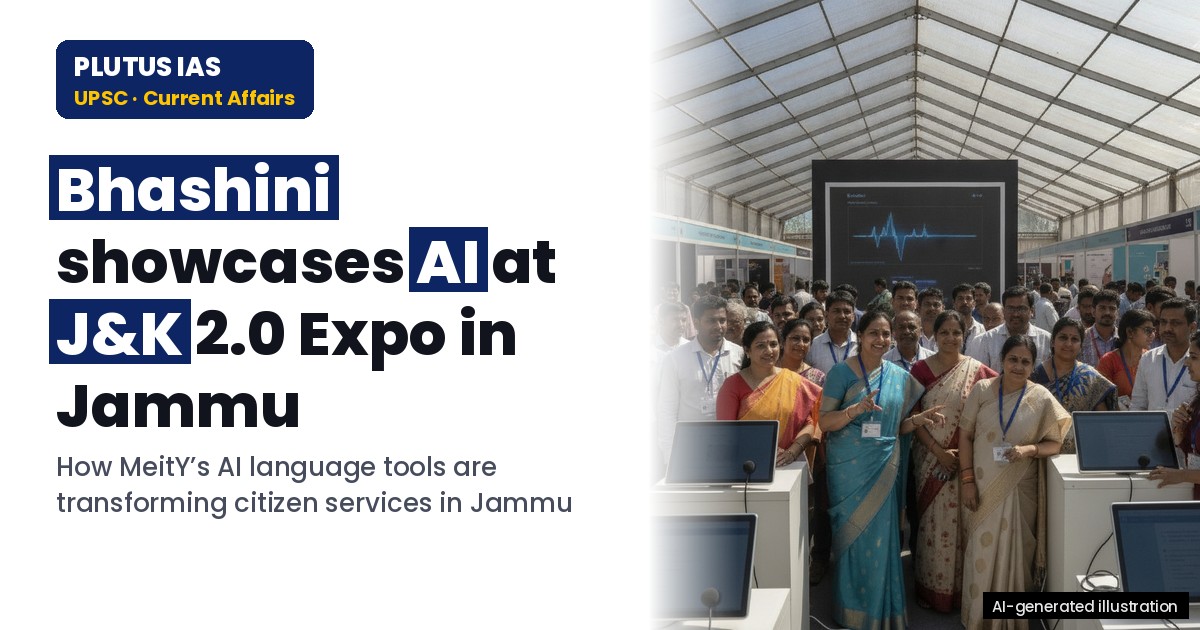
02 Oct Bhashini’s Multilingual AI Solutions Showcased in J&K 2.0 Expo
✎ Bhashini, under MeitY, is building India’s first multilingual AI ecosystem to integrate language technologies (speech recognition, translation, synthesis) into public digital services, ensuring inclusive governance across…
Subject Relevance — Where This Topic Fits
- GS Paper II — Governance, Constitution, Polity, Social Justice and International Relations (Digital Governance, Language Inclusion)
- Prelims: Bhashini, Digital India Corporation, MEITY, AI-based language technologies, multilingual digital inclusion, speech recognition, speech synthesis, translation, transliteration, Digital India Bhashini Division (DIBD), National Language Technology Mission
- Essay: Digital Inclusion: Bridging Linguistic Divides in Governance, Artificial Intelligence as a Catalyst for Equitable Public Service Delivery
Quick Revision: Bhashini, under MeitY, is building India’s first multilingual AI ecosystem to integrate language technologies (speech recognition, translation, synthesis) into public digital services, ensuring inclusive governance across linguistic communities.
Why is this in the news?
The Digital India Bhashini Division (DIBD), under the Ministry of Electronics and Information Technology (MeitY), participated as a collaborative partner in the three-day national exhibition ‘Dynamic Jammu and Kashmir 2.0’ held in Jammu from 28 to 30 September 2026. The event showcased the practical applications of multilingual AI solutions in governance and citizen services, highlighting Bhashini’s role in enabling accessible, inclusive, and multilingual digital public service delivery under the vision of ‘Developed India @2047’.
Background
- The Ministry of Electronics and Information Technology (MeitY) is the nodal agency responsible for formulating and implementing policies related to electronics, IT, and digital governance in India.
- The Digital India Corporation (DIC), an autonomous body under MeitY, implements the Digital India programme and its sub-schemes, including those focused on digital inclusion and language technologies.
- The National Education Policy (NEP) 2020 and subsequent digital governance frameworks emphasize the need for multilingual access to public services to ensure equitable participation across linguistic communities.
- Jammu and Kashmir, with its diverse linguistic landscape, serves as a critical case study for testing multilingual AI solutions in governance, particularly in bridging the digital divide in remote and multilingual regions.
- The ‘Dynamic Jammu and Kashmir 2.0’ exhibition was designed to showcase citizen-centric technologies aligned with the vision of ‘Developed India @2047’, fostering collaboration among government departments, institutions, and technology providers.
What is the Digital India Bhashini Division (DIBD)?
- The Digital India Bhashini Division (DIBD) is a dedicated initiative under the Digital India Corporation (DIC), operating under the Ministry of Electronics and Information Technology (MeitY), to develop a national multilingual AI ecosystem for digital inclusion.
- The ecosystem includes AI-driven tools such as speech recognition, speech synthesis, machine translation, transliteration, and voice-based interaction systems to facilitate multilingual digital communication.
- Bhashini’s architecture is designed to integrate with government portals, mobile applications, and citizen service platforms, ensuring that digital services are accessible to speakers of all Indian languages.
- Bhashini’s multilingual AI solutions are particularly relevant for regions like Jammu and Kashmir, where linguistic diversity is high, and digital literacy varies across communities.
- The platform enables real-time translation and transcription services, which are critical for delivering citizen services in linguistically diverse states.
- Bhashini’s participation in events like ‘Dynamic Jammu and Kashmir 2.0’ demonstrates its commitment to fostering collaboration between government, industry, academia, and civil society for inclusive digital governance.
Key Features
| Feature | Significance |
|---|---|
| Multilingual AI ecosystem | Enables seamless integration of 36 Indian text languages, 23 Indian speech languages, and 35 international languages into digital governance platforms. |
| Speech recognition | Converts spoken input into machine-readable text, facilitating voice-based citizen-government interaction. |
| Speech synthesis (TTS) | Generates natural-sounding speech from text, improving accessibility for visually impaired citizens. |
| Machine translation | Translates text between languages in real-time, reducing linguistic barriers in public service delivery. |
| Transliteration | Converts text between scripts (e.g., Devanagari to Latin) while preserving phonetic accuracy, aiding non-native speakers. |
| Voice-based interaction | Allows citizens to access services via voice commands, enhancing usability in rural and remote regions. |
Why it Matters
Digital Governance & Inclusion
- Demonstrates practical deployment of AI-driven multilingual tools in public service delivery, aligning with the vision of ‘Viksit Bharat @2047’.
- Reduces digital divide by enabling access to government services in local languages, particularly in linguistically diverse regions like Jammu & Kashmir.
- Enhances citizen-centric service delivery by integrating AI technologies into existing digital infrastructure.
Technological Advancement
- Showcases India’s indigenous capabilities in AI-driven language technologies, reducing dependence on foreign solutions.
- Highlights the scalability of multilingual AI ecosystems for diverse linguistic contexts, including tribal and minority languages.
- Promotes interoperability between government departments through standardized language processing APIs.
Policy & Institutional Synergy
- Strengthens collaboration between MeitY, Digital India Corporation, and state governments to implement AI in governance.
- Provides a platform for stakeholders to identify gaps and co-develop solutions for multilingual digital inclusion.
- Demonstrates the role of public-private partnerships in advancing AI adoption for public welfare.
Challenges
1. Data Scarcity for Low-Resource Languages
- Limited availability of annotated datasets for tribal and regional languages hampers training of AI models.
- Requires investment in data collection and annotation initiatives to improve model accuracy.
UPSC Link: GS-III: Science & Tech
2. Computational Resource Constraints
- High computational costs for real-time processing of multiple languages, especially in edge devices.
- Need for optimization techniques to deploy AI models on low-end hardware common in rural areas.
UPSC Link: GS-III: Science & Tech
3. Standardization & Interoperability
- Lack of uniform standards for language processing APIs across government departments leads to fragmentation.
- Requires development of common frameworks to ensure seamless integration of multilingual AI tools.
UPSC Link: GS-II: Governance
4. Digital Literacy Gaps
- Low awareness among citizens about AI-enabled services limits adoption and utilization.
- Need for targeted awareness campaigns and user-friendly interfaces to bridge the literacy divide.
UPSC Link: GS-II: Governance
5. Ethical & Privacy Concerns
- Risks of data misuse in voice and speech-based interactions necessitate robust privacy safeguards.
- Requires adherence to data protection frameworks like the Digital Personal Data Protection Act, 2023.
UPSC Link: GS-II: Governance
Challenges — UPSC Perspective
| Issue | Concern |
|---|---|
| Data scarcity | Insufficient annotated datasets for low-resource languages impeding AI model training. |
| Computational costs | High resource requirements for real-time multilingual processing. |
| Standardization gaps | Fragmented APIs and lack of interoperability across departments. |
| Digital literacy | Low citizen awareness limiting adoption of AI-enabled services. |
| Privacy risks | Potential misuse of voice/speech data necessitating strict safeguards. |
Way Forward
- Establish a national repository of annotated datasets for low-resource languages to improve AI model training.
- Develop lightweight, edge-compatible AI models to reduce computational costs and improve accessibility.
- Formulate standardized APIs and frameworks for seamless integration of multilingual AI tools across government platforms.
- Launch targeted digital literacy campaigns in collaboration with local bodies to enhance citizen awareness.
- Strengthen data protection mechanisms, including encryption and anonymization, to safeguard citizen data.
- Expand partnerships with academic institutions and industry to co-develop scalable multilingual AI solutions.
- Pilot AI-driven multilingual services in high-need regions (e.g., J&K) to refine deployment strategies.
UPSC Value Addition
Keywords for Mains Answer-Writing
Bhashini Initiative · Multilingual AI · Digital India Corporation · Digital Governance · AI-driven Public Services · Language Technology Ecosystem · Digital Inclusion · Artificial Intelligence in Governance · Ministry of Electronics and Information Technology (MeitY) · Digital Public Infrastructure · Citizen-Centric Services · Jammu and Kashmir 2.0 Exhibition
Concept Flow
Constitutional mandate for linguistic inclusivity (Article 343-351) → → Digital India initiative to bridge digital divide → → Development of AI-driven multilingual tools by MeitY → → Deployment in governance (e.g., J&K 2.0 exhibition) → → Enhanced citizen access to services in local languages → → Strengthened democratic participation and service delivery
Prelims Practice Questions
Q1. Consider the following statements regarding the Digital India Bhashini Initiative (DI-BD):
1. It is an initiative under the Ministry of Electronics and Information Technology (MeitY).
2. It supports 36 Indian text languages and 23 Indian speech languages.
3. It focuses exclusively on English and Hindi for digital governance services.
4. It aims to enable multilingual digital inclusion through AI-driven language technologies.
How many of the above statements are correct?
- Only one
- Only two
- Only three
- All four
Answer: Only three — Statements 1, 2, and 4 are correct. Statement 3 is incorrect as DI-Bhashini supports 36 Indian text languages and 23 Indian speech languages, not exclusively English and Hindi.
Q2. Assertion (A): The Digital India Bhashini Initiative (DI-BD) integrates speech recognition, speech synthesis, and translation technologies to enhance digital governance.
Reason (R): These technologies are essential for bridging language barriers and ensuring inclusive access to public services in a linguistically diverse country like India.
- Both A and R are true, and R is the correct explanation of A
- Both A and R are true, but R is not the correct explanation of A
- A is true, but R is false
- A is false, but R is true
Answer: Both A and R are true, and R is the correct explanation of A — Both A and R are true, and R correctly explains A. The integration of speech recognition, speech synthesis, and translation technologies is a core objective of DI-Bhashini to enable multilingual digital governance.
Q3. Match the following technologies with their primary applications in the Digital India Bhashini Initiative (DI-BD):
Column I (Technology) — Column II (Application)
1. Speech Recognition — A. Converting spoken words into written text
2. Speech Synthesis — B. Converting text into spoken words
3. Translation — C. Converting text from one language to another
4. Transliteration — D. Converting text from one script to another while retaining the original language
Select the correct match:
- 1-A, 2-B, 3-C, 4-D
- 1-B, 2-A, 3-C, 4-D
- 1-A, 2-B, 3-D, 4-C
- 1-D, 2-C, 3-B, 4-A
Answer: 1-A, 2-B, 3-C, 4-D — The correct matches are: 1-A (Speech Recognition converts spoken words into written text), 2-B (Speech Synthesis converts text into spoken words), 3-C (Translation converts text from one language to another), and 4-D (Transliteration converts text from one script to another while retaining the original language).
Mains Practice Question
✍ Critically examine the role of the Digital India Bhashini Initiative (DI-BD) in enabling multilingual digital governance in India. How far has it succeeded in bridging the digital divide through AI-driven language technologies? Also, discuss the challenges it faces in achieving universal accessibility. (15 Marks)
Approach: MODEL-ANSWER SKELETON:
1. **Introduction (2 Marks)**
– Define the Digital India Bhashini Initiative (DI-BD) and its objectives under MeitY.
– Contextualise the need for multilingual digital governance in India’s linguistic diversity (e.g., 22 officially recognised languages, over 19,500 mother tongues).
2. **Role of DI-BD in Multilingual Digital Governance (5 Marks)**
– **AI-driven Language Technologies**: Explain the integration of speech recognition, speech synthesis, translation, and transliteration technologies.
– **Citizen-Centric Services**: Highlight applications in public service delivery, e-governance, and digital inclusion (e.g., AI-powered chatbots, multilingual government portals).
– **Institutional Framework**: Role of Digital India Corporation (DIC) and MeitY in operationalising DI-BD.
– **Recent Initiatives**: Reference to the participation in ‘Gatishil Jammu and Kashmir 2.0’ exhibition (Sept 2026) as a case study.
3. **Success in Bridging the Digital Divide (4 Marks)**
– **Quantitative and Qualitative Impact**: Cite measurable outcomes (e.g., number of supported languages, user engagement metrics from exhibitions).
– **Inclusivity**: Discuss how DI-BD addresses barriers for non-English speakers and persons with disabilities (e.g., voice-based interfaces for visually impaired users).
– **Comparative Advantage**: Contrast with traditional e-governance models reliant on English/Hindi.
4. **Challenges and Limitations (3 Marks)**
– **Technological Constraints**: Limitations in accuracy of AI models for low-resource languages, dialectal variations, and script complexities.
– **Infrastructure Gaps**: Digital divide in rural and remote areas, lack of internet penetration, and device accessibility.
– **Policy and Governance**: Issues of data privacy, ethical AI use, and interoperability with existing government systems.
5. **Way Forward (1 Mark)**
– Suggest measures such as public-private partnerships, capacity-building in local languages, and integration with other digital public infrastructure (e.g., Aadhaar, DigiLocker).
**Balance of Views**:
– Proponents argue that DI-BD is a transformative step toward inclusive governance.
– Critics highlight the need for sustained investment, technological refinement, and policy support to overcome ground realities.
Source: PIB (Press Information Bureau)
Jammu & Kashmir PCS (JKPSC (KAS)) — State PCS Practice
Prelims: Which of the following initiatives by ‘भाषिनी’ (Bhashini) aligns with the goal of promoting multilingual AI solutions in Jammu & Kashmir under the ‘गतिशील जम्मू और कश्मीर 2.0’ framework?
- A. Launch of a dedicated AI-powered translation tool for Kashmiri, Dogri, and Pahari languages to facilitate local governance and tourism.
- B. Development of a blockchain-based platform for digital land records in Ladakh.
- C. Implementation of a solar-powered microgrid initiative in rural Jammu districts.
- D. Introduction of a new high-speed rail corridor between Jammu and Srinagar.
Answer: A. Launch of a dedicated AI-powered translation tool for Kashmiri, Dogri, and Pahari languages to facilitate local governance and tourism. — The initiative by ‘भाषिनी’ focuses on multilingual AI solutions, specifically targeting regional languages like Kashmiri, Dogri, and Pahari, to enhance governance and tourism in J&K.
Mains: Discuss the significance of integrating multilingual AI solutions in Jammu & Kashmir’s governance and public service delivery under the ‘गतिशील जम्मू और कश्मीर 2.0’ framework. How can such initiatives bridge linguistic barriers and promote inclusivity in the region?
Generated by AanyaAi for educational purpose.
Related guides on our sites
- Best PSIR optional coaching for upsc
- Best PSIR optional teacher for upsc
- Best teacher of PSIR optional for upsc
- Best PSIR optional coaching in delhi for UPSC


No Comments