


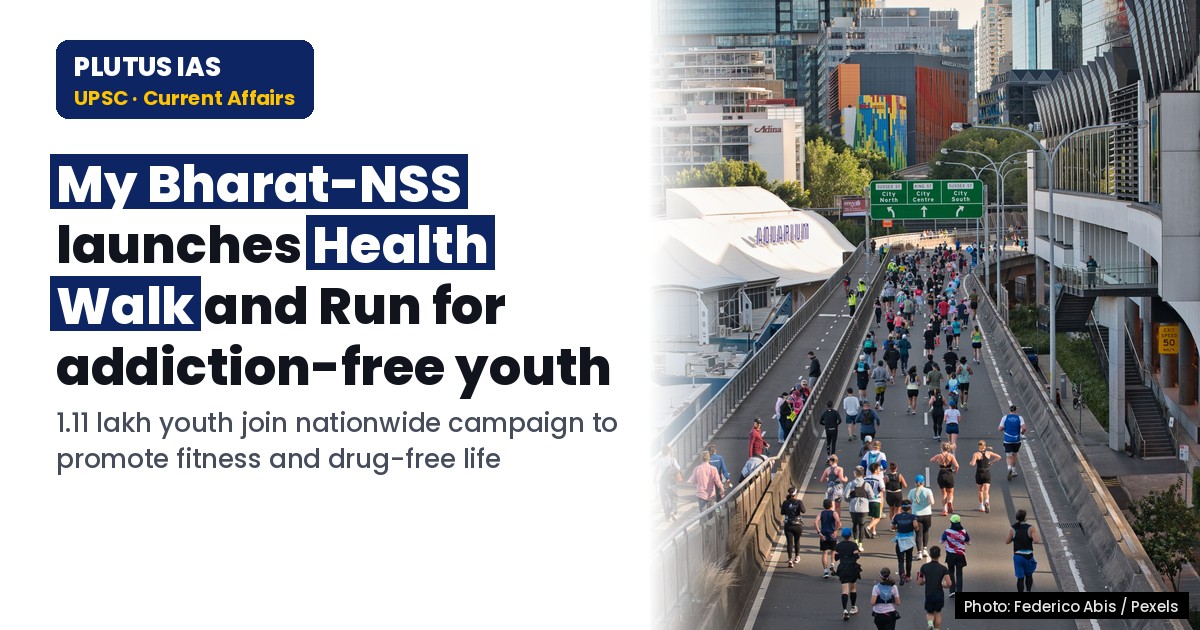
02 Oct My Bharat-NSS launches nationwide Health Walk & Run to promote drug-free youth
✎ The ‘Health Walk and Run’ under ‘Nasha Mukt Yuva Abhiyaan’ is a preventive public health initiative that combines physical activity, community engagement, and substance abuse awareness to foster a healthy and responsible youth…
Subject Relevance — Where This Topic Fits
- GS Paper II — Social Justice (Health and Well-being of Youth) | GS Paper III — Issues relating to Development and Management of Social Sector/Services relating to Health | GS Paper IV — Ethics in Governance (Community Engagement and Public Health Initiatives)
- Prelims: Nasha Mukt Yuva Abhiyaan, Mera Swasthya, Mera Gaurav, Mera Bharat-NSS, Health Walk and Run, Heritage Walk, Substance Abuse Prevention, Youth Empowerment, National Service Scheme (NSS)
- Essay: The Role of Youth in Nation-Building: Health, Wellness, and Responsibility, Public Health Interventions: A Pathway to Social Transformation
Quick Revision: The ‘Health Walk and Run’ under ‘Nasha Mukt Yuva Abhiyaan’ is a preventive public health initiative that combines physical activity, community engagement, and substance abuse awareness to foster a healthy and responsible youth demographic in alignment with the ‘Viksit Bharat’ vision.
Why is this in the news?
The Ministry of Youth Affairs and Sports, through the ‘My Bharat-NSS’ initiative, organised a nationwide ‘Health Walk and Run’ on 1 October 2026 as part of the ‘Nasha Mukt Yuva Abhiyaan’ (Drug-Free Youth Campaign) under the theme ‘Mera Swasthya, Mera Gaurav’ (My Health, My Pride). The event engaged over 1.11 lakh youth across 198 institutions and adopted villages, promoting physical activity, community engagement, and awareness against substance abuse. This initiative aligns with the broader national goal of fostering a healthy and addiction-free youth demographic as envisaged in the ‘Viksit Bharat’ (Developed India) vision.
Background
- The National Service Scheme (NSS), launched in 1969 under the Ministry of Youth Affairs and Sports, is a central sector scheme aimed at developing the personality and character of student youth through voluntary community service.
- Substance abuse among youth remains a critical public health challenge in India, with the National Drug Dependence Treatment Centre (NDDTC) reporting that approximately 2.5 crore individuals aged 10–75 years are estimated to be current users of alcohol and/or opioids.
- The Government of India’s ‘Nasha Mukt Bharat Abhiyaan’ (NMBA), launched in 2020, is a multi-stakeholder campaign targeting drug abuse prevention, with a focus on youth, educational institutions, and community-based interventions.
- The ‘My Bharat’ initiative, launched in 2023, is an umbrella programme under the NSS, designed to engage youth in nation-building activities through volunteerism, skill development, and social responsibility.
- Physical inactivity and sedentary lifestyles among youth are recognised as major risk factors for non-communicable diseases (NCDs), including cardiovascular diseases, diabetes, and mental health disorders, as highlighted in the National NCD Action Plan (2013) and the WHO Global Action Plan for Physical Activity (2018).
- The integration of ‘Heritage Walks’ in the campaign underscores the importance of cultural preservation and community pride as tools for holistic youth development and social cohesion.
What is the ‘Health Walk and Run’ initiative under ‘Nasha Mukt Yuva Abhiyaan’?
- The ‘Health Walk and Run’ is a nationwide physical activity campaign organised under the ‘Nasha Mukt Yuva Abhiyaan’, aimed at promoting regular exercise, healthy lifestyles, and substance abuse prevention among youth.
- The initiative is conducted in collaboration with educational institutions, local communities, and the NSS, engaging youth in structured walking and running events to foster discipline, teamwork, and outdoor engagement.
- ‘Heritage Walks’ are integrated into the campaign to combine physical activity with cultural education, enabling participants to explore local history, architecture, and traditions while promoting community pride and social cohesion.
- The ‘Nasha Mukt Yuva Sankalp’ (Drug-Free Youth Pledge) is a key component, wherein participants commit to adopting a drug-free lifestyle and spreading awareness about the harms of substance abuse within their communities.
- The campaign leverages peer engagement and community participation to amplify its impact, utilising visual aids such as banners, placards, and slogans to reinforce its messages on health and addiction prevention.
- The initiative aligns with the ‘Viksit Bharat’ (Developed India) vision by addressing two critical pillars: public health and youth empowerment, through grassroots-level interventions.
- The ‘Health Walk and Run’ serves as a preventive measure against substance abuse by promoting positive peer influence, outdoor activities, and structured physical routines, which are known to reduce risk-taking behaviours.
- The campaign also facilitates access to counselling and support services, ensuring that participants are aware of resources for mental health and addiction-related assistance.
Key Features
| Feature | Significance |
|---|---|
| Multi-modal physical activities (Health Walk & Run, Heritage Walk) | Promotes holistic well-being by integrating cardiovascular fitness, cultural heritage appreciation, and community engagement among youth |
| Nasha-Mukt Yuva Sankalp (pledge) | Encourages voluntary commitment to abstain from substance abuse and disseminate awareness on its socio-economic and health impacts |
| Institutional participation (198 institutions) | Leverages existing NSS infrastructure to ensure systematic outreach across educational campuses and adopted villages |
| Community integration | Bridges institutional youth with local stakeholders, fostering collective responsibility for public health and addiction prevention |
| Awareness through symbolic action | Uses mass participation in walks/runs to normalise healthy lifestyles and reduce stigma around addiction recovery |
Why it Matters
Public Health
- Addresses rising non-communicable diseases (NCDs) among youth by institutionalising regular physical activity as a preventive health measure
- Targets substance abuse—a leading risk factor for mental health disorders, crime, and economic loss—through early intervention and peer-led advocacy
- Aligns with WHO’s Global Action Plan for Physical Activity 2030 and UN Sustainable Development Goal 3 (Good Health and Well-being)
Social Cohesion
- Strengthens intergenerational and cross-community bonds by involving local leaders, heritage sites, and adopted villages in shared activities
- Promotes inclusive participation across gender lines (near-equal male-female ratios in events) and marginalised groups through NSS’s grassroots reach
- Enhances civic engagement by linking personal health outcomes to broader societal well-being
Governance & Policy
- Demonstrates a whole-of-government approach by combining the Ministry of Youth Affairs and Sports with NSS’s volunteer network for scalable public campaigns
- Serves as a model for integrating cultural heritage preservation with health promotion, potentially informing future ‘Healthy Heritage’ initiatives
- Provides empirical data on youth participation in preventive health, aiding evidence-based policy formulation
Youth Development
- Fosters leadership and teamwork through structured volunteer roles (e.g., route marshals, awareness campaigners)
- Builds resilience and discipline via regular outdoor activities, countering sedentary lifestyles and screen addiction
- Encourages civic responsibility by embedding service-learning (NSS’s core ethos) into health advocacy
Challenges
1. Sustaining Long-Term Behavioural Change
- Risk of one-off event fatigue without follow-up mechanisms (e.g., mentorship programs, digital tracking of commitments)
- Need for periodic reinforcement to prevent relapse into substance use or sedentary habits post-campaign
- Limited reach in remote or conflict-affected areas due to logistical and security constraints
UPSC Link: GS2: Health Governance
2. Resource Allocation & Equity
- Disparities in institutional capacity (urban vs. rural, private vs. government colleges) may skew participation and impact
- Dependence on volunteer-driven models risks uneven supervision and quality control across 198 sites
- Sustainability hinges on continued funding for infrastructure (e.g., walking tracks, counselling centres)
UPSC Link: GS2: Social Justice
3. Stigma & Cultural Barriers
- Substance abuse remains a taboo subject in many communities, hindering open dialogue and seeking help
- Gender norms may deter female participation in certain regions, requiring targeted outreach
- Lack of awareness about available de-addiction services (e.g., toll-free helplines, rehab centres)
UPSC Link: GS1: Social Empowerment
4. Monitoring & Evaluation
- Absence of a centralised database to track individual commitments or measure long-term health outcomes
- Difficulty in attributing behavioural changes solely to the campaign without control-group comparisons
- Need for multi-stakeholder audits (e.g., health departments, NGOs) to validate impact
UPSC Link: GS4: Governance
5. Policy Coordination
- Fragmentation between central schemes (e.g., Nasha Mukt Bharat Abhiyaan) and state-level initiatives may dilute impact
- Lack of convergence with other ministries (e.g., Social Justice, Women and Child Development) for holistic addiction prevention
- Need for a unified national framework with clear KPIs (e.g., reduction in youth substance use rates)
UPSC Link: GS2: Centre-State Relations
Challenges — UPSC Perspective
| Issue | Concern |
|---|---|
| Participation Drop-off | Declining youth engagement in follow-up activities post-initial enthusiasm |
| Data Privacy | Challenges in securely storing personal health data from participants for longitudinal studies |
| Counselling Gaps | Inadequate trained professionals to provide post-event support for high-risk individuals |
| Heritage Site Accessibility | Physical barriers (e.g., stairs, lack of signage) limiting inclusive participation in Heritage Walks |
| Corporate Sponsorship Bias | Potential influence of sponsors (e.g., fitness brands) on campaign messaging or event design |
Government Initiatives — Must-Memorise for Prelims
- Nasha Mukt Bharat Abhiyaan (NMBA)
- Mera Yuva Bharat (MY Bharat)
- National Service Scheme (NSS)
Way Forward
- Establish a digital portal for participants to log commitments, access counselling resources, and track progress via gamified challenges
- Integrate the campaign with existing government schemes (e.g., Ayushman Bharat, Poshan Abhiyaan) for cross-sectoral synergy
- Develop a tiered mentorship program where NSS alumni and fitness professionals guide new volunteers on sustainable lifestyle changes
- Conduct quarterly impact assessments using quasi-experimental designs (e.g., pre-post surveys, control-group comparisons) to refine strategies
- Expand Heritage Walks to include UNESCO-recognised sites and leverage local cultural festivals for wider outreach
- Partner with sports federations (e.g., Athletics Federation of India) to certify event organisers and standardise training protocols
- Launch a national helpline with multilingual support, linked to district-level de-addiction centres for real-time intervention
- Incorporate the campaign’s themes into school curricula (e.g., CBSE’s Health and Physical Education syllabus) for institutionalisation
UPSC Value Addition
Keywords for Mains Answer-Writing
National Service Scheme (NSS) · Mera Bharat NSS · Drug-free India campaign · Health Walk and Run initiative · Youth empowerment through physical activity · Prevention of Substance Abuse · Community engagement for public health · Heritage Walks for cultural awareness · Mental and physical health of youth · Government schemes for youth development · National Youth Policy · Substance abuse prevention strategies · Volunteer-led health programs · Sustainable Development Goals (SDG) 3 and 4
Constitutional & Policy Linkages
- Article 47: Duty of the State to improve public health (Directive Principles of State Policy)
- Article 51A(e): Fundamental Duty to promote harmony and the spirit of common brotherhood
Concept Flow
Youth engagement in physical activity → Reduction in sedentary lifestyles and NCD risk → Improved mental health and resilience → Community-based walks → Enhanced social capital and collective efficacy → Lower tolerance for substance abuse → NSS volunteer networks → Scalable peer-led advocacy → Wider dissemination of addiction prevention messages → Institutional participation (198 colleges) → Multiplier effect in adopted villages → Grassroots behavioural change → Symbolic commitment (pledges) → Internalisation of health values → Long-term abstinence from substance use → Policy feedback loop → Data-driven adjustments to Nasha Mukt Bharat Abhiyaan → Strengthened governance for public health
Prelims Practice Questions
Q1. Consider the following statements regarding the National Service Scheme (NSS):
1. NSS is a Central Sector Scheme under the Ministry of Youth Affairs and Sports.
2. The scheme aims to develop the personality and character of student volunteers through community service.
3. NSS was launched in the year 1970.
4. The ‘Mera Bharat NSS’ initiative is a sub-scheme under NSS focused solely on cultural heritage preservation.
How many of the above statements are correct?
- Only one
- Only two
- Only three
- All four
Answer: Only three — Statements 1, 2, and 3 are correct. Statement 4 is incorrect because ‘Mera Bharat NSS’ is not solely focused on cultural heritage preservation but encompasses broader youth empowerment and community engagement activities, including health and substance abuse prevention.
Q2. Assertion (A): The ‘Health Walk and Run’ initiative under the ‘Drug-free India for Developed India’ campaign is primarily aimed at promoting physical fitness among youth.
Reason (R): Regular physical activity is a key strategy to prevent substance abuse and improve mental health, as recognized by the World Health Organization (WHO).
- Both A and R are true, and R is the correct explanation of A
- Both A and R are true, but R is not the correct explanation of A
- A is true, but R is false
- A is false, but R is true
Answer: Both A and R are true, but R is not the correct explanation of A — The initiative indeed promotes physical fitness among youth, and regular physical activity is a globally recognized strategy for preventing substance abuse and enhancing mental health, making both statements correct with R explaining A.
Q3. Match the following initiatives under the ‘Drug-free India for Developed India’ campaign with their primary objectives:
Column I (Initiative) | Column II (Objective)
1. Health Walk and Run | A. Promoting cultural heritage awareness
2. Heritage Walk | B. Encouraging physical activity and fitness
3. Nasha Mukt Yuva Sankalp | C. Raising awareness about substance abuse and fostering a drug-free lifestyle
4. Mera Bharat NSS | D. Engaging youth in community service and nation-building
- 1-B, 2-A, 3-C, 4-D; 1-A, 2-B, 3-C, 4-D; 1-C, 2-A, 3-B, 4-D; 1-D, 2-B, 3-A, 4-C
- answer_letter_indexes_to_match_string_array_indexes_above_answer_0
- explain_any_remaining_statements_in_2_lines
- format
- match
- answer_letter_indexes_to_match_string_array_indexes_above_answer_0
Answer: 1-B, 2-A, 3-C, 4-D; 1-A, 2-B, 3-C, 4-D; 1-C, 2-A, 3-B, 4-D; 1-D, 2-B, 3-A, 4-C — 1-B (Health Walk and Run promotes physical activity), 2-A (Heritage Walk promotes cultural heritage awareness), 3-C (Nasha Mukt Yuva Sankalp focuses on substance abuse awareness), 4-D (Mera Bharat NSS engages youth in community service).
Mains Practice Question
✍ The ‘Health Walk and Run’ initiative, launched under the ‘Drug-free India for Developed India’ campaign, exemplifies a multi-dimensional approach to youth empowerment and public health. Critically examine the role of such volunteer-led health programs in achieving the objectives of the National Youth Policy 2021 and Sustainable Development Goals (SDGs) 3 and 4. Also, discuss the challenges in scaling such initiatives to ensure equitable participation across diverse socio-economic and geographical contexts. (15 Marks)
Approach: MODEL-ANSWER SKELETON:
1. Introduction (2 marks):
– Briefly define the ‘Health Walk and Run’ initiative and its alignment with the ‘Drug-free India for Developed India’ campaign.
– Mention the National Youth Policy 2021 objectives (e.g., youth empowerment, health and well-being, skill development) and SDG 3 (Good Health and Well-being) and SDG 4 (Quality Education).
2. Role of Volunteer-led Health Programs (5 marks):
– **Youth Empowerment**: Highlight how such programs foster leadership, discipline, and community engagement among youth (cite NSS framework).
– **Public Health Promotion**: Explain the role of physical activity in preventing non-communicable diseases and substance abuse (reference WHO guidelines).
– **Social Cohesion**: Discuss how community participation strengthens social bonds and reduces stigma around mental health (reference Durkheim’s theory of social integration).
– **Skill Development**: Link physical activity and heritage walks to holistic development (reference Bloom’s taxonomy for affective and psychomotor domains).
3. Alignment with National Youth Policy 2021 and SDGs (4 marks):
– **SDG 3**: Discuss how regular physical activity contributes to reducing mortality from cardiovascular diseases and mental health disorders.
– **SDG 4**: Emphasize the role of such programs in promoting inclusive education and lifelong learning through experiential activities.
– **National Youth Policy**: Highlight provisions related to health, fitness, and community service (e.g., para 3.2 on youth participation in nation-building).
4. Challenges in Scaling Initiatives (3 marks):
– **Socio-economic Barriers**: Discuss disparities in access to resources, digital divide, and urban-rural divides.
– **Geographical Diversity**: Highlight challenges in hilly, tribal, and remote areas (reference NITI Aayog’s Aspirational Districts Programme).
– **Sustainability**: Address issues of long-term engagement, funding, and institutional support.
5. Conclusion (1 mark):
– Summarize the transformative potential of volunteer-led health programs while acknowledging the need for adaptive strategies to ensure inclusivity and scalability.
Source: PIB (Press Information Bureau)
Generated by AanyaAi for educational purpose.
Related guides on our sites
- Anthropology VS PSIR
- Best PSIR optional coaching
- Best PSIR optional coaching online
- Current affairs for upsc 2026

- My Bharat-NSS launches nationwide Health Walk & Run to promote drug-free youth - October 2, 2026
- एससीडीपीएम 6: ई-कचरा प्रबंधन और स्वच्छता अभियान की शुरुआत - October 2, 2026
- RODTEP Scheme Extended to Dec 2026: UPSC Polity & Governance Insights - October 2, 2026

No Comments