


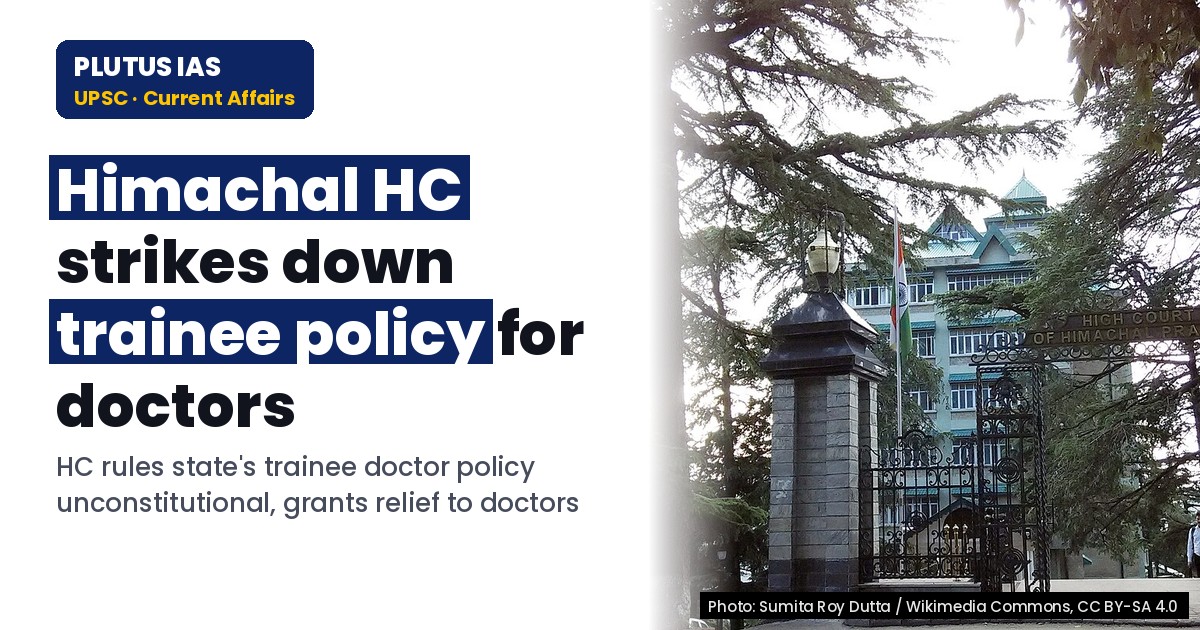
02 Oct Himachal HC Strikes Down Trainee Policy for Doctors: UPSC Governance Insight
✎ The Himachal Pradesh High Court ruled that altering service conditions retrospectively to convert contractual appointments into trainee appointments violates constitutional principles of fairness and judicial review, entitling…
Subject Relevance — Where This Topic Fits
- GS Paper II — Constitutional and Non-Constitutional Bodies (Judiciary) | GS Paper II — Functions and Responsibilities of the Union and the States | GS Paper III — Issues Relating to Development and Management of Social Sector/Services relating to Health
- Prelims: Article 32, Article 226, Judicial Review, Writ Jurisdiction, State Public Service Commission, Contractual Employment, Trainee Appointments, Recruitment Rules, Service Conditions, Non-Practising Allowance (NPA), Himachal Pradesh Public Service Commission (HPPSC), Himachal Pradesh Government Servants (Recruitment and Service Conditions) Act 2024
- Essay: Judicial Primacy in Safeguarding Constitutional Morality, Balancing Administrative Efficiency and Constitutional Safeguards in Public Employment
Quick Revision: The Himachal Pradesh High Court ruled that altering service conditions retrospectively to convert contractual appointments into trainee appointments violates constitutional principles of fairness and judicial review, entitling selected candidates to contractual benefits and eligibility for higher education.
Why is this in the news?
The Himachal Pradesh High Court, in a significant judgment delivered on 2 October 2026, declared the state government’s policy of appointing selected medical officers as ‘trainees’ under the Himachal Pradesh Government Servants (Recruitment and Service Conditions) Act 2024 unconstitutional. The court held that the policy violated the principles of judicial review, procedural fairness, and the sanctity of recruitment processes, thereby providing substantial relief to aggrieved doctors who had been denied contractual benefits and higher educational opportunities.
Background
- The Himachal Pradesh Government Servants (Recruitment and Service Conditions) Act 2024 was enacted to regulate recruitment and service conditions of state employees, including medical officers.
- In 2024, the state government, through the Himachal Pradesh Public Service Commission (HPPSC), advertised posts for Medical Officers on a contractual basis.
- A merit list was published in August 2025, and selected candidates were subsequently notified to join as ‘Job Trainees’ under a new policy, despite the original advertisement being for contractual appointments.
- The state government introduced a cut-off date (19 July 2025) to exclude selected doctors from availing benefits such as eligibility for postgraduate (PG) and super-speciality courses, as well as Non-Practising Allowance (NPA).
- The aggrieved doctors filed writ petitions challenging the constitutionality of the trainee policy and the retrospective alteration of service conditions.
- The High Court, in its earlier judgment in the case of *Devendra Kumar v. State of Himachal Pradesh*, had already struck down certain provisions of the 2024 Act as unconstitutional.
What is the Legal Framework Governing Trainee Appointments in Public Employment?
- Trainee appointments in public employment are governed by service rules framed under the relevant state or central service acts, which must align with constitutional provisions such as Articles 14 (Right to Equality), 16 (Equality of Opportunity in Public Employment), and 311 (Conduct of Government Servants).
- The Constitution mandates that recruitment processes must be transparent, fair, and free from arbitrary or retrospective changes that prejudice selected candidates.
- Judicial review under Article 226 empowers High Courts to examine the legality of executive actions, including policies that violate constitutional principles or established service conditions.
- The doctrine of ‘legitimate expectation’ ensures that once a recruitment process is initiated, the government cannot unilaterally alter the terms of appointment to the detriment of selected candidates without compelling justification.
- The Himachal Pradesh High Court relied on the precedent set in *Devendra Kumar v. State of Himachal Pradesh*, where it held that the 2024 Act’s provisions enabling trainee appointments were ultra vires the Constitution.
- The court emphasised that the government cannot introduce new conditions post-selection, as such actions undermine the sanctity of the recruitment process and violate the principles of natural justice.
- The judgment reinforces the constitutional safeguard that selected candidates are entitled to the benefits and conditions advertised at the time of recruitment, unless explicitly modified through a legally valid process.
Key Features
| Feature | Significance |
|---|---|
| Constitutional Validity of Recruitment Policy | The Himachal Pradesh High Court ruled that the state government’s policy of appointing selected medical officers as ‘trainees’ under the Himachal Pradesh Government Employees (Recruitment and Service Conditions) Act, 2024 was unconstitutional, reinforcing the principle that post-advertisement changes to recruitment rules violate Article 14 (Equality before Law) and Article 16 (Equality of Opportunity). |
| Retrospective Application of Policy | The court held that the government cannot retroactively alter the terms of employment after the selection process has been completed, ensuring legal certainty and fairness in public employment procedures. |
| Contractual vs. Trainee Status | The judgment clarified that medical officers selected through the Himachal Pradesh Public Service Commission (HPPSC) must be treated as contractual employees rather than trainees, preserving their eligibility for higher education benefits such as PG courses and Non-Practising Allowance (NPA). |
| Judicial Review of Administrative Actions | The decision exemplifies the judiciary’s role in reviewing executive actions to prevent arbitrary or unconstitutional policy shifts that undermine the sanctity of competitive examinations and public trust in governance. |
| Protection of Service Benefits | The court mandated that the selected doctors be entitled to all contractual benefits from their initial appointment date, including quotas for PG and super-specialty courses, thereby safeguarding their career progression rights. |
Why it Matters
Constitutional and Legal
- Upholds the doctrine of legitimate expectation in public employment, ensuring that candidates selected through a transparent process cannot be subjected to retrospective changes in service conditions.
- Reinforces the supremacy of constitutional provisions (Articles 14 and 16) over executive orders, particularly in matters of recruitment and service conditions.
- Sets a precedent for judicial scrutiny of administrative decisions that alter the terms of employment post-selection, ensuring compliance with constitutional mandates.
Administrative and Governance
- Highlights the need for coherence between legislative intent and executive implementation, particularly in matters of public service recruitment.
- Emphasises the importance of stability in recruitment policies to maintain public trust in the selection process and avoid litigation.
- Demonstrates the judiciary’s role in ensuring that administrative actions align with constitutional principles and statutory frameworks.
Professional and Career Development
- Protects the career progression rights of medical professionals by ensuring their eligibility for higher education and specialised training opportunities.
- Prevents arbitrary restrictions on service benefits, such as NPA and quotas for PG courses, which are critical for professional growth in the medical field.
Challenges
1. Retrospective Policy Changes in Recruitment
- Governments may face challenges in implementing retrospective changes to recruitment policies without violating constitutional provisions.
- Such policy shifts can lead to litigation, administrative delays, and erosion of public trust in the recruitment process.
- Ensuring consistency between legislative intent and executive actions remains a persistent governance challenge.
UPSC Link: GS-II: Constitutional Framework, Judiciary
2. Judicial Scrutiny of Executive Actions
- The judiciary’s role in reviewing executive actions can lead to conflicts between the separation of powers and the need for judicial oversight.
- Administrative bodies must ensure that their decisions are legally sound and constitutionally valid to avoid judicial intervention.
UPSC Link: GS-II: Separation of Powers, Judicial Review
3. Protection of Service Benefits for Medical Officers
- Ensuring that service benefits such as NPA and PG quotas are not arbitrarily restricted requires robust legal and administrative frameworks.
- Medical professionals may face challenges in accessing career-enhancing opportunities if service conditions are not clearly defined or enforced.
UPSC Link: GS-II: Public Health, Service Conditions
4. Transparency and Fairness in Recruitment Processes
- Maintaining transparency in recruitment processes is critical to prevent allegations of bias or arbitrary decision-making.
- Governments must ensure that changes to recruitment policies are communicated clearly and applied uniformly to all candidates.
UPSC Link: GS-II: Transparency in Governance
Challenges — UPSC Perspective
| Issue | Concern |
|---|---|
| Retrospective Policy Changes | Violation of constitutional principles and erosion of public trust in recruitment processes. |
| Judicial Scrutiny of Executive Actions | Potential conflicts between the judiciary and executive over policy implementation. |
| Protection of Service Benefits | Risk of arbitrary restrictions on career-enhancing opportunities for medical officers. |
| Transparency in Recruitment | Need for clear communication and uniform application of recruitment policies to avoid litigation. |
| Administrative Coherence | Ensuring alignment between legislative intent and executive implementation in public service recruitment. |
Way Forward
- Governments must ensure that any changes to recruitment policies are prospective and do not alter the terms of employment post-selection.
- Administrative bodies should conduct thorough legal reviews before implementing new policies to avoid constitutional challenges.
- Judicial bodies should continue to uphold the principle of legitimate expectation in public employment to safeguard candidates’ rights.
- Medical professionals should be made aware of their service benefits and rights under existing laws and policies.
- Governments should establish clear and transparent mechanisms for communicating changes in recruitment policies to all stakeholders.
- Administrative training programs should include modules on constitutional compliance and judicial scrutiny to enhance governance standards.
- Judicial bodies should prioritise timely disposal of cases related to recruitment policies to minimise administrative delays.
UPSC Value Addition
Keywords for Mains Answer-Writing
Constitutional validity of executive orders · Judicial review of administrative actions · Doctors’ recruitment policy · Himachal Pradesh High Court judgment · Article 14 of the Constitution · Doctors’ service conditions · Judicial intervention in executive policies · Constitutional governance in public employment · Doctors’ contractual appointments · Judicial activism in service matters
Constitutional & Policy Linkages
- Article 14: Equality before Law (Ensures fairness in recruitment processes).
- Article 16: Equality of Opportunity in Public Employment (Protects candidates’ rights post-selection).
- Article 226: Power of High Courts to issue writs (Enables judicial review of executive actions).
Concept Flow
Government introduces a recruitment policy for medical officers under the HP Government Employees (Recruitment and Service Conditions) Act, 2024. → Selection process is completed, and merit lists are published by the Himachal Pradesh Public Service Commission (HPPSC). → Government introduces a retrospective policy change, appointing selected doctors as ‘trainees’ instead of contractual employees. → Selected doctors challenge the policy in the Himachal Pradesh High Court, arguing violation of constitutional provisions. → High Court rules the policy unconstitutional, upholding the rights of selected doctors to contractual benefits and higher education opportunities. → Judgment reinforces the principle of legitimate expectation and judicial review in public employment.
Prelims Practice Questions
Q1. Consider the following statements regarding the Himachal Pradesh High Court’s judgment on trainee appointments:
1. The court declared the policy of appointing doctors as trainees under the Himachal Pradesh Government Employees (Recruitment and Service Conditions) Act, 2024 unconstitutional.
2. The court held that the government cannot alter recruitment rules mid-process after the advertisement for contractual posts has been issued.
3. The judgment directed that selected doctors must be appointed as regular employees and not as trainees.
How many of the above statements are correct?
- Only one
- Only two
- Only three
- None
Answer: Only three — Statements 1 and 2 are correct as the court declared the policy unconstitutional and prohibited mid-process rule changes. Statement 3 is incorrect because the court directed that selected doctors be treated as contractual employees, not regular employees.
Q2. Assertion (A): The Himachal Pradesh High Court ruled that the state government cannot force selected candidates to sign a trainee agreement after the merit list is declared.
Reason (R): The court held that the recruitment process must adhere to the principles of fairness and transparency as enshrined under Article 14 of the Constitution.
Options:
A. Both A and R are true, and R is the correct explanation of A.
B. Both A and R are true, but R is not the correct explanation of A.
C. A is true, but R is false.
D. A is false, but R is true.
Answer: ? — Both the assertion and reason are true. The court’s ruling against mid-process rule changes aligns with the constitutional guarantee of equality under Article 14, which ensures fairness in recruitment processes.
Q3. Match the following provisions with their correct descriptions:
Column I
1. Article 14 of the Constitution
2. Himachal Pradesh Government Employees (Recruitment and Service Conditions) Act, 2024
3. Judicial review
4. Contractual appointment
Column II
A. Ensures equality before law and equal protection of laws
B. Declared unconstitutional by the Himachal Pradesh High Court for trainee appointments
C. A legal doctrine empowering courts to examine the validity of executive actions
D. An appointment mode where employees are hired for a fixed term without permanent status
- 1-A, 2-B, 3-C, 4-D; 1-B, 2-A, 3-D, 4-C; 1-C, 2-D, 3-A, 4-B; 1-D, 2-C, 3-B, 4-A
- answer
- explain
- format
Answer: 1-A, 2-B, 3-C, 4-D; 1-B, 2-A, 3-D, 4-C; 1-C, 2-D, 3-A, 4-B; 1-D, 2-C, 3-B, 4-A —
Mains Practice Question
✍ The Himachal Pradesh High Court, in a recent judgment, declared the state government’s policy of appointing doctors as trainees under the Himachal Pradesh Government Employees (Recruitment and Service Conditions) Act, 2024 unconstitutional. Critically examine the constitutional and administrative implications of this judgment with reference to the principles of judicial review, equality, and the doctrine of legitimate expectations in public employment. (15 Marks)
Approach: MODEL-ANSWER SKELETON:
1. **Constitutional Validity and Judicial Review (3 Marks)**
– Reference to Article 14 (Right to Equality) and Article 21 (Right to Livelihood) as the constitutional anchors.
– Explanation of judicial review under Article 226 of the Constitution and its role in curbing executive overreach.
– Citation of the judgment: *Himachal Pradesh High Court v. State of Himachal Pradesh* (2026), emphasizing the court’s invocation of judicial review to strike down an unconstitutional policy.
2. **Principle of Equality and Non-Arbitrariness (4 Marks)**
– Analysis of how the policy violated the principle of equality by altering recruitment rules mid-process, thereby creating an arbitrary distinction between selected and non-selected candidates.
– Reference to the doctrine of *legitimate expectations* (cited in *Union of India v. Hindustan Development Corporation*, 1993) and its application in this case.
– Discussion on how the court upheld the sanctity of the recruitment process by prohibiting retrospective rule changes.
3. **Doctrine of Legitimate Expectations (4 Marks)**
– Definition and legal basis of the doctrine, rooted in administrative law and fairness.
– Application to the case: Selected doctors had a legitimate expectation of contractual appointments based on the advertised process; the state’s mid-process policy change breached this expectation.
– Contrast with *State of Punjab v. Amarjeet Singh* (2022), where the Supreme Court upheld legitimate expectations in service matters.
4. **Administrative and Governance Implications (4 Marks)**
– Impact on governance: The judgment reinforces the need for transparency and predictability in administrative actions.
– Consequences for future recruitment policies: States must ensure policy stability post-advertisement to avoid legal challenges.
– Broader significance: The ruling serves as a precedent for protecting the rights of selected candidates in public employment across India.
Balance of Views:
– Acknowledge the state’s argument of administrative flexibility but highlight the primacy of constitutional guarantees over executive discretion.
Source: amarujala.com
Himachal Pradesh PCS (HPPSC (HAS)) — State PCS Practice
Prelims: Recently, the Himachal Pradesh High Court declared the state government’s policy regarding the appointment of trainee doctors as unconstitutional. Under which constitutional provision did the High Court primarily base its judgment?
- A. Article 14 (Right to Equality)
- B. Article 16 (Equity in Public Employment)
- C. Article 309 (Recruitment and Conditions of Service of Persons Serving the Union or a State)
- D. Article 311 (Dismissal, Removal or Reduction in Rank of Persons Employed in Civil Capacity under the Union or a State)
Answer: B. Article 16 (Equity in Public Employment) — The High Court primarily relied on Article 16, which ensures equality in public employment, to declare the trainee doctor appointment policy unconstitutional due to lack of transparency and fairness.
Mains: Critically analyze the implications of the Himachal Pradesh High Court’s recent judgment declaring the state’s trainee doctor appointment policy unconstitutional. How can the state government ensure compliance with constitutional provisions while addressing the shortage of medical professionals in the public health sector?
Generated by AanyaAi for educational purpose.
Related guides on our sites
- Current affairs for upsc 2026
- Best PSIR optional coaching for upsc
- Best PSIR optional teacher for upsc
- Best teacher of PSIR optional for upsc

- Himachal HC Strikes Down Trainee Policy for Doctors: UPSC Governance Insight - October 2, 2026
- हिमाचल में विकास: मुख्यमंत्री सुक्खू ने 28 परियोजनाओं का किया लोकार्पण - October 2, 2026
- Kerala CM Announces Separate SC/ST Housing Scheme to End Delays - October 2, 2026

No Comments