


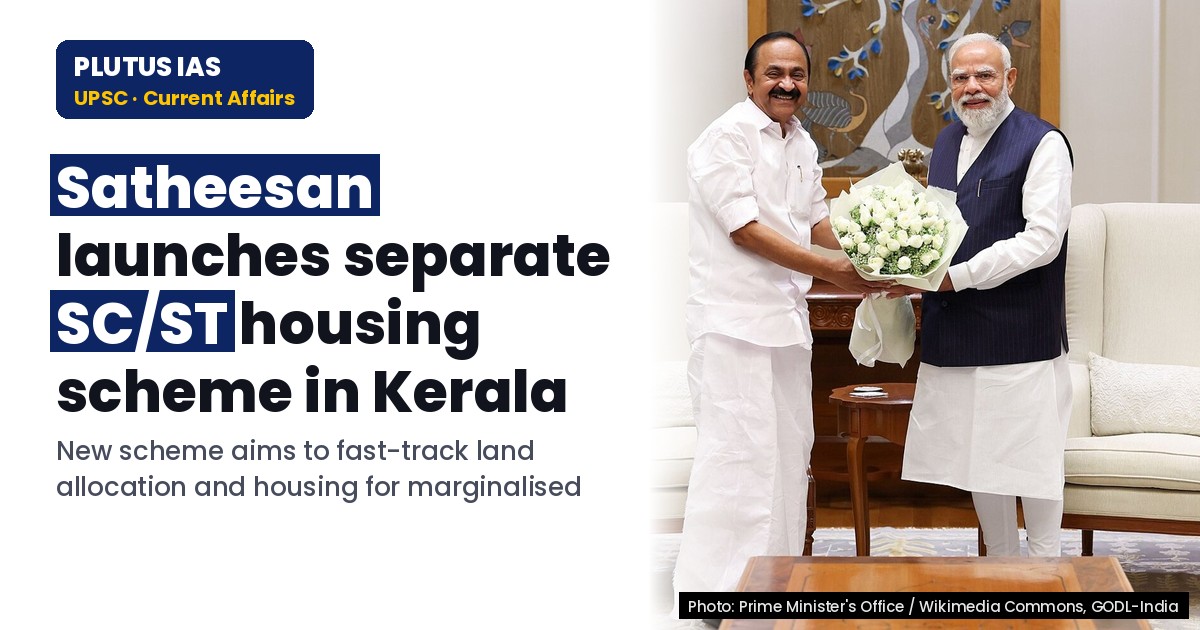
02 Oct Kerala CM Announces Separate SC/ST Housing Scheme to End Delays
✎ The proposed separate housing scheme for SC/ST families in Kerala aims to eliminate procedural delays by creating a dedicated, legally backed framework for land provision and financial assistance, aligning with constitutional…
Subject Relevance — Where This Topic Fits
- GS Paper II — Governance, Welfare Schemes for Vulnerable Sections | GS Paper III — Social Sector Initiatives, Inclusive Growth
- Prelims: Scheduled Castes and Scheduled Tribes (Prevention of Atrocities) Act, 1989, Pradhan Mantri Awas Yojana (PMAY), Life Mission (Kerala), Social Solidarity Fortnight, Tribal University, e-grants and scholarships
- Essay: Inclusive development and the role of targeted welfare schemes in bridging socio-economic disparities, The interplay between constitutional provisions for social justice and grassroots implementation
Quick Revision: The proposed separate housing scheme for SC/ST families in Kerala aims to eliminate procedural delays by creating a dedicated, legally backed framework for land provision and financial assistance, aligning with constitutional directives for social justice.
Why is this in the news?
The announcement of a separate housing scheme for Scheduled Castes (SC) and Scheduled Tribes (ST) families in Kerala by the Chief Minister, during the State-level observance of the Social Solidarity Fortnight, marks a significant governance intervention aimed at addressing systemic delays and ensuring targeted welfare delivery. This initiative underscores the state’s commitment to moving beyond symbolic gestures toward substantive policy action for marginalised communities.
Background
- Kerala’s Life Mission, a flagship housing scheme, has faced criticism for procedural delays and inadequate coverage of marginalised groups, particularly SC/ST communities.
- The Social Solidarity Fortnight, organised annually by the Department for the Welfare of Scheduled Castes, Scheduled Tribes and Backward Classes, serves as a platform for reviewing and accelerating welfare initiatives.
- The proposed legislation aligns with constitutional provisions such as Articles 46 and 38(2), which direct the state to promote the educational and economic interests of weaker sections.
- Kerala’s budgetary allocation of ₹500 crore for SC/ST welfare schemes reflects a prioritisation of inclusive development in the state’s fiscal planning.
- The initiative follows the government’s announcement to establish a tribal university in Wayanad, indicating a multi-pronged approach to tribal welfare.
What is the proposed separate housing scheme for SC/ST families in Kerala?
- The scheme is designed as a standalone initiative, distinct from the existing Life Mission, to expedite housing provision for SC/ST families, addressing delays in implementation.
- It includes the provision of land to all landless SC/ST families, ensuring a durable asset base for socio-economic security.
- Financial assistance under the scheme will be enhanced to cover eligible homeless beneficiaries comprehensively, reducing dependency on general housing programmes.
- The government plans to introduce enabling legislation during the forthcoming Assembly session to formalise the scheme’s framework and ensure legal backing.
- The initiative is part of a broader strategy to institutionalise welfare delivery, moving beyond ad-hoc measures to structured, rights-based interventions.
- The scheme will be implemented in conjunction with other welfare programmes, such as scholarships and e-grants, to ensure holistic support for SC/ST communities.
- The proposal reflects a governance approach that integrates constitutional mandates with ground-level execution, emphasising accountability and transparency.
- The initiative is expected to serve as a model for other states in addressing the housing deficit among marginalised communities through targeted policy design.
Key Features
| Feature | Significance |
|---|---|
| Separate housing scheme for SC/ST families | Addresses structural delays in existing schemes by creating a dedicated mechanism for historically marginalised communities. |
| Provision of land to landless SC/ST families | Aims to address root causes of homelessness by ensuring asset ownership, a critical step for socio-economic mobility. |
| Enhanced financial assistance for housing | Increases the quantum of support to ensure housing for all eligible homeless beneficiaries, reducing dependency on general schemes. |
| Legislative framework for land allocation | Proposes statutory backing to guarantee land rights, ensuring permanence and legal enforceability of entitlements. |
| Tribal university in Wayanad | Institutionalises higher education access for tribal communities, preserving indigenous knowledge systems while fostering integration. |
Why it Matters
Social Justice
- Reinforces the constitutional mandate of Article 46 to promote educational and economic interests of weaker sections.
- Shifts welfare from symbolic gestures to tangible, rights-based interventions for SC/ST communities.
- Aligns with the Directive Principles of State Policy (Part IV) to minimise inequalities and ensure equitable development.
Administrative Reforms
- Demonstrates a departure from one-size-fits-all welfare models by tailoring schemes to specific community needs.
- Highlights the role of state-level initiatives in complementing central schemes like the Pradhan Mantri Awas Yojana (PMAY).
- Showcases the integration of land rights with housing policies, a critical but often overlooked linkage in welfare delivery.
Economic Empowerment
- Land ownership and housing security can unlock credit access for SC/ST families, fostering entrepreneurship and livelihood diversification.
- Reduces vulnerability to exploitation by landlords or middlemen, a persistent issue in rural and peri-urban areas.
- Enhanced financial assistance acts as a direct income transfer, stimulating local economies through construction and allied sectors.
Cultural Preservation
- Establishment of a tribal university in Wayanad underscores the importance of preserving indigenous languages, arts, and traditions.
- Institutional recognition of tribal festivals and cultural events reinforces social cohesion and identity among marginalised groups.
Fiscal Federalism
- Showcases Kerala’s proactive fiscal stance in allocating ₹500 crore for SC/ST welfare, demonstrating state-level innovation within federal constraints.
- Emphasises the need for Centre-State coordination to avoid duplication of efforts between state-specific and centrally sponsored schemes.
Challenges
1. Implementation Gaps in Targeted Schemes
- Historical underutilisation of dedicated funds due to bureaucratic delays, lack of awareness, or administrative inefficiencies.
- Risk of elite capture where benefits accrue disproportionately to better-off sections within SC/ST communities.
- Need for robust monitoring mechanisms to prevent diversion of funds or misallocation of resources.
UPSC Link: GS2: Welfare schemes for vulnerable sections
2. Land Titling and Legal Ambiguities
- Complexities in land records, especially in tribal areas, may delay or obstruct land allocation processes.
- Potential conflicts with forest rights under the Forest Rights Act (FRA), 2006, requiring harmonisation of laws.
- Lack of convergence between state land records and central land surveys may create duplication or gaps.
UPSC Link: GS3: Land reforms and land records
3. Socio-Cultural Barriers
- Deep-rooted caste-based discrimination may persist in housing markets, limiting access to quality housing even with financial support.
- Resistance from dominant land-owning groups to redistributive policies, necessitating community engagement and consensus-building.
- Cultural stigma associated with SC/ST communities may deter private sector participation in housing projects.
UPSC Link: GS1: Social empowerment
4. Financial Sustainability
- Long-term viability of enhanced financial assistance depends on state’s fiscal health and prioritisation of welfare over other expenditures.
- Risk of fiscal strain if the scheme expands rapidly without corresponding revenue augmentation or cost-efficiency measures.
- Need for innovative financing models, such as public-private partnerships (PPPs), to supplement state funding.
UPSC Link: GS3: Government budgeting
5. Inter-Sectoral Coordination
- Housing schemes require convergence with other sectors like water supply, sanitation, and electricity to ensure holistic development.
- Delays in approvals or clearances from multiple departments may hinder project timelines and outcomes.
- Need for a single-window clearance mechanism to streamline processes and reduce bureaucratic red tape.
UPSC Link: GS2: Centre-State relations
Challenges — UPSC Perspective
| Issue | Concern |
|---|---|
| Bureaucratic inertia | Delays in scheme formulation, land allocation, and fund disbursement due to procedural rigidities. |
| Awareness deficits | Low uptake of benefits due to lack of information dissemination among target communities. |
| Elite capture | Risk of benefits being cornered by relatively better-off sections within SC/ST groups. |
| Land record discrepancies | Inconsistencies in land records may lead to disputes or exclusion of eligible beneficiaries. |
| Monitoring and evaluation | Absence of real-time tracking systems to assess progress and address grievances promptly. |
| Private sector reluctance | Limited participation from private developers due to perceived low profitability in marginalised areas. |
Government Initiatives — Must-Memorise for Prelims
- Life Mission (Kerala)
- Scheduled Castes and Scheduled Tribes (Prevention of Atrocities) Act, 1989 (Central)
Way Forward
- Constitute a high-powered inter-departmental task force to draft the legislative framework for land allocation and housing scheme within three months.
- Launch a state-wide awareness campaign in local languages to educate SC/ST families about eligibility, application processes, and grievance redressal mechanisms.
- Digitise and integrate land records with the state’s revenue department to resolve discrepancies and expedite land titling for landless families.
- Establish a dedicated grievance redressal portal with real-time tracking of applications and disbursements to ensure transparency and accountability.
- Collaborate with academic institutions and NGOs to design the curriculum for the tribal university in Wayanad, ensuring cultural relevance and academic rigour.
- Explore public-private partnerships (PPPs) to augment housing supply, leveraging CSR funds from corporate entities operating in Kerala.
- Conduct a baseline survey to identify landless SC/ST families and map their socio-economic profiles for targeted interventions.
- Institutionalise quarterly reviews with district collectors to monitor progress, address bottlenecks, and reallocate resources dynamically.
UPSC Value Addition
Keywords for Mains Answer-Writing
Scheduled Castes and Scheduled Tribes (SC/ST) welfare · Affirmative action for marginalised communities · Constitutional provisions for SC/ST (Articles 15(4), 16(4), 46, 330, 332, 334) · State-level welfare schemes for SC/ST · Land reform and housing rights for SC/ST · Social Solidarity Fortnight initiatives · Kerala’s welfare model for vulnerable groups · Tribal university and cultural preservation · Constitutional obligations under Directive Principles of State Policy (DPSP) · Judicial interpretation of equality and reservation (Indra Sawhney vs Union of India, 1992) · Special Component Plan (SCP) and Tribal Sub-Plan (TSP) · Economic empowerment of SC/ST communities · Housing schemes for marginalised groups in India · Constitutional morality and welfare governance
Constitutional & Policy Linkages
- Article 46 – Promotion of educational and economic interests of weaker sections
Concept Flow
Identification of structural gaps in existing housing schemes for SC/ST communities → → Announcement of a separate, rights-based housing scheme with land allocation → → Legislative and administrative framework for implementation → → Convergence with land reforms and forest rights laws → → Institutional capacity-building for monitoring and grievance redressal → → Socio-economic upliftment through asset ownership and housing security → → Long-term cultural preservation via tribal university and community events
Prelims Practice Questions
Q1. Consider the following statements regarding the constitutional provisions for the welfare of Scheduled Castes (SC) and Scheduled Tribes (ST) in India:
1. Article 15(4) empowers the State to make special provisions for the advancement of socially and educationally backward classes of citizens.
2. Article 16(4) allows the State to reserve appointments in favour of any backward class of citizens which, in the opinion of the State, is not adequately represented in the services under the State.
3. Article 46 directs the State to promote with special care the educational and economic interests of the weaker sections of the people, and, in particular, of the Scheduled Castes and Scheduled Tribes.
4. Article 330 reserves seats for SCs and STs in the Lok Sabha, while Article 332 reserves seats for them in the State Legislative Assemblies.
How many of the above statements are correct?
- Only one
- Only two
- Only three
- All
Answer: All — Statements 1, 2, and 3 are correct as they directly relate to constitutional provisions for SC/ST welfare. Statement 4 is also correct as it specifies the reservation of seats in Parliament and State Legislatures for SCs and STs.
Q2. Assertion (A): The Special Component Plan (SCP) and Tribal Sub-Plan (TSP) are centrally sponsored schemes aimed at the socio-economic development of Scheduled Castes and Scheduled Tribes, respectively.
Reason (R): These plans ensure that a proportionate share of development funds is earmarked for SC/ST communities to bridge historical inequalities.
In the context of the above two statements, which of the following is correct?
- Both A and R are true, and R is the correct explanation of A
- Both A and R are true, but R is not the correct explanation of A
- A is true but R is false
- A is false but R is true
Answer: Both A and R are true, and R is the correct explanation of A — Both the Assertion and Reason are correct. The SCP and TSP are indeed centrally sponsored schemes designed to allocate development funds for SC and ST communities, respectively, to address historical disparities.
Q3. Which of the following is NOT a feature of the Pradhan Mantri Awas Yojana (PMAY) in India?
- It aims to provide affordable housing to the urban poor through Credit Linked Subsidy Scheme (CLSS)
- It includes a sub-scheme specifically for the welfare of Scheduled Castes and Scheduled Tribes
- It is implemented by the Ministry of Housing and Urban Affairs
- It mandates the use of eco-friendly and sustainable construction materials
Answer: It includes a sub-scheme specifically for the welfare of Scheduled Castes and Scheduled Tribes — While PMAY includes components for economically weaker sections and low-income groups, it does not have a sub-scheme specifically dedicated to Scheduled Castes and Scheduled Tribes. The Kerala government’s announcement of a separate housing scheme for SC/ST families is a state-specific initiative.
Mains Practice Question
✍ The announcement of a separate housing scheme for Scheduled Castes (SC) and Scheduled Tribes (ST) families in Kerala underscores the need for targeted affirmative action in addressing historical injustices. Critically examine the constitutional and policy framework governing the welfare of SC/ST communities in India. Also, analyse how such state-level initiatives align with the Directive Principles of State Policy and judicial interpretations of equality and reservation. (15 Marks)
Approach: MODEL-ANSWER SKELETON:
1. **Constitutional Framework**:
– Articles 15(4), 16(4), 46, 330, 332, and 334 as foundational provisions for SC/ST welfare.
– Directive Principles of State Policy (DPSP) under Part IV, particularly Article 46, which mandates the State to promote the educational and economic interests of weaker sections.
2. **Policy Framework**:
– Special Component Plan (SCP) and Tribal Sub-Plan (TSP) as centrally sponsored schemes for targeted development.
– Role of the National Commission for Scheduled Castes (NCSC) and National Commission for Scheduled Tribes (NCST) in monitoring and safeguarding rights.
– State-level schemes such as Kerala’s Life Mission and the newly announced separate housing scheme for SC/ST families.
3. **Judicial Interpretations**:
– Landmark judgments: Indra Sawhney vs Union of India (1992) on the ceiling of reservation and the concept of ‘creamy layer’.
– Ashoka Kumar Thakur vs Union of India (2008) on the constitutional validity of reservation in educational institutions.
– Recent Supreme Court observations on the need for proportionate representation and affirmative action.
4. **Alignment with DPSP and Judicial Precedents**:
– How state-level initiatives like Kerala’s housing scheme reflect the spirit of Article 46 and judicial interpretations of equality (Article 14).
– The balance between formal equality (Article 14) and substantive equality (Article 16(4)) in policy formulation.
5. **Challenges and Criticisms**:
– Issues of implementation delays, bureaucratic hurdles, and lack of land rights for SC/ST communities.
– Criticisms of tokenism in welfare schemes and the need for structural reforms.
6. **Conclusion**:
– State-level initiatives like Kerala’s housing scheme are steps toward fulfilling constitutional obligations and judicial mandates.
– Emphasise the need for convergence between constitutional morality, policy frameworks, and ground-level implementation for meaningful welfare outcomes.
Source: The Hindu
Generated by AanyaAi for educational purpose.
Related guides on our sites
- Current affairs for upsc 2026
- Best PSIR optional coaching for upsc
- Best sociology optional coaching for upsc
- Which is best sociology optional coaching for upsc

- Kerala CM Announces Separate SC/ST Housing Scheme to End Delays - October 2, 2026
- बक्सा टाइगर रिजर्व में वापसी: बिहार से आई बाघिन से शुरू हुआ नया अध्याय - October 2, 2026
- Swachhata Hi Seva 2026 Culminates at SECL with Gandhi Jayanti - October 2, 2026

No Comments