


02 Oct Khadi Revival: 500% Sales Surge in 12 Years Explained for UPSC & State PCS
✎ Khadi’s revival is driven by institutional mechanisms such as KVIC’s marketing strategies, and alignment with national initiatives like 'Vocal for Local' and 'Atmanirbhar Bharat,' transforming it from a symbolic relic into a…
Subject Relevance — Where This Topic Fits
- GS Paper I — Indian Culture and Heritage: Contributions of Indian Freedom Struggle; GS Paper III — Indian Economy: Growth, Development and Employment; GS Paper III — Issues Relating to Growth and Development; GS Paper III — Liberalisation, Globalisation and Disinvestment
- Prelims: Khadi and Village Industries Commission (KVIC), Swadeshi Movement, Atmanirbhar Bharat, Vocal for Local, Local to Global, Gandhian Economics, Charkha, Sabarmati Ashram, Sabarmati Ashram Redevelopment Project
- Essay: The Role of Indigenous Industries in India’s Economic Renaissance, Gandhian Vision of Self-Reliance and Modern Economic Policies
Quick Revision: Khadi’s revival is driven by institutional mechanisms such as KVIC’s marketing strategies, and alignment with national initiatives like ‘Vocal for Local’ and ‘Atmanirbhar Bharat,’ transforming it from a symbolic relic into a modern economic and cultural icon.
Why is this in the news?
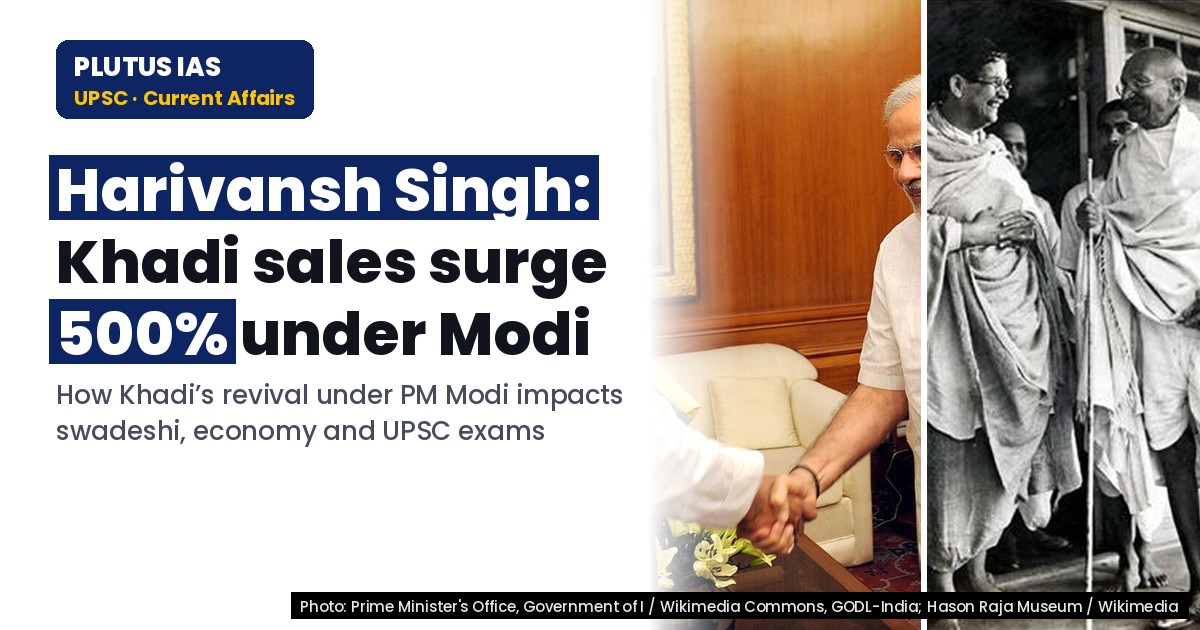
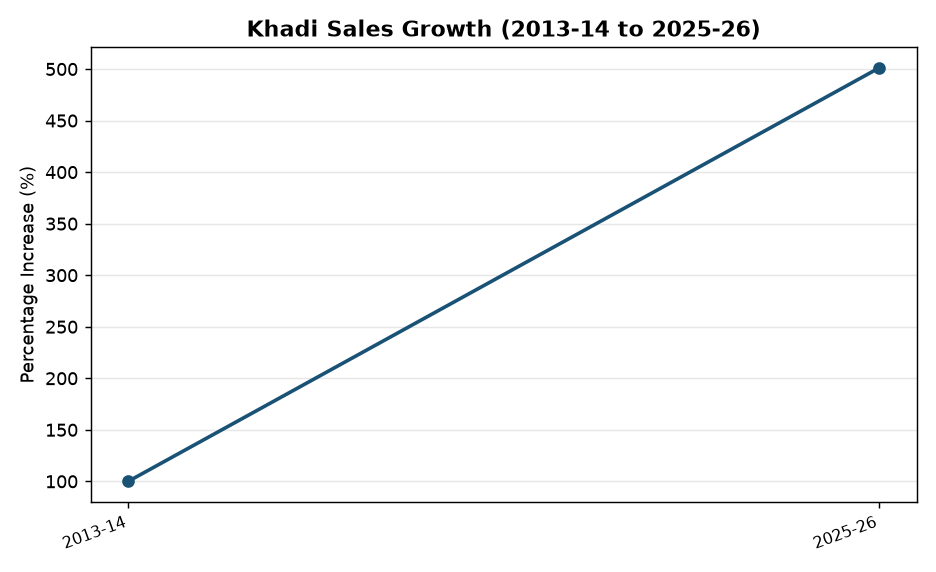
The statement by the Rajya Sabha Deputy Chairman highlighting a 501% increase in Khadi sales over 12 years underscores the renewed policy focus on reviving traditional industries as instruments of economic empowerment, employment generation, and cultural identity. This revival aligns with contemporary national initiatives such as ‘Vocal for Local,’ ‘Local to Global,’ and ‘Atmanirbhar Bharat,’ reflecting a strategic integration of Gandhian principles with modern economic governance.
Background
- Khadi, a hand-spun and hand-woven fabric, emerged as a symbol of the Swadeshi Movement during India’s freedom struggle, championed by Mahatma Gandhi to promote self-reliance and boycott British goods.
- Post-Independence, Khadi’s prominence waned due to industrialisation, market competition, and limited institutional support, reducing it largely to symbolic or ceremonial use.
- The Khadi and Village Industries Commission (KVIC), established in 1956 under the Khadi and Village Industries Commission Act, was mandated to promote Khadi and village industries through financial assistance, training, and marketing support.
- The decline in Khadi’s market share was exacerbated by the lack of modern branding, limited retail penetration, and competition from mechanised textile industries.
- Recent policy shifts, particularly after 2014, have reframed Khadi not merely as a heritage product but as a strategic tool for rural employment, skill development, and economic self-sufficiency.
- The Sabarmati Ashram Redevelopment Project, with a budget of ₹1,200 crore, symbolises the renewed institutional commitment to preserving and promoting Gandhian heritage and its economic philosophy.
What is Khadi and its Revival?
- Khadi is hand-spun and hand-woven cloth, traditionally produced using the charkha (spinning wheel), and is a symbol of India’s Swadeshi Movement and Gandhian economics of self-reliance.
- The Khadi and Village Industries Commission (KVIC), a statutory body under the Ministry of Micro, Small and Medium Enterprises (MSME), is the apex organisation responsible for the promotion, development, and marketing of Khadi and village industries in India.
- KVIC’s functions include providing financial assistance, technical guidance, training, and marketing support to artisans, while also ensuring quality control and certification of Khadi products.
- The revival of Khadi is linked to the ‘Vocal for Local’ initiative, which encourages the use of indigenous products to boost local economies and reduce import dependence, aligning with the broader ‘Atmanirbhar Bharat’ (Self-Reliant India) mission.
- The integration of Khadi into modern fashion and retail, through collaborations with designers, e-commerce platforms, and international exhibitions, has expanded its market reach and appeal to younger demographics.
- The revival is also supported by institutional efforts such as the establishment of Khadi India outlets, participation in global trade fairs, and the promotion of Khadi in government procurement under the Public Procurement Policy for Micro and Small Enterprises (MSEs).
- The economic impact of Khadi’s revival extends beyond sales, contributing to rural employment generation, skill development, and the preservation of traditional artisanal techniques, particularly among women and marginalised communities.
Key Features
| Feature | Significance |
|---|---|
| Sales Growth (501% in 12 years) | Demonstrates a sustained revival in market demand for Khadi, reflecting successful policy interventions and public engagement. |
| Philosophical Rebranding (‘Khadi for Nation, Khadi for Fashion, Khadi for Transformation’) | Transforms Khadi from a historical symbol into a contemporary cultural and economic emblem, aligning with modern consumer trends. |
| Institutional Role of KVIC | The Khadi and Village Industries Commission has acted as the nodal agency for policy implementation, quality control, and market expansion. |
| Swadeshi Integration | Reconnects Khadi with the broader swadeshi movement, reinforcing self-reliance and indigenous production as national priorities. |
| Grassroots Empowerment Focus | Emphasises the economic upliftment of rural artisans, particularly women and marginalised communities, through decentralised production. |
Why it Matters
Economic
- Revitalises a traditional industry, contributing to GDP growth through increased production and export potential of Khadi products.
- Promotes rural entrepreneurship and micro-enterprises, reducing migration to urban centres and fostering inclusive growth.
- Enhances India’s soft power by positioning Khadi as a globally recognised symbol of sustainable and ethical fashion.
Cultural and Symbolic
- Reinforces India’s historical narrative of self-reliance and resistance against colonial exploitation, as envisaged by Mahatma Gandhi.
- Serves as a unifying national symbol, transcending political and regional divides through its association with Gandhian principles.
- Encourages a cultural shift towards conscious consumerism, aligning with global trends in sustainable and handcrafted goods.
Policy and Governance
- Demonstrates the efficacy of targeted policy interventions in reviving traditional industries through institutional support (e.g., KVIC).
- Illustrates the integration of Gandhian economic philosophy into contemporary governance, bridging historical ideals with modern development strategies.
- Highlights the role of leadership in driving sectoral revival, with a focus on grassroots-level implementation.
Social
- Empowers rural artisans, particularly women, by providing sustainable livelihoods and reducing economic disparities.
- Fosters social cohesion by promoting localised production networks, strengthening community bonds in rural areas.
Challenges
1. Market Competition
- Khadi faces stiff competition from mechanised textile industries and cheaper synthetic alternatives, necessitating continuous innovation in design and marketing.
- Maintaining price competitiveness while ensuring fair wages for artisans remains a persistent challenge.
UPSC Link: GS3: Industrial Policy
2. Supply Chain Bottlenecks
- Dependency on seasonal raw material supply (e.g., cotton) can disrupt production cycles, requiring diversification of inputs.
- Logistical inefficiencies in rural areas hinder timely distribution and market access for Khadi products.
UPSC Link: GS3: Logistics and Infrastructure
3. Skill Preservation and Succession
- Aging artisan workforce and lack of formal training infrastructure threaten the transmission of traditional spinning and weaving skills.
- Urban migration of younger generations reduces the pool of skilled labour for Khadi production.
UPSC Link: GS1: Social Empowerment
4. Brand Perception and Consumer Awareness
- Khadi is often stereotyped as a low-cost, low-fashion commodity, requiring targeted campaigns to reposition it as a premium, sustainable choice.
- Limited awareness among urban consumers about the cultural and economic value of Khadi products.
UPSC Link: GS4: Ethics and Integrity in Governance
5. Environmental Sustainability
- Sustainable sourcing of raw materials (e.g., organic cotton) and eco-friendly dyeing processes are essential to align with global sustainability standards.
- Balancing traditional production methods with modern environmental regulations poses compliance challenges.
UPSC Link: GS3: Environmental Conservation
Challenges — UPSC Perspective
| Issue | Concern |
|---|---|
| Market Competition | Price competitiveness against synthetic textiles and mechanised industries. |
| Supply Chain Bottlenecks | Seasonal raw material dependency and rural logistical inefficiencies. |
| Skill Preservation | Aging workforce and lack of formal training infrastructure. |
| Brand Perception | Stereotypical image as low-cost commodity, limiting urban market penetration. |
| Environmental Sustainability | Need for eco-friendly production methods while preserving traditional techniques. |
| Consumer Awareness | Limited understanding of Khadi’s cultural and economic value among younger demographics. |
Government Initiatives — Must-Memorise for Prelims
- Khadi and Village Industries Commission (KVIC) Revival Schemes
- SFURTI (Scheme of Fund for Regeneration of Traditional Industries) – Khadi Clusters
Way Forward
- Strengthen institutional support for KVIC through increased budgetary allocations for R&D, marketing, and skill development.
- Expand market linkages via e-commerce platforms and international trade fairs to enhance global visibility of Khadi products.
- Introduce formal vocational training programmes in collaboration with ITIs and NGOs to preserve and modernise traditional skills.
- Launch targeted awareness campaigns in urban centres to reposition Khadi as a sustainable and fashionable choice.
- Diversify product range to include high-value items (e.g., Khadi apparel, home decor) to attract premium segments.
- Enhance supply chain resilience by promoting contract farming of organic cotton and other raw materials.
- Foster public-private partnerships to integrate Khadi into mainstream fashion and retail sectors.
- Implement a robust monitoring and evaluation framework to assess the socio-economic impact of Khadi revival initiatives.
UPSC Value Addition
Keywords for Mains Answer-Writing
Khadi and Village Industries Commission (KVIC) · Swadeshi Movement · Atmanirbhar Bharat · Vocal for Local · Sustainable livelihoods · Rural industrialisation · Gandhian economics · Self-reliance · Khadi revival · Local to Global initiative · Sabarmati Ashram redevelopment · Institutional empowerment · Decentralised production · Cottage industries · Economic nationalism
Constitutional & Policy Linkages
- Directive Principles of State Policy (Article 43) – Promotion of cottage industries.
Concept Flow
Colonial exploitation → Khadi as swadeshi symbol during freedom struggle → Post-Independence decline due to industrialisation → Policy revival (2014 onwards) → Institutional support (KVIC) → Market rebranding (‘Khadi for Nation, Fashion, Transformation’) → Sustained sales growth (501%) → Rural empowerment and economic revival.
Prelims Practice Questions
Q1. Consider the following statements regarding the Khadi and Village Industries Commission (KVIC):
1. KVIC is a statutory body established under the Khadi and Village Industries Commission Act, 1956.
2. It functions under the administrative control of the Ministry of Micro, Small and Medium Enterprises (MSME).
3. The primary objective of KVIC is to promote and develop khadi and village industries in rural areas.
How many of the above statements are correct?
- Only one
- Only two
- All three
- None
Answer: All three — Statements 1 and 3 are correct. Statement 2 is incorrect as KVIC functions under the Ministry of Micro, Small and Medium Enterprises (MSME), not the Ministry of Rural Development.
Q2. Assertion (A): The ‘Vocal for Local’ initiative is aimed at promoting indigenous products and reducing import dependency.
Reason (R): The initiative aligns with the principles of Gandhian economics, particularly the emphasis on swadeshi and self-reliance.
Options:
A. Both A and R are true, and R is the correct explanation of A.
B. Both A and R are true, but R is not the correct explanation of A.
C. A is true, but R is false.
D. A is false, but R is true.
Answer: ? — Both Assertion (A) and Reason (R) are true, and Reason (R) correctly explains Assertion (A). The ‘Vocal for Local’ initiative promotes indigenous products and aligns with Gandhian principles of swadeshi and self-reliance.
Q3. Match the following initiatives with their respective objectives:
Column I (Initiatives)
A. Atmanirbhar Bharat
B. Local to Global
C. Khadi for Nation
D. Sabarmati Ashram redevelopment
Column II (Objectives)
1. Promoting khadi as a symbol of national pride and economic transformation
2. Developing rural industries to enhance self-reliance and reduce import dependency
3. Revitalising the Sabarmati Ashram as a heritage site and centre for Gandhian studies
4. Positioning local products in global markets to boost exports
Options:
A – 2, B – 4, C – 1, D – 3
A – 1, B – 2, C – 4, D – 3
A – 3, B – 1, C – 2, D – 4
A – 2, B – 1, C – 4, D – 3
Answer: ? — The correct match is: A (Atmanirbhar Bharat) – 2 (Promoting rural industries to enhance self-reliance), B (Local to Global) – 4 (Positioning local products in global markets), C (Khadi for Nation) – 1 (Promoting khadi as a symbol of national pride), D (Sabarmati Ashram redevelopment) – 3 (Revitalising the Sabarmati Ashram).
Mains Practice Question
✍ The revival of khadi in contemporary India represents a confluence of economic nationalism, Gandhian philosophy, and modern market dynamics. Critically examine the role of institutional mechanisms such as the Khadi and Village Industries Commission (KVIC) in this revival, with reference to the ‘Vocal for Local’, ‘Local to Global’, and ‘Atmanirbhar Bharat’ initiatives. Also, analyse the socio-economic implications of this revival for rural communities. (15 Marks)
Approach: MODEL-ANSWER SKELETON:
1. **Introduction (2 marks)**
– Define khadi as a symbol of swadeshi and Gandhian economics.
– Contextualise the decline post-Independence and the recent revival under ‘Vocal for Local’, ‘Local to Global’, and ‘Atmanirbhar Bharat’.
2. **Institutional Mechanisms and KVIC (4 marks)**
– Role of KVIC as a statutory body under the MSME Ministry (Khadi and Village Industries Commission Act, 1956).
– KVIC’s functions: promotion of khadi, village industries, and rural employment generation.
– Policy interventions: financial support, skill development, and market linkages (e.g., Khadi Mark certification).
– Institutional partnerships: collaboration with state governments, NGOs, and private sector for scaling up production and marketing.
3. **Policy Initiatives Driving Revival (4 marks)**
– ‘Vocal for Local’: Emphasis on indigenous products, reducing import dependency, and fostering self-reliance.
– ‘Local to Global’: Positioning khadi and village products in international markets to enhance export competitiveness.
– ‘Atmanirbhar Bharat’: Integration of khadi into the broader agenda of self-sufficiency and sustainable livelihoods.
– Data: Reference to the 501% increase in khadi sales (2013-14 to 2025-26) as a quantitative indicator of success.
4. **Socio-Economic Implications for Rural Communities (3 marks)**
– Employment generation: Direct and indirect employment in khadi and village industries.
– Women empowerment: Khadi’s role in providing livelihoods to rural women through spinning and weaving.
– Skill development: Training programmes under KVIC and allied schemes (e.g., PMEGP, SFURTI).
– Economic resilience: Diversification of income sources and reduced vulnerability to market fluctuations.
– Challenges: Ensuring fair wages, quality control, and sustainable raw material supply.
5. **Critical Analysis and Balanced View (2 marks)**
– Successes: Quantifiable growth in sales, market penetration, and institutional support.
– Limitations: Dependence on government subsidies, competition from mass-produced textiles, and scalability issues.
– Long-term sustainability: Need for innovation, branding, and integration with global supply chains.
6. **Conclusion (2 marks)**
– Summarise the revival as a model for rural industrialisation and economic nationalism.
– Emphasise the need for continuous policy support, market diversification, and community participation for sustained impact.
Source: The Indian Express
Generated by AanyaAi for educational purpose.
Related guides on our sites
- Best PSIR optional coaching for upsc
- Best economics optional coaching for upsc
- Best PSIR optional teacher for upsc
- Best teacher of PSIR optional for upsc

- Gujarat UCC Bill: Key Features for UPSC & State PCS Exam - October 3, 2026
- इंदिरा गांधी प्राणी उद्यान में वन्यजीव सप्ताह का शुभारंभ, जानिए मुख्य गतिविधियां - October 3, 2026
- Sharam Samvad: Govt’s PR Campaign for Labour Codes in Delhi-NCR & Uttarakhand - October 2, 2026

No Comments