


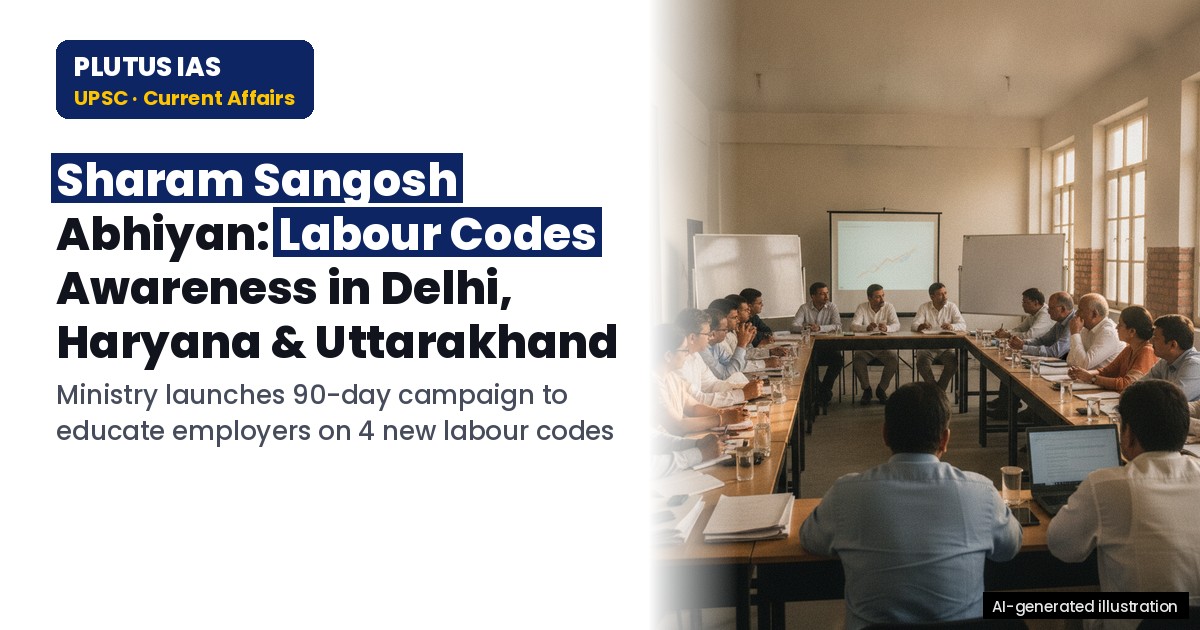
02 Oct Sharam Samvad: Govt’s PR Campaign for Labour Codes in Delhi-NCR & Uttarakhand
✎ The ‘Shram Samvaad’ campaign is a 90-day national outreach initiative by the Ministry of Labour and Employment to drive compliance with the Labour Codes through district-level stakeholder engagement in industrial clusters.
Subject Relevance — Where This Topic Fits
- GS Paper II — Governance, Administration and Challenges | GS Paper III — Labour, Employment and Social Security
- Prelims: Labour Codes 2020, Pradhan Mantri Rojgar Protsahan Yojana (PMRPY), Pradhan Mantri Shram Yogi Maan-dhan (PM-SYM), Employees’ Provident Fund Organisation (EPFO), Employees’ State Insurance Corporation (ESIC), District-level compliance, Code on Wages, 2019, Industrial Relations Code, 2020, Code on Social Security, 2020, Occupational Safety, Health and Working Conditions Code, 2020
- Essay: Role of participatory governance in public policy implementation, Balancing labour market flexibility with worker protection
Quick Revision: The ‘Shram Samvaad’ campaign is a 90-day national outreach initiative by the Ministry of Labour and Employment to drive compliance with the Labour Codes through district-level stakeholder engagement in industrial clusters.
Why is this in the news?
The Ministry of Labour and Employment, Government of India, launched district-level awareness and capacity-building programmes under the ‘Shram Samvaad’ outreach campaign on 1 October 2026 in Haridwar (Uttarakhand), Naraina Industrial Area (New Delhi), and Sonipat (Haryana). These events are part of a 90-day national public relations initiative aimed at clarifying the provisions of the Labour Codes, enhancing employer compliance, and strengthening the implementation of flagship employment and social security schemes at the grassroots level.
Background
- The four Labour Codes—Code on Wages, 2019; Industrial Relations Code, 2020; Code on Social Security, 2020; and Occupational Safety, Health and Working Conditions Code, 2020—were enacted to consolidate and modernise India’s labour laws, replacing 29 central labour laws.
- The Labour Codes introduce unified definitions, simplified compliance regimes, and enhanced social security coverage, including provisions for gig workers and unorganised sector employees.
- The Government of India has emphasised the phased implementation of the Labour Codes through extensive stakeholder consultations, capacity-building programmes, and digital compliance portals.
- The ‘Shram Samvaad’ campaign is a 90-day national outreach initiative launched on 28 September 2026, targeting 316 districts across all states and union territories, with a focus on industrial clusters.
- The campaign seeks to address implementation challenges such as employer awareness gaps, procedural ambiguities, and the need for coordinated action among labour enforcement agencies.
- Key social security schemes linked to the Labour Codes include the Pradhan Mantri Rojgar Protsahan Yojana (PMRPY) for employment generation and the Pradhan Mantri Shram Yogi Maan-dhan (PM-SYM) for unorganised sector workers.
What is the ‘Shram Samvaad’ Campaign?
- A 90-day national public relations and capacity-building initiative launched by the Ministry of Labour and Employment to enhance awareness and compliance with the Labour Codes.
- The campaign is structured around district-level stakeholder engagement programmes in industrial clusters, involving government officials, employers, industry associations, HR and legal professionals, and representatives of social security organisations.
- The primary objectives are to clarify the applicability, provisions, and compliance requirements of the Labour Codes, address implementation challenges, and facilitate direct interaction between stakeholders and enforcement authorities.
- Technical sessions cover the Code on Wages, Industrial Relations Code, Code on Social Security, and Occupational Safety, Health and Working Conditions Code, along with dedicated modules on Pradhan Mantri Rojgar Protsahan Yojana (PMRPY) and Pradhan Mantri Shram Yogi Maan-dhan (PM-SYM).
- The campaign includes interactive dialogue sessions where participants raise practical compliance issues, seek clarifications, and receive real-time guidance from senior officials of EPFO, ESIC, and the Central Labour Commissioner’s office.
- The initiative is implemented in collaboration with industry bodies such as SCOPE, CII, and local associations, ensuring sector-specific relevance and outreach.
- The campaign aligns with the broader objective of formalising the workforce, enhancing ease of doing business, and ensuring universal social security coverage.
- The outreach model prioritises industrial clusters to address the concentration of formal and informal employment, thereby maximising the impact of compliance efforts.
Key Features
| Feature | Significance |
|---|---|
| Nationwide ‘Shram Samvad’ PR Campaign | A 90-day outreach initiative by the Ministry of Labour and Employment to enhance awareness and compliance regarding the four Labour Codes across 36 states/UTs and 316 districts, with a focus on industrial clusters. |
| District-Level Capacity-Building Programmes | Multi-stakeholder engagement in industrial hubs (Haridwar, Naraina, Sonipat) to disseminate provisions of the Labour Codes, employer obligations, and social security schemes, ensuring grassroots implementation. |
| Technical Sessions on Labour Codes | Detailed discussions on the four Labour Codes (2019–2020): Wage Code, Industrial Relations Code, Social Security Code, and Occupational Safety, Health & Working Conditions Code, clarifying applicability and compliance requirements. |
| Dedicated Sessions on PM-VBKY and PM-SYM | Focused deliberations on the Pradhan Mantri Vishwakarma Shram Samman Yojana (PM-VBKY) and Pradhan Mantri Shram Yogi Maan-dhan (PM-SYM) to promote formal employment and social security coverage. |
| Interactive Q&A with Regulatory Authorities | Direct engagement between stakeholders (employers, HR professionals, legal experts) and officials from EPFO, ESIC, and the Office of the Chief Labour Commissioner to resolve practical compliance issues. |
Why it Matters
Governance and Policy Implementation
- Demonstrates the Union Government’s commitment to ensuring smooth transition and effective enforcement of the Labour Codes, which consolidate 29 central labour laws into four unified frameworks.
- Enhances transparency and reduces compliance ambiguity for employers, particularly in industrial clusters, by clarifying statutory obligations under the new Codes.
- Strengthens the interface between policymakers, industry associations, and regulatory bodies to address ground-level challenges in implementation.
Economic and Industrial Development
- Supports formalisation of the workforce by promoting awareness of social security schemes (e.g., PM-SYM) and employment-linked initiatives (e.g., PM-VBKY), thereby reducing informality in labour markets.
- Facilitates ease of doing business by streamlining compliance processes through the Labour Codes, which standardise definitions, procedures, and penalties across states.
- Encourages investment in industrial hubs by ensuring regulatory clarity and reducing operational risks for businesses.
Social Security and Labour Welfare
- Expands coverage of social security benefits (e.g., EPFO, ESIC) by raising awareness among both employers and employees, particularly in unorganised and semi-organised sectors.
- Promotes the integration of informal workers into formal social security frameworks, aligning with the objectives of the Social Security Code, 2020.
- Strengthens the institutional capacity of labour departments and enforcement agencies to monitor and ensure compliance with welfare provisions.
Stakeholder Collaboration and Capacity Building
- Fosters multi-stakeholder dialogue between government, industry, and professional bodies (e.g., CII, SCOPE) to co-create solutions for labour market challenges.
- Builds institutional capacity among HR and legal professionals to interpret and implement the Labour Codes, reducing legal ambiguities in employment contracts.
- Creates a feedback loop for policymakers to identify implementation bottlenecks and refine enforcement strategies based on ground-level inputs.
Challenges
1. Diverse State-Level Implementation Frameworks
- Variations in state-level rules under the Labour Codes may lead to compliance complexities for businesses operating across multiple jurisdictions.
- Need for synchronised training and capacity-building programmes for state labour departments to ensure uniform enforcement.
UPSC Link: GS-II: Labour Policies
2. Informal Sector Integration
- Limited awareness and participation of informal workers in social security schemes (e.g., PM-SYM) due to low digital literacy and lack of formal documentation.
- Challenges in extending EPFO/ESIC coverage to gig workers and platform-based labour under the Social Security Code, 2020.
UPSC Link: GS-II: Social Sector Schemes
3. Employer Compliance Burden
- SMEs and micro-enterprises may face financial and operational constraints in meeting the compliance requirements of the Labour Codes, particularly regarding wage payments and safety standards.
- Need for simplified compliance procedures and digital tools to reduce administrative burden on small businesses.
UPSC Link: GS-III: Ease of Doing Business
4. Monitoring and Enforcement Gaps
- Limited institutional capacity of labour inspectorates and enforcement agencies to conduct regular audits and ensure adherence to the Labour Codes.
- Risk of underreporting of violations due to lack of robust grievance redressal mechanisms and whistle-blower protections.
UPSC Link: GS-II: Government Policies
5. Awareness and Behavioural Barriers
- Low awareness among workers about their rights and entitlements under the new Codes, leading to underutilisation of social security benefits.
- Resistance to change among traditional employers accustomed to pre-existing labour laws, necessitating sustained outreach and capacity-building.
UPSC Link: GS-II: Human Resource Development
Challenges — UPSC Perspective
| Issue | Concern |
|---|---|
| State-Level Rule Variations | Potential compliance inconsistencies for businesses operating across multiple states under the Labour Codes. |
| Informal Sector Coverage | Challenges in extending social security to gig workers and platform-based labour due to lack of formal documentation. |
| SME Compliance Costs | Financial and operational burden on small businesses to meet wage, safety, and record-keeping requirements. |
| Enforcement Capacity | Limited institutional resources for labour inspectors to monitor and enforce the Labour Codes effectively. |
| Worker Awareness Deficit | Low participation in social security schemes due to lack of knowledge about eligibility and benefits. |
| Digital Divide | Barriers to accessing online compliance portals and digital records for workers and small employers in rural areas. |
Government Initiatives — Must-Memorise for Prelims
- Pradhan Mantri Shram Yogi Maan-dhan (PM-SYM)
Way Forward
- Strengthen state-level coordination mechanisms to harmonise implementation frameworks under the Labour Codes, ensuring consistency across jurisdictions.
- Expand digital infrastructure (e.g., unified compliance portals, mobile apps) to simplify registration, filing, and grievance redressal for employers and workers.
- Launch targeted awareness campaigns in regional languages, leveraging local media, NGOs, and industry associations to reach informal workers and SMEs.
- Enhance capacity-building programmes for labour inspectors, HR professionals, and legal practitioners to improve enforcement and interpretation of the Codes.
- Introduce simplified compliance guidelines and self-certification mechanisms for SMEs to reduce administrative burdens while maintaining accountability.
- Establish a grievance redressal system with dedicated helplines and online portals to address violations and provide timely resolutions.
- Promote public-private partnerships to conduct regular audits and third-party compliance assessments in industrial clusters.
- Monitor key performance indicators (e.g., EPFO/ESIC enrolment rates, wage compliance) to assess the impact of the Labour Codes and adjust policies accordingly.
UPSC Value Addition
Keywords for Mains Answer-Writing
Labour Codes 2020 · Pradhan Mantri Vishwakarma Rojgar Yojana (PMVBY) · Pradhan Mantri Shram Yogi Maan-dhan (PM-SYM) · Industrial Relations Code, 2020 · Social Security Code, 2020 · Occupational Safety, Health and Working Conditions Code, 2020 · Wage Code, 2019 · employer compliance · labour welfare schemes · district-level capacity building · EPFO, ESIC, DGMS · public-private partnership in labour governance
Constitutional & Policy Linkages
- Article 246 (7th Schedule): Division of legislative powers between the Union and States under the Concurrent List (Entry 22: Labour).
- Article 39 (Directive Principles of State Policy): Ensuring just and humane conditions of work and social security.
- Article 43 (Directive Principles): Promotion of cottage and small-scale industries with a view to securing a decent standard of life for workers.
Concept Flow
Enactment of four Labour Codes (2019–2020) → Consolidation of 29 central labour laws into unified frameworks → → Need for nationwide awareness and compliance facilitation → Launch of ‘Shram Samvad’ PR campaign → → District-level capacity-building programmes in industrial clusters → Engagement of stakeholders (employers, HR, regulators) → → Clarification of provisions under the Labour Codes (wage, safety, social security) → Addressing compliance ambiguities → → Promotion of social security schemes (PM-SYM, PM-VBKY) → Expansion of formal employment and welfare coverage → → Feedback loop to policymakers for refining enforcement strategies → Strengthening governance and labour market formalisation.
Prelims Practice Questions
Q1. Consider the following statements about the four Labour Codes enacted in 2020:
1. The Wage Code, 2019 consolidates four existing labour laws related to wages.
2. The Industrial Relations Code, 2020 replaces the Industrial Disputes Act, 1947.
3. The Social Security Code, 2020 subsumes the Employees’ Provident Funds and Miscellaneous Provisions Act, 1952.
4. The Occupational Safety, Health and Working Conditions Code, 2020 does not cover establishments with less than 10 workers.
How many of the above statements are correct?
- Only one
- Only two
- Only three
- All four
Answer: Only three — Statements 1, 2, and 3 are correct. Statement 4 is incorrect as the OSH Code, 2020 applies to establishments with 10 or more workers, but also includes certain provisions for smaller establishments under specific conditions.
Q2. Assertion (A): The Pradhan Mantri Shram Yogi Maan-dhan (PM-SYM) is a voluntary pension scheme for unorganised workers.
Reason (R): The scheme is administered by the Employees’ State Insurance Corporation (ESIC) under the Ministry of Labour and Employment.
In the context of the above two statements, which one of the following is correct?
- Both A and R are true, and R is the correct explanation of A
- Both A and R are true, but R is not the correct explanation of A
- A is true, but R is false
- A is false, but R is true
Answer: A is true, but R is false — Assertion (A) is correct as PM-SYM is a voluntary pension scheme for unorganised workers. Reason (R) is also correct, but it is not the correct explanation of (A) because the scheme is administered by the Ministry of Labour and Employment, not ESIC.
Q3. Match the following Labour Codes with their respective key provisions:
Column I (Labour Code) Column II (Key Provision)
A. Wage Code, 2019 1. Fixes minimum wages and ensures timely payment
B. Industrial Relations Code, 2020 2. Regulates industrial disputes and trade unions
C. Social Security Code, 2020 3. Consolidates social security schemes
D. OSH Code, 2020 4. Ensures safety, health, and working conditions
Select the correct match:
- A-1, B-2, C-3, D-4
- A-2, B-1, C-4, D-3
- A-3, B-4, C-1, D-2
- A-4, B-3, C-2, D-1
Answer: A-1, B-2, C-3, D-4 — The correct matches are: A-1 (Wage Code fixes minimum wages and ensures timely payment), B-2 (Industrial Relations Code regulates industrial disputes and trade unions), C-3 (Social Security Code consolidates social security schemes), and D-4 (OSH Code ensures safety, health, and working conditions).
Mains Practice Question
✍ The Ministry of Labour and Employment has launched the ‘Shram Samvaad’ outreach campaign to enhance awareness and compliance with the four Labour Codes of 2020. Critically examine the significance of this initiative in the context of India’s labour governance architecture. Also, analyse the challenges in ensuring effective implementation of these codes at the district level. (15 Marks)
Approach: MODEL-ANSWER SKELETON:
1. **Introduction (2 marks)**
– Briefly introduce the four Labour Codes (Wage Code, 2019; Industrial Relations Code, 2020; Social Security Code, 2020; OSH Code, 2020) and their objectives.
– Mention the ‘Shram Samvaad’ initiative as a district-level capacity-building and awareness campaign launched by the Ministry of Labour and Employment.
2. **Significance of the Initiative (5 marks)**
– **Bridging the Knowledge Gap**: The campaign addresses the lack of awareness among employers, employees, and other stakeholders regarding the provisions, applicability, and compliance requirements of the Labour Codes.
– **Multi-Stakeholder Engagement**: Involvement of government officials, industry associations, HR professionals, and legal experts ensures a collaborative approach to labour governance.
– **District-Level Focus**: Targeting industrial clusters in specific districts (e.g., Haridwar, Naraina, Sonipat) aligns with the ground-level implementation challenges and ensures localized solutions.
– **Integration with Social Security Schemes**: Linkages with schemes like PMVBY and PM-SYM highlight the government’s commitment to comprehensive social security coverage.
– **Public-Private Partnership**: Collaboration with industry bodies (e.g., CII, SCOPE) and professional networks enhances the reach and credibility of the campaign.
3. **Challenges in Implementation (6 marks)**
– **Complexity of Labour Codes**: The consolidation of multiple laws into four codes has increased complexity, making it difficult for small and medium enterprises (SMEs) to comprehend and comply.
– **Lack of Awareness Among Workers**: Many unorganised sector workers remain unaware of their rights and entitlements under the new codes.
– **Resource Constraints**: District-level authorities often face capacity and resource constraints in conducting awareness programs and monitoring compliance.
– **Industry Resistance**: Some industries may resist compliance due to perceived financial burdens or operational disruptions.
– **Fragmented Enforcement**: Overlapping jurisdictions of EPFO, ESIC, DGMS, and state labour departments can lead to confusion and inefficiencies.
– **Digital Divide**: Limited digital literacy and access to online compliance portals in rural and semi-urban areas hinder effective implementation.
4. **Way Forward (2 marks)**
– Strengthening district-level institutions (e.g., labour offices, industry associations) to act as nodal centres for compliance support.
– Leveraging digital platforms (e.g., Shram Suvidha Portal) for streamlined registration, reporting, and grievance redressal.
– Conducting periodic audits and capacity-building programs for enforcement agencies.
– Promoting industry-led self-regulation and peer-learning mechanisms to enhance compliance culture.
Source: PIB (Press Information Bureau)
Haryana PCS (HPSC / HCS) — State PCS Practice
Prelims: Which of the following objectives is NOT directly associated with the ‘Sharam Samvaad’ public awareness campaign launched by the Ministry of Labour and Employment in Haryana?
- A. Promoting awareness about labour rights and welfare schemes among industrial workers
- B. Facilitating direct dialogue between labour unions and industrial employers in Haryana
- C. Expanding the coverage of the campaign to include agricultural labourers in Haryana
- D. Enhancing compliance with labour laws in industrial clusters of Haryana
Answer: C. Expanding the coverage of the campaign to include agricultural labourers in Haryana — The campaign specifically targets industrial workers in clusters of Haryana, Delhi, and Uttarakhand, focusing on labour rights and compliance, not agricultural labourers.
Mains: Discuss the significance of the ‘Sharam Samvaad’ public awareness campaign for industrial workers in Haryana, highlighting its potential impact on labour welfare, compliance with labour laws, and socio-economic development in the state. Suggest measures to ensure its effective implementation and outreach in Haryana’s industrial clusters.
Generated by AanyaAi for educational purpose.
Related guides on our sites
- Best PSIR optional coaching in delhi for UPSC
- Best PSIR optional coaching for upsc
- Best sociology optional coaching for upsc
- Which is best sociology optional coaching for upsc

- Sharam Samvad: Govt’s PR Campaign for Labour Codes in Delhi-NCR & Uttarakhand - October 2, 2026
- खादी उत्पादों पर 20% तक छूट: गांधी जयंती पर KVIC की पहल - October 2, 2026
- DoT Launches Special Campaign 6: Key Goals for UPSC & State PCS - October 2, 2026

No Comments