


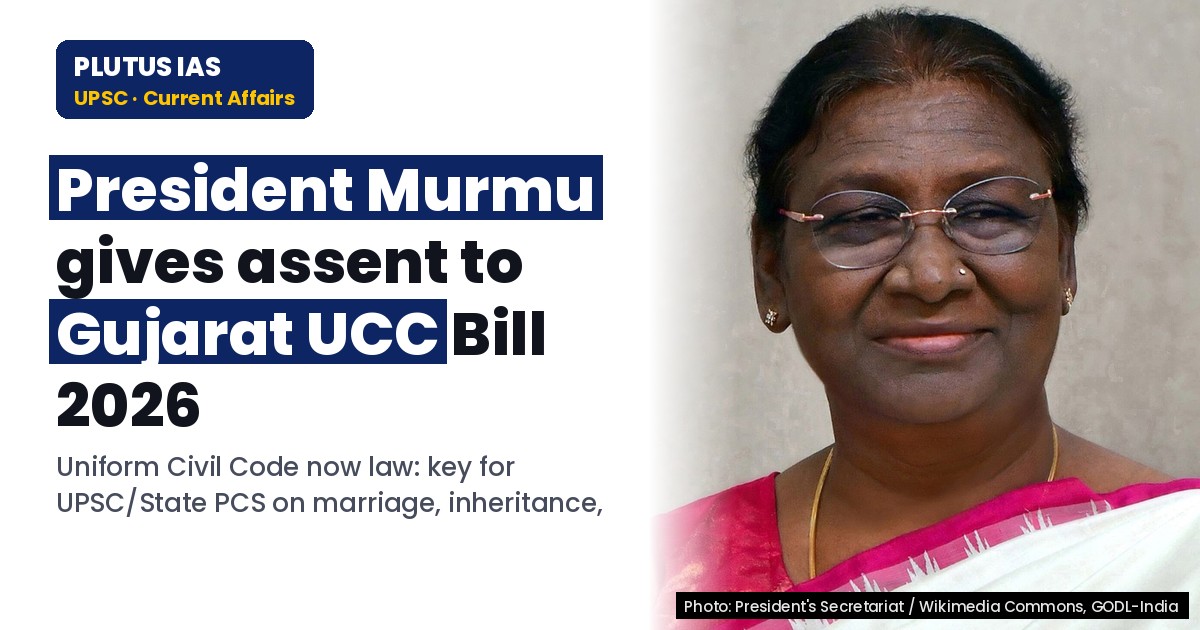
03 Oct Gujarat UCC Bill: Key Features for UPSC & State PCS Exam
✎ The Gujarat UCC Bill, 2026, is a state-level legislative initiative to harmonise personal civil laws, including marriage, divorce, succession, adoption, and live-in relationships, while respecting constitutional safeguards for…
Subject Relevance — Where This Topic Fits
- GS Paper II — Constitutional and Non-Constitutional Bodies (Role of the President, State Legislatures) | GS Paper II — Fundamental Rights and Directive Principles of State Policy (Articles 14, 15, 21, 44) | GS Paper III — Government Policies and Interventions for Development in Various Sectors (Social Justice, Gender Justice) | GS Paper IV — Ethical Governance (Transparency, Accountability, and Implementation Challenges)
- Prelims: Uniform Civil Code (UCC), Article 44 of the Directive Principles of State Policy, President’s assent under Article 200, Personal laws vs. civil code, Live-in relationships, marriage, divorce, succession, adoption, Scheduled Tribes (STs) and customary rights under Part XXI of the Constitution
- Essay: The Role of Uniform Civil Code in Achieving Constitutional Goals of Equality and Justice, Balancing Uniformity and Pluralism: The Governance Challenge of Personal Laws in India
Quick Revision: The Gujarat UCC Bill, 2026, is a state-level legislative initiative to harmonise personal civil laws, including marriage, divorce, succession, adoption, and live-in relationships, while respecting constitutional safeguards for Scheduled Tribes and customary rights.
Why is this in the news?
The Gujarat Uniform Civil Code (UCC) Bill, 2026, has received the President’s assent, marking a significant development in the realm of personal civil laws in India. This legislation, largely modeled on Uttarakhand’s UCC, seeks to regulate personal civil matters such as marriage, divorce, succession, adoption, and live-in relationships for the residents of Gujarat. The enactment of this law underscores the ongoing discourse on the Uniform Civil Code as envisaged under Article 44 of the Constitution and raises critical questions about its implementation, scope, and implications for governance and social justice.
Background
- The concept of a Uniform Civil Code (UCC) finds its constitutional mandate in Article 44 of the Directive Principles of State Policy, which directs the State to endeavour to secure a UCC for the citizens of India.
- The UCC has been a subject of debate and discussion in India for decades, with proponents arguing for its role in promoting gender justice, equality, and national integration, while critics highlight concerns over cultural and religious pluralism.
- The Gujarat UCC Bill, 2026, was passed by the Gujarat Assembly in March 2026 after an extensive debate, reflecting the state’s intent to harmonise personal civil laws.
- The Bill was proposed following a report by a committee headed by former Supreme Court judge Ranjana Desai, which examined the feasibility and implications of implementing a UCC in Gujarat.
- The President’s assent to the Bill, as per Article 200 of the Constitution, is a critical step in its legislative journey, empowering the state government to implement the law.
What is the Gujarat Uniform Civil Code (UCC) Bill, 2026?
- The Gujarat UCC Bill, 2026, is a legislative framework aimed at regulating personal civil matters such as marriage, divorce, succession, adoption, and live-in relationships for the residents of Gujarat.
- The Bill seeks to replace existing personal laws, which are governed by religious customs and traditions, with a uniform set of civil laws applicable to all citizens, irrespective of their religion.
- The law includes provisions for the registration of live-in relationships, ensuring legal recognition and safeguards for parties involved, while also addressing issues such as maintenance, inheritance, and succession.
- The Bill introduces gender-neutral provisions in matters of inheritance and succession, aiming to promote equality and justice in familial and property rights.
- The UCC Bill does not apply to members of Scheduled Tribes (STs) or to persons whose customary rights are protected under Part XXI of the Constitution, thereby respecting the constitutional safeguards for tribal communities.
- The law is designed to be progressive, incorporating modern legal principles while balancing the need for uniformity and cultural sensitivity.
- The implementation of the UCC is expected to streamline legal processes, reduce litigation, and ensure uniformity in the application of personal civil laws across the state.
- The Bill reflects the state’s commitment to achieving the constitutional goal of a UCC, as outlined in Article 44, while also addressing contemporary social issues such as live-in relationships and gender justice.
Key Features
| Feature | Significance |
|---|---|
| Unified Marriage & Divorce Provisions | Standardises civil marriage, divorce, and related procedures across religious communities, replacing personal laws with a single statutory framework. |
| Live-in Relationships Regulation | Introduces a mandatory registration system for live-in couples, ensuring legal recognition and rights while imposing obligations such as maintenance and cohabitation duration. |
| Uniform Succession & Inheritance Rules | Replaces diverse religious inheritance laws with a single statutory inheritance regime, ensuring gender-neutral and uniform succession principles. |
| Adoption Framework | Establishes a uniform adoption process for all residents, irrespective of religion, aligning with the Juvenile Justice (Care and Protection of Children) Act, 2015. |
| Exclusion of Customary Rights | Exempts Scheduled Tribes and groups protected under Part XXI of the Constitution from the UCC, preserving their customary personal laws. |
Why it Matters
Legal & Judicial
- Reduces multiplicity of personal laws, thereby diminishing litigation arising from conflicts between religious and civil laws.
- Enhances predictability in judicial outcomes by replacing discretionary religious interpretations with statutory clarity.
- Strengthens the principle of ‘equality before law’ (Article 14) by treating all citizens uniformly in civil matters.
Social & Gender
- Promotes gender equality by ensuring uniform inheritance rights, divorce entitlements, and adoption processes, irrespective of religious affiliation.
- Provides legal recognition and protection to live-in relationships, addressing rights of women and children in such unions.
- May reduce social discrimination by removing religiously motivated differential treatment in civil matters.
Administrative & Governance
- Centralises civil registration functions (marriage, divorce, live-in) under a single statutory authority, improving efficiency and data integrity.
- Facilitates better policy formulation by providing a uniform dataset on civil matters across communities.
- Reduces administrative burden on courts by streamlining dispute resolution through statutory provisions.
Challenges
1. Constitutional Validity & Fundamental Rights
- Potential challenge under Article 25 (Freedom of Religion) for encroaching upon religious personal laws.
- Risk of violating Article 26 (Freedom to Manage Religious Affairs) if the UCC is perceived as restricting religious autonomy.
- Question of whether the state can legislate on ‘personal civil matters’ without encroaching on the domain of religion.
UPSC Link: Article 25-28
2. Implementation & Enforcement Gaps
- Challenge in ensuring uniform compliance across diverse communities and regions within Gujarat.
- Need for extensive capacity-building of administrative and judicial authorities to handle the new legal framework.
- Risk of underreporting or misuse of live-in relationship registrations due to social stigma or lack of awareness.
UPSC Link: Part IV (DPSP)
3. Social Resistance & Cultural Sensitivities
- Possible backlash from religious groups perceiving the UCC as an imposition of majoritarian values.
- Cultural resistance to changes in marriage, divorce, and inheritance practices, particularly among conservative sections.
- Need for extensive public awareness campaigns to ensure acceptance and smooth transition.
UPSC Link: Article 51A (Fundamental Duties)
4. Exclusion of Scheduled Tribes
- Risk of alienating tribal communities by excluding them from the UCC, potentially leading to demands for separate legal frameworks.
- Challenge in defining ‘customary rights’ and ensuring their protection without creating legal ambiguities.
- Need for a balanced approach to preserve tribal autonomy while ensuring their integration into mainstream legal systems.
UPSC Link: Part XXI (Special Provisions)
5. Inter-State Legal Harmonisation
- Potential conflict with personal laws in other states, leading to legal uncertainty for inter-state couples.
- Challenge in ensuring consistency with the UCC in Uttarakhand and any future UCCs in other states.
- Need for a national-level framework to avoid legal fragmentation across states.
UPSC Link: Article 246 (7th Schedule)
Challenges — UPSC Perspective
| Issue | Concern |
|---|---|
| Constitutional Challenges | Risk of violating Articles 25-28 due to encroachment on religious freedoms. |
| Implementation Gaps | Lack of administrative capacity to enforce the UCC uniformly across communities. |
| Social Resistance | Cultural and religious resistance to changes in personal laws. |
| Tribal Exclusion | Potential alienation of Scheduled Tribes due to exclusion from the UCC. |
| Inter-State Conflicts | Legal uncertainty for inter-state couples due to varying state UCCs. |
Way Forward
- Conduct extensive public consultations and awareness campaigns to ensure community buy-in and address concerns.
- Establish a dedicated enforcement authority with trained personnel to implement the UCC uniformly.
- Develop a robust grievance redressal mechanism to address implementation challenges and disputes.
- Ensure gender-sensitive training for judicial and administrative officials to handle civil disputes under the UCC.
- Promote inter-state coordination to harmonise personal laws and avoid legal conflicts for inter-state couples.
- Monitor and evaluate the UCC’s impact on social indicators such as gender equality, inheritance disputes, and live-in relationship registrations.
- Strengthen legal aid services to assist marginalised communities in navigating the new legal framework.
UPSC Value Addition
Keywords for Mains Answer-Writing
Uniform Civil Code (UCC) · Personal laws · Directive Principles of State Policy (DPSP) Article 44 · Right to Equality (Article 14) · Right to Freedom of Religion (Article 25) · Live-in relationships · Succession and inheritance · Uniform Civil Code Bill 2026 · Gujarat Assembly · Scheduled Tribes and customary rights · Constitutional morality · Gender justice in personal laws
Constitutional & Policy Linkages
- Article 14 (Equality before Law)
- Article 25 (Freedom of Religion)
- Article 26 (Freedom to Manage Religious Affairs)
- Part XXI (Special Provisions for Scheduled Tribes)
Concept Flow
State Assembly passes UCC Bill → President’s assent → Gazette notification → Implementation date determination → UCC replaces diverse personal laws → Uniform civil procedures for marriage, divorce, inheritance, adoption → Standardised registration systems → Legal recognition of live-in relationships → Mandatory registration → Rights and obligations framework → Exclusion of Scheduled Tribes → Preservation of customary rights → Potential tribal autonomy debates → Implementation challenges → Capacity-building for authorities → Public awareness campaigns → Judicial review of UCC → Constitutional validity challenges → Supreme Court interpretation → Inter-state harmonisation → Legal consistency for inter-state couples → National-level framework discussion
Prelims Practice Questions
Q1. Consider the following statements regarding the Uniform Civil Code (UCC) in India:
1. The UCC aims to replace all religious personal laws with a single set of secular laws.
2. Article 44 of the Constitution of India explicitly mandates the state to endeavour to secure a Uniform Civil Code for the citizens.
3. The UCC is enforceable as a fundamental right under Article 14 of the Constitution.
4. The UCC, as proposed in Gujarat, includes provisions for regulating live-in relationships.
How many of the above statements are correct?
- Only one
- Only two
- Only three
- All four
Answer: Only three — Statements 1, 2, and 4 are correct. Statement 3 is incorrect because the UCC is not a fundamental right but a Directive Principle of State Policy (DPSP) under Article 44.
Q2. Assertion (A): The Uniform Civil Code (UCC) seeks to ensure gender justice by providing equal rights in matters of marriage, divorce, and inheritance.
Reason (R): Personal laws in India are currently governed by religious scriptures, which often discriminate against women.
Options:
A. Both A and R are true, and R is the correct explanation of A.
B. Both A and R are true, but R is not the correct explanation of A.
C. A is true, but R is false.
D. A is false, but R is true.
Answer: ? — Both A and R are true, and R correctly explains A, as personal laws often contain gender-discriminatory provisions that the UCC aims to address.
Q3. Match the following provisions of the Gujarat Uniform Civil Code Bill 2026 with their correct descriptions:
Column I (Provision)
1. Regulation of live-in relationships
2. Succession and inheritance
3. Exclusion of Scheduled Tribes
4. Marriage and divorce
Column II (Description)
A. Applies to all citizens except members of Scheduled Tribes and those protected by customary rights.
B. Introduces uniform age of marriage and grounds for divorce.
C. Requires registration of live-in relationships and provides legal recognition.
D. Standardises rules for property inheritance and succession.
Options:
A. 1-C, 2-D, 3-A, 4-B
B. 1-A, 2-B, 3-C, 4-D
C. 1-D, 2-C, 3-B, 4-A
D. 1-B, 2-A, 3-D, 4-C
Answer: ? — The correct match is: 1-C (Live-in relationships), 2-D (Succession and inheritance), 3-A (Exclusion of Scheduled Tribes), 4-B (Marriage and divorce).
Mains Practice Question
✍ The Gujarat Uniform Civil Code (UCC) Bill 2026 represents a significant step towards harmonising personal civil laws in India. Critically examine the constitutional and legal dimensions of the UCC, with reference to its implications for gender justice, religious freedom, and federalism. Also, analyse the exclusion of Scheduled Tribes from its ambit. (15 Marks)
Approach: MODEL-ANSWER SKELETON:
1. **Constitutional Basis and Directive Principles:**
– Article 44 of the Constitution (DPSP) mandates the state to endeavour to secure a UCC for citizens.
– Distinguish between Fundamental Rights (Articles 14, 25) and DPSPs; explain the non-justiciable nature of Article 44.
– Reference the Supreme Court’s observations in *Shayara Bano v. Union of India* (2017) and *Joseph Shine v. Union of India* (2018) on gender justice and personal laws.
2. **Gender Justice and Personal Laws:**
– Highlight discriminatory provisions in existing personal laws (e.g., polygamy, unequal inheritance rights).
– Explain how the UCC aims to address these through uniform age of marriage, divorce grounds, and inheritance rules.
– Reference the *Uniform Civil Code Committee Report* (2023) and its recommendations on gender parity.
3. **Religious Freedom and Secularism:**
– Article 25 guarantees freedom of religion but subject to public order, morality, and health.
– Analyse the balance between secular governance and religious practices under the UCC.
– Discuss the *S.R. Bommai v. Union of India* (1994) judgment on secularism and the state’s role in regulating religious practices.
4. **Federalism and State Autonomy:**
– The UCC is a concurrent subject, but states like Uttarakhand and Gujarat have taken the lead.
– Examine the constitutional validity of state-level UCCs under Article 256 and the doctrine of pith and substance.
– Reference the *Pannalal Bansilal v. State of Andhra Pradesh* (1996) case on the overlap of concurrent subjects.
5. **Exclusion of Scheduled Tribes:**
– Part XXI of the Constitution (Article 244) protects customary rights of Scheduled Tribes.
– Explain the rationale for exclusion under the Gujarat UCC and its alignment with constitutional safeguards.
– Discuss the *Samatha v. State of Andhra Pradesh* (1997) judgment on tribal land rights.
6. **Critique and Challenges:**
– Potential resistance from religious groups and political parties.
– Implementation challenges, including awareness and enforcement mechanisms.
– Contrast with the Uttarakhand UCC and its reception.
7. **Conclusion:**
– The UCC is a progressive step towards gender justice and legal uniformity but must balance constitutional principles and social realities.
Source: The Indian Express
Gujarat PCS (GPSC) — State PCS Practice
Prelims: Which of the following provisions is NOT included in the Gujarat Uniform Civil Code (UCC) Bill, 2024, after receiving the President’s assent?
- Mandatory registration of live-in relationships
- Uniform divorce procedures for all communities
- Abolition of polygamy across all religions
- Introduction of a common civil code for inheritance across religions
Answer: Introduction of a common civil code for inheritance across religions — The Gujarat UCC Bill focuses on marriage, divorce, and live-in relationships but does not introduce a common civil code for inheritance, which remains governed by existing laws.
Mains: Critically analyze the constitutional validity of the Gujarat Uniform Civil Code (UCC) Bill, 2024, in the context of fundamental rights guaranteed under Articles 14, 25, and 26 of the Indian Constitution. Discuss the potential socio-legal implications for Gujarat’s diverse communities.
Generated by AanyaAi for educational purpose.
Related guides on our sites
- Current affairs for upsc 2026
- Best PSIR optional coaching for upsc
- Best PSIR optional teacher for upsc
- Best teacher of PSIR optional for upsc

- Gujarat UCC Bill: Key Features for UPSC & State PCS Exam - October 3, 2026
- इंदिरा गांधी प्राणी उद्यान में वन्यजीव सप्ताह का शुभारंभ, जानिए मुख्य गतिविधियां - October 3, 2026
- Sharam Samvad: Govt’s PR Campaign for Labour Codes in Delhi-NCR & Uttarakhand - October 2, 2026

No Comments