


04 Oct GST Reform: Arrest Powers of Officers to be Scrapped in Next Big Change
✎ The proposed GST reform seeks to decriminalise minor offences by removing arrest powers from tax officials, introducing judicial oversight for arrests, and raising the prosecution threshold to ₹5 crore, thereby balancing…
Subject Relevance — Where This Topic Fits
- GS Paper III — Indian Economy: Issues relating to planning, mobilisation of resources, growth, development and employment; Inclusive growth and issues arising from it | GS Paper III — Government Budgeting; Taxation; Fiscal Policy
- Prelims: Goods and Services Tax (GST), GST Council, Central GST Act, Section 69, Input Tax Credit (ITC), prosecution threshold, compounding of offences, decriminalisation of economic offences, Jan Vishwas (Amendment of Provisions) Act 2026
- Essay: The balance between enforcement and ease of doing business: A case study of GST reforms, Decriminalisation of economic offences: Implications for governance and compliance
Quick Revision: The proposed GST reform seeks to decriminalise minor offences by removing arrest powers from tax officials, introducing judicial oversight for arrests, and raising the prosecution threshold to ₹5 crore, thereby balancing enforcement with ease of doing business.
Why is this in the news?
The GST Council is poised to deliberate on a transformative reform agenda at its October 7, 2026 meeting, focusing on the decriminalisation of economic offences within the GST framework. Key proposals include the removal of arrest powers from tax officials under Section 69 of the Central GST Act and the introduction of judicial oversight for arrests, alongside raising the prosecution threshold to ₹5 crore. These measures are part of the broader ‘Next-Generation GST’ reforms aimed at simplifying administration, reducing compliance costs, and fostering a more business-friendly tax regime.
Background
- The Goods and Services Tax (GST) was introduced in India on July 1, 2017, subsuming multiple indirect taxes to create a unified tax system, thereby simplifying compliance and reducing cascading effects of taxation.
- A major rate rationalisation exercise was undertaken in September 2025, simplifying the GST structure into a 5% merit rate, an 18% standard rate, and a 40% rate for select luxury and demerit goods, aimed at reducing complexity and enhancing revenue buoyancy.
- The GST Council, chaired by the Union Finance Minister and comprising state finance ministers, serves as the apex decision-making body for GST-related policies, ensuring cooperative federalism in tax administration.
- The Central GST Act, 2017, and state GST Acts provide the legal framework for GST administration, including enforcement, prosecution, and penalties for non-compliance.
- India’s efforts to decriminalise economic offences are part of a global trend, where jurisdictions like the United Kingdom and Australia have similarly reduced the use of criminal sanctions for regulatory breaches in favour of civil penalties and compounding mechanisms.
What is the proposed reform in GST enforcement and prosecution?
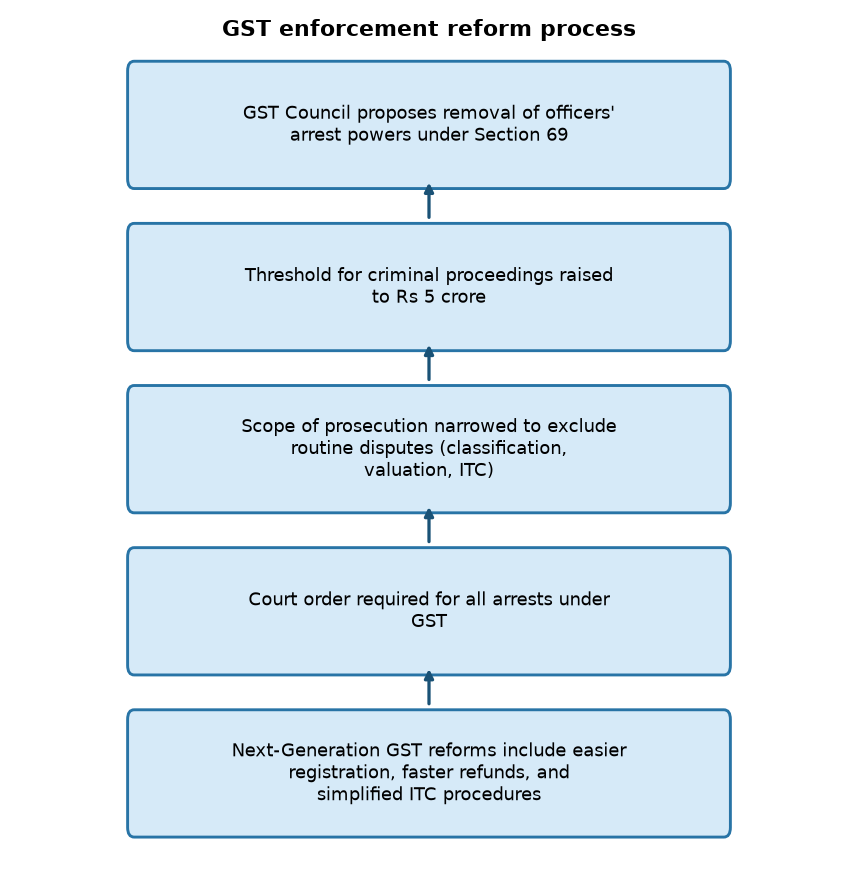
- The proposed reform seeks to decriminalise minor and routine GST offences by removing arrest powers from tax officials under Section 69 of the Central GST Act, thereby reducing the risk of arbitrary detention and fostering a more business-friendly environment.
- Any arrest under GST laws would require prior judicial authorisation, ensuring checks and balances and preventing misuse of enforcement powers, while maintaining the government’s ability to recover taxes and impose financial penalties.
- The prosecution threshold for launching criminal proceedings for GST offences is proposed to be raised to ₹5 crore, ensuring that only significant cases involving substantial tax evasion or fraud are pursued criminally, while routine disputes over classification, valuation, or Input Tax Credit (ITC) are resolved through administrative or civil mechanisms.
- The reform narrows the scope of prosecution provisions to exclude routine disputes, such as those arising from differing interpretations of the same transaction between businesses and tax authorities, thereby reducing litigation and compliance burdens.
- Compounding provisions would be made more accessible, allowing taxpayers to settle minor offences by paying prescribed tax, interest, and penalties, thereby reducing the burden on judicial systems and promoting voluntary compliance.
- The proposed changes do not dilute the government’s ability to recover taxes or impose financial penalties for non-compliance, ensuring that serious cases of tax evasion or fraud continue to face stringent action through recovery proceedings and statutory consequences.
- The reform is part of the ‘Next-Generation GST’ agenda, which follows the 2025 rate rationalisation and aims to simplify administration, reduce compliance costs, and enhance the ease of doing business by making enforcement more proportionate and predictable.
Key Features
| Feature | Significance |
|---|---|
| Removal of arrest powers under Section 69 of CGST Act, 2017 | Shifts enforcement from coercive to judicial oversight, reducing arbitrary arrests while maintaining deterrence for serious offences. |
| Requirement of judicial authorisation for arrests | Ensures proportionality in enforcement, aligning with constitutional safeguards under Article 21 (Right to Liberty). |
| Raising prosecution threshold to ₹5 crore for criminal proceedings | Reduces frivolous litigation, decriminalises minor disputes, and focuses resources on high-value evasion cases. |
| Narrowing scope of prosecution to exclude routine disputes | Excludes classification, valuation, and ITC disputes from criminal liability, reducing compliance burden on businesses. |
| Introduction of compounding provisions for offences | Provides a mechanism for settlement through payment of tax, interest, and penalty, reducing litigation and easing compliance. |
UPSC Value Addition
Keywords for Mains Answer-Writing
Goods and Services Tax (GST) · GST Council · GST enforcement reforms · Next-Generation GST reforms · Section 69 of the Central GST Act · decriminalisation of economic offences · Jan Vishwas (Amendment of Provisions) Act, 2026 · prosecution thresholds under GST · judicial authorisation for arrest · input tax credit disputes · compounding provisions in GST · rate rationalisation in GST · compliance cost reduction in indirect taxation
Prelims Practice Questions
Q1. Consider the following statements regarding the proposed reforms to GST enforcement:
1. The GST Council is considering removing arrest powers from tax officials under Section 69 of the Central GST Act.
2. Any arrest under GST would henceforth require judicial authorisation as per the proposed changes.
3. The proposed reforms aim to decriminalise all offences under GST, including deliberate tax evasion.
4. The threshold for launching criminal proceedings for GST offences is proposed to be raised to ₹5 crore.
How many of the above statements are correct?
- Only one
- Only two
- Only three
- All
Answer: Only three — Statements 1, 2, and 4 are correct. Statement 3 is incorrect because the reforms do not seek to decriminalise all offences; serious cases involving deliberate evasion or fraud would continue to be prosecuted.
Q2. Assertion (A): The Jan Vishwas (Amendment of Provisions) Act, 2026, seeks to decriminalise a range of economic and regulatory offences across central laws.
Reason (R): The proposed GST enforcement reforms align with the broader government effort to decriminalise minor economic offences and reduce compliance burdens.
In the context of the above two statements, which of the following is correct?
- Both A and R are true, and R is the correct explanation of A
- Both A and R are true, but R is not the correct explanation of A
- A is true but R is false
- A is false but R is true
Answer: Both A and R are true, but R is not the correct explanation of A — Both the Assertion and Reason are true. The Jan Vishwas Act, 2026, is part of the broader decriminalisation agenda, and the GST enforcement reforms are a specific application of this principle to indirect taxation.
Q3. Match the following provisions/concepts with their respective descriptions:
Column I
A. Section 69 of the Central GST Act
B. Jan Vishwas (Amendment of Provisions) Act, 2026
C. Input Tax Credit (ITC)
D. Compounding under GST
Column II
1. Mechanism to settle minor offences by payment of tax, interest, and penalty
2. Provision allowing arrest of persons for specified GST offences
3. Act aimed at decriminalising minor economic offences
4. Mechanism to adjust taxes paid on inputs against output tax liability
- {‘A’: 2, ‘B’: 3, ‘C’: 4, ‘D’: 1}
- {‘A’: 3, ‘B’: 2, ‘C’: 1, ‘D’: 4}
- {‘A’: 1, ‘B’: 4, ‘C’: 2, ‘D’: 3}
- {‘A’: 4, ‘B’: 1, ‘C’: 3, ‘D’: 2}
Answer: {‘A’: 2, ‘B’: 3, ‘C’: 4, ‘D’: 1} — A-2: Section 69 of the Central GST Act allows arrest for specified offences. B-3: The Jan Vishwas Act, 2026, aims to decriminalise minor economic offences. C-4: Input Tax Credit (ITC) allows adjustment of taxes paid on inputs against output tax liability. D-1: Compounding under GST is a mechanism to settle minor offences by payment of tax, interest, and penalty.
Mains Practice Question
✍ The Goods and Services Tax (GST) regime in India is poised for its next major reform phase, focusing on simplifying administration and reducing compliance burdens. Critically examine the proposed enforcement reforms, including the removal of arrest powers from tax officials and the introduction of judicial authorisation for arrests. Also, analyse how these reforms align with the broader agenda of decriminalising economic offences in India. (15 Marks)
Approach: MODEL-ANSWER SKELETON:
1. **Context and Background (2 Marks)**
– Brief overview of GST and its rate rationalisation in September 2025.
– Introduction to the Next-Generation GST reforms agenda.
2. **Proposed Enforcement Reforms (5 Marks)**
– Removal of arrest powers under Section 69 of the Central GST Act: rationale and implications.
– Introduction of judicial authorisation for arrests: constitutional and procedural dimensions.
– Raising the threshold for criminal proceedings to ₹5 crore: impact on compliance and enforcement.
– Narrowing the scope of prosecution to exclude routine disputes (classification, valuation, ITC).
3. **Alignment with Decriminalisation Agenda (4 Marks)**
– Role of the Jan Vishwas (Amendment of Provisions) Act, 2026, in decriminalising minor economic offences.
– Comparison with similar reforms in income-tax recovery rules.
– Balancing enforcement with ease of doing business: reducing compliance costs and fostering trust.
4. **Critique and Challenges (3 Marks)**
– Potential risks: dilution of deterrence against serious tax evasion or fraud.
– Need for robust judicial mechanisms to ensure timely authorisation.
– Ensuring that compounding provisions do not encourage non-compliance.
5. **Conclusion (1 Mark)**
– Synthesis: reforms represent a progressive step towards a more business-friendly GST regime while maintaining accountability for serious offences.
Source: orissapost.com
Generated by AanyaAi for educational purpose.
Related guides on our sites
- Best economics services coaching
- Best economics optional coaching
- Best economics optional coaching for upsc
- best teacher of economics optional

- GST Reform: Arrest Powers of Officers to be Scrapped in Next Big Change - October 4, 2026
- सुप्रीम कोर्ट 5 अक्टूबर को सीईसी ग्यानेश कुमार के निलंबन पर सुनेगा याचिकाएं - October 4, 2026
- Telangana’s Revenue Shortfall: Budget vs Actuals Analysis for UPSC & State PCS - October 4, 2026

No Comments