


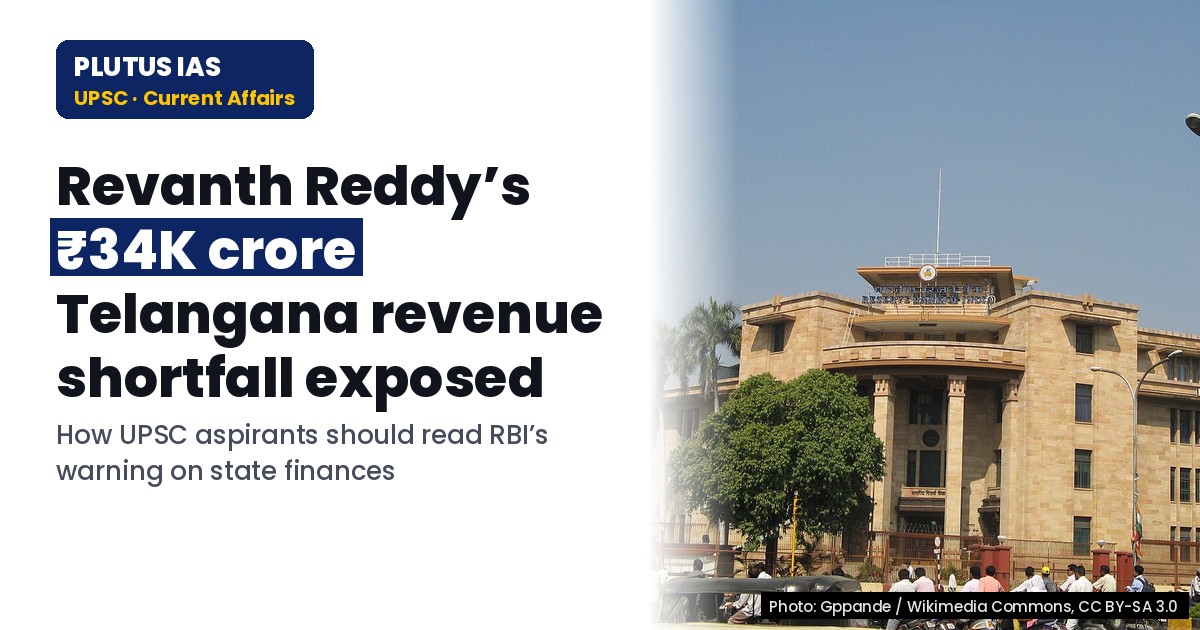
04 Oct Telangana’s Revenue Shortfall: Budget vs Actuals Analysis for UPSC & State PCS
✎ Revenue receipts in state budgets comprise tax revenue, non-tax revenue, and grants-in-aid, with actual collections often falling short of estimates due to economic volatility, administrative constraints, or delays in central…
Subject Relevance — Where This Topic Fits
- GS Paper II — Functions and Responsibilities of the Union and the States, Issues and Challenges Pertaining to the Federal Structure | GS Paper III — Indian Economy and Issues Relating to Planning, Mobilisation of Resources, Growth, Development and Employment
- Prelims: Revenue Receipts, Budget Estimates vs Actuals, Fiscal Deficit, Ways and Means Advances (WMA), Grants-in-Aid, Non-Tax Revenue, Comptroller and Auditor General (CAG), Reserve Bank of India (RBI), State Finances, Fiscal Federalism
- Essay: Fiscal Federalism and the Challenges of Resource Mobilisation in India, The Role of Institutions in Ensuring Fiscal Discipline: RBI, CAG, and State Governments
Quick Revision: Revenue receipts in state budgets comprise tax revenue, non-tax revenue, and grants-in-aid, with actual collections often falling short of estimates due to economic volatility, administrative constraints, or delays in central transfers.
Why is this in the news?
The Reserve Bank of India (RBI) has highlighted a persistent shortfall in Telangana’s actual revenue receipts compared to its budget estimates for the financial years 2022–23, 2023–24, and 2024–25. This discrepancy underscores broader challenges in state-level fiscal management, including overestimation of revenue streams such as grants-in-aid and non-tax revenue, which are critical for bridging resource gaps and sustaining developmental expenditures. The RBI’s observations, embedded in its recommendations on the state’s Ways and Means Advances (WMA) limit, draw attention to the structural issues in revenue forecasting and fiscal planning at the sub-national level.
Background
- The Constitution of India vests the power of taxation and revenue generation primarily with the Union and state governments, with the latter relying heavily on devolved funds, grants-in-aid, and own tax and non-tax revenues to meet expenditure obligations.
- State budgets are prepared annually, projecting revenue receipts and expenditures based on economic assumptions, policy priorities, and central transfers. These projections are subject to scrutiny by institutions like the RBI, Comptroller and Auditor General (CAG), and Finance Commissions.
- The RBI plays a pivotal role in assessing state finances, particularly through its oversight of fiscal indicators such as revenue receipts, fiscal deficit, and debt sustainability. Its recommendations on WMA limits are based on a state’s cash flow position and ability to meet short-term obligations.
- Grants-in-aid and contributions from the Union government are a significant component of state revenue receipts, designed to address fiscal imbalances, promote equity, and support developmental schemes in less affluent regions.
- Non-tax revenue for states includes earnings from services, fees, fines, and other miscellaneous sources, which are often volatile and dependent on economic activity and administrative efficiency.
- Fiscal federalism in India requires a delicate balance between autonomy in revenue generation and the need for central transfers to ensure equitable development across regions.
Revenue Receipts and Fiscal Management in State Budgets
- Revenue receipts are the inflows to the state exchequer that do not create liabilities or reduce assets, comprising tax revenue (e.g., sales tax, stamp duties), non-tax revenue (e.g., fees, fines), and grants-in-aid from the Union government.
- Budget estimates are projections of revenue receipts and expenditures prepared by state governments at the beginning of a financial year. These estimates are revised periodically based on actual collections and economic conditions.
- The discrepancy between budget estimates and actual revenue receipts can arise due to over-optimistic assumptions, economic slowdowns, delays in central transfers, or administrative inefficiencies in revenue collection.
- Grants-in-aid are non-repayable transfers from the Union to states, allocated under constitutional provisions (e.g., Article 275) to address fiscal imbalances and support specific developmental schemes. Their actualisation depends on the Union’s fiscal capacity and the state’s eligibility criteria.
- Non-tax revenue includes earnings from services rendered by state agencies (e.g., electricity, transport), fees for administrative services, and other miscellaneous sources. These revenues are often unpredictable and sensitive to economic cycles.
- Fiscal discipline requires states to align revenue receipts with expenditures to avoid excessive borrowing, which can lead to unsustainable debt levels and crowd out developmental spending.
- The RBI’s oversight of state finances, including its recommendations on WMA limits, ensures that states maintain liquidity and avoid default on short-term obligations. WMA is a mechanism to bridge temporary cash flow gaps in state finances.
- The Comptroller and Auditor General (CAG) audits state finances, including revenue receipts, to ensure transparency, accountability, and adherence to fiscal rules prescribed by the Constitution and the Fiscal Responsibility and Budget Management (FRBM) Act.
Key Features
| Feature | Significance |
|---|---|
| Revenue Receipts | The actual revenue receipts of Telangana fell short of budget estimates by ₹34,000 crore in 2022-23, ₹47,000 crore in 2023-24, and ₹54,000 crore in 2024-25, indicating systemic underperformance in revenue mobilisation. |
| Grants-in-Aid & Contributions | Actual receipts under this head were only 32% of estimates in 2022-23, 24% in 2023-24, and 37% in 2024-25, reflecting dependency on central transfers and weak state-level resource generation. |
| Non-Tax Revenue | Non-tax revenue fell short by ₹11,600 crore in 2022-23 and ₹10,000 crore in 2023-24, highlighting underutilisation of state-owned enterprises, fees, and other non-tax sources. |
| Budget Estimate vs Actuals | The persistent gap between projected and realised revenue receipts underscores fiscal mismanagement, over-optimistic revenue forecasting, or structural revenue constraints in the state economy. |
| Ways and Means Advances (WMA) | The RBI’s assessment of Telangana’s revenue receipts directly impacts its WMA limit, which is critical for managing short-term liquidity gaps and ensuring uninterrupted public expenditure. |
Why it Matters
Fiscal Federalism
- The shortfall in revenue receipts constrains Telangana’s fiscal autonomy, increasing reliance on central transfers under Article 275 and Article 282 of the Constitution.
- Persistent underperformance may trigger fiscal correction mechanisms under the Fiscal Responsibility and Budget Management (FRBM) framework, applicable to states under Article 293.
- The RBI’s role in assessing state finances for WMA limits reinforces the centre-state financial oversight mechanism, ensuring fiscal discipline.
Public Finance Management
- Revenue shortfalls necessitate higher fiscal deficits or reallocation of expenditure, potentially crowding out developmental spending or capital investments.
- Underperformance in non-tax revenue suggests inefficiencies in state-owned enterprises, user fee collection, or asset monetisation strategies.
- Grants-in-aid shortfalls may delay implementation of centrally sponsored schemes or state-specific developmental initiatives.
Macroeconomic Implications
- Lower revenue receipts reduce the state’s contribution to national tax collections, impacting the overall tax-to-GDP ratio and fiscal consolidation efforts.
- Persistent fiscal gaps may lead to higher borrowing costs for the state, affecting its debt sustainability and credit ratings.
- Weak revenue performance could signal broader economic slowdown or structural issues in revenue-generating sectors.
Institutional Accountability
- The RBI’s scrutiny of state finances through WMA recommendations strengthens institutional oversight of state budgets.
- Frequent deviations from budget estimates raise questions about the robustness of the state’s Medium-Term Fiscal Policy Statement under FRBM rules.
- The Comptroller and Auditor General (CAG) may scrutinise the causes of revenue shortfalls, particularly under non-tax heads.
Challenges
1. Revenue Forecasting Errors
- Over-optimistic revenue projections in budget estimates lead to fiscal gaps, undermining credibility of the state’s fiscal planning.
- Lack of granular data on sectoral revenue performance hampers accurate forecasting, particularly for non-tax revenue streams.
UPSC Link: Budgetary Process – FRBM Act
2. Dependence on Central Transfers
- Shortfalls in grants-in-aid and contributions force greater reliance on central transfers, reducing fiscal flexibility.
- Delays or reductions in central transfers can disrupt state-level expenditure commitments.
UPSC Link: Article 275 – Grants from Union to States
3. Weak Non-Tax Revenue Mobilisation
- Underutilisation of state-owned enterprises, fees, and penalties indicates poor asset management and revenue administration.
- Lack of diversification in non-tax revenue sources limits the state’s fiscal resilience.
UPSC Link: State Finance Commission – Article 243I
4. Fiscal Deficit Management
- Persistent revenue shortfalls may force the state to exceed its fiscal deficit targets, triggering corrective measures under FRBM rules.
- Higher borrowing to bridge revenue gaps increases the debt burden, affecting long-term fiscal sustainability.
UPSC Link: Fiscal Responsibility and Budget Management Act
5. Institutional Coordination Gaps
- Delays in releasing central grants or weak coordination between state and central agencies exacerbate revenue shortfalls.
- Inadequate capacity in state finance departments may hinder effective revenue administration and forecasting.
UPSC Link: Inter-State Council – Article 263
Challenges — UPSC Perspective
| Issue | Concern |
|---|---|
| Over-optimistic Revenue Projections | Leads to fiscal gaps, undermining budget credibility and planning. |
| Dependence on Central Transfers | Reduces fiscal autonomy and increases vulnerability to central funding delays. |
| Weak Non-Tax Revenue Mobilisation | Indicates poor asset management and limits revenue diversification. |
| Fiscal Deficit Escalation | May force the state to breach FRBM targets, triggering corrective measures. |
| Institutional Coordination Gaps | Delays in fund releases and weak revenue administration exacerbate shortfalls. |
| Data Gaps in Revenue Forecasting | Hampers accurate sectoral and non-tax revenue projections. |
Way Forward
- Conduct a detailed revenue gap analysis to identify sectors underperforming against projections, particularly non-tax revenue streams.
- Strengthen state-owned enterprise (SOE) performance through governance reforms, asset monetisation, and improved fee collection mechanisms.
- Enhance capacity of state finance departments in revenue forecasting and fiscal planning to reduce reliance on optimistic estimates.
- Improve coordination with central agencies to ensure timely release of grants-in-aid and contributions under centrally sponsored schemes.
- Explore diversification of non-tax revenue sources, including user charges, penalties, and asset monetisation, to reduce dependency on tax revenue.
- Align state budget estimates with realistic macroeconomic assumptions and sectoral growth projections to minimise forecasting errors.
- Implement a robust monitoring mechanism for revenue receipts, with quarterly reviews to enable corrective actions during the fiscal year.
- Leverage technology for real-time revenue tracking and data analytics to improve the accuracy of revenue projections.
UPSC Value Addition
Keywords for Mains Answer-Writing
State finances · Revenue receipts · Budget estimates vs actuals · Fiscal federalism · State tax devolution · Grants-in-Aid · Non-tax revenue · Fiscal deficit management · Comptroller and Auditor General of India (CAG) · Finance Commission · Ways and Means Advances (WMA) · Fiscal Responsibility and Budget Management (FRBM) Act · Resource gap bridging mechanisms · Multi-tiered fiscal governance · Revenue mobilisation challenges in Indian States
Concept Flow
State Budget Preparation → Revenue Projection → Actual Revenue Realisation → Shortfall Identification → Fiscal Deficit Adjustment → Borrowing & WMA Limits → Central Transfers & Grants-in-Aid → Expenditure Reallocation → FRBM Compliance Review
Prelims Practice Questions
Q1. Consider the following statements regarding State revenue receipts in India:
1. Revenue receipts include both tax and non-tax revenues.
2. Grants-in-Aid are a component of revenue receipts and are provided to States under Article 275 of the Constitution.
3. The Finance Commission recommends the principles governing the distribution of Grants-in-Aid to States.
4. Non-tax revenue includes proceeds from disinvestment of State-owned enterprises.
How many of the above statements are correct?
- Only one
- Only two
- Only three
- All
Answer: All — Statements 1, 2, and 3 are correct. Statement 4 is incorrect as proceeds from disinvestment are capital receipts, not revenue receipts.
Q2. Assertion (A): The Comptroller and Auditor General of India (CAG) audits the accounts of State Governments to ensure compliance with fiscal rules.
Reason (R): The CAG’s role is limited to examining the legality of expenditure and does not extend to evaluating the efficiency of revenue mobilisation by States.
- Both A and R are true, and R is the correct explanation of A
- Both A and R are true, but R is NOT the correct explanation of A
- A is true, but R is false
- A is false, but R is true
Answer: A is true, but R is false — Assertion (A) is true as the CAG audits State accounts for compliance with fiscal rules. Reason (R) is true but does not explain (A) because the CAG also evaluates efficiency and economy in expenditure, including revenue mobilisation.
Q3. Match the following heads of revenue receipts with their correct classifications:
Column I (Head of Revenue Receipt) Column II (Classification)
1. Tax Revenue from Goods and Services Tax (GST) A. Non-tax Revenue
2. Dividends from Public Sector Undertakings (PSUs) B. Tax Revenue
3. Fees collected by State Government for services rendered C. Grants-in-Aid
4. Central Government grants for centrally sponsored schemes D. Tax Revenue
Select the correct match:
- 1-D, 2-A, 3-B, 4-C
- 1-B, 2-A, 3-A, 4-C
- 1-D, 2-A, 3-A, 4-C
- 1-B, 2-D, 3-A, 4-C
Answer: 1-D, 2-A, 3-B, 4-C — GST is a tax revenue (1-D). Dividends from PSUs are non-tax revenue (2-A). Fees for services rendered are non-tax revenue (3-A). Central grants for centrally sponsored schemes are Grants-in-Aid (4-C).
Mains Practice Question
✍ The divergence between budgeted revenue receipts and actual realisations in States reflects systemic challenges in fiscal federalism. Critically examine the institutional, legal, and economic factors contributing to this gap. Also, analyse the role of the Finance Commission and the CAG in addressing these issues. (15 Marks)
Approach: MODEL-ANSWER SKELETON:
1. **Introduction (2 marks)**: Define revenue receipts (tax and non-tax revenues, Grants-in-Aid) and their significance in State finances. Highlight the constitutional framework (Article 270-281 for tax devolution, Article 275 for Grants-in-Aid).
2. **Institutional Factors (3 marks)**:
– **Budgetary Processes**: Explain the role of State Finance Departments, Planning Departments, and the State Legislature in budget preparation and execution.
– **Tax Administration**: Weaknesses in GST compliance, tax buoyancy issues, and revenue leakage in State taxes (e.g., stamp duties, excise).
– **Ways and Means Advances (WMA)**: RBI’s role in providing short-term liquidity and its impact on State finances.
3. **Legal and Constitutional Provisions (3 marks)**:
– **Finance Commission (FC)**: Discuss the FC’s mandate (Articles 280-281) to recommend tax devolution and Grants-in-Aid, including the 15th FC’s recommendations.
– **Fiscal Responsibility and Budget Management (FRBM) Act**: State-level FRBM Acts and their enforcement mechanisms.
– **CAG’s Role**: Audit of State accounts (Article 149), performance audits, and recommendations to bridge revenue gaps.
4. **Economic Factors (3 marks)**:
– **Tax Base Erosion**: Impact of exemptions, tax holidays, and informal sector dominance.
– **Non-Tax Revenue Challenges**: Dependence on dividends, fees, and penalties; volatility in non-tax streams.
– **Fiscal Federalism**: Vertical and horizontal imbalances (e.g., GST compensation cess phase-out, revenue neutral rates).
5. **Comparative Analysis (2 marks)**: Contrast Telangana’s experience with other States (e.g., Maharashtra, Karnataka) to highlight systemic vs. State-specific issues.
6. **Conclusion and Way Forward (2 marks)**:
– **Reforms**: Strengthening tax administration (e.g., GST Network, e-way bills), rationalising exemptions, and improving compliance.
– **Institutional Reforms**: Enhancing the role of the FC in addressing horizontal imbalances and the CAG in performance audits.
– **Balanced View**: Acknowledge that revenue gaps are not solely a governance failure but also reflect structural economic challenges.
Source: The Hindu
Telangana PCS (TGPSC (TSPSC)) — State PCS Practice
Prelims: As per the latest Comptroller and Auditor General (CAG) report, what is the primary reason cited for Telangana’s actual revenue receipts falling short of the budget estimates in the financial year 2022-23?
- A. Lower-than-expected GST collections due to economic slowdown
- B. Decline in State’s own tax revenue due to reduced industrial activity
- C. Delay in devolution of central taxes to the State
- D. Excessive expenditure on welfare schemes leading to revenue deficits
Answer: B. Decline in State’s own tax revenue due to reduced industrial activity — The CAG report highlighted a shortfall in State’s own tax revenue, particularly due to reduced industrial activity and lower collections from commercial taxes.
Mains: Examine the impact of Telangana’s revenue receipts falling short of budget estimates on the State’s fiscal deficit and developmental expenditure. Suggest measures to bridge the revenue gap while ensuring sustainable economic growth.
Generated by AanyaAi for educational purpose.
Related guides on our sites
- Current affairs for upsc 2026
- Best economics optional coaching for upsc
- Best economics optional teacher for upsc
- How to prepare for GS paper 1 for UPSC CSE mains exam


No Comments