


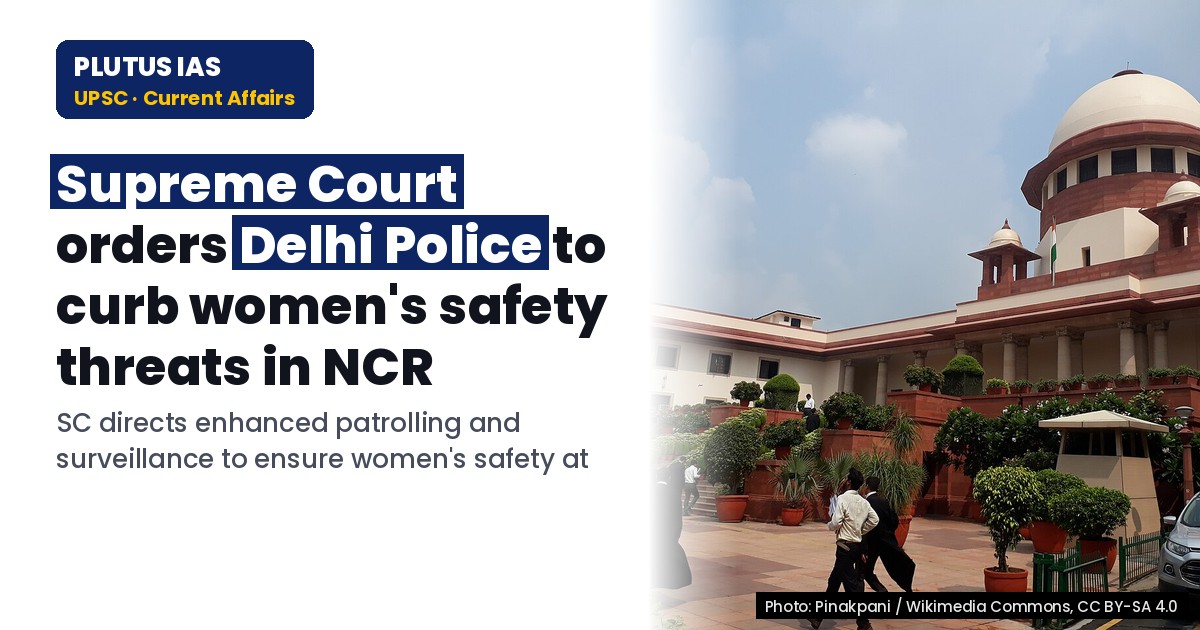
05 Oct SC Directives to Curb Women Safety Issues in Delhi-NCR
✎ The Supreme Court’s suo motu intervention in women’s safety cases in the NCR reaffirms the State’s constitutional duty under Articles 14, 15, and 21 to ensure a safe environment for women through proactive law-and-order measures…
Subject Relevance — Where This Topic Fits
- GS Paper II — Fundamental Rights (Article 14, 15, 21) | GS Paper III — Internal Security (Police Reforms, Crime Prevention)
- Prelims: Nirbhaya Fund, Protection of Women from Domestic Violence Act, 2005, Criminal Law (Amendment) Act, 2013, Delhi Police Act, 1978, Section 375 IPC (Rape), Section 354 IPC (Assault on Women with Intent to Outrage Modesty), Section 509 IPC (Word, Gesture or Act Intended to Insult the Modesty of a Woman), Section 154 CrPC (Information to Police and Investigation), Section 166A IPC (Public Servant Disobeying Direction Under Law), Section 468 IPC (Forgery for Purpose of Cheating)
- Essay: The Role of Judiciary in Ensuring Fundamental Rights: A Case Study of Women’s Safety in Urban Spaces, Balancing Liberty and Security: The State’s Duty to Protect Vulnerable Groups
Quick Revision: The Supreme Court’s suo motu intervention in women’s safety cases in the NCR reaffirms the State’s constitutional duty under Articles 14, 15, and 21 to ensure a safe environment for women through proactive law-and-order measures, including targeted surveillance and patrolling in vulnerable public spaces.
Why is this in the news?
On 5 October 2026, a two-judge bench of the Supreme Court of India, comprising Justices J B Pardiwala and K Vinod Chandran, expressed grave concern over the perceived lack of safety for women in the National Capital Region (NCR), particularly in vulnerable public spaces such as parks, metro stations, and bus stands. The Court, acting suo motu in a matter titled ‘In Re: Recent rape incidents in Delhi NCR’, directed the Delhi Police to intensify surveillance, patrolling, and preventive measures, emphasising that the primary objective of law enforcement must be deterrence rather than post-crime response. The observation underscores the judiciary’s role in monitoring executive performance on constitutional obligations under Articles 14, 15, and 21 of the Constitution of India.
Background
- The National Capital Region (NCR), comprising Delhi and parts of adjoining states, has been a focal point for debates on women’s safety due to recurring incidents of sexual violence, including high-profile cases such as the 2012 Nirbhaya gangrape.
- The Supreme Court’s intervention follows a suo motu cognisance of recent rape incidents in the NCR, indicating judicial dissatisfaction with the adequacy of executive measures despite existing statutory and institutional frameworks.
- The Constitution of India guarantees equality before law (Article 14), prohibition of discrimination on grounds of sex (Article 15), and protection of life and personal liberty (Article 21), which include the right to live with dignity and freedom from fear.
- The Criminal Law (Amendment) Act, 2013, introduced stringent provisions such as enhanced punishment for rape, acid attacks, and stalking, following public outrage over the Nirbhaya case.
- The Nirbhaya Fund, established in 2013, was envisaged to support initiatives for women’s safety, including CCTV surveillance, one-stop crisis centres, and helplines, though its utilisation has faced criticism for delays and inefficiencies.
- The Delhi Police, a union territory force under the administrative control of the Ministry of Home Affairs, is statutorily mandated under the Delhi Police Act, 1978, to maintain public order and prevent crime, including offences against women.
Judicial Oversight of Women’s Safety: Constitutional Framework and Institutional Mechanisms
- The Supreme Court’s directive to the Delhi Police to intensify surveillance and patrolling in vulnerable public spaces is rooted in the constitutional duty of the State to protect fundamental rights, particularly the right to life and personal liberty under Article 21.
- The Court’s emphasis on deterrence aligns with the principle of ‘Rule of Law’ and the doctrine of ‘State’s Obligation to Protect’, which requires proactive measures to prevent crime rather than reactive responses after its commission.
- The suo motu cognisance by the Supreme Court reflects the judiciary’s role as a guardian of constitutional rights, particularly when executive agencies fail to address systemic failures in law enforcement.
- The Court’s observation that ‘rape is not acceptable to any society’ underscores the gravity of sexual violence as a violation of human dignity and a threat to social order, warranting stringent preventive measures.
- The directive to focus on public spaces such as parks, metro stations, and bus stands highlights the need for targeted interventions in areas identified as high-risk zones for crimes against women.
- The observation that ‘every woman should feel safe even at 11 pm’ reflects the State’s obligation to ensure a safe environment for all citizens, irrespective of time or location, in line with the principles of inclusivity and non-discrimination.
UPSC Value Addition
Keywords for Mains Answer-Writing
Supreme Court of India · gender-based violence · Nirbhaya case · criminal law reform · public order maintenance · Delhi Police · constitutional obligations · women’s safety · judicial activism · CCTV surveillance · Rule of Law · socio-legal dimensions of crime · National Capital Region security · due process · preventive policing · right to life and personal liberty (Article 21) · gender justice · institutional accountability · judicial review of executive action
Prelims Practice Questions
Q1. Consider the following statements regarding the Supreme Court of India’s suo motu cognisance of crimes against women in Delhi-NCR:
1. The Supreme Court can take suo motu cognisance of matters involving a breach of fundamental rights or public interest.
2. The suo motu case titled ‘In Re: Recent rape incidents in Delhi NCR’ was initiated by the Delhi Police.
3. The Supreme Court can direct state governments to implement specific measures to ensure public safety.
How many of the above statements are correct?
- Only one
- Only two
- All
- None
Answer: Only two — Statement 1 is correct as the Supreme Court can take suo motu cognisance under Article 32 of the Constitution for enforcement of fundamental rights. Statement 2 is incorrect because the case was initiated by the Supreme Court itself, not the Delhi Police. Statement 3 is correct as the Court can issue directions to ensure public safety under its writ jurisdiction.
Q2. Assertion (A): The Supreme Court of India has the power to issue directions to the Delhi Police for enhanced patrolling and surveillance in vulnerable areas.
Reason (R): The Constitution of India vests the Supreme Court with the authority to issue writs for enforcement of fundamental rights and for any other purpose under Article 32 and Article 136.
- Both A and R are true, and R is the correct explanation of A.
- Both A and R are true, but R is not the correct explanation of A.
- A is true, but R is false.
- A is false, but R is true.
Answer: Both A and R are true, but R is not the correct explanation of A. — The Supreme Court can issue directions to the Delhi Police under its writ jurisdiction (Article 32) and appellate jurisdiction (Article 136) to ensure enforcement of fundamental rights, including the right to life and personal liberty (Article 21). The Reason correctly explains the Assertion.
Q3. Match the following provisions of the Indian Constitution with their corresponding rights or obligations:
Column I (Provision)
A. Article 21
B. Article 14
C. Article 15(3)
D. Article 32
Column II (Right/Obligation)
1. Right to equality before law
2. Right to constitutional remedies
3. Right to life and personal liberty
4. Special provisions for women and children
- A-3, B-1, C-4, D-2; A-1, B-3, C-2, D-4; A-4, B-2, C-1, D-3; A-2, B-4, C-3, D-1
- answer_array_indexes_in_order_of_columns_above
Answer: A-3, B-1, C-4, D-2; A-1, B-3, C-2, D-4; A-4, B-2, C-1, D-3; A-2, B-4, C-3, D-1 — Article 21 guarantees the right to life and personal liberty. Article 14 guarantees equality before law. Article 15(3) empowers the State to make special provisions for women and children. Article 32 provides the right to constitutional remedies.
Mains Practice Question
✍ The Supreme Court of India, in a suo motu case concerning crimes against women in Delhi-NCR, has emphasised the need for preventive policing and systemic reforms to ensure women’s safety. Critically analyse the constitutional and legal framework governing the State’s obligation to protect women from gender-based violence. Also, examine the role of judicial activism in addressing such systemic failures. (15 Marks)
Approach: 1. **Constitutional Framework**:
– Article 21 (Right to Life and Personal Liberty) and its judicial interpretation (e.g., Vishaka Guidelines, 1997; Prakash Singh v. Union of India, 2006).
– Article 14 (Right to Equality) and Article 15(3) (Special Provisions for Women).
– Directive Principles of State Policy (Articles 38, 39, 42) and their relevance to gender justice.
2. **Legal and Institutional Obligations**:
– Criminal Law (Amendment) Act, 2013 (Nirbhaya Act) and subsequent amendments.
– Protection of Women from Domestic Violence Act, 2005.
– Role of Delhi Police under the Code of Criminal Procedure, 1973, and the Delhi Police Act, 1978.
– Institutional mechanisms: National Commission for Women (NCW), State Women’s Commissions, and District Legal Services Authorities.
3. **Judicial Activism and Preventive Policing**:
– Supreme Court’s suo motu jurisdiction (Article 32) and its exercise in public interest litigation (PIL).
– Landmark judgments: Vishaka Guidelines (1997), Lalita Kumari v. Govt. of U.P. (2013) on FIR registration, and recent directives on CCTV surveillance and patrolling.
– Role of amicus curiae and court-appointed committees in monitoring compliance.
4. **Challenges and Systemic Failures**:
– Implementation gaps: Underreporting of crimes, delayed investigations, and low conviction rates.
– Socio-cultural barriers: Patriarchal norms, stigma, and lack of awareness.
– Resource constraints: Inadequate police personnel, infrastructure, and technological gaps in surveillance.
5. **Way Forward**:
– Strengthening preventive policing: Community policing, gender-sensitive training, and rapid response systems.
– Leveraging technology: AI-driven surveillance, real-time monitoring, and predictive policing.
– Inter-agency coordination: Collaboration between police, local bodies, and civil society.
– Awareness campaigns: Sensitisation of stakeholders and public participation.
**Balanced View**: Acknowledge the progress made (e.g., Nirbhaya Fund, One-Stop Centres) while critiquing systemic inertia. Conclude with a reasoned position on the judiciary’s role as a catalyst for reform.
Source: orissapost.com
Generated by AanyaAi for educational purpose.
Related guides on our sites
- Best sociology optional coaching
- Best coaching for sociology optional
- Best sociology optional coaching online
- is sociology good optional


No Comments