


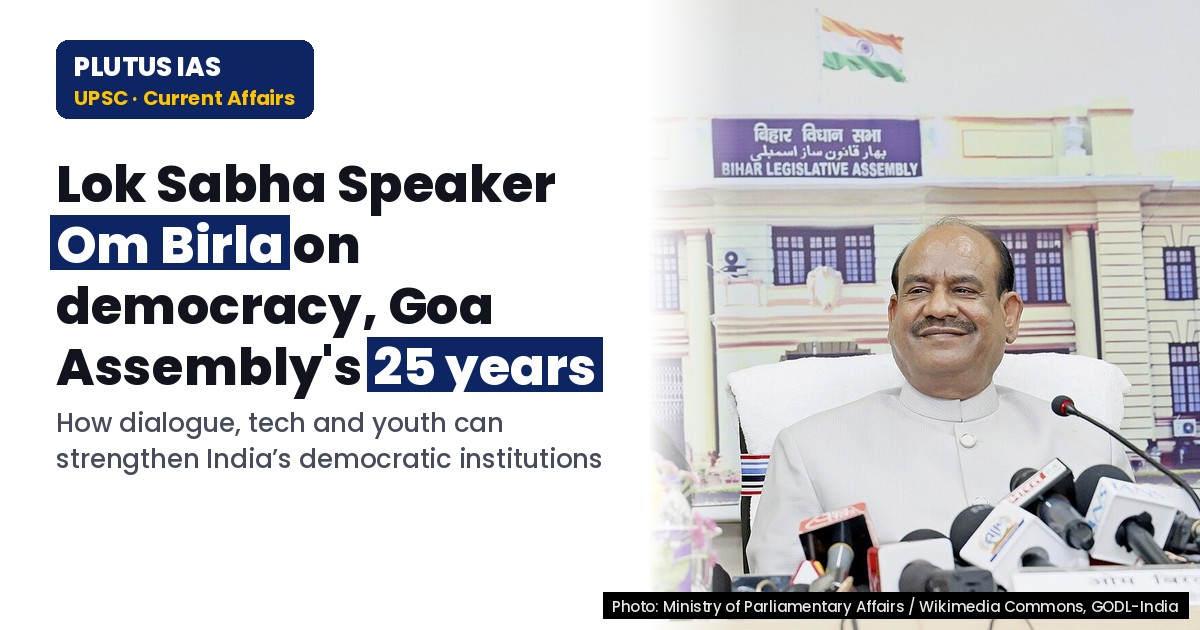
06 Oct Lok Sabha Speaker on Strengthening Democracy Through Dialogue and Inclusion
✎ Legislative assemblies in India function as the cornerstone of representative democracy, balancing lawmaking, executive oversight, and citizen engagement while upholding the constitutional principles of inclusivity, transparency…
Subject Relevance — Where This Topic Fits
- GS Paper II — Polity and Governance: Parliament and State Legislatures — Structure, Functioning, Conduct of Business, Role of the Speaker | GS Paper II — Polity and Governance: Role of State Legislatures in Democratic Decentralisation and Local Governance | GS Paper IV — Ethics, Integrity and Aptitude: Public Service Values and Citizen Participation in Governance
- Prelims: State Legislature, Speaker of Lok Sabha, Democratic Decentralisation, Legislative Transparency, E-governance in Legislatures, Youth Participation in Governance, Citizen Engagement in Policy Making
- Essay: Democracy as a living institution: The interplay of debate, dissent, and consensus, The role of technology in deepening democratic participation and governance
Quick Revision: Legislative assemblies in India function as the cornerstone of representative democracy, balancing lawmaking, executive oversight, and citizen engagement while upholding the constitutional principles of inclusivity, transparency, and pluralism.
Why is this in the news?
The Speaker of the Lok Sabha, during the silver jubilee celebrations of the Goa Legislative Assembly building, underscored the foundational principles of a robust democracy—meaningful dialogue, accommodation of diverse viewpoints, and active citizen participation. The address highlighted the importance of legislative assemblies as platforms for debate and dissent, the potential of technology in enhancing transparency, and the imperative of youth engagement in strengthening democratic institutions. The remarks, delivered in the context of Goa’s developmental trajectory, also advocated for inter-state cooperation and healthy competition in adopting best legislative practices.
Background
- Legislative assemblies in India operate as the primary institutions of representative democracy at the state level, tasked with lawmaking, oversight of the executive, and articulation of regional aspirations within the federal framework.
- The Speaker of the Lok Sabha, as the constitutional authority presiding over the lower house of Parliament, plays a pivotal role in maintaining the decorum of legislative proceedings and upholding the principles of democratic deliberation.
- Goa, a small state with a distinct cultural and historical identity, has emerged as a model of balanced development, integrating economic growth with environmental conservation and heritage preservation.
- The silver jubilee celebration of the Goa Legislative Assembly building marks a quarter-century of the building, reflecting the state’s journey in governance, policy formulation, and institutional strengthening.
- India’s democratic strength lies in its institutional capacity to accommodate pluralism, dissent, and consensus, a principle embedded in the Constitution and reflected in the functioning of its legislatures.
- The global perception of India’s democracy has been shaped by its constitutional commitments, institutional resilience, and the ability to address diverse socio-economic challenges through participatory governance.
Legislative Assemblies in India: Structure, Functions, and Democratic Principles
- Legislative assemblies in India are unicameral or bicameral institutions, depending on the state, and serve as the primary forum for deliberation on laws, policies, and public concerns within their jurisdiction.
- The Speaker of the Legislative Assembly, elected by the members, ensures the orderly conduct of proceedings, maintains impartiality, and upholds the rights of members while facilitating constructive debate.
- Democratic governance in legislative assemblies is premised on the principles of inclusivity, transparency, and accountability, where diverse viewpoints are not only permitted but encouraged to enrich policy outcomes.
- The Constitution of India, under Article 168 to 212, delineates the structure, powers, and functioning of state legislatures, ensuring their autonomy within the federal framework while aligning with parliamentary democracy.
- Legislative assemblies exercise three critical functions: lawmaking, financial oversight (through budgetary debates and appropriations), and executive accountability (via questions, motions, and committees).
- The principle of ‘meaningful participation’ entails not only the presence of elected representatives but also the engagement of citizens in policy processes, facilitated by mechanisms such as public consultations, grievance redressal, and digital platforms.
- Dissent and debate are not adversarial but essential components of democratic governance, enabling the identification of gaps, the correction of policy errors, and the evolution of consensus-based solutions.
- Technological integration in legislative processes—such as e-legislature portals, digital archives, and live streaming of proceedings—enhances transparency, accessibility, and public trust in democratic institutions.
- Inter-state cooperation and healthy competition among legislative assemblies can foster the exchange of best practices in governance, legislative drafting, and institutional reforms, thereby strengthening the broader democratic ecosystem.
Key Features
| Feature | Significance |
|---|---|
| Deliberative democracy | Emphasises dialogue, dissent, and consensus as pillars of institutional strength, ensuring inclusive governance. |
| Citizen participation | Mandates meaningful engagement of citizens in legislative processes to enhance transparency and accountability. |
| Technological integration | Facilitates access to legislative information, enabling informed citizenry and reducing information asymmetry. |
| Inter-state collaboration | Promotes healthy competition among state legislatures to adopt best practices in governance and institutional reforms. |
| Youth engagement | Leverages demographic dividend by integrating young voices into legislative and policy-making processes for future-oriented governance. |
Why it Matters
Institutional Strengthening
- Reinforces the foundational principle that robust democracies thrive on pluralism, debate, and structured disagreement within constitutional frameworks.
- Highlights the role of legislative assemblies as forums for reasoned discourse, ensuring policy outcomes reflect diverse societal perspectives.
- Underscores the importance of institutional resilience in accommodating dissent while maintaining functional governance.
Governance Transparency
- Advocates for leveraging technology to demystify legislative processes, enabling citizens to track bills, debates, and committee reports in real time.
- Promotes the use of digital platforms to bridge the gap between elected representatives and constituents, fostering trust and responsiveness.
Federalism and Inter-State Learning
- Encourages state legislatures to emulate successful models, fostering a culture of collaborative governance and policy innovation.
- Positions smaller states like Goa as laboratories for democratic experimentation, balancing development with heritage conservation.
Demographic Dividend Utilisation
- Recognises the critical role of youth in shaping future policies, advocating for their inclusion in legislative consultations and capacity-building initiatives.
- Links youth participation to evidence-based policymaking, ensuring policies are responsive to contemporary challenges.
Challenges
1. Information Asymmetry in Governance
- Citizens often lack awareness of legislative processes, leading to passive participation and reduced accountability of representatives.
- Digital divide may exclude marginalised sections from accessing legislative information, exacerbating inequities in participation.
UPSC Link: GS-II: Role of Civil Society
2. Balancing Development and Heritage Conservation
- Small states face the dual challenge of economic growth and preservation of cultural/natural heritage, requiring nuanced policy trade-offs.
- Policy rigidity or short-termism may undermine long-term sustainability goals.
UPSC Link: GS-III: Environmental Governance
3. Ensuring Meaningful Youth Participation
- Structural barriers, such as lack of platforms or mentorship, may hinder sustained youth engagement in legislative processes.
- Tokenistic inclusion risks undermining the depth and impact of their contributions.
UPSC Link: GS-II: Youth and Governance
4. Inter-State Policy Convergence vs. Diversity
- While healthy competition is desirable, excessive uniformity may stifle contextualised policy solutions tailored to local needs.
- Coordination challenges among states could impede collaborative learning and implementation of best practices.
UPSC Link: GS-II: Federalism
Challenges — UPSC Perspective
| Issue | Concern |
|---|---|
| Digital literacy gaps | Limited access to technology among rural/elderly populations may widen participation disparities. |
| Policy myopia | Short-term electoral cycles may prioritise immediate gains over long-term sustainability in governance. |
| Representational deficits | Underrepresentation of marginalised groups in legislative bodies could skew policy priorities. |
| Bureaucratic inertia | Slow adoption of technological tools in legislative workflows may delay transparency initiatives. |
| Cultural resistance | Traditional governance practices may clash with modern participatory mechanisms, creating implementation hurdles. |
Way Forward
- Establish state-level digital repositories for legislative documents, ensuring real-time accessibility and multilingual support.
- Design structured youth engagement programmes, such as mock legislative sessions or policy hackathons, to foster participatory skills.
- Create inter-state forums for sharing best practices in legislative transparency, technology adoption, and citizen outreach.
- Develop mentorship initiatives pairing young professionals with legislators to bridge knowledge gaps and build institutional trust.
- Institute mandatory training modules for legislators on digital governance tools and participatory governance frameworks.
- Promote citizen assemblies or deliberative polls to gather informed public input on key legislative proposals.
- Strengthen data governance frameworks to ensure secure and ethical use of citizen data in policy design.
UPSC Value Addition
Keywords for Mains Answer-Writing
Lok Sabha Speaker’s address on democratic institutions · Meaningful public participation in governance · Role of State Legislatures in strengthening democracy · Youth engagement in legislative processes · Technological integration in legislative transparency · Healthy competition among State Legislatures · Legislative processes and consensus-building · Goa Legislative Assembly’s 25-year journey · Balancing economic development with environmental conservation · Institutional resilience in democratic governance
Constitutional & Policy Linkages
- [‘Article 75(3)’, ‘Collective responsibility of Ministers to Parliament’]
- [‘Article 105’, ‘Powers and privileges of Parliament’]
- [‘Article 267’, ‘Contingency Fund and Public Account of India’]
- [‘Seventh Schedule’, ‘Division of legislative powers between Union and States’]
Concept Flow
Diverse societal perspectives → Structured legislative debate → Inclusive policy outcomes → Enhanced citizen trust → Strengthened democratic institutions → Technological integration → Improved legislative transparency → Increased citizen participation → Accountable governance → Policy legitimacy → Inter-state collaboration → Policy learning → Innovation in governance → Competitive federalism → National development → Youth engagement → Fresh policy ideas → Future-oriented governance → Demographic dividend utilisation → Sustainable development → Balanced development policies → Heritage conservation → Cultural identity preservation → Inclusive growth → Social cohesion
Prelims Practice Questions
Q1. Consider the following statements regarding the role of the Speaker of the Lok Sabha in India’s democratic framework:
1. The Speaker emphasizes that strong democracies are based on meaningful public participation and dialogue.
2. The Speaker advocates for the inclusion of diverse viewpoints in legislative processes.
3. The Speaker asserts that legislative assemblies are platforms exclusively for consensus-building and not for dissent.
How many of the above statements are correct?
- Only one
- Only two
- All three
- None
Answer: Only two — Statement 1 and 2 are correct as they align with the Speaker’s emphasis on public participation and inclusion of diverse viewpoints. Statement 3 is incorrect because the Speaker explicitly acknowledged the importance of space for dissent in legislative processes.
Q2. Which of the following principles was NOT explicitly highlighted by the Lok Sabha Speaker during the Goa Legislative Assembly’s Silver Jubilee celebration?
A. Technological integration in legislative transparency
B. Youth participation in legislative processes
C. Centralisation of legislative powers
D. Healthy competition among State Legislatures
- A
- B
- C
- D
Answer: C — The Lok Sabha Speaker explicitly highlighted technological integration (A), youth participation (B), and healthy competition among State Legislatures (D). Centralisation of legislative powers (C) was not mentioned.
Q3. Assertion (A): The Lok Sabha Speaker stated that India’s democratic strength lies in its institutions’ ability to accommodate diverse opinions and viewpoints.
Reason (R): The Speaker emphasized that legislative assemblies serve as platforms for debate, discussion, and exchange of differing ideas, thereby strengthening democracy.
Code:
- Both A and R are true, and R is the correct explanation of A
- Both A and R are true, but R is NOT the correct explanation of A
- A is true, but R is false
- A is false, but R is true
Answer: Both A and R are true, and R is the correct explanation of A — Both Assertion (A) and Reason (R) are true, and Reason (R) correctly explains Assertion (A) as the Speaker linked India’s democratic strength to institutions accommodating diverse opinions through legislative debates.
Mains Practice Question
✍ The strength of a democracy lies not merely in its electoral processes but in the quality of its legislative institutions and the meaningful participation of citizens in governance. Critically examine this statement with reference to the role of State Legislatures in India, citing the observations made by the Lok Sabha Speaker during the Goa Legislative Assembly’s Silver Jubilee celebration. (15 Marks)
Approach: MODEL-ANSWER SKELETON:
1. **Introduction (2 marks)**
– Define the core argument: Democracy’s strength is contingent on the robustness of legislative institutions and citizen participation.
– Reference the Lok Sabha Speaker’s emphasis on dialogue, diverse viewpoints, and meaningful public participation as pillars of democratic strength.
2. **Role of State Legislatures (4 marks)**
– **Constitutional Framework**: Article 168-177 outlines the composition, powers, and functions of State Legislatures (e.g., lawmaking, oversight, representation).
– **Legislative Processes**: Highlight the Speaker’s reference to legislative assemblies as platforms for debate, dissent, and consensus-building.
– **Institutional Resilience**: Cite examples of State Legislatures functioning as deliberative bodies (e.g., Standing Committees, Question Hour).
3. **Meaningful Public Participation (4 marks)**
– **Citizen Engagement**: Discuss mechanisms like public consultations, citizen charters, and grievance redressal systems.
– **Technological Integration**: Reference the Speaker’s call for transparency via digital platforms (e.g., e-legislature initiatives, citizen portals).
– **Youth Involvement**: Emphasise the Speaker’s advocacy for youth participation in legislative processes (e.g., internships, youth parliaments).
4. **Challenges and Critique (3 marks)**
– **Limited Participation**: Address issues like low voter turnout, elite capture of institutions, and bureaucratic dominance.
– **Political Polarisation**: Discuss how partisan politics may hinder deliberative processes in Legislatures.
– **Institutional Constraints**: Highlight constraints such as lack of resources, inadequate research support, and weak oversight mechanisms.
5. **Conclusion (2 marks)**
– Reiterate the argument: Strengthening State Legislatures and enhancing citizen participation are essential for democratic resilience.
– Suggest reforms: Institutional capacity-building, digital governance, and civic education initiatives.
Source: PIB (Press Information Bureau)
Generated by AanyaAi for educational purpose.
Related guides on our sites
- Anthropology VS PSIR
- Best PSIR optional coaching
- Best PSIR optional coaching online
- Best PSIR optional teacher

- क्या शांतिपूर्ण असहमति भारत में कमजोर हो रही है? जानिए संवैधानिक अधिकार - October 7, 2026
- Lok Sabha Speaker on Strengthening Democracy Through Dialogue and Inclusion - October 6, 2026
- बेंगलुरु में पांच पुलिस आयुक्तालयों के गठन को कैबिनेट की मंजूरी, पूर्व अधिकारियों ने व्यक्त की चिंता - October 6, 2026

No Comments