


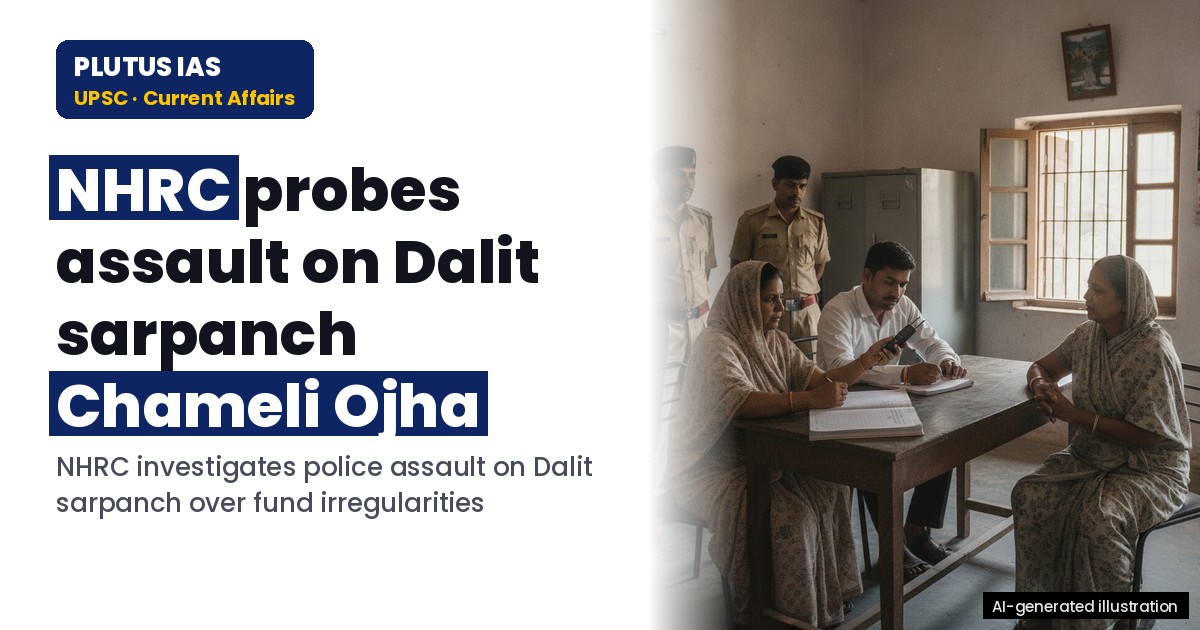
06 Oct NHRC investigates assault on Dalit sarpanch in Odisha: UPSC key points
✎ The NHRC’s inquiry into the alleged assault of a Dalit sarpanch in Odisha exemplifies the statutory safeguards for human rights in India, particularly for marginalised communities in local governance.
Subject Relevance — Where This Topic Fits
- GS Paper II — Constitutional and Statutory Bodies (NHRC) | GS Paper II — Functions and Responsibilities of the Union and the States (Local Governance)
- Prelims: NHRC, Article 21, Panchayati Raj Act 1993, Scheduled Castes and Scheduled Tribes (Prevention of Atrocities) Act 1989, FIR, BDO, Sarpanch
- Essay: Role of constitutional bodies in protecting marginalised communities, Challenges to grassroots democracy in India
Quick Revision: The NHRC’s inquiry into the alleged assault of a Dalit sarpanch in Odisha exemplifies the statutory safeguards for human rights in India, particularly for marginalised communities in local governance.
Why is this in the news?
The National Human Rights Commission (NHRC) has initiated a ground-level inquiry into allegations of assault against a Dalit woman sarpanch in Odisha’s Kendrapada district. The incident, involving police personnel and a Block Development Officer (BDO), underscores systemic vulnerabilities in local governance, particularly for marginalised representatives, and raises questions about the efficacy of institutional safeguards for elected officials.
Background
- The incident pertains to Chameli Ojha, a Dalit woman sarpanch of Tikhiri gram panchayat in Kendrapada district, Odisha, who alleged physical assault by police and administrative officials on 11 June 2026.
- Ojha’s allegations stem from her efforts to expedite pending payments for development works in her panchayat and her objections to alleged irregularities in project implementation.
- The NHRC’s intervention follows her complaint to the Odisha Chief Minister and the subsequent registration of multiple First Information Reports (FIRs), described by authorities as ‘cross-cases’.
- The incident highlights recurring concerns about the safety of elected representatives, especially women and marginalised communities, in India’s Panchayati Raj system.
- Odisha, a state with a significant Scheduled Caste (SC) population (approximately 17% as per Census 2011), has witnessed multiple instances of caste-based discrimination and violence in rural governance.
What is the National Human Rights Commission (NHRC)?
- The NHRC is a statutory body established under the Protection of Human Rights Act, 1993, to safeguard and promote human rights in India, defined as rights relating to life, liberty, equality, and dignity.
- It operates under the aegis of the Ministry of Home Affairs and functions as a multi-member commission, including a Chairperson and members with judicial or administrative experience.
- The NHRC’s mandate includes inquiring into complaints of human rights violations by government agencies, recommending relief to victims, and intervening in court proceedings involving human rights issues.
- The Commission is empowered to summon witnesses, examine documents, and visit places of detention to investigate violations, as demonstrated in the current inquiry in Odisha.
- The NHRC’s recommendations are advisory and not legally binding, but they carry significant moral and institutional weight, often leading to corrective actions by state governments.
- The Commission’s role is particularly critical in cases involving marginalised groups, such as Dalits, Adivasis, and women, who face structural barriers in accessing justice.
- The NHRC’s inquiry into the Odisha incident aligns with its broader focus on protecting the rights of elected representatives, especially women and Dalits, in local governance structures.
- The Commission’s findings in this case may influence future policies on the security of panchayat officials and the accountability of administrative and police personnel.
Key Features
| Feature | Significance |
|---|---|
| National Human Rights Commission (NHRC) inquiry | Demonstrates the institutional mechanism for investigating allegations of human rights violations by state authorities, including police and administrative officials. |
| Allegations of assault on a Dalit woman sarpanch | Highlights systemic vulnerabilities faced by marginalised groups in local governance, particularly in rural India. |
| Cross-FIRs and counter-allegations | Underscores the procedural complexities in cases involving public servants and elected representatives, requiring impartial scrutiny. |
| Pending development funds in panchayats | Reflects structural issues in fund disbursement and financial transparency in rural local bodies. |
| Ground investigation by NHRC team | Ensures first-hand assessment of evidence, statements, and on-ground realities, enhancing credibility of the inquiry process. |
Why it Matters
Human Rights and Governance
- The incident underscores the need for robust mechanisms to protect elected representatives, especially women and Dalits, from harassment by administrative and law enforcement agencies.
- It exemplifies how local governance structures can become arenas of power struggles, affecting democratic participation and accountability.
- The NHRC’s intervention reinforces the principle that no individual, regardless of their official position, is above scrutiny when human rights are allegedly violated.
Institutional Accountability
- The case highlights the role of oversight bodies like the NHRC in ensuring accountability of state actors, including police and block development officers.
- It demonstrates the importance of separating administrative and law enforcement functions to prevent misuse of authority.
- The presence of cross-FIRs necessitates a fair and transparent investigation to determine the veracity of allegations.
Social Justice and Inclusion
- The victim’s identity as a Dalit woman sarpanch amplifies concerns about caste and gender-based discrimination in rural governance.
- It raises questions about the implementation of constitutional provisions for social justice, particularly Articles 15, 16, and 17, in local administrative contexts.
Financial Transparency in Local Governance
- The allegation of withheld development funds points to systemic issues in fund flow and utilisation in panchayats, affecting grassroots development.
- It underscores the need for stronger financial auditing and monitoring mechanisms in rural local bodies to prevent misappropriation or delays.
Challenges
1. Protection of Elected Representatives from Harassment
- Elected representatives, particularly women and marginalised groups, often face intimidation or violence when challenging administrative decisions.
- Lack of secure institutional mechanisms to shield representatives from retaliatory actions by officials or dominant social groups.
- Need for legal and administrative safeguards to ensure their safety and autonomy in discharging duties.
UPSC Link: GS-II: Local Governance
2. Accountability of Police and Administrative Officials
- Instances of alleged assault by police on citizens, including public servants, erode public trust in law enforcement.
- Cross-FIRs complicate accountability, as counter-allegations may delay or dilute justice.
- Requires impartial investigations and adherence to due process to uphold the rule of law.
UPSC Link: GS-II: Police Reforms
3. Financial Delays and Transparency in Panchayats
- Withholding of development funds disrupts grassroots projects, affecting rural welfare and employment.
- Lack of transparency in fund disbursement and utilisation can lead to corruption or inefficiency in local governance.
- Need for digital tracking and real-time monitoring of fund flows to ensure accountability.
UPSC Link: GS-II: Panchayati Raj
4. Social Discrimination in Rural Governance
- Dalit and women representatives often face caste and gender-based discrimination, limiting their effective participation in decision-making.
- Structural biases in rural power dynamics can marginalise minority voices, undermining democratic decentralisation.
- Requires awareness campaigns and capacity-building to foster inclusive governance.
UPSC Link: GS-II: Social Justice
5. Effectiveness of Oversight Bodies like NHRC
- While the NHRC provides a vital platform for grievance redressal, its recommendations are not legally binding, limiting enforcement.
- Delays in investigations and lack of punitive powers can undermine public confidence in such institutions.
- Need for stronger statutory backing and faster redressal mechanisms to enhance credibility.
UPSC Link: GS-II: Human Rights
Challenges — UPSC Perspective
| Issue | Concern |
|---|---|
| Alleged assault on sarpanch | Violation of constitutional rights under Articles 14, 21, and 17, impacting democratic participation |
| Cross-FIRs and counter-allegations | Procedural delays and potential miscarriage of justice due to conflicting narratives |
| Pending development funds | Disruption of rural welfare schemes and erosion of trust in local governance |
| Social discrimination in panchayats | Marginalisation of Dalit and women representatives in decision-making processes |
| NHRC’s investigatory role | Limited enforcement powers and delays in redressal affecting public confidence |
Way Forward
- Conduct a time-bound, impartial investigation by the NHRC, ensuring all stakeholders are heard and evidence is thoroughly scrutinised.
- Strengthen institutional safeguards for elected representatives, particularly women and Dalits, to prevent harassment or intimidation by officials.
- Implement real-time digital tracking of development funds in panchayats to enhance transparency and accountability in disbursement.
- Review and streamline the process of registering FIRs in cases involving public servants to avoid procedural delays and cross-allegations.
- Enhance capacity-building programmes for panchayat members on financial management, rights, and governance to empower marginalised groups.
- Ensure strict adherence to constitutional provisions (Articles 14, 15, 16, 17, and 21) in local governance to prevent discrimination and uphold democratic principles.
- Establish a dedicated grievance redressal mechanism within the NHRC for elected representatives facing threats or harassment.
- Promote awareness campaigns in rural areas to sensitise communities and officials about the rights of Dalit and women representatives.
UPSC Value Addition
Keywords for Mains Answer-Writing
National Human Rights Commission · Human Rights Protection in India · Protection of Civil Rights Act, 1955 · Scheduled Castes and Scheduled Tribes (Prevention of Atrocities) Act, 1989 · Gram Panchayat governance · Police accountability · Constitutional safeguards for marginalised groups · NHRC powers and functions · Dalit rights and representation · Administrative accountability in local governance · Protection of Human Rights Act, 1993 · Judicial review of administrative actions
Constitutional & Policy Linkages
- Article 14: Right to Equality before Law
- Article 15: Prohibition of Discrimination on Grounds of Religion, Race, Caste, Sex, or Place of Birth
- Article 16: Equality of Opportunity in Public Employment
- Article 17: Abolition of Untouchability
- Article 21: Protection of Life and Personal Liberty
Concept Flow
Alleged assault on Dalit woman sarpanch → Institutional grievance (NHRC intervention) → Cross-FIRs and counter-allegations → Ground investigation by NHRC team → Scrutiny of evidence and statements → Determination of human rights violations → Recommendations for accountability and reforms → Strengthening of safeguards for elected representatives
Prelims Practice Questions
Q1. Consider the following statements regarding the National Human Rights Commission (NHRC) of India:
1. The NHRC is a constitutional body established under Article 338 of the Constitution of India.
2. The Chairperson of the NHRC must be a retired Chief Justice of India.
3. The NHRC can investigate complaints of human rights violations only if the victim files a complaint within 30 days of the incident.
4. The Protection of Human Rights Act, 1993 empowers the NHRC to enquire into complaints involving violation of human rights by the Armed Forces.
How many of the above statements are correct?
- Only one
- Only two
- Only three
- All four
Answer: Only two — Statement 1 is incorrect: NHRC is a statutory body established under the Protection of Human Rights Act, 1993, not a constitutional body under Article 338. Statement 2 is correct: The Chairperson must be a retired Chief Justice of India. Statement 3 is incorrect: No such time limit is prescribed for filing complaints. Statement 4 is correct: NHRC can enquire into complaints involving violation of human rights by the Armed Forces under Section 19 of the Act.
Q2. Assertion (A): The Scheduled Castes and Scheduled Tribes (Prevention of Atrocities) Act, 1989, provides for special courts to try offences against SCs and STs.
Reason (R): The Act mandates that such offences shall be investigated by a police officer not below the rank of a Deputy Superintendent of Police.
In the context of the above statements, which of the following is correct?
- Both A and R are true, and R is the correct explanation of A
- Both A and R are true, but R is not the correct explanation of A
- A is true but R is false
- A is false but R is true
Answer: A is true but R is false — Assertion (A) is correct: The Act provides for the establishment of Special Courts under Section 14. Reason (R) is also correct: Section 17(2) mandates that such offences shall be investigated by a police officer not below the rank of Deputy Superintendent of Police. However, R does not explain A, as the establishment of Special Courts is a separate provision from the investigation requirements.
Q3. Match the following institutions with their primary functions:
Institution:
A. NHRC
B. National Commission for Scheduled Castes (NCSC)
C. State Human Rights Commission (SHRC)
D. Gram Sabha
Function:
1. Enquire into complaints of violation of human rights
2. Monitor the implementation of constitutional safeguards for SCs
3. Enquire into complaints of violation of human rights at the state level
4. Function as a deliberative body in Panchayati Raj institutions
Select the correct match:
- A-1, B-2, C-3, D-4; A-2, B-1, C-3, D-4; A-3, B-2, C-1, D-4; A-1, B-3, C-2, D-4
- answer_list_indexes_and_explaination_in_json_only_for_internal_use_not_to_be_returned_here
Answer: A-1, B-2, C-3, D-4; A-2, B-1, C-3, D-4; A-3, B-2, C-1, D-4; A-1, B-3, C-2, D-4 —
Mains Practice Question
✍ The National Human Rights Commission (NHRC) plays a pivotal role in safeguarding human rights in India, particularly for marginalised communities. Critically examine the effectiveness of NHRC in addressing human rights violations in rural governance, with special reference to the protection of Dalit rights. Also, analyse the challenges faced by the NHRC in ensuring accountability of local administration and police in such cases. (15 Marks)
Approach: MODEL-ANSWER SKELETON:
1. **Introduction (2 Marks)**
– Define NHRC and its constitutional/statutory basis (Protection of Human Rights Act, 1993).
– State its mandate: enquiry into human rights violations, intervention in court proceedings, and recommendations for remedial action.
2. **Role of NHRC in Rural Governance and Dalit Rights (5 Marks)**
– Reference to the Protection of Civil Rights Act, 1955, and the SC/ST (Prevention of Atrocities) Act, 1989, as legal frameworks.
– NHRC’s proactive role in investigating complaints of atrocities against Dalits, including cases of police excesses and administrative apathy.
– Example: NHRC’s intervention in cases of Dalit sarpanches facing harassment (as in the Chameli Ojha case) to highlight systemic issues in rural governance.
– Mention NHRC’s power to recommend interim relief, monetary compensation, and prosecution of erring officials under Section 18 of the Act.
3. **Challenges in Ensuring Accountability (5 Marks)**
– **Structural Limitations**: NHRC’s recommendations are advisory and not binding; lack of suo motu powers in all cases.
– **Delay in Justice**: Prolonged enquiries and weak follow-up on recommendations.
– **Political and Administrative Pressure**: Resistance from local authorities, especially in cases involving police or bureaucrats.
– **Lack of Awareness**: Limited awareness among marginalised communities about NHRC’s role and procedures.
– **Resource Constraints**: Inadequate manpower and infrastructure to handle the volume of complaints.
4. **Way Forward (3 Marks)**
– Strengthening NHRC’s investigative powers with binding recommendations (as recommended by the 273rd Law Commission Report).
– Empowering NHRC to directly prosecute erring officials in cases of grave violations.
– Enhancing coordination with State Human Rights Commissions (SHRCs) and local bodies like Gram Sabhas.
– Conducting awareness campaigns in rural areas to educate marginalised communities about their rights and recourse mechanisms.
– Ensuring timely implementation of NHRC’s recommendations by state governments through periodic reviews.
Source: orissapost.com
Odisha PCS (OPSC (OAS)) — State PCS Practice
Prelims: The National Human Rights Commission (NHRC) recently initiated an inquiry into the alleged assault of a Dalit sarpanch in Odisha. Which of the following statements is correct regarding this incident?
- The sarpanch, Chameli Ojha, belongs to the Scheduled Caste (SC) community and was allegedly assaulted by upper-caste villagers in Khurda district.
- The incident occurred in Koraput district, where the sarpanch was allegedly attacked by political rivals over land disputes.
- The NHRC took suo motu cognizance of the matter after a video of the assault went viral on social media.
- The sarpanch was allegedly assaulted for opposing the construction of a temple in her panchayat area.
Answer: The sarpanch, Chameli Ojha, belongs to the Scheduled Caste (SC) community and was allegedly assaulted by upper-caste villagers in Khurda district. — The NHRC took cognizance of the alleged assault on Dalit sarpanch Chameli Ojha in Khurda district, Odisha, where she was reportedly attacked by upper-caste villagers due to caste-based discrimination.
Mains: Critically analyze the role of the National Human Rights Commission (NHRC) in addressing caste-based violence and discrimination against marginalized communities in Odisha. Suggest measures to strengthen the implementation of constitutional safeguards for Dalit rights in the state.
Generated by AanyaAi for educational purpose.
Related guides on our sites
- Best sociology optional coaching for upsc
- Which is best sociology optional coaching for upsc
- Best teacher of sociology optional for upsc
- How to prepare for GS paper 1 for UPSC CSE mains exam

- RBI Report: India’s Rural Economy Less Dependent on Monsoons - October 8, 2026
- तमिलनाडु सरकार ने ‘थाईमामन थंगा मोथिरम’ योजना में निवास शर्त में ढील दी - October 8, 2026
- India’s wildlife revival: Great Indian Bustard hatching & conservation gains - October 8, 2026

No Comments