


07 Oct Madras HC rejects interim relief for DMK leader E.V. Velu in lake excavation case
✎ The Madras High Court’s refusal to grant interim relief in the lake bed excavation case underscores that allegations of environmental violation and corruption must be backed by specific, verifiable acts; frivolous or politically…
Subject Relevance — Where This Topic Fits
- GS Paper II — Polity and Governance: Role of Judiciary, Judicial Review, and Enforcement of Environmental Laws | GS Paper III — Environment and Ecology: Wetland Conservation, Illegal Sand Mining, and Sustainable Land Use | GS Paper IV — Ethics, Integrity and Aptitude: Conflict of Interest, Abuse of Position, and Public Trust Doctrine
- Prelims: Lake bed excavation, Sand mining regulations, Directorate of Vigilance and Anti-Corruption (DVAC), Prevention of Corruption Act, 1988, Section 17A of PCA, First Information Report (FIR), Public exchequer, Wetland conservation, Judicial review, Ex-parte interim relief
- Essay: The Role of Judiciary in Balancing Environmental Conservation and Development, Ethical Governance: Preventing Abuse of Public Office and Ensuring Accountability
Quick Revision: The Madras High Court’s refusal to grant interim relief in the lake bed excavation case underscores that allegations of environmental violation and corruption must be backed by specific, verifiable acts; frivolous or politically motivated FIRs are subject to judicial scrutiny under the Prevention of Corruption Act, 1988, and environmental laws.
Why is this in the news?
The Madras High Court’s refusal to grant interim relief to E.V. Velu and his son in a case involving alleged illegal excavation of a lake bed for a political event underscores the judiciary’s role in scrutinising environmental violations and corruption allegations. The case highlights the intersection of political activity, environmental law, and anti-corruption enforcement, raising questions about the legal boundaries of public office and the protection of natural resources.
Background
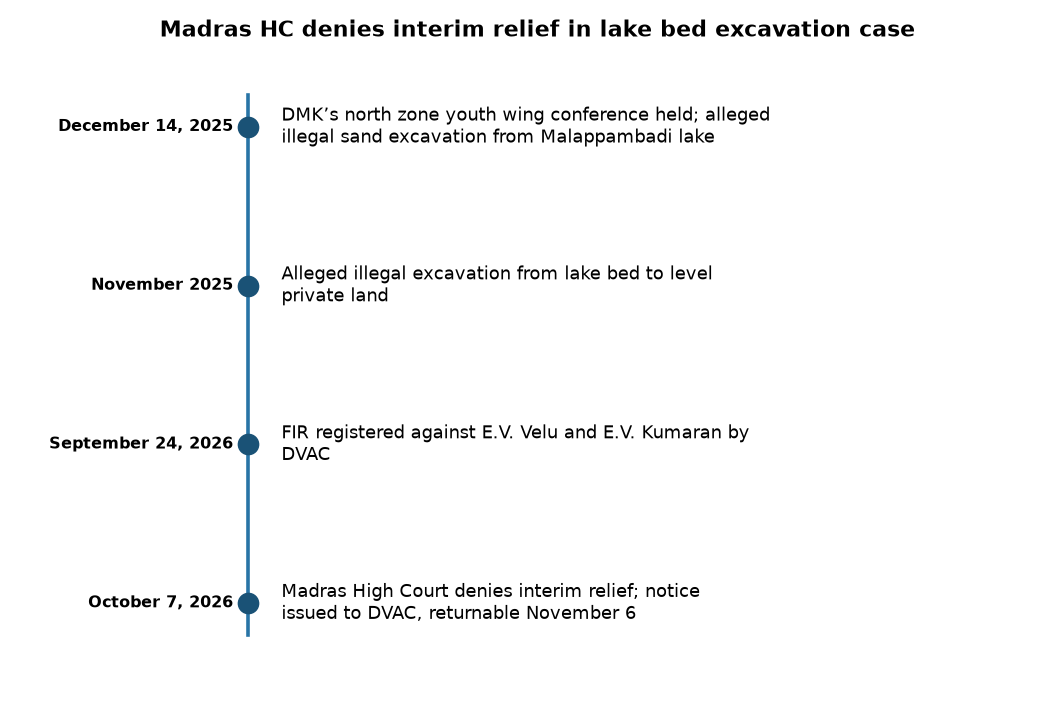
- The case pertains to the alleged excavation of approximately 45,72,058 cubic feet of sand from Malappambadi lake in Tiruvannamalai district, Tamil Nadu, for levelling land to host a political event organised by the DMK’s north zone youth wing on December 14, 2025.
- The excavation is alleged to have occurred in and around November 2025, resulting in an estimated loss of ₹8.22 crore to the public exchequer, as per the complaint filed by the anti-corruption NGO Arappor Iyakkam.
- The First Information Report (FIR) was registered by the Directorate of Vigilance and Anti-Corruption (DVAC) on September 24, 2026, following a change in the state government in Tamil Nadu in May 2026.
- The petitioners, E.V. Velu and his son E.V. Kumaran, have denied the allegations, claiming innocence and asserting that the FIR lacks specific allegations of criminal conduct or abuse of official position.
- The case is one of two FIRs filed against E.V. Velu after the formation of the new government, with the first relating to alleged irregularities in highway construction.
- The court’s order to issue notice to the DVAC, returnable by November 6, 2026, reflects the procedural stage of judicial review in corruption and environmental violation cases.
What is the Legal Framework Governing Lake Bed Excavation and Anti-Corruption Proceedings in India?
- **Lake Bed Excavation and Environmental Laws**: Lake beds are protected under the *Environment Protection Act, 1986*, which prohibits unauthorised excavation or alteration of water bodies to prevent ecological damage and ensure sustainable water management.
- **Sand Mining Regulations**: Sand mining is governed by state-specific rules, which mandate adherence to sustainable mining practices, and prohibition of illegal extraction to protect riverbeds and wetlands.
- **Role of the Directorate of Vigilance and Anti-Corruption (DVAC)**: The DVAC is a statutory body in Tamil Nadu tasked with investigating corruption cases involving public servants and acts under the *Prevention of Corruption Act, 1988* to prosecute offences such as abuse of official position, bribery, and misappropriation of public funds.
- **Prevention of Corruption Act, 1988**: This Act criminalises acts of corruption by public servants, including abuse of position for personal gain. Section 17A, introduced in 2018, mandates prior sanction from the appropriate authority for prosecution of public servants in corruption cases, ensuring checks against frivolous litigation.
- **First Information Report (FIR)**: An FIR is a formal document recording a cognisable offence, registered by the police under *Section 154 of the Code of Criminal Procedure, 1973*. It initiates criminal proceedings and is subject to judicial scrutiny for its validity and sufficiency of grounds.
- **Judicial Review in Environmental and Corruption Cases**: Courts play a pivotal role in reviewing the legality of FIRs, ensuring that allegations are not frivolous or politically motivated. They examine whether the FIR discloses a cognisable offence and whether procedural safeguards, such as prior sanction under Section 17A of the PCA, have been complied with.
- **Public Trust Doctrine**: This legal principle holds that natural resources like lakes, rivers, and forests are held in trust by the state for the benefit of the public. Any unauthorised exploitation violates this doctrine, entailing legal liability and environmental restoration obligations.
- **Role of Anti-Corruption NGOs**: Organisations like Arappor Iyakkam act as watchdogs, filing complaints to expose corruption and environmental violations. Their role is crucial in ensuring transparency and accountability in governance.
Key Features
| Feature | Significance |
|---|---|
| Interim relief denied by Madras High Court | Demonstrates judicial scrutiny of executive actions and adherence to due process in anti-corruption cases. |
| FIR under Prevention of Corruption Act, 1988 | Highlights the legal framework governing abuse of official position and corruption in public office. |
| Section 17A of PC Act, 1988 | Mandates prior approval for investigation against public servants, ensuring procedural safeguards against arbitrary action. |
| DVAC investigation | Illustrates the role of state anti-corruption agencies in enforcing accountability in land-use violations. |
| Public exchequer loss (₹8.22 crore) | Quantifies the fiscal impact of illegal excavation, reinforcing the economic dimension of environmental violations. |
Why it Matters
Legal and Judicial
- The case underscores the judiciary’s role in balancing executive accountability with procedural fairness, particularly in anti-corruption inquiries involving public servants.
- The rejection of interim relief reflects the court’s emphasis on prima facie evidence rather than political conjecture, aligning with constitutional principles of justice.
- The petitioners’ argument regarding the timing of the FIR (post-government change) raises questions about the independence of investigative agencies and the need for institutional safeguards.
Environmental Governance
- The illegal excavation of a lake bed highlights gaps in the enforcement of environmental laws, such as the Water (Prevention and Control of Pollution) Act, 1974, and the Environment (Protection) Act, 1986.
- The case exemplifies the conflict between land-use for political events and ecological conservation, necessitating stricter compliance with the Wetlands (Conservation and Management) Rules, 2017.
- The fiscal loss (₹8.22 crore) to the exchequer underscores the economic externalities of environmental degradation, linking ecological harm to public finance.
Institutional Accountability
- The involvement of the Directorate of Vigilance and Anti-Corruption (DVAC) demonstrates the state’s institutional framework for investigating corruption, though the timing of the FIR invites scrutiny of its impartiality.
- The case raises questions about the independence of anti-corruption agencies from political influence, particularly in cases involving high-profile individuals.
- The complainant’s role (Arappor Iyakkam) reflects the importance of civil society in holding public institutions accountable for environmental and financial misconduct.
Challenges
1. Politicisation of Anti-Corruption Investigations
- The timing of the FIR post a change in government may suggest selective enforcement, undermining public trust in anti-corruption agencies.
- The petitioners’ claim of political conjecture highlights the risk of investigations being weaponised for partisan purposes, necessitating transparent and objective processes.
- The need for prior approval under Section 17A of the PC Act, 1988, may inadvertently delay investigations, creating loopholes for misuse.
UPSC Link: GS2: Statutory bodies
2. Enforcement Gaps in Environmental Laws
- The illegal excavation of a lake bed indicates weak implementation of the Water Act, 1974, and the Wetlands Rules, 2017, despite their stringent provisions.
- The lack of real-time monitoring and third-party audits in environmental clearances exacerbates such violations, requiring systemic reforms.
- The fiscal loss (₹8.22 crore) underscores the need for stricter penalties and compensatory mechanisms for ecological damage.
UPSC Link: GS3: Environmental conservation
3. Judicial Scrutiny vs. Executive Discretion
- The court’s refusal to grant interim relief balances the need for judicial oversight with the executive’s discretion in governance, particularly in anti-corruption cases.
- The petitioners’ argument that the FIR lacks overt acts raises questions about the sufficiency of evidence required to initiate investigations.
- The case exemplifies the tension between procedural fairness and the urgency of addressing corruption, a recurring challenge in governance.
UPSC Link: GS2: Judiciary
4. Role of Civil Society in Governance
- Arappor Iyakkam’s complaint demonstrates the critical role of NGOs in exposing corruption and environmental violations, acting as a watchdog for public institutions.
- However, the reliance on civil society for accountability highlights the limitations of state institutions in proactively addressing such issues.
- The case underscores the need for stronger institutional mechanisms to support and protect whistleblowers and complainants.
UPSC Link: GS4: Civil society
5. Fiscal Impact of Environmental Degradation
- The estimated loss of ₹8.22 crore to the public exchequer reflects the economic cost of environmental violations, linking ecological harm to public finance.
- The case highlights the need for integrating environmental economics into policy-making, particularly in land-use planning and infrastructure development.
- The fiscal burden underscores the importance of preventive measures and stricter enforcement to avoid long-term ecological and financial costs.
UPSC Link: GS3: Economic development
Challenges — UPSC Perspective
| Issue | Concern |
|---|---|
| Selective enforcement of anti-corruption laws | Undermines public trust in investigative agencies and may lead to partisan misuse of legal processes. |
| Weak implementation of environmental laws | Allows for unchecked ecological degradation, with long-term fiscal and ecological consequences. |
| Timing of FIR post-government change | Raises questions about the impartiality and objectivity of anti-corruption investigations. |
| Lack of prior approval under Section 17A of PC Act, 1988 | May delay investigations, creating opportunities for misuse or evasion of accountability. |
| Insufficient real-time monitoring of environmental projects | Enables violations to go undetected until significant damage has occurred. |
| Limited institutional support for whistleblowers | Discourages individuals from reporting corruption or environmental violations due to fear of reprisal. |
Way Forward
- Strengthen the independence of anti-corruption agencies by institutionalising transparent processes for initiating investigations, including clear guidelines for prior approval under Section 17A of the PC Act, 1988.
- Enhance enforcement of environmental laws by mandating real-time monitoring, third-party audits, and stricter penalties for violations of the Water Act, 1974, and Wetlands Rules, 2017.
- Integrate environmental economics into policy-making to quantify the fiscal impact of ecological degradation and prioritise preventive measures in land-use planning.
- Establish a dedicated mechanism to support and protect whistleblowers, ensuring their safety and incentivising the reporting of corruption and environmental violations.
- Promote inter-agency coordination between the DVAC, environmental regulators, and civil society to address systemic gaps in enforcement and accountability.
- Conduct regular training for judicial and investigative personnel on the intersection of environmental law, corruption, and public finance to improve case adjudication.
- Encourage the use of technology, such as satellite imagery and blockchain for land records, to detect and deter illegal excavation and land-use violations.
- Review the Wetlands (Conservation and Management) Rules, 2017, to address enforcement challenges and align them with contemporary ecological and developmental needs.
UPSC Value Addition
Keywords for Mains Answer-Writing
Prevention of Corruption Act, 1988 · FIR quashing criteria · Judicial review of FIR · Section 17A PC Act · Judicial scrutiny of anti-corruption cases · Directorate of Vigilance and Anti-Corruption (DVAC) · Madras High Court powers · Lake bed excavation regulation · Constitutional remedies against FIR · Judicial review of executive action · Abuse of official position under PC Act · Procedural safeguards in anti-corruption laws
Concept Flow
Political event planning → Illegal excavation of lake bed for land levelling → Violation of environmental laws (Water Act, 1974; Wetlands Rules, 2017) → Fiscal loss to public exchequer (₹8.22 crore) → FIR registered under IPC and PC Act, 1988 → Petition for quashing FIR → Judicial scrutiny of evidence and procedural fairness → Rejection of interim relief → Notice to DVAC → Ongoing investigation and potential trial
Prelims Practice Questions
Q1. Consider the following statements regarding the quashing of an FIR by a High Court under the Code of Criminal Procedure, 1973:
1. The High Court can quash an FIR if it finds that the allegations do not prima facie constitute any offence.
2. The High Court can quash an FIR if it finds that the allegations are politically motivated.
3. The High Court can quash an FIR if it finds that the allegations are based on surmises and conjectures without any overt act.
How many of the above statements are correct?
- Only one
- Only two
- Only three
- None
Answer: Only three — Statement 1 is correct as per judicial precedents (e.g., State of Haryana v. Bhajan Lal). Statement 2 is incorrect as political motivation alone is not a ground for quashing an FIR. Statement 3 is correct as the High Court can quash an FIR if it lacks any material particulars or overt acts.
Q2. Assertion (A): The Prevention of Corruption Act, 1988, mandates prior approval under Section 17A for prosecution of a public servant.
Reason (R): Section 17A of the PC Act, 1988, was inserted to prevent frivolous prosecution of public servants and ensure procedural safeguards.
Options:
A. Both A and R are true, and R is the correct explanation of A.
B. Both A and R are true, but R is not the correct explanation of A.
C. A is true, but R is false.
D. A is false, but R is true.
Answer: ? — Both Assertion (A) and Reason (R) are correct. Section 17A of the PC Act, 1988, indeed mandates prior approval for prosecution of a public servant, and this provision was introduced to prevent misuse of anti-corruption laws against public servants.
Q3. Match the following provisions with their respective statutes:
Column I (Provision) | Column II (Statute)
1. Section 17A | A. Code of Criminal Procedure, 1973
2. Section 482 | B. Prevention of Corruption Act, 1988
3. Section 156(3) | C. Indian Penal Code, 1860
Options:
A. 1-B, 2-A, 3-C
B. 1-B, 2-C, 3-A
C. 1-A, 2-B, 3-C
D. 1-C, 2-A, 3-B
Answer: ? — Section 17A of the Prevention of Corruption Act, 1988, mandates prior approval for prosecution of public servants. Section 482 of the Code of Criminal Procedure, 1973, empowers the High Court to quash proceedings. Section 156(3) of the Code of Criminal Procedure, 1973, empowers the Magistrate to order investigation.
Mains Practice Question
✍ The Madras High Court, in its recent order in the case of E.V. Velu v. State, refused to grant interim relief to the petitioners against an FIR registered under the Prevention of Corruption Act, 1988. Critically examine the judicial standards applied by the High Court in refusing to quash the FIR at the interim stage. Also, elucidate the constitutional and statutory safeguards available to public servants against frivolous prosecutions. (15 Marks)
Approach: MODEL-ANSWER SKELETON:
1. **Judicial Standards for Quashing FIR at Interim Stage** (6 points):
– Reference to the landmark judgment in *State of Haryana v. Bhajan Lal* (1992) and subsequent cases (e.g., *R.P. Kapur v. State of Punjab*, *Sukhdev Singh v. State of Punjab*) to outline the grounds for quashing an FIR: (a) lack of prima facie offence, (b) absence of material particulars, (c) abuse of process of law, (d) political motivation, and (e) lack of overt act.
– Emphasise the High Court’s discretion under Section 482 of the Code of Criminal Procedure, 1973, to prevent abuse of process.
– Discuss the Madras High Court’s reasoning in refusing interim relief: reliance on the prima facie case made out by the DVAC, the need for investigation, and the absence of any overt act attributed to the petitioners in the FIR.
– Contrast with the petitioners’ contention that the FIR was based on surmises and lacked material particulars.
2. **Constitutional and Statutory Safeguards for Public Servants** (6 points):
– **Constitutional Safeguards**: Article 311(1) of the Constitution of India provides protection to civil servants against arbitrary dismissal, but does not directly address criminal prosecutions. However, the principle of natural justice and fair trial (Article 21) applies.
– **Statutory Safeguards under PC Act, 1988**:
– Section 17A: Mandates prior approval of the Central or State Government for prosecution of a public servant.
– Section 19: Protection against prosecution for acts done in good faith.
– Section 197: Protection to public servants for acts done in discharge of official duties (requires sanction from the appropriate government).
– **Judicial Precedents**: Cite *P.V. Narasimha Rao v. State* (1998) on the immunity of legislators under Article 105(2), and *K. Veeraswami v. Union of India* (1991) on the need for sanction for prosecution of public servants.
– **Procedural Safeguards**: Highlight the role of the DVAC in ensuring due diligence before registering an FIR, and the judiciary’s role in scrutinising the legality of such actions.
3. **Balanced View and Conclusion** (3 points):
– Acknowledge the tension between the need for accountability and the protection of public servants from frivolous prosecutions.
– Stress the importance of judicial scrutiny to prevent misuse of anti-corruption laws while ensuring that genuine cases are not stifled.
– Conclude that the Madras High Court’s order aligns with established judicial principles, balancing the rights of the accused and the public interest in anti-corruption enforcement.
Source: The Hindu
Generated by AanyaAi for educational purpose.
Related guides on our sites
- Best PSIR optional coaching for upsc
- Best PSIR optional teacher for upsc
- Best teacher of PSIR optional for upsc
- Best PSIR optional coaching in delhi for UPSC

- कर्नाटक उच्च न्यायालय ने बाल हिरासत मामलों में ‘पेरेंटिंग टाइम’ शब्द अपनाने का आदेश दिया - October 7, 2026
- RBI Rate Hike: How Home Loan EMIs Burden Middle-Class Buyers - October 7, 2026
- भारत के राज्यमंत्री (स्वतंत्र प्रभार) की आर्कटिक सर्कल असेंबली में भागीदारी - October 7, 2026

No Comments