


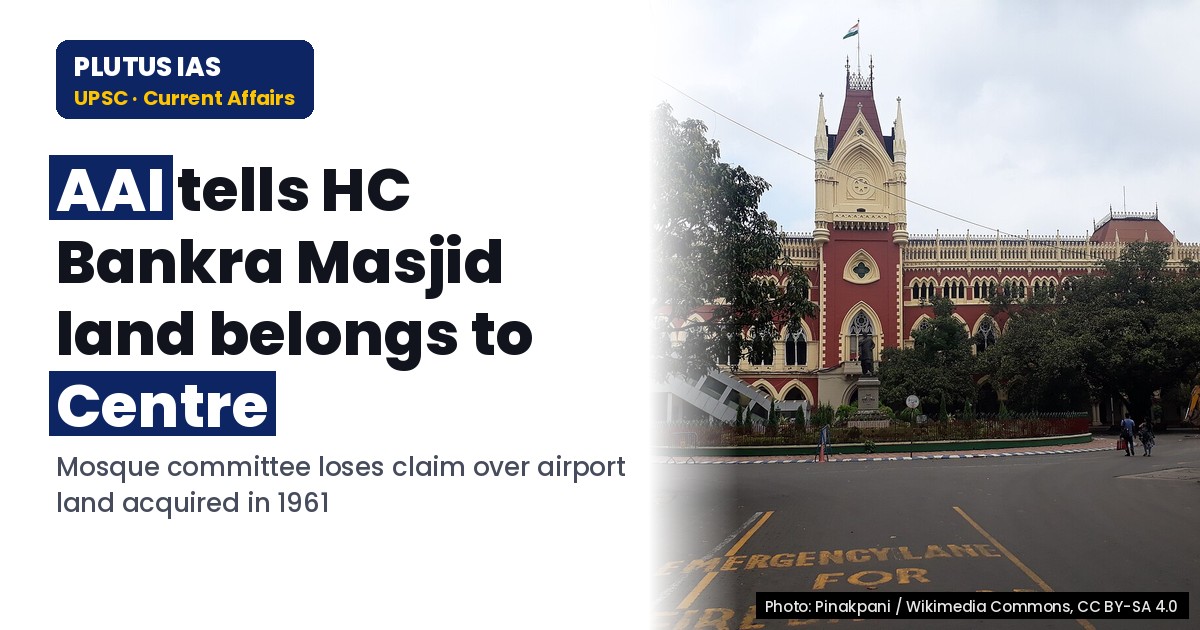
07 Oct AAI Tells Calcutta HC: Bankra Masjid Land Belongs to Centre
✎ The right to freedom of religion under Article 25 of the Constitution is not absolute and may be restricted in the interest of public order or national security, particularly when land has been lawfully acquired by the State for…
Subject Relevance — Where This Topic Fits
- GS Paper II — Polity and Governance | GS Paper III — Security and Infrastructure
- Prelims: Land Acquisition Act, 1894, Right to Freedom of Religion (Article 25), Airports Authority of India (AAI), Bureau of Civil Aviation Security (BCAS), Places of Worship Act, 1991
- Essay: Secularism and the balance between religious freedom and public order, State intervention in religious matters: constitutional and ethical considerations
Quick Revision: The right to freedom of religion under Article 25 of the Constitution is not absolute and may be restricted in the interest of public order or national security, particularly when land has been lawfully acquired by the State for public purposes.
Why is this in the news?
The Calcutta High Court is currently adjudicating a dispute involving the Bankra Masjid, located within the premises of the Netaji Subhas Chandra Bose International Airport in Kolkata. The Airport Authority of India (AAI) has asserted before the court that the land on which the mosque stands was acquired by the Central Government in 1961 for the expansion of the airport runway, thereby extinguishing any private or communal claims over the property. The case raises critical questions about the interplay between land acquisition laws, national security imperatives, and the right to freedom of religion under the Constitution of India.
Background
- The Bankra Masjid, established 136 years ago, is situated within the operational premises of the Netaji Subhas Chandra Bose International Airport in Kolkata.
- Compensation was paid to the affected parties at the time of acquisition, as per the legal framework governing land acquisition.
- The Bureau of Civil Aviation Security (BCAS) suspended public access to the mosque in July 2026, citing security concerns that allegedly interfered with flight operations.
- The dispute has now reached the Calcutta High Court, with the Bankra Masjid Committee seeking interim relief to resume Friday prayers and regular access for devotees.
- The case intersects with broader constitutional principles, including the right to freedom of religion (Article 25 of the Constitution) and the doctrine of eminent domain under land acquisition laws.
What is the legal and administrative framework governing land acquisition and religious rights in this context?
- Right to Freedom of Religion (Article 25, Constitution of India): This fundamental right guarantees the freedom to profess, practice, and propagate religion, subject to public order, morality, and health. However, this right is not absolute and may be restricted in the interest of public order or national security.
- Eminent Domain: The doctrine of eminent domain allows the State to acquire private property for public use, provided just compensation is paid. Once land is acquired, the original owner or occupier loses all rights over it, including any religious or customary claims.
- Places of Worship Act, 1991: This Act prohibits the conversion of any place of worship of any religious denomination into a place of worship of a different denomination or section. However, it does not apply to cases where the place of worship was acquired by the State for public purposes prior to the Act’s enforcement.
- Airport Security Regulations: The Bureau of Civil Aviation Security (BCAS) and the Central Industrial Security Force (CISF) are responsible for ensuring the security of airports in India. Their directives, including restrictions on access to certain areas within airport premises, are issued in the interest of national security and operational safety.
- Judicial Review of Administrative Actions: Courts in India have consistently upheld the primacy of national security and public order over individual rights, provided the State acts within the bounds of constitutional and statutory authority. Judicial review ensures that administrative actions do not violate fundamental rights or exceed the scope of legal powers.
- Interim Relief in Judicial Proceedings: Courts may grant interim relief in cases where irreparable harm is likely to occur before the final adjudication. However, such relief is subject to the balance of convenience and the prima facie merits of the case.
Key Features
| Feature | Significance |
|---|---|
| Acquisition of land by Central Government (1961 notification) | Establishes legal ownership of the land under the Land Acquisition Act, 1894, overriding any prior claims or usage rights. |
| Suspension of mosque access since July 2026 | Demonstrates the exercise of sovereign authority by the State in matters of national security, particularly in critical infrastructure zones. |
| Calcutta High Court proceedings | Provides a judicial forum for adjudicating disputes between private religious practices and public interest, including national security. |
| Security clearance by Bureau of Civil Aviation Security (BCAS) | Highlights the statutory role of BCAS in regulating access to airport premises to prevent security breaches. |
| Compensation paid to displaced residents | Illustrates the implementation of the Right to Fair Compensation and Transparency in Land Acquisition Act, 2013, in compensating affected parties. |
Why it Matters
Strategic Infrastructure
- The Netaji Subhas Chandra Bose International Airport is a critical node in India’s aviation network, handling over 20 million passengers annually, and its uninterrupted operation is vital for economic connectivity and national security.
- The presence of a religious structure within airport premises poses potential security risks, as highlighted by the BCAS and international aviation authorities, necessitating stringent access controls.
- The case underscores the primacy of national security over individual or community rights in areas designated for strategic infrastructure, as per constitutional jurisprudence.
Legal and Governance
- The dispute exemplifies the conflict between the Places of Worship Act, 1991, and the imperative of national security, raising questions about the enforceability of religious rights in restricted zones.
- The acquisition of land by the Central Government in 1961, followed by compensation under the Land Acquisition Act, 1894, demonstrates the State’s role in balancing development and individual rights.
- The judicial process in the Calcutta High Court provides a mechanism for resolving such disputes while ensuring adherence to the rule of law and procedural fairness.
Administrative Coordination
- The involvement of multiple agencies—AII, BCAS, CISF, and the West Bengal government—highlights the need for inter-departmental coordination in managing complex infrastructure and security challenges.
- The case reflects the administrative challenges in reconciling public access to religious sites with the operational requirements of high-security zones like airports.
- The decision to suspend access to the mosque, despite its long-standing presence, underscores the State’s duty to prioritize collective security over individual or community claims.
Challenges
1. Balancing Religious Rights and National Security
- The case presents a fundamental challenge in reconciling the right to freedom of religion (Article 25 of the Constitution) with the State’s duty to protect national security and public order.
- The Places of Worship Act, 1991, prohibits conversion of places of worship but does not explicitly address access restrictions in high-security zones, creating a legal grey area.
- The State must demonstrate that restrictions on religious access are proportionate, necessary, and non-discriminatory, failing which they may be challenged under Article 14 (Right to Equality).
UPSC Link: GS2 Fundamental Rights
2. Land Acquisition and Compensation Disputes
- The case highlights the complexities of land acquisition for public purposes, particularly when compensation disputes arise decades after acquisition.
- The Right to Fair Compensation and Transparency in Land Acquisition Act, 2013, mandates fair compensation, but delays in disbursement or disputes over valuation can lead to prolonged litigation.
- The State must ensure transparent and timely compensation to avoid alienating affected communities and to uphold the principles of natural justice.
UPSC Link: GS2 Land Reforms
3. Inter-Agency Coordination in Security Management
- The involvement of multiple agencies—AII, BCAS, CISF, and state authorities—necessitates seamless coordination to address security concerns without infringing on legal rights.
- Lack of clarity in roles and responsibilities among agencies can lead to operational inefficiencies or conflicts, as seen in the suspension of mosque access.
- The State must establish clear protocols for inter-agency collaboration to ensure that security measures are implemented without undermining legal or constitutional rights.
UPSC Link: GS3 Internal Security
4. Judicial Adjudication of Security vs. Rights
- The Calcutta High Court’s role in adjudicating the dispute raises questions about the judiciary’s capacity to balance competing interests in cases involving national security.
- Courts must ensure that their decisions are grounded in constitutional principles, statutory provisions, and precedents, rather than subjective assessments of security risks.
- The case may set a precedent for future disputes involving religious sites in high-security zones, influencing how such conflicts are resolved.
UPSC Link: GS2 Judiciary
Challenges — UPSC Perspective
| Issue | Concern |
|---|---|
| Freedom of Religion vs. National Security | Determining the extent to which religious rights can be restricted in areas designated for national security. |
| Compensation for Displaced Communities | Ensuring fair and timely compensation for residents displaced by land acquisition for public purposes. |
| Inter-Agency Coordination | Streamlining roles and responsibilities among security agencies to avoid operational conflicts. |
| Legal Ambiguity in High-Security Zones | Clarifying the applicability of the Places of Worship Act, 1991, in restricted areas like airports. |
| Judicial Review of Security Decisions | Balancing judicial scrutiny with the State’s duty to protect national security. |
| Public Access to Religious Sites | Reconciling the right to worship with the operational requirements of critical infrastructure. |
Way Forward
- Conduct a comprehensive security audit of all religious sites located within critical infrastructure zones to assess risks and compliance with BCAS guidelines.
- Formulate a national policy on the management of religious sites in high-security zones, in consultation with religious bodies, security agencies, and legal experts.
- Establish a dedicated inter-agency task force to oversee the coordination between AAI, BCAS, CISF, and state authorities in managing such disputes.
- Ensure timely disbursement of compensation to affected parties under the Right to Fair Compensation and Transparency in Land Acquisition Act, 2013, to prevent legal disputes.
- Clarify the legal framework governing access to religious sites in high-security zones, including the applicability of the Places of Worship Act, 1991, and constitutional provisions.
- Strengthen community engagement mechanisms to address grievances and foster trust between religious communities and security agencies.
- Develop standard operating procedures (SOPs) for the temporary relocation of religious sites in high-security zones, if necessary, with adequate compensation and alternative arrangements.
- Enhance judicial capacity to adjudicate disputes involving national security and fundamental rights, ensuring decisions are grounded in constitutional principles and precedents.
UPSC Value Addition
Keywords for Mains Answer-Writing
Land Acquisition Act, 1894 · Right to Freedom of Religion under Article 25 · Acquisition of land for public purposes · National security and public order · Places of Worship Act, 1991 · Calcutta High Court · Airport Authority of India (AAI) · Bureau of Civil Aviation Security (BCAS) · Central Industrial Security Force (CISF) · Constitutional provisions on property rights · Compensation for land acquisition · Balance between secularism and security · Constitutional morality · Public interest vs individual rights · Doctrine of eminent domain
Constitutional & Policy Linkages
- Article 25 (Freedom of Religion) — Balancing religious rights with public order and morality.
- Article 14 (Right to Equality) — Ensuring non-discriminatory application of restrictions.
- Article 21 (Right to Life and Personal Liberty) — Protecting individuals from arbitrary restrictions.
- Article 300A (Right to Property) — Safeguarding property rights in land acquisition cases.
Concept Flow
Land acquisition by Central Government (1961) → Compensation under Land Acquisition Act → Establishment of airport infrastructure → Long-standing presence of Bankra Masjid → Security concerns flagged by BCAS (2026) → Suspension of mosque access → Legal dispute filed in Calcutta High Court → AAI submits land ownership proof → Court examines security implications → Judgment awaited on balance between religious rights and national security
Prelims Practice Questions
Q1. Consider the following statements regarding the Land Acquisition Act, 1894:
1. The Act empowers the government to acquire private land for public purposes after paying compensation.
2. The Act does not apply to land acquired for defence or security purposes.
3. The Act mandates a prior notification and opportunity for hearing before acquisition.
How many of the above statements are correct?
- Only one
- Only two
- All three
- None
Answer: Only two — Statement 1 is correct as the Land Acquisition Act, 1894, allows the government to acquire private land for public purposes with compensation. Statement 2 is incorrect because the Act does apply to land acquired for defence or security purposes. Statement 3 is correct as the Act requires a prior notification and opportunity for hearing before acquisition.
Q2. Assertion (A): The Right to Freedom of Religion under Article 25 of the Constitution is absolute and cannot be restricted.
Reason (R): Public order, morality, and health are valid grounds to impose reasonable restrictions on the right to freedom of religion.
- Both A and R are true, and R is the correct explanation of A
- Both A and R are true, but R is not the correct explanation of A
- A is true, but R is false
- A is false, but R is true
Answer: A is false, but R is true — Assertion (A) is false because the Right to Freedom of Religion under Article 25 is not absolute and can be restricted on grounds of public order, morality, and health. Reason (R) is true as it correctly states the grounds for restriction.
Q3. Match the following provisions with their respective constitutional or legal frameworks:
Column I
1. Right to Freedom of Religion
2. Acquisition of land for public purposes
3. National security concerns
4. Places of Worship Act, 1991
Column II
A. Land Acquisition Act, 1894
B. Article 25 of the Constitution
C. Places of Worship (Special Provisions) Act, 1991
D. Doctrine of eminent domain
- 1-B, 2-A, 3-D, 4-C; 1-A, 2-B, 3-C, 4-D; 1-C, 2-D, 3-A, 4-B; 1-D, 2-C, 3-B, 4-A
- answer_expected_ordering_list_index_to_match_output_ordering_list_index
- explain_explanation_text
- format_match
Answer: 1-B, 2-A, 3-D, 4-C; 1-A, 2-B, 3-C, 4-D; 1-C, 2-D, 3-A, 4-B; 1-D, 2-C, 3-B, 4-A — 1-B (Right to Freedom of Religion is guaranteed under Article 25), 2-A (Acquisition of land for public purposes is governed by the Land Acquisition Act, 1894), 3-D (National security concerns are addressed under the Doctrine of eminent domain), 4-C (The Places of Worship Act, 1991, regulates the maintenance of religious character of places of worship).
Mains Practice Question
✍ The acquisition of land for public purposes, including national security, often conflicts with the right to freedom of religion. In this context, critically examine the constitutional and legal framework governing such conflicts, with particular reference to the doctrine of eminent domain and the doctrine of reasonable restrictions. Also, analyse the role of the judiciary in balancing these competing interests. (15 Marks)
Approach: MODEL-ANSWER SKELETON:
1. **Doctrine of Eminent Domain**: Define as the power of the State to acquire private property for public use, subject to payment of compensation (Land Acquisition Act, 1894). Mention the constitutional basis under Article 300A (right to property) and the State’s obligation to compensate.
2. **Right to Freedom of Religion (Article 25)**: Outline the scope of the right, including the freedom to practice, profess, and propagate religion, and its limitations on grounds of public order, morality, and health.
3. **Doctrine of Reasonable Restrictions**: Explain how the State can impose reasonable restrictions on fundamental rights, including religious freedom, in the interest of public order and national security. Cite relevant judicial precedents (e.g., *S.R. Bommai v. Union of India*, 1994).
4. **Judicial Role in Balancing Interests**: Discuss the judiciary’s approach to resolving conflicts between property rights and religious freedom, citing cases such as *T.M.A. Pai Foundation v. State of Karnataka* (2002) and *M. Ismail Faruqui v. Union of India* (1994). Highlight the principle of proportionality and the need to ensure minimal impairment of rights.
5. **Contemporary Context**: Relate the framework to the Bankra Masjid case, where national security concerns (runway safety) conflict with the right to religious freedom. Discuss the judiciary’s potential to weigh security imperatives against individual rights.
6. **Conclusion**: Emphasise the need for a balanced approach that upholds constitutional morality, ensures procedural fairness, and protects both public interest and individual rights.
Source: The Indian Express
Generated by AanyaAi for educational purpose.
Related guides on our sites
- Anthropology VS PSIR
- Best PSIR optional coaching
- Best PSIR optional coaching online
- Best PSIR optional teacher


No Comments