


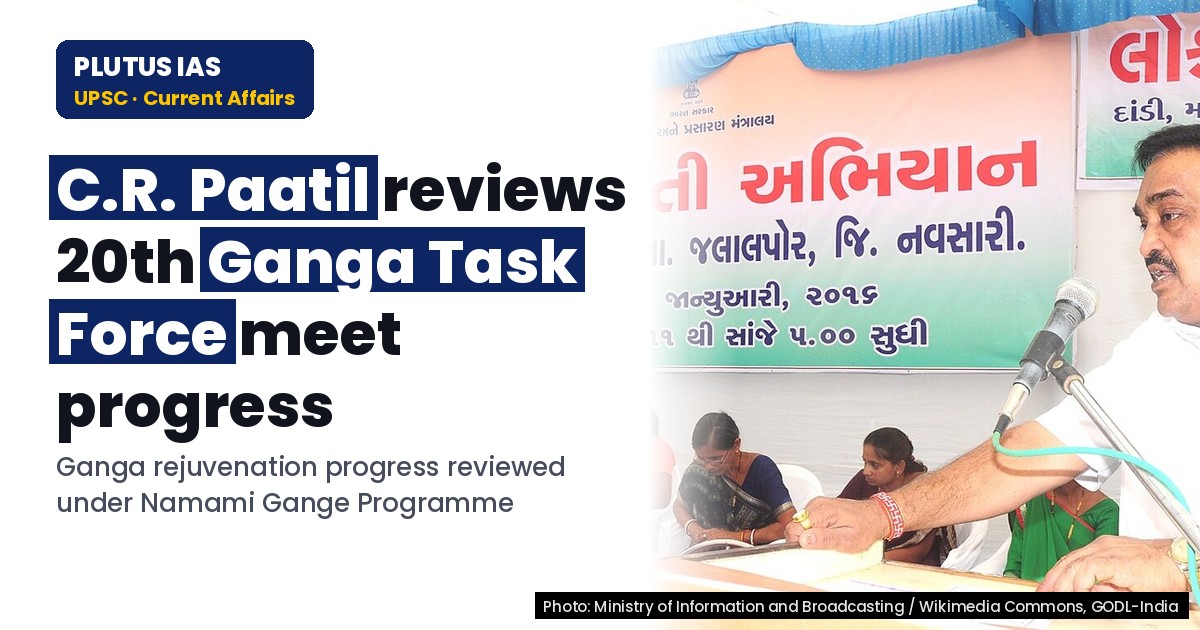
08 Oct Jal Shakti Minister Reviews Ganga Rejuvenation Progress in 20th Task Force Meet
✎ The Empowered Task Force (ETF) on Ganga Rejuvenation is the apex inter-ministerial body overseeing the Namami Gange Programme, mandated to ensure multi-stakeholder coordination, compliance with environmental laws, and…
Subject Relevance — Where This Topic Fits
- GS Paper II — Governance, Transparency and Accountability | GS Paper III — Environment and Disaster Management
- Prelims: National Mission for Clean Ganga (NMCG), Namami Gange Programme, Empowered Task Force (ETF), Ganga Action Plan (GAP), River Basin Management, Clean Ganga Fund, National Green Tribunal (NGT), Environmental Impact Assessment (EIA)
- Essay: Sustainable Development and Environmental Governance: Balancing Growth and Conservation, Water Security in India: Challenges and Policy Responses
Quick Revision: The Empowered Task Force (ETF) on Ganga Rejuvenation is the apex inter-ministerial body overseeing the Namami Gange Programme, mandated to ensure multi-stakeholder coordination, compliance with environmental laws, and technological integration for the rejuvenation of the Ganga river basin.
Why is this in the news?
The 20th meeting of the Empowered Task Force (ETF) on Ganga Rejuvenation, chaired by the Union Minister for Jal Shakti, highlights the institutional review and policy adjustments required to sustain the progress of the Namami Gange Programme. This meeting underscores the importance of multi-stakeholder coordination, technological interventions, and compliance monitoring in the rejuvenation of the Ganga river system, a critical national priority under India’s constitutional framework for environmental protection and sustainable development.
Background
- The Ganga, declared the ‘National River’ of India in 2008, is central to the cultural, ecological, and economic fabric of the country, supporting over 40% of India’s population across 11 states.
- The Ganga Action Plan (GAP-I, 1985; GAP-II, 1993) marked the first formal governmental intervention to address pollution in the river, focusing on point-source abatement.
- The National Mission for Clean Ganga (NMCG), constituted under the National Ganga River Basin Authority (NGRBA) in 2011, was restructured as an autonomous body in 2016 under the Ministry of Jal Shakti to enhance operational efficiency.
- The Empowered Task Force (ETF) on Ganga Rejuvenation, reconstituted in 2016, serves as the apex body for inter-ministerial coordination, monitoring, and policy direction under the Namami Gange Programme.
- The 20th ETF meeting reflects a shift from isolated interventions to a holistic, basin-wide approach, incorporating climate resilience, digital monitoring, and community-based conservation.
What is the Empowered Task Force (ETF) on Ganga Rejuvenation?
- The ETF is a high-level inter-ministerial body established to oversee the implementation of the Namami Gange Programme, ensuring convergence among Central Ministries, State Governments, and implementing agencies.
- It is chaired by the Union Minister for Jal Shakti and includes representatives from the Ministries of Environment, Forest and Climate Change; Urban Development; Rural Development; and key scientific institutions such as the Central Pollution Control Board (CPCB) and the National Remote Sensing Centre (NRSC).
- The ETF’s mandate includes reviewing progress, approving projects, resolving inter-state disputes, and ensuring compliance with environmental norms, particularly under the Water (Prevention and Control of Pollution) Act, 1974, and the Environment Protection Act, 1986.
- Key functions include: (a) approving Annual Action Plans for States; (b) monitoring the performance of Sewage Treatment Plants (STPs); (c) assessing the efficacy of afforestation and riverfront development initiatives; and (d) ensuring adherence to the ‘Minimum Flow’ norms for the Ganga and its tributaries.
- The ETF operates through a structured governance framework, including District Ganga Committees (DGCs) and State-level Empowered Committees, to decentralize implementation and enhance accountability.
- Technological integration is a cornerstone of the ETF’s strategy, with real-time monitoring systems (e.g., CPCB’s ‘Ganga Prahari’ app) and satellite-based surveillance (e.g., NRSC’s ‘Ganga Basin Information System’) used to track pollution hotspots and compliance.
- The ETF also facilitates the convergence of schemes such as the ‘Namami Gange’ with other Central and State programmes, including the Swachh Bharat Mission (Urban/Rural), AMRUT, and the Jal Jeevan Mission, to maximize resource utilization.
- Recent ETF meetings have emphasized the need for climate-resilient infrastructure, nature-based solutions (e.g., constructed wetlands), and the integration of traditional knowledge systems in conservation efforts.
Key Features
| Feature | Significance |
|---|---|
| Empowered Task Force on Ganga Rejuvenation (ETFGR) | A high-level inter-ministerial body established under the National Mission for Clean Ganga (NMCG) to oversee and accelerate the implementation of the Ganga Action Plan and its subsequent phases. |
| 20th Meeting of ETFGR | A periodic review mechanism to assess progress, address bottlenecks, and realign strategies for the rejuvenation of the Ganga river basin, ensuring multi-stakeholder coordination. |
| Ministerial Chairpersonship | The Union Minister for Jal Shakti chairs the ETFGR, underscoring the central government’s commitment to river basin governance and water resource management. |
| Multi-Dimensional Approach | Integration of pollution control, afforestation, biodiversity conservation, and community engagement in the Ganga rejuvenation strategy. |
| Monitoring and Evaluation Framework | Use of satellite imagery, real-time data, and third-party audits to track compliance and outcomes of rejuvenation efforts. |
Why it Matters
Environmental and Ecological
- The Ganga is a critical river system supporting biodiversity, agriculture, and livelihoods for millions, necessitating sustained conservation efforts.
- Rejuvenation aligns with India’s commitments under international conventions such as the Ramsar Convention and the Sustainable Development Goals (SDG 6 and 14).
- Restoration of the Ganga’s ecological health mitigates the impact of climate change on water availability and quality.
- Prevents the loss of endemic species and preserves the river’s role in carbon sequestration through riparian ecosystems.
Economic and Livelihood
- Sustainable management of the Ganga basin supports agriculture, fisheries, and tourism, contributing to rural and regional economies.
- Reduction in water pollution lowers healthcare costs and improves public health outcomes, particularly in densely populated regions.
- Enhanced riverine transport and hydropower potential can stimulate economic activity in the basin states.
- Job creation in sectors such as eco-tourism, waste management, and renewable energy linked to river conservation.
Institutional and Governance
- Demonstrates the efficacy of a multi-tiered governance model involving central, state, and local authorities for river basin management.
- Highlights the role of technology in environmental governance through the use of GIS, remote sensing, and data analytics.
- Sets a precedent for integrated water resource management (IWRM) in other major river systems in India.
- Strengthens the National Mission for Clean Ganga (NMCG) as a model for river rejuvenation initiatives.
Legal and Policy
- Implements the provisions of the Water (Prevention and Control of Pollution) Act, 1974, and the Environment (Protection) Act, 1986.
- Aligns with the National Water Policy (2012) and the National Environment Policy (2006) to ensure sustainable water use.
- Supports the objectives of the Namami Gange Programme, a centrally sponsored scheme with a budgetary outlay of ₹20,000 crore (approx.) for 2015-2025.
Challenges
1. Pollution from Domestic and Industrial Sources
- Untreated sewage discharge from urban centres remains a primary source of pollution in the Ganga.
- Industrial effluents, particularly from tanneries and chemical units, contribute to heavy metal contamination.
- Lack of adequate wastewater treatment infrastructure in many cities along the river basin.
UPSC Link: GS3: Environmental Pollution & Degradation
2. Agricultural Runoff and Non-Point Source Pollution
- Excessive use of chemical fertilizers and pesticides in agriculture leads to nutrient loading in the river.
- Runoff from agricultural fields introduces high levels of nitrogen and phosphorus, causing eutrophication.
- Limited adoption of organic farming and precision agriculture in the basin states.
UPSC Link: GS3: Conservation, Environmental Pollution & Degradation
3. Ecological Degradation and Biodiversity Loss
- Fragmentation of riverine habitats due to dams, barrages, and encroachments disrupts aquatic ecosystems.
- Decline in fish populations and loss of endangered species such as the Ganges river dolphin.
- Invasive species and altered flow regimes further threaten native biodiversity.
UPSC Link: GS3: Conservation, Environmental Pollution & Degradation
4. Institutional and Coordination Challenges
- Fragmented governance across multiple states and agencies leads to policy implementation gaps.
- Lack of real-time data sharing and integrated monitoring systems among stakeholders.
- Inadequate community participation and awareness in conservation efforts.
UPSC Link: GS2: Government Policies & Interventions
5. Climate Change Impacts
- Altered precipitation patterns and glacial melt affect the river’s flow regime and water availability.
- Increased frequency of extreme weather events (floods and droughts) exacerbates pollution and ecological stress.
- Rising temperatures and reduced water levels intensify the concentration of pollutants.
UPSC Link: GS3: Climate Change
6. Financial and Resource Constraints
- Sustained funding for long-term conservation initiatives remains a challenge despite central allocations.
- High operational and maintenance costs for wastewater treatment plants and afforestation projects.
- Limited private sector investment in river conservation due to perceived low returns.
UPSC Link: GS3: Resource Mobilisation
Challenges — UPSC Perspective
| Issue | Concern |
|---|---|
| Sewage Treatment | Only 30% of urban wastewater is treated before discharge into the Ganga. |
| Industrial Effluents | Over 500 grossly polluting industries (GPIs) operate along the Ganga without adequate effluent treatment. |
| Agricultural Runoff | Excessive use of nitrogenous fertilizers in Uttar Pradesh and Bihar contributes to 40% of nutrient pollution. |
| Riverfront Encroachments | Illegal constructions and sand mining disrupt natural flow and degrade riparian habitats. |
| Monitoring Gaps | Lack of real-time water quality data in remote stretches of the river basin. |
| Community Engagement | Low awareness among local communities about their role in conservation efforts. |
Government Initiatives — Must-Memorise for Prelims
- National Mission for Clean Ganga (NMCG)
- Ganga Action Plan Phase-I and II
- Clean Ganga Fund
Way Forward
- Accelerate the construction and upgradation of sewage treatment plants (STPs) in identified urban centres along the Ganga basin.
- Enforce stringent compliance with effluent treatment norms for industries, including third-party audits and real-time monitoring.
- Promote organic farming and precision agriculture through subsidies and farmer awareness campaigns to reduce chemical runoff.
- Strengthen riparian buffer zones through afforestation and restoration of wetlands to enhance natural filtration.
- Develop a basin-wide early warning system for pollution and ecological stress using AI and remote sensing technologies.
- Enhance inter-state coordination through regular meetings of the ETFGR and state-level Ganga Committees.
- Increase public participation via awareness drives, citizen science programs, and eco-tourism initiatives.
- Leverage corporate social responsibility (CSR) funds for localized conservation projects in the Ganga basin.
UPSC Value Addition
Keywords for Mains Answer-Writing
Ganga Rejuvenation · National Mission for Clean Ganga (NMCG) · Empowered Task Force (ETF) · Jal Shakti Ministry · River Basin Management · Namami Gange Programme · Ganga Action Plan · Inter-State River Water Disputes · Pollution Control Measures · Sustainable River Management · Environmental Governance · Water Quality Monitoring · River Conservation Framework
Constitutional & Policy Linkages
- Article 21 (Right to Life and Personal Liberty) – Ensuring clean water as part of the right to a healthy environment.
- Article 48A (Directive Principles of State Policy) – Protection and improvement of the environment and safeguarding of forests and wildlife.
- Article 51A(g) (Fundamental Duties) – Duty of every citizen to protect and improve the natural environment.
Concept Flow
Pollution and ecological degradation in the Ganga basin → Formulation of the Ganga Action Plan (1985) → Establishment of the National Mission for Clean Ganga (NMCG) (2011) → Launch of Namami Gange Programme (2015) → Creation of the Empowered Task Force on Ganga Rejuvenation (ETFGR) → Periodic reviews and multi-stakeholder coordination → Implementation of pollution control measures and ecological restoration → Monitoring and evaluation using technology → Sustained rejuvenation and long-term conservation.
Prelims Practice Questions
Q1. Consider the following statements regarding the National Mission for Clean Ganga (NMCG):
1. NMCG is a statutory body established under the Environment Protection Act, 1986.
2. The Empowered Task Force (ETF) on Ganga Rejuvenation is chaired by the Prime Minister of India.
3. The Namami Gange Programme is a centrally sponsored scheme with 100% central funding.
How many of the above statements are correct?
- Only one
- Only two
- All three
- None
Answer: Only one — Statement 1 is incorrect: NMCG is an autonomous organisation under the Jal Shakti Ministry, not a statutory body. Statement 2 is incorrect: The ETF is chaired by the Union Minister for Jal Shakti, not the Prime Minister. Statement 3 is incorrect: The Namami Gange Programme is centrally sponsored with 100% central funding only for the Ganga river basin states; other states receive 50% central funding.
Q2. Assertion (A): The Ganga Action Plan (GAP) Phase-I, launched in 1985, was primarily focused on pollution abatement in the Ganga river.
Reason (R): The GAP Phase-I was implemented by the Central Pollution Control Board (CPCB) in collaboration with state governments.
In the context of the above two statements, which of the following is correct?
- Both A and R are true, and R is the correct explanation of A.
- Both A and R are true, but R is not the correct explanation of A.
- A is true but R is false.
- A is false but R is true.
Answer: Both A and R are true, but R is not the correct explanation of A. — Assertion (A) is true: GAP Phase-I aimed at pollution abatement in the Ganga river. Reason (R) is also true, but it is not the correct explanation of A, as GAP Phase-I was implemented by the Ganga Project Directorate under the Ministry of Environment, Forest and Climate Change, not solely by the CPCB.
Q3. Match the following initiatives with their respective objectives:
Column I (Initiative) | Column II (Objective)
———————————————–|————————————————
A. Namami Gange Programme | 1. Interlinking of rivers for water transfer
B. National River Conservation Plan (NRCP) | 2. Comprehensive river basin management
C. Inter-State River Water Disputes Act, 1956 | 3. Resolution of disputes over water sharing
D. National Water Mission | 4. Conservation of rivers and water bodies
Select the correct match:
- A-2, B-4, C-3, D-1
- A-4, B-2, C-1, D-3
- A-2, B-4, C-1, D-3
- A-4, B-3, C-2, D-1
Answer: A-2, B-4, C-3, D-1 — Correct matches: A (Namami Gange Programme) – 2 (Comprehensive river basin management), B (National River Conservation Plan) – 4 (Conservation of rivers and water bodies), C (Inter-State River Water Disputes Act, 1956) – 3 (Resolution of disputes over water sharing), D (National Water Mission) – 1 (Interlinking of rivers for water transfer).
Mains Practice Question
✍ The 20th Meeting of the Empowered Task Force (ETF) on Ganga Rejuvenation, chaired by the Union Minister for Jal Shakti, underscores the evolving institutional framework for river basin management in India. Critically examine the role and effectiveness of the ETF in achieving the objectives of the Namami Gange Programme. Also, analyse the challenges in inter-state coordination and suggest measures to enhance the efficacy of river rejuvenation efforts. (15 Marks)
Approach: MODEL-ANSWER SKELETON:
1. **Institutional Framework and Role of ETF**:
– Define the Empowered Task Force (ETF) on Ganga Rejuvenation: composition, mandate, and legal basis (e.g., under the Namami Gange Programme).
– Explain its role in policy formulation, coordination among states, and monitoring of the Namami Gange Programme.
– Reference the 20th Meeting’s outcomes (e.g., progress on projects, pollution control measures, or funding mechanisms) as per official reports.
2. **Effectiveness of ETF**:
– Assess the ETF’s achievements: cite data on pollution reduction, sewage treatment capacity augmentation, or afforestation along the Ganga basin.
– Highlight limitations: bureaucratic delays, lack of uniform implementation across states, or inadequate community participation.
– Reference statutory bodies like the National Mission for Clean Ganga (NMCG) and their collaboration with the ETF.
3. **Challenges in Inter-State Coordination**:
– Discuss constitutional provisions (e.g., Article 262 on inter-state river disputes) and their impact on coordination.
– Analyse practical challenges: conflicting state priorities, inadequate data sharing, or lack of a unified river basin management plan.
– Cite examples of disputes (e.g., Uttar Pradesh vs. Uttarakhand on Ganga water sharing) to illustrate governance gaps.
4. **Measures to Enhance Efficacy**:
– Propose institutional reforms: strengthening the ETF’s decision-making powers, or establishing a dedicated river basin authority.
– Suggest technological interventions: real-time water quality monitoring systems or GIS-based mapping of pollution sources.
– Emphasise community engagement: involving local stakeholders in monitoring and maintenance of riverine ecosystems.
5. **Balanced View**:
– Acknowledge the ETF’s progress while critiquing its shortcomings to present a nuanced perspective.
– Conclude with a forward-looking statement on the need for integrated, participatory, and data-driven river management.
Source: PIB (Press Information Bureau)
Generated by AanyaAi for educational purpose.
Related guides on our sites
- Best geography optional coaching
- Best geography optional coaching
- Best geography optional teacher
- Best geography optional teacher

- पीएम महिला एवं बाल विकास शिखर सम्मेलन के समापन सत्र में होंगे शामिल - October 8, 2026
- Indian Coast Guard’s SAREX-2026: Paradip Hosts Major Maritime Rescue Drill - October 8, 2026
- झारखंड: जल जीवन मिशन की विफलता, 16 पंचायतों में जांच क्यों? - October 8, 2026

No Comments