

09 Oct RBI’s 25 bps rate hike: Why inflation remains a UPSC priority
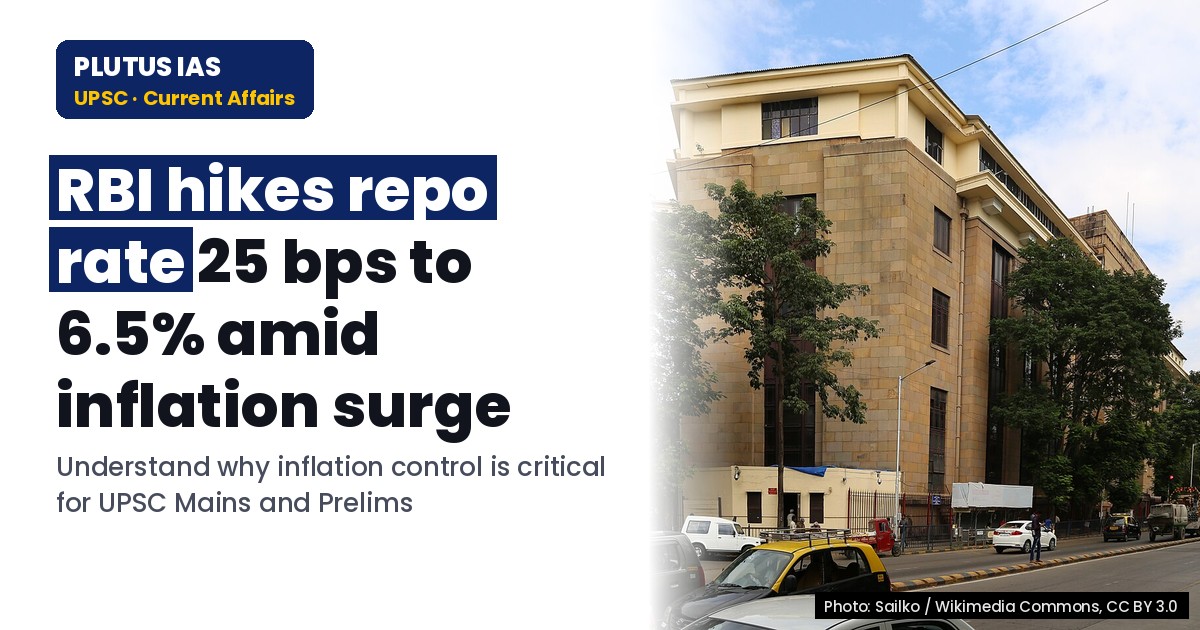
✎ The RBI’s MPC raised the repo rate by 25 basis points and shifted to ‘calibrated tightening’ to anchor inflation expectations amid supply-side pressures from rising crude oil prices and deficient monsoon conditions.
Subject Relevance — Where This Topic Fits
- GS Paper III — Indian Economy and Issues Relating to Planning, Mobilisation of Resources, Growth, Development and Employment
- Prelims: Monetary Policy Committee (MPC), Repo Rate, Reverse Repo Rate, Inflation Targeting, Supply-side Inflation, Fiscal-Monetary Coordination, Food Inflation, Crude Oil Prices, Monsoon Deficiency, GDP Growth Forecast, Foreign Portfolio Investors (FPIs), Calibrated Tightening
- Essay: The interplay between growth and inflation: Can India achieve sustainable development without compromising macroeconomic stability?, The role of institutions in economic governance: The RBI’s autonomy and effectiveness in inflation management
Quick Revision: The RBI’s MPC raised the repo rate by 25 basis points and shifted to ‘calibrated tightening’ to anchor inflation expectations amid supply-side pressures from rising crude oil prices and deficient monsoon conditions.
Why is this in the news?
The Reserve Bank of India’s Monetary Policy Committee (MPC) has raised the policy repo rate by 25 basis points and shifted its monetary policy stance to ‘calibrated tightening’ in response to rising inflationary pressures. This decision, coupled with upward revisions in inflation and GDP growth projections, underscores the central bank’s proactive approach to anchoring inflation expectations while balancing growth objectives. The move is significant as it signals a departure from the neutral stance and highlights the challenges posed by supply-side inflation drivers, particularly elevated global crude oil prices and deficient monsoon conditions.
Background
- The RBI’s Monetary Policy Committee (MPC) is statutorily mandated under the Reserve Bank of India Act, 1934, to maintain price stability while supporting growth, with a target inflation band of 4% ± 2% for the medium term.
- India’s retail inflation, as measured by the Consumer Price Index (CPI), has remained persistently above the upper tolerance limit of 6% for several months, driven by supply-side factors such as rising global oil prices and adverse monsoon conditions.
- Global crude oil prices have surged beyond $100 per barrel in recent months, exerting upward pressure on domestic fuel prices despite government interventions to moderate price increases.
- The RBI’s decision to raise the repo rate by 25 basis points follows a period of prolonged monetary accommodation, reflecting the central bank’s shift towards a more restrictive policy stance to curb inflationary expectations.
- The government has employed administrative measures, such as strategic foodgrain buffers and export controls, to mitigate food inflation, though their effectiveness remains contingent on timely implementation and market conditions.
What is the Monetary Policy Committee (MPC) and its role in inflation management?
- The Monetary Policy Committee (MPC) is a statutory body constituted under the Reserve Bank of India Act, 1934, responsible for setting monetary policy to achieve the inflation target set by the government.
- The MPC consists of six members: three from the RBI (including the Governor) and three external members appointed by the Central Government, ensuring a balance between institutional expertise and external perspectives.
- The MPC operates under a flexible inflation-targeting framework, where the primary objective is to maintain price stability while supporting growth, with a target inflation rate of 4% with a tolerance band of ±2%.
- The MPC uses various monetary policy instruments, including the repo rate, reverse repo rate, and open market operations, to influence liquidity conditions and borrowing costs in the economy.
- The repo rate is the rate at which the RBI lends short-term funds to commercial banks, and its adjustment directly impacts lending and deposit rates across the financial system.
- The MPC’s decisions are guided by a forward-looking assessment of inflation and growth dynamics, incorporating data on global commodity prices, monsoon conditions, and domestic demand-supply imbalances.
- The MPC’s communication strategy, including policy statements and forward guidance, plays a critical role in shaping inflation expectations, which are a key determinant of actual inflation outcomes.
- The MPC’s shift to a ‘calibrated tightening’ stance indicates a gradual withdrawal of monetary accommodation, signalling a commitment to containing inflationary pressures without disrupting growth prospects.
Key Features
| Feature | Significance |
|---|---|
| Monetary Policy Committee (MPC) stance shift to ‘calibrated tightening’ | Signals the RBI’s proactive intent to manage inflation expectations by signalling future rate hikes, beyond the immediate 25 bps increase. |
| 25 basis points (bps) interest rate hike | A calibrated monetary tightening measure to curb demand-side inflationary pressures, while acknowledging supply-side constraints. |
| Revised inflation projections (Q2: 4.9%, Q3: 6%, Q4: 5.7%) | Highlights the persistence of inflationary pressures, driven by global oil prices and deficient monsoon, necessitating policy intervention. |
| Revised GDP growth forecast (2026-27: 7.1%) | Indicates the RBI’s confidence in the economy’s resilience to absorb monetary tightening, despite global headwinds. |
| Government’s role in price stabilisation | Emphasises the need for fiscal measures (e.g., strategic buffers, import/export controls) to complement monetary policy in addressing supply-side inflation. |
Why it Matters
Monetary Policy and Inflation Management
- The MPC’s decision to raise interest rates by 25 bps reflects a shift towards pre-emptive monetary tightening to anchor inflation expectations, a critical tool in inflation management when supply-side factors dominate.
- The stance change to ‘calibrated tightening’ underscores the RBI’s commitment to using all available tools to maintain price stability, signalling a prolonged tightening cycle if necessary.
- The RBI’s projection of higher inflation in Q3 (6%) despite a 25 bps hike highlights the limitations of monetary policy in addressing supply-side inflation, necessitating complementary fiscal measures.
Macroeconomic Stability and Growth-Inflation Trade-off
- The upward revision of GDP growth to 7.1% for 2026-27 suggests that the RBI believes the economy can withstand monetary tightening, balancing growth and inflation objectives.
- The growth-inflation trade-off remains a critical challenge, as higher interest rates may dampen investment and consumption, while unchecked inflation erodes purchasing power and macroeconomic stability.
- The potential exodus of Foreign Portfolio Investors (FPIs) due to higher interest rates could impact exchange rate stability, necessitating careful policy calibration.
Supply-Side Inflation and Fiscal Measures
- Rising global oil prices (above $100/barrel) and a deficient monsoon have exacerbated inflationary pressures, demonstrating the limitations of monetary policy in addressing supply-side shocks.
- Government intervention through strategic food buffers, import/export controls, anti-hoarding measures, and open market operations is essential to mitigate food inflation and stabilise prices.
- The RBI’s reliance on fiscal authorities to address supply-side inflation underscores the need for coordinated policy responses to achieve durable price stability.
Inflation Expectations and Policy Communication
- The MPC’s emphasis on dampening inflation expectations is a critical aspect of monetary policy, as self-fulfilling inflationary expectations can perpetuate price pressures independent of underlying factors.
- The shift in stance and the 25 bps hike serve as strong communication tools to signal the RBI’s resolve to control inflation, influencing market behaviour and public sentiment.
Challenges
1. Supply-Side Inflation and Monetary Policy Limitations
- Monetary policy tools, such as interest rate hikes, have limited efficacy in addressing inflation driven by supply-side factors like rising oil prices and food shortages.
- The RBI’s projections indicate that inflation may remain elevated in Q3 (6%), despite a 25 bps hike, highlighting the need for complementary fiscal measures.
- Persistent supply-side inflation can lead to a vicious cycle of higher prices, eroding consumer confidence and economic stability.
UPSC Link: GS III: Indian Economy – Inflation
2. Growth-Inflation Trade-off and Policy Dilemma
- Higher interest rates, while necessary to curb inflation, risk dampening economic growth by increasing borrowing costs for businesses and households.
- The RBI’s upward revision of GDP growth to 7.1% suggests confidence in the economy’s resilience, but the trade-off between growth and inflation remains a delicate balancing act.
- A slowdown in the second half of the year, as predicted by economic agencies, could exacerbate the challenges of managing inflation without stifling growth.
UPSC Link: GS III: Indian Economy – Growth and Development
3. Exchange Rate Stability and Capital Outflows
- Higher interest rates may attract foreign capital, but prolonged tightening could also trigger an exodus of Foreign Portfolio Investors (FPIs), impacting exchange rate stability.
- The RBI’s ability to manage exchange rate volatility is critical, as currency depreciation can further fuel inflation through higher import costs.
- Coordinated policy responses are needed to ensure that monetary tightening does not inadvertently destabilise the financial system.
UPSC Link: GS III: Indian Economy – External Sector
4. Food Inflation and Supply Chain Management
- A deficient monsoon has disrupted agricultural output, leading to higher food prices and exacerbating inflationary pressures.
- Government interventions, such as strategic food buffers, import/export controls, and anti-hoarding measures, are essential to stabilise food prices and ensure supply chain resilience.
- Ineffective implementation of these measures can lead to hoarding, black marketing, and further price distortions, undermining policy efforts.
UPSC Link: GS III: Indian Economy – Agriculture and Food Management
5. Inflation Expectations and Market Sentiment
- Inflation expectations can become self-fulfilling, driving higher prices even in the absence of underlying demand-side pressures.
- The RBI’s communication strategy, including the stance shift and rate hike, is critical to anchoring expectations and preventing a spiral of rising prices.
- Failure to manage expectations effectively can undermine the credibility of monetary policy and exacerbate inflationary pressures.
UPSC Link: GS III: Indian Economy – Monetary Policy
Challenges — UPSC Perspective
| Issue | Concern |
|---|---|
| Supply-side inflation (oil prices, monsoon) | Monetary policy tools are less effective; requires fiscal interventions to stabilise prices. |
| Growth-inflation trade-off | Higher interest rates may dampen growth; balancing inflation control with economic expansion is critical. |
| Exchange rate volatility | Capital outflows due to higher rates can destabilise the rupee, increasing import costs and inflation. |
| Food inflation and supply chain disruptions | Deficient monsoon and hoarding exacerbate price pressures; government interventions are essential. |
| Inflation expectations | Self-fulfilling prophecies can perpetuate inflation; RBI’s communication is key to anchoring expectations. |
Way Forward
- Enhance government interventions to stabilise food prices, including strategic buffers, import/export controls, and anti-hoarding measures.
- Strengthen coordination between the RBI and fiscal authorities to address supply-side inflation through complementary policies.
- Monitor and manage exchange rate stability to prevent capital outflows and minimise import cost inflation.
- Refine monetary policy communication to anchor inflation expectations and reinforce the RBI’s commitment to price stability.
- Conduct regular assessments of inflation projections and adjust policy measures as needed to balance growth and inflation objectives.
- Improve agricultural supply chain resilience to mitigate the impact of deficient monsoons and other supply-side shocks.
- Enhance transparency in policy decisions to build public trust and ensure policy credibility in managing inflation.
UPSC Value Addition
Keywords for Mains Answer-Writing
Monetary Policy Committee · inflation targeting · supply-side inflation · calibrated tightening stance · inflation expectations · RBI’s policy tools · fiscal-monetary coordination · food inflation management · strategic food reserves · open market operations · GDP growth-inflation trade-off · monsoon deficiency and inflation · crude oil price volatility · Foreign Portfolio Investors (FPI) and interest rates · MPC stance change from neutral to calibrated tightening
Concept Flow
Rising global oil prices (>$100/barrel) and deficient monsoon → Supply-side inflationary pressures → Higher retail inflation projections (Q2: 4.9%, Q3: 6%) → Supply-side inflation limits effectiveness of monetary policy → RBI raises interest rates by 25 bps and shifts stance to ‘calibrated tightening’ → MPC’s stance change signals future rate hikes → Dampens inflation expectations and influences market sentiment → Higher interest rates aim to curb demand-side inflation but risk growth slowdown → RBI revises GDP growth forecast upward to 7.1% for 2026-27, indicating confidence in economic resilience → Potential FPI exodus due to higher rates → Exchange rate volatility and import cost inflation → Government interventions (strategic buffers, import/export controls) required to address supply-side inflation → Complementary fiscal measures to support monetary policy → Balancing growth-inflation trade-off → Continuous policy calibration to ensure macroeconomic stability
Prelims Practice Questions
Q1. Consider the following statements regarding the Monetary Policy Committee (MPC) of the Reserve Bank of India (RBI):
1. The MPC is a statutory body established under the Reserve Bank of India Act, 1934.
2. The MPC consists of three members from the RBI and three external members nominated by the Government of India.
3. The MPC is mandated to maintain retail inflation at 4% with a tolerance band of ±2% around it.
4. The MPC can change its stance from ‘neutral’ to ‘calibrated tightening’ without altering the policy rate.
How many of the above statements are correct?
- Only one
- Only two
- Only three
- All
Answer: All — Statements 1, 2, and 3 are correct. The MPC is indeed a statutory body under the RBI Act, 1934, with six members (three from RBI and three external). It targets inflation at 4% ±2%. Statement 4 is incorrect because a stance change to ‘calibrated tightening’ typically accompanies or follows a rate hike, though it can technically occur independently.
Q2. Assertion (A): The Reserve Bank of India (RBI) raised the policy repo rate by 25 basis points in its October 2026 policy review.
Reason (R): The RBI’s decision was primarily driven by rising global crude oil prices and a deficient monsoon affecting food inflation.
Select the correct code:
- Both A and R are true, and R is the correct explanation of A
- Both A and R are true, but R is NOT the correct explanation of A
- A is true, but R is false
- A is false, but R is true
Answer: Both A and R are true, but R is NOT the correct explanation of A — Both the assertion and reason are true. The RBI did raise the repo rate by 25 bps in October 2026. The reason correctly explains the RBI’s action, as rising crude prices and monsoon deficiency were key drivers of inflation, necessitating monetary tightening.
Q3. Match the following terms related to inflation management with their correct descriptions:
Column I
A. Calibrated tightening
B. Inflation expectations
C. Open market operations
D. Strategic food reserves
Column II
1. Measures to influence money supply by buying or selling government securities
2. Government-held buffer stocks of essential food items to stabilize prices
3. A monetary policy stance aimed at gradually withdrawing accommodation
4. Public perception of future inflation trends that can influence current economic behavior
- {‘A’: 3, ‘B’: 4, ‘C’: 1, ‘D’: 2}
- {‘A’: 1, ‘B’: 2, ‘C’: 3, ‘D’: 4}
- {‘A’: 2, ‘B’: 3, ‘C’: 4, ‘D’: 1}
- {‘A’: 4, ‘B’: 1, ‘C’: 2, ‘D’: 3}
Answer: {‘A’: 3, ‘B’: 4, ‘C’: 1, ‘D’: 2} — A-3: Calibrated tightening is a monetary policy stance; B-4: Inflation expectations refer to public perceptions of future inflation; C-1: Open market operations involve buying/selling government securities to manage money supply; D-2: Strategic food reserves are buffer stocks to stabilize food prices.
Mains Practice Question
✍ Critically analyse the efficacy of monetary policy in addressing supply-side inflation in India. Discuss the role of the Monetary Policy Committee (MPC) in managing inflation expectations, and evaluate the limitations of interest rate adjustments in such scenarios. (15 Marks)
Approach: MODEL-ANSWER SKELETON:
1. **Definition and context of supply-side inflation**: Explain supply-side inflation as driven by factors like rising crude oil prices, deficient monsoons, and supply chain disruptions (cite recent data from the article).
2. **Role of the MPC and monetary tools**:
– MPC’s mandate under the RBI Act, 1934, and inflation targeting framework (4% ±2%).
– Policy tools: repo rate adjustments, stance changes (e.g., ‘calibrated tightening’ in Oct 2026), and their signalling effect on inflation expectations.
– Reference the article’s observation that rate hikes have marginal direct impact on supply-side inflation but serve to anchor expectations.
3. **Limitations of monetary policy**:
– Supply-side shocks (e.g., oil price volatility, monsoon deficiency) are beyond the ambit of monetary tools.
– Transmission lag: Interest rate hikes take time to affect inflation via credit channels.
– Growth-inflation trade-off: Higher rates may curb demand but risk slowing GDP growth (cite RBI’s upward revision of GDP growth to 7.1% for 2026-27).
4. **Complementary fiscal measures**:
– Role of government: Strategic food reserves, import/export controls, anti-hoarding measures, and open market operations (OMOs).
– Coordination between RBI and government: Fiscal-monetary policy synergy to address supply-side pressures.
5. **Balanced conclusion**: Acknowledge that while monetary policy alone cannot fully address supply-side inflation, it plays a crucial role in managing expectations and maintaining macroeconomic stability. Highlight the need for a multi-pronged approach.
Source: The Hindu
Generated by AanyaAi for educational purpose.
Related guides on our sites
- Best economics optional coaching for upsc
- Best economics optional teacher for upsc
- Best economics services coaching
- How to prepare for GS paper 1 for UPSC CSE mains exam

- NAMASTE Scheme: Enhancing Sanitation Workers’ Livelihoods & Safety - November 14, 2026
- एमएसएमई का विशेष अभियान 6.0: स्वच्छता और लंबित मामलों का निपटारा - November 14, 2026
- Sea Vigil-26: Coastal Defence Drills Off Visakhapatnam - November 14, 2026

No Comments