


09 Oct GST Reforms: Telangana’s Revenue Protection Concerns Explained for UPSC & PCS
✎ GST reforms must prioritise State revenue protection through transparent impact assessments, sector-specific compliance measures, and robust mechanisms to prevent identity theft and tax evasion, while aligning with the…
Subject Relevance — Where This Topic Fits
- GS Paper II — Functions and Responsibilities of the Union and the States, Federalism | GS Paper III — Indian Economy and issues relating to Planning, Mobilisation of Resources, Growth, Development and Employment
- Prelims: Goods and Services Tax (GST), GST Council, GST Network (GSTN), Input Tax Credit (ITC), Revenue Neutral Rate (RNR), Compensation Cess, Fiscal Federalism, Tax Evasion, Aadhaar, PAN, Scrap Sector
- Essay: Federalism and Fiscal Autonomy: The GST Challenge, Taxation as a Tool for Public Welfare: Balancing Efficiency and Equity
Quick Revision: GST reforms must prioritise State revenue protection through transparent impact assessments, sector-specific compliance measures, and robust mechanisms to prevent identity theft and tax evasion, while aligning with the constitutional principles of fiscal federalism.
Why is this in the news?
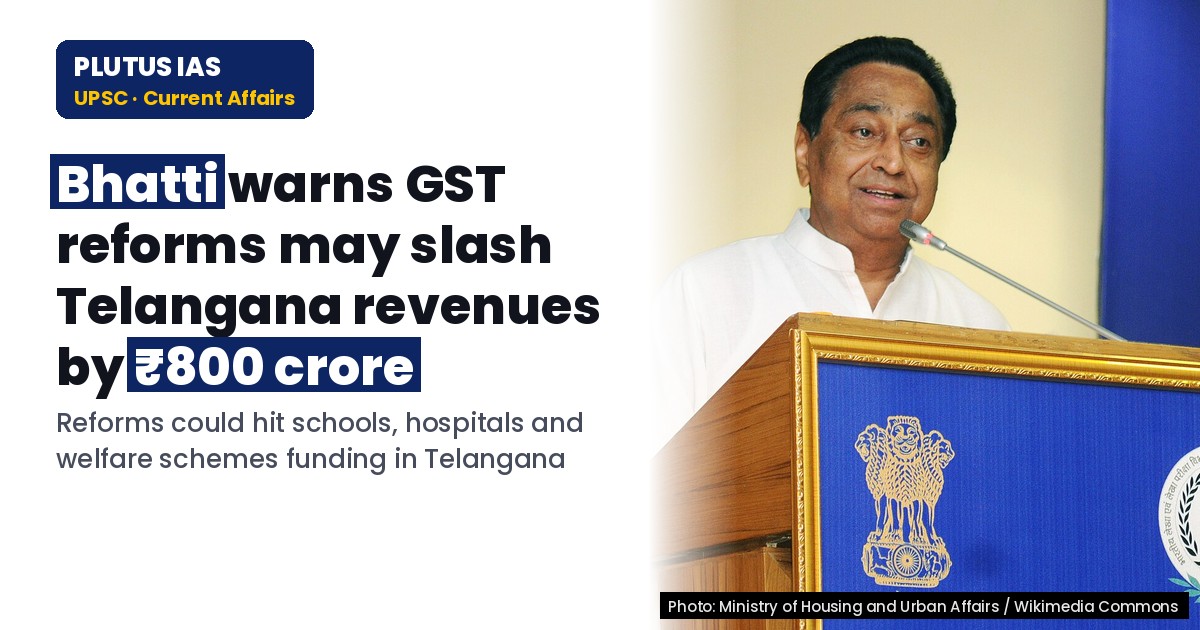
The 57th meeting of the GST Council has brought to the fore the critical issue of safeguarding State revenues amid proposed GST reforms, with Telangana’s Deputy Chief Minister and Finance Minister highlighting potential revenue losses of over ₹800 crore annually from motor vehicle-related changes alone. This underscores the broader challenge of aligning GST reforms with fiscal federalism, compliance enhancement, and sector-specific vulnerabilities such as the scrap industry and identity theft in tax evasion.
Background
- The Goods and Services Tax (GST), implemented in 2017, subsumed multiple indirect taxes to create a unified indirect tax regime, fundamentally altering Centre-State fiscal relations.
- GST revenues are shared between the Centre and States based on a constitutional framework, with States compensated for revenue losses during the initial five-year transition period (2017–2022) via a Compensation Cess.
- Post-2022, the GST Council has been deliberating on structural reforms, including rate rationalisation, compliance simplification, and sector-specific adjustments, to ensure long-term revenue sustainability.
- States like Telangana, where GST contributes approximately 35% to their own tax revenue, are particularly vulnerable to revenue fluctuations arising from GST reforms.
- The GST Council, a constitutional body under Article 279A, serves as the apex decision-making authority for GST-related matters, comprising the Union Finance Minister and State Finance Ministers.
- Recent discussions have also focused on the misuse of identity documents (Aadhaar, PAN) for fraudulent GST registrations and the challenges posed by unorganised sectors like the scrap industry to tax compliance.
What is the GST Framework and Why Does Revenue Protection Matter?
- The GST is a destination-based, multi-stage tax levied on the supply of goods and services, replacing a plethora of indirect taxes such as excise, service tax, and VAT.
- The GST Council, established under Article 279A of the Constitution, is tasked with making recommendations on GST rates, exemptions, thresholds, and other operational aspects to ensure a harmonised tax regime.
- Revenue protection for States is enshrined in the GST architecture through the principles of fiscal federalism, which mandate that GST reforms must not disproportionately impact State finances, particularly in revenue-dependent sectors.
- The GST compensation mechanism, though transitionary, highlighted the Centre’s commitment to protecting States’ revenues during the initial phase of GST implementation.
- Proposed reforms, such as adjustments to refund mechanisms for motor vehicles and capital goods, can have cascading effects on State revenues, necessitating rigorous impact assessments prior to implementation.
- Compliance enhancement, particularly in sectors like the scrap industry—characterised by cash transactions and unorganised operations—requires targeted interventions to curb fraudulent invoicing and input tax credit (ITC) misuse.
- The misuse of identity documents (Aadhaar, PAN) for creating fraudulent GST registrations poses a dual challenge: eroding tax base integrity and exposing vulnerable individuals (e.g., elderly, homemakers, daily-wage workers) to identity theft risks.
- Regional offices of the GST Network (GSTN) and the GST Council Secretariat can enhance administrative efficiency, leveraging local technological capabilities (e.g., Hyderabad’s strengths in AI and data analytics) to improve compliance and dispute resolution.
Key Features
| Feature | Significance |
|---|---|
| GST reforms concerning motor vehicles, capital goods, and input services | Proposed changes may reduce State revenues by over ₹800 crore annually for Telangana, impacting critical public expenditure. |
| Demand for revenue impact assessment prior to implementation | Ensures fiscal predictability and transparency, aligning with cooperative federalism under the GST framework. |
| Proposal for stringent action against GST fraud | Targets fake registrations, fraudulent invoices, and misuse of identity details to safeguard revenue integrity. |
| Constitution of a Group of Ministers (GoM) for the scrap sector | Addresses tax evasion in an unorganised, cash-based industry through targeted policy recommendations. |
| Regional offices of GSTN and GST Council Secretariat in Hyderabad | Leverages Telangana’s technological expertise for efficient GST administration and compliance. |
Why it Matters
Fiscal Federalism
- Highlights the constitutional principle of cooperative federalism enshrined in Article 279A, where States and the Centre jointly govern GST to balance revenue autonomy and national uniformity.
- Demonstrates the fiscal interdependence of States on GST, which contributes 35% of Telangana’s own tax revenue, necessitating safeguards against revenue erosion.
- Underscores the need for consensus-based decision-making in the GST Council to prevent unilateral policy changes that disproportionately affect States.
Revenue Security
- Exposes vulnerabilities in GST compliance, particularly in sectors like motor vehicles, capital goods, and the scrap industry, where fraudulent practices erode tax bases.
- Emphasises the importance of robust data analytics and identity verification to prevent misuse of Aadhaar, PAN, and other personal identifiers in fraudulent GST registrations.
- Stresses the urgency of addressing input tax credit fraud, which distorts the tax chain and reduces legitimate revenue collections.
Public Expenditure Impact
- Links GST revenue declines directly to reductions in expenditure on essential public services such as education, healthcare, welfare schemes, and infrastructure development.
- Illustrates how fiscal shocks to State revenues can cascade into broader socio-economic challenges, particularly in welfare-dependent regions.
Administrative Efficiency
- Proposes decentralised GST administration through regional offices of GSTN and the GST Council Secretariat, leveraging local technological capabilities.
- Advocates for a technology-driven approach to GST compliance, including AI and data analytics, to enhance detection of fraud and streamline processes.
Challenges
1. Revenue Erosion from GST Reforms
- Proposed changes in motor vehicle taxation alone could reduce Telangana’s annual GST revenue by over ₹800 crore, necessitating compensatory mechanisms.
- Lack of prior impact assessment for GST reforms risks destabilising State finances, particularly for revenue-dependent States.
- Divergent State interests in GST reforms may lead to prolonged negotiations, delaying critical policy implementations.
UPSC Link: GS-II: Cooperative Federalism and GST Council
2. Fraud and Compliance Gaps in GST
- Fake GST registrations and fraudulent invoices undermine the tax base, enabling tax evasion and revenue leakage.
- Misuse of identity details (e.g., Aadhaar, PAN) for fraudulent registrations disproportionately affects vulnerable groups like the elderly and daily-wage workers.
- The unorganised nature of the scrap sector facilitates cash-based transactions and fake invoicing, complicating tax administration.
UPSC Link: GS-III: Tax Evasion and GST Compliance
3. Administrative and Technological Challenges
- Centralised GST administration struggles to address regional disparities in compliance and fraud detection, necessitating decentralised solutions.
- Limited technological infrastructure in certain sectors (e.g., scrap industry) hampers effective GST implementation and monitoring.
- Delays in establishing regional GST offices may impede efficient tax administration and dispute resolution.
UPSC Link: GS-II: Centre-State Administrative Relations
4. Balancing Simplification and Enforcement
- Streamlining GST compliance for honest taxpayers must coexist with zero tolerance for deliberate evasion to maintain revenue integrity.
- Overly stringent enforcement may deter genuine businesses, while lax measures enable fraud, creating a policy paradox.
- The need for a calibrated approach to balance ease of doing business with robust anti-evasion measures.
UPSC Link: GS-III: Tax Administration and Ease of Doing Business
Challenges — UPSC Perspective
| Issue | Concern |
|---|---|
| Revenue impact of GST reforms | Potential annual loss of over ₹800 crore for Telangana, threatening public expenditure on critical services. |
| Fraudulent GST registrations | Misuse of identity details (Aadhaar, PAN) by fraudsters, particularly affecting vulnerable groups. |
| Input tax credit fraud | Fake invoicing and fraudulent transfer of credits distort the tax chain, reducing legitimate revenue. |
| Unorganised sector compliance (scrap industry) | Cash-based transactions and lack of formal records facilitate tax evasion and fraud. |
| Centralised GST administration | Inability to address regional disparities in compliance and fraud detection effectively. |
| Delayed establishment of regional GST offices | Hampers efficient tax administration and dispute resolution in States like Telangana. |
Government Initiatives — Must-Memorise for Prelims
- Goods and Services Tax (GST) Council
- GST Network (GSTN)
Way Forward
- Conduct a comprehensive impact assessment of proposed GST reforms on State revenues before implementation to ensure fiscal predictability.
- Establish a Group of Ministers (GoM) to examine tax evasion in the scrap sector and recommend sector-specific reforms and compliance mechanisms.
- Strengthen identity verification protocols for GST registrations, including enhanced scrutiny of Aadhaar and PAN linkages.
- Enhance data analytics and AI capabilities within GSTN to detect fraudulent transactions and streamline compliance monitoring.
- Decentralise GST administration by setting up regional offices of GSTN and the GST Council Secretariat in technologically advanced States like Telangana.
- Introduce targeted awareness campaigns for vulnerable groups (e.g., elderly, daily-wage workers) to prevent identity theft in GST registrations.
- Formulate a transparent mechanism for States to receive a share of Health Security and National Security Cesses to bolster public health infrastructure.
- Promote formalisation of the scrap sector through digital invoicing and mandatory GST registration to curb cash-based tax evasion.
UPSC Value Addition
Keywords for Mains Answer-Writing
Goods and Services Tax (GST), GST Council, fiscal federalism, cooperative federalism, State revenue autonomy, GST reforms, motor vehicle taxation under GST, input tax credit fraud, GST Network (GSTN), tax evasion in unorganised sectors, scrap sector taxation, Health Security Cess, National Security Cess, fiscal devolution, intergovernmental fiscal relations · GST reforms, fiscal federalism, State revenue protection, GST Council mechanisms, tax compliance reforms, GSTN regional offices, identity theft in GST registration, fraudulent input tax credit, scrap sector taxation challenges, cess utilisation for public health infrastructure
Constitutional & Policy Linkages
- Article 279A: GST Council – Cooperative federalism in tax administration.
Concept Flow
Proposal for GST reforms → Potential revenue decline for States → Impact on public expenditure (schools, hospitals, infrastructure) → Need for revenue safeguards → Demand for impact assessment and transparency → Focus on fraud detection and compliance → Proposal for decentralised GST administration → Leveraging technology (AI, data analytics) → Strengthening fiscal federalism.
Prelims Practice Questions
Q1. Consider the following statements regarding the Goods and Services Tax (GST) in India:
1. GST is a destination-based tax levied on the supply of goods and services across India.
2. The GST Council is a constitutional body with the Union Finance Minister as its Chairperson.
3. States have no role in the decision-making process of the GST Council.
4. The GST Network (GSTN) is responsible for the administration of the GST portal and IT backbone.
How many of the above statements are correct?
- Only one
- Only two
- Only three
- All
Answer: Only three — Statements 1 and 4 are correct. Statement 2 is correct as the GST Council is chaired by the Union Finance Minister. Statement 3 is incorrect because States are equal partners in the GST Council and participate in decision-making.
Q2. Assertion (A): The GST Council is empowered to recommend the rates of GST on goods and services.
Reason (R): The GST Council functions under the provisions of Article 279A of the Constitution of India.
- Both A and R are true, and R is the correct explanation of A
- Both A and R are true, but R is not the correct explanation of A
- A is true, but R is false
- A is false, but R is true
Answer: Both A and R are true, but R is not the correct explanation of A — Both the Assertion and Reason are true. The GST Council is indeed empowered to recommend GST rates under Article 279A of the Constitution, which provides the legal framework for its functioning.
Q3. Match the following committees/authorities with their respective functions under the GST regime:
Column I
A. GST Council
B. GST Network (GSTN)
C. Group of Ministers (GoM)
D. State Finance Commission
Column II
1. Administers the GST portal and IT infrastructure
2. Recommends GST rate changes and exemptions
3. Examines sector-specific tax evasion issues
4. Advises on the distribution of resources between State and local governments
- A-2, B-1, C-3, D-4
- A-1, B-2, C-3, D-4
- A-2, B-1, C-4, D-3
- A-4, B-1, C-2, D-3
Answer: A-2, B-1, C-3, D-4 — A-2 (GST Council recommends GST rates), B-1 (GSTN administers the GST portal), C-3 (GoM examines sector-specific issues like tax evasion in the scrap sector), D-4 (State Finance Commission advises on intergovernmental fiscal transfers).
Mains Practice Question
✍ The proposed reforms in the Goods and Services Tax (GST) regime must balance the imperatives of fiscal federalism with the need for uniform tax administration. In this context, critically examine the concerns raised by States regarding the protection of their revenue interests. Also, outline the institutional mechanisms available under the GST framework to address tax evasion and fraud in unorganised sectors such as the scrap industry. (15 Marks)
Approach: 1. **Introduction**: Define GST and its constitutional basis (Article 279A) and the principle of cooperative federalism.
2. **State Revenue Concerns**: Discuss the fiscal dependency of States on GST (e.g., Telangana’s 35% reliance) and the potential revenue impact of reforms (e.g., motor vehicle taxation changes). Highlight the principle of fiscal autonomy and the need for States to protect their revenue base.
3. **Institutional Mechanisms for Revenue Protection**:
– Role of the GST Council in decision-making and rate-setting.
– Importance of transparency in sharing financial implications of reforms with States.
– Need for regional offices of GSTN to enhance compliance and data analytics.
4. **Addressing Tax Evasion in Unorganised Sectors**:
– Challenges in the scrap sector: unorganised nature, cash-based transactions, and fraudulent input tax credit.
– Proposed solutions: constitution of a Group of Ministers (GoM) to examine sector-specific issues, stringent action against fake registrations, and misuse of identity documents.
5. **Conclusion**: Emphasise the need for a balanced approach that safeguards State revenues while ensuring tax compliance and administrative efficiency. Mention the role of technology (AI, data analytics) in detecting fraud.
Source: The Hindu
Generated by AanyaAi for educational purpose.
Related guides on our sites
- Current affairs for upsc 2026
- Best economics optional coaching for upsc
- Best economics optional teacher for upsc
- How to prepare for GS paper 1 for UPSC CSE mains exam


No Comments