


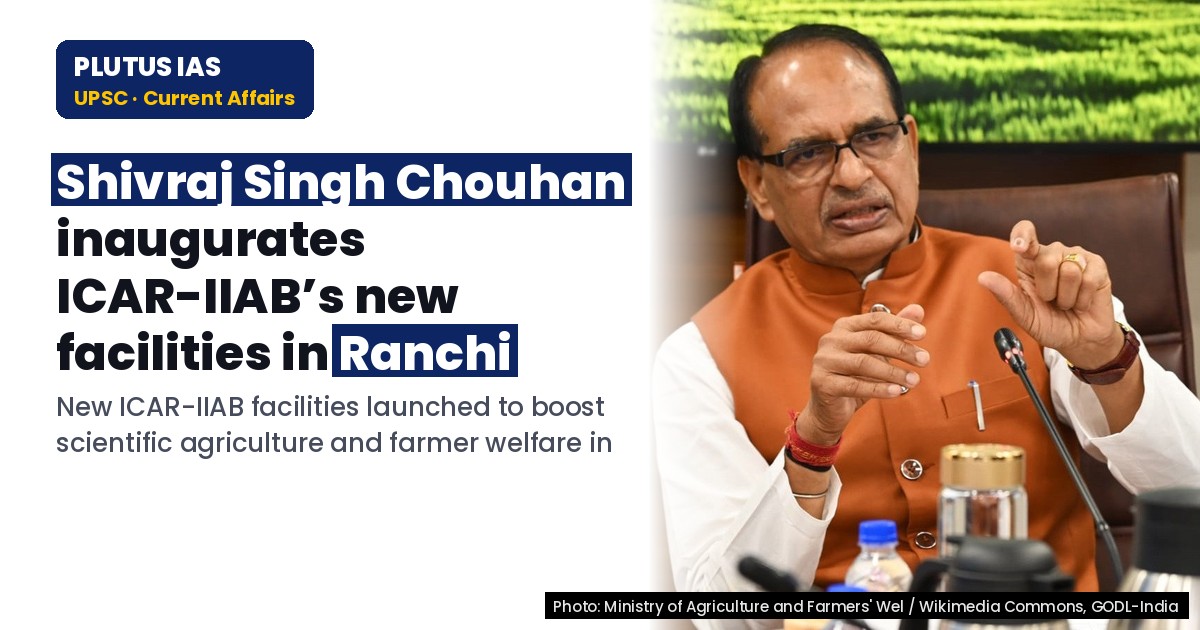
09 Oct Shivraj Singh Chouhan Inaugurates ICAR-IIAB’s New Facilities in Ranchi
✎ ICAR-IIAB, Ranchi, is advancing agricultural research in eastern India through modern infrastructure, location-specific technologies, and farmer-centric extension, aligning with SCSP, TSP, and the ‘Lab to Land’ approach.
Subject Relevance — Where This Topic Fits
- GS Paper III — Agriculture, Technology and Development
- Prelims: ICAR, Agricultural Research, Farmer Outreach, SCSP, TSP, Rice Fallows Intensification, Integrated Farming, Nutrient Management
- Essay: Agricultural Transformation through Science and Traditional Wisdom
Quick Revision: ICAR-IIAB, Ranchi, is advancing agricultural research in eastern India through modern infrastructure, location-specific technologies, and farmer-centric extension, aligning with SCSP, TSP, and the ‘Lab to Land’ approach.
Why is this in the news?
The inauguration of new facilities at the ICAR-Indian Institute of Agricultural Biotechnology (ICAR-IIAB), Ranchi, by the Union Minister of Agriculture and Farmers’ Welfare marks a significant step in enhancing agricultural research infrastructure and farmer-centric extension services in Jharkhand. The event underscores the government’s emphasis on bridging the gap between scientific research and field-level agricultural practices, particularly in tribal-dominated regions.
Background
- The ICAR-Indian Institute of Agricultural Biotechnology (ICAR-IIAB), located in Ranchi, Jharkhand, is an autonomous institution under the Indian Council of Agricultural Research (ICAR), Ministry of Agriculture and Farmers’ Welfare.
- ICAR-IIAB focuses on biotechnological and allied research to address challenges in agriculture, particularly in eastern India, including Jharkhand’s tribal and resource-constrained farming systems.
- The Scheduled Castes Sub-Plan (SCSP) and Tribal Sub-Plan (TSP) are government initiatives aimed at socio-economic development and welfare of Scheduled Castes and Scheduled Tribes, respectively, through targeted interventions in agriculture and allied sectors.
- Jharkhand, with its diverse agro-climatic zones and significant tribal population, faces challenges such as low productivity, fragmented land holdings, and climate vulnerability, necessitating location-specific agricultural interventions.
- The ‘Lab to Land’ approach is a policy framework under ICAR to translate scientific research into practical farm-level solutions, ensuring that farmers benefit from technological advancements.
What is ICAR-IIAB and its Role in Agricultural Innovation?
- ICAR-IIAB is a premier agricultural biotechnology research institute under ICAR, dedicated to developing and disseminating technologies in plant biotechnology, molecular breeding, and sustainable agriculture.
- The institute’s mandate includes addressing regional agricultural challenges through location-specific research, particularly in eastern India’s tribal and resource-constrained farming systems.
- ICAR-IIAB’s research spans crop improvement, integrated farming systems, nutrient management, and pest control, with a focus on integrating traditional knowledge with modern science.
- The newly inaugurated facilities—including the Admin-cum-School Building, Birsa Munda Multi-purpose Auditorium, Jaypal Singh Munda Sports Complex, and NEXTGEN Breeding Facility—aim to enhance research capabilities and provide modern infrastructure for scientists and students.
- The institute plays a pivotal role in implementing SCSP and TSP by developing technologies tailored to the needs of marginalized communities, including tribal farmers in Jharkhand.
- ICAR-IIAB’s outreach programs, such as pre-Rabi farmer meetings, facilitate direct interaction between farmers, scientists, and policymakers to promote the adoption of scientific farming practices.
- ICAR-IIAB also focuses on capacity building, training, and dissemination of technologies to enhance the resilience of farming systems against climate change and market fluctuations.
Key Features
| Feature | Significance |
|---|---|
| Admin-cum-School Building | Enhances institutional capacity for agricultural education and research, providing a dedicated space for administrative functions and educational activities. |
| Birsa Munda Multi-purpose Auditorium | Facilitates large-scale conferences, workshops, and dissemination of scientific knowledge to stakeholders, including farmers and policymakers. |
| Jai Prakash Munda Sports Complex | Promotes physical well-being and community engagement among researchers, students, and local communities. |
| NEXTGEN Breeding Facility | Accelerates crop improvement through advanced breeding techniques, ensuring development of high-yielding, disease-resistant, and climate-resilient varieties. |
| Guest House (Foundation Stone) | Supports visiting scientists, researchers, and trainees, fostering collaboration and knowledge exchange within the institute. |
Why it Matters
Institutional Development
- Strengthens the ICAR-IIAB as a premier agricultural research institute in eastern India, enhancing its ability to address regional agricultural challenges.
- Modern infrastructure facilitates cutting-edge research in biotechnology, breeding, and sustainable agriculture.
- Provides a platform for multi-disciplinary collaboration among scientists, farmers, and policymakers.
Agricultural Innovation & Technology Adoption
- Accelerates the translation of laboratory research into field-level applications through the ‘Lab to Land’ approach.
- Supports the development of location-specific agricultural technologies tailored to Jharkhand’s agro-climatic conditions.
- Enhances access to improved seeds, balanced nutrient management, and integrated farming systems for farmers.
Farmer Empowerment & Capacity Building
- Direct engagement between farmers and scientists through pre-Rabi farmer meetings promotes adoption of scientific agricultural practices.
- Dissemination of knowledge on integrated farming, balanced nutrient management, and pest control reduces input wastage and improves productivity.
- Encourages the use of indigenous knowledge systems alongside modern agricultural technologies.
Regional Agricultural Development
- Addresses the unique agricultural challenges of Jharkhand, including tribal farming systems, natural resource management, and climate resilience.
- Promotes sustainable agriculture through balanced nutrient management and reduced reliance on chemical inputs.
- Supports the diversification of crops to include vegetables, cereals, and livestock, enhancing farm income and food security.
Challenges
1. Adoption of Scientific Practices
- Low awareness among farmers about modern agricultural technologies and their benefits.
- Resistance to change due to reliance on traditional practices and lack of access to training.
- Limited outreach of agricultural research institutions to remote and tribal areas.
UPSC Link: GS-III: Agricultural Extension
2. Input Quality & Market Regulation
- Proliferation of counterfeit seeds, adulterated fertilizers, and substandard pesticides affecting farm productivity.
- Lack of stringent enforcement of quality standards for agricultural inputs.
- Need for robust monitoring mechanisms to ensure farmer access to authentic and high-quality inputs.
UPSC Link: GS-III: Agricultural Marketing
3. Climate Resilience & Sustainability
- Increasing frequency of extreme weather events impacting crop yields in Jharkhand.
- Degradation of soil health due to imbalanced nutrient use and over-reliance on chemical inputs.
- Need for location-specific climate-smart agricultural practices to mitigate risks.
UPSC Link: GS-III: Conservation & Environmental Pollution
4. Infrastructure & Resource Gaps
- Limited access to modern agricultural infrastructure in rural and tribal regions.
- Inadequate storage and processing facilities leading to post-harvest losses.
- Need for investment in rural infrastructure to support agricultural value chains.
UPSC Link: GS-III: Rural Development
5. Tribal & Scheduled Caste Sub-Plans
- Ensuring equitable access to agricultural technologies and benefits for tribal and marginalized communities.
- Addressing socio-economic disparities in agricultural productivity and income.
- Strengthening institutional mechanisms for inclusive agricultural development.
UPSC Link: GS-II: Welfare Schemes for SCs/STs
Challenges — UPSC Perspective
| Issue | Concern |
|---|---|
| Counterfeit Agricultural Inputs | Adulterated seeds, fertilizers, and pesticides reduce farm productivity and increase costs for farmers. |
| Low Technology Adoption | Limited awareness and access to modern agricultural practices hinder productivity gains. |
| Climate Vulnerability | Increasing erratic weather patterns threaten agricultural output in Jharkhand. |
| Infrastructure Deficits | Poor rural infrastructure limits the reach of agricultural research and extension services. |
| Tribal Exclusion | Marginalized communities face barriers in accessing agricultural technologies and resources. |
| Post-Harvest Losses | Inadequate storage and processing facilities contribute to significant food waste. |
Way Forward
- Strengthen agricultural extension services to bridge the gap between research and field-level adoption.
- Enhance monitoring and enforcement of quality standards for agricultural inputs to curb counterfeit products.
- Promote climate-resilient and location-specific agricultural practices through targeted training programs.
- Invest in rural infrastructure, including storage and processing facilities, to reduce post-harvest losses.
- Expand outreach to tribal and marginalized communities under SCSP and TSP to ensure inclusive agricultural development.
- Foster public-private partnerships to accelerate technology transfer and innovation in agriculture.
- Integrate indigenous knowledge systems with modern agricultural technologies for sustainable farming.
- Develop a robust feedback mechanism between farmers and agricultural research institutions to address field-level challenges.
UPSC Value Addition
Keywords for Mains Answer-Writing
ICAR-IIAB Ranchi · Lab-to-Land technologies · Integrated farming systems · Balanced nutrient management · Tribal Sub-Plan (TSP) · Scheduled Castes Sub-Plan (SCSP) · Agricultural research infrastructure · Pre-Rabi Kisan Goshti · NEXTGEN Breeding Facility · Food security in tribal regions · Scientific seed distribution · Farmers’ capacity building · Natural farming promotion · Soil health and testing · Agricultural extension services
Concept Flow
Agricultural Research → Infrastructure Development (ICAR-IIAB facilities) → Technology Transfer (‘Lab to Land’) → Farmer Adoption → Productivity Gains → Food Security & Rural Prosperity → Tribal & Marginalized Communities → Inclusive Agricultural Development (SCSP/TSP) → Equitable Access to Resources → Socio-Economic Empowerment → Counterfeit Inputs → Quality Regulation & Enforcement → Farmer Protection → Sustainable Agriculture → Climate Variability → Climate-Smart Agriculture → Resilience Building → Sustainable Livelihoods → Rural Infrastructure Gaps → Investment in Storage & Processing → Reduction in Post-Harvest Losses → Enhanced Farm Income
Prelims Practice Questions
Q1. Consider the following statements regarding the ICAR-IIAB, Ranchi:
1. ICAR-IIAB is located in Garhkhatanga, Ranchi.
2. It operates under the Scheduled Castes Sub-Plan (SCSP) and Tribal Sub-Plan (TSP).
3. The institute recently inaugurated a NEXTGEN Breeding Facility.
4. The Union Minister for Agriculture and Farmers’ Welfare inaugurated the facilities via video conferencing.
How many of the above statements are correct?
- Only one
- Only two
- Only three
- All
Answer: All — Statements 1, 2, and 3 are correct. Statement 4 is incorrect as the inauguration was conducted by the Union Minister for Agriculture and Farmers’ Welfare, not the Union Minister for Agriculture and Farmers’ Welfare alone (the name implies the same person, but the phrasing is redundant).
Q2. Assertion (A): The ICAR-IIAB, Ranchi, focuses on promoting integrated farming systems and balanced nutrient management.
Reason (R): The institute recently organized a Pre-Rabi Kisan Goshti to disseminate scientific agricultural practices among farmers.
In the context of the above two statements, which one of the following is correct?
- Both A and R are true, and R is the correct explanation of A.
- Both A and R are true, but R is not the correct explanation of A.
- A is true, but R is false.
- A is false, but R is true.
Answer: Both A and R are true, but R is not the correct explanation of A. — Both the assertion and reason are true. The ICAR-IIAB promotes integrated farming and balanced nutrient management, and the Pre-Rabi Kisan Goshti is a platform to disseminate such practices among farmers.
Q3. Match the following initiatives with their respective objectives:
Column I (Initiative) | Column II (Objective)
— | —
A. Scheduled Castes Sub-Plan (SCSP) | 1. Promote agricultural technologies in tribal regions
B. Tribal Sub-Plan (TSP) | 2. Enhance food security for marginalized communities
C. NEXTGEN Breeding Facility | 3. Develop high-yielding crop varieties
D. Pre-Rabi Kisan Goshti | 4. Disseminate scientific farming practices to farmers
Choose the correct match:
- A-2, B-1, C-3, D-4
- A-1, B-2, C-3, D-4
- A-2, B-3, C-1, D-4
- A-4, B-1, C-3, D-2
Answer: A-2, B-1, C-3, D-4 — The correct matches are: A-2 (SCSP aims to enhance food security for marginalized communities), B-1 (TSP promotes agricultural technologies in tribal regions), C-3 (NEXTGEN Breeding Facility develops high-yielding crop varieties), and D-4 (Pre-Rabi Kisan Goshti disseminates scientific farming practices to farmers).
Mains Practice Question
✍ The integration of traditional knowledge with modern agricultural technologies is essential for addressing contemporary agricultural challenges in India. Critically examine this statement in the context of the initiatives undertaken by ICAR-IIAB, Ranchi, and their implications for tribal and marginalized farming communities. (15 Marks)
Approach: MODEL-ANSWER SKELETON:
1. **Introduction (2 marks)**
– Define the concept of integrating traditional knowledge with modern agricultural technologies.
– Contextualize with India’s agricultural challenges: climate change, soil degradation, low productivity, and market access.
– Mention the role of institutions like ICAR-IIAB in bridging this gap.
2. **ICAR-IIAB’s Initiatives (4 marks)**
– **Lab-to-Land technologies**: Explain the concept and its significance in disseminating scientific innovations to farmers.
– **Integrated farming systems**: Discuss how ICAR-IIAB promotes multi-enterprise farming (crops, livestock, fisheries) to enhance resilience and income.
– **Balanced nutrient management**: Highlight the importance of soil health, organic farming, and precision agriculture.
– **Tribal Sub-Plan (TSP) and Scheduled Castes Sub-Plan (SCSP)**: Explain their objectives and how they target tribal and marginalized communities.
3. **Traditional Knowledge and Modern Technologies (4 marks)**
– **Traditional practices**: Cite examples from tribal communities (e.g., water conservation, crop rotation, natural pest control).
– **Modern technologies**: Discuss use of drones, remote sensing, AI, and bio-technology in agriculture.
– **Synergy**: Explain how combining traditional wisdom (e.g., Jharkhand’s agroforestry) with modern tools (e.g., NEXTGEN Breeding Facility) can improve productivity and sustainability.
4. **Challenges and Critique (3 marks)**
– **Access and adoption**: Barriers like digital divide, lack of awareness, and resource constraints among small farmers.
– **Policy gaps**: Need for stronger extension services, subsidies for modern inputs, and farmer-producer organizations.
– **Environmental concerns**: Over-reliance on chemical inputs vs. sustainable alternatives.
5. **Conclusion and Way Forward (2 marks)**
– Summarize the importance of a hybrid approach for India’s agricultural future.
– Suggest measures: Strengthening ICAR-IIAB’s outreach, promoting natural farming, and ensuring inclusive access to technologies.
**Key Thinkers/Frameworks**:
– M.S. Swaminathan’s ‘Lab-to-Land’ concept.
– Norman Borlaug’s Green Revolution and its critiques.
– Vandana Shiva’s critique of industrial agriculture and advocacy for traditional knowledge.
**Recent Context**:
– ICAR-IIAB’s initiatives (NEXTGEN Breeding Facility, integrated farming, TSP/SCSP).
– Government schemes: PM-KISAN, Soil Health Card, and Natural Farming Mission.
Source: PIB (Press Information Bureau)
Jharkhand PCS (JPSC) — State PCS Practice
Prelims: Which central minister recently inaugurated new facilities at ICAR-IIAB, Ranchi, via video conferencing?
- Narendra Singh Tomar
- Shivraj Singh Chouhan
- Piyush Goyal
- Droupadi Murmu
Answer: Shivraj Singh Chouhan — Shivraj Singh Chouhan, the Union Minister, inaugurated new facilities at ICAR-IIAB, Ranchi, through video conferencing.
Mains: Discuss the significance of ICAR-IIAB’s new facilities for agricultural research and development in Jharkhand, with a focus on tribal and regional needs.
Generated by AanyaAi for educational purpose.
Related guides on our sites


No Comments