


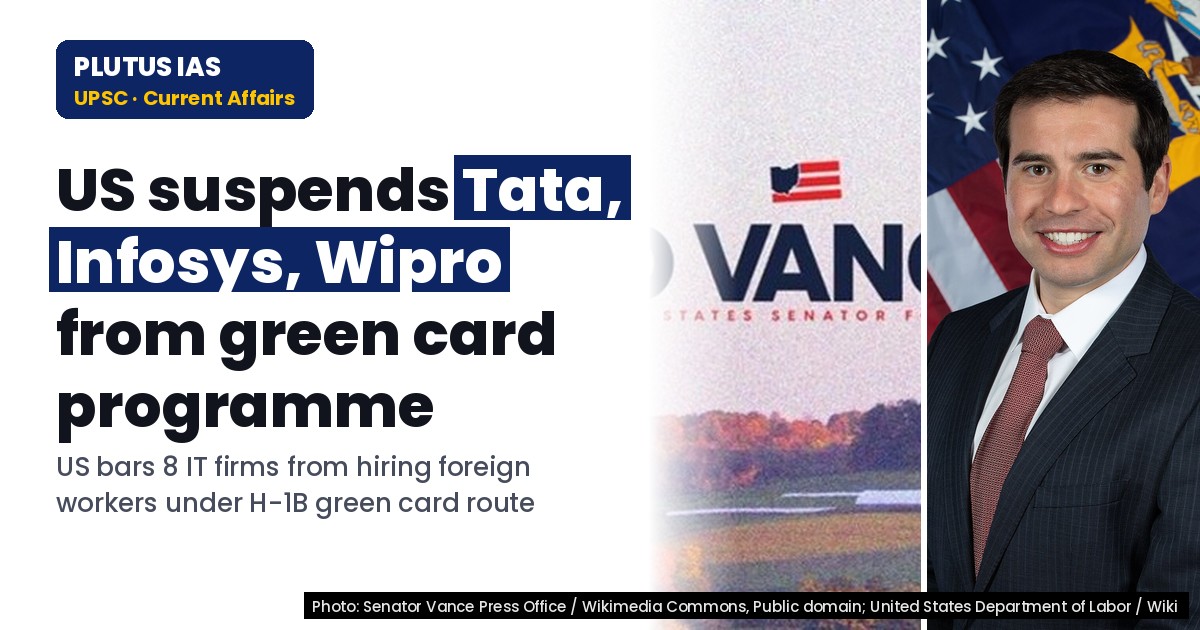
09 Oct US Suspends Indian IT Firms from Green Card Programme: Key Implications for UPSC Aspirants
✎ The PERM programme is a US Department of Labour certification process that mandates employers to prove no qualified US workers are available before sponsoring a foreign worker for a green card, and its suspension for major Indian…
Subject Relevance — Where This Topic Fits
- GS Paper II — International Relations (Bilateral Agreements, Labour Migration) | GS Paper III — Economy (Globalisation, Labour Market Reforms, Employment Generation)
- Prelims: PERM programme, H-1B visa, Green Card (EB-2/EB-3), Labour Certification, US Department of Labour, Anti-Fraud Task Force, Outsourcing, IT-BPM sector
- Essay: Globalisation and its discontents: The case of labour migration policies, Balancing national interest and economic interdependence in a multipolar world
Quick Revision: The PERM programme is a US Department of Labour certification process that mandates employers to prove no qualified US workers are available before sponsoring a foreign worker for a green card, and its suspension for major Indian IT firms underscores the intersection of labour market policies, immigration law, and global talent mobility.
Why is this in the news?
The United States has suspended eight prominent IT firms, including Tata, Infosys, Wipro, HCL Technologies, Cognizant, and Capgemini, from the Permanent Labour Certification (PERM) programme. This action, announced by the US Department of Labour under the aegis of the Anti-Fraud Task Force, halts their ability to file or process new or pending permanent labour certification applications for foreign workers. The move is framed as a measure to protect American workers from perceived displacement by foreign labour, particularly in the IT sector, and follows federal investigations into alleged abuses of the H-1B and PERM programmes.
Background
- The PERM programme is administered by the US Department of Labour under the Immigration and Nationality Act (INA) and is a prerequisite for obtaining an employment-based green card (EB-2 or EB-3 categories) for foreign workers.
- The H-1B visa programme allows US employers to temporarily employ foreign workers in specialty occupations, often in the IT sector, and is closely linked to the PERM process for permanent residency.
- Indian IT firms have historically relied on the H-1B and PERM programmes to deploy skilled professionals to the US, with Indian nationals constituting over 70% of approved H-1B petitions annually.
- The US government has cited concerns over job displacement of American workers, potential fraud in labour certification applications, and the use of the programmes as ‘visa mills’ that prioritise foreign labour over domestic talent.
- The suspension follows a broader US policy shift towards tightening immigration pathways, particularly in high-skilled sectors, with increased scrutiny on labour market impact and compliance with federal regulations.
- The action is part of the US Anti-Fraud Task Force’s mandate to investigate and prevent abuses in immigration programmes, including fraudulent labour certification applications and misrepresentation of job requirements.
What is the PERM Programme and its Relevance to the US-India Labour Migration Framework?
- The Permanent Labour Certification (PERM) programme is a US Department of Labour initiative that requires employers to obtain certification that there are no qualified, willing, and able US workers available for a specific job before hiring a foreign worker on a permanent basis.
- The process involves a rigorous labour market test, where employers must advertise the job in the US for at least 30 days and document the absence of qualified domestic candidates before filing a PERM application.
- PERM certification is a prerequisite for filing an immigrant petition (Form I-140) with US Citizenship and Immigration Services (USCIS) for an employment-based green card under the EB-2 (advanced degree) or EB-3 (skilled worker) categories.
- The programme is designed to ensure that the admission of foreign workers does not adversely affect the wages and working conditions of US workers, in line with the provisions of the Immigration and Nationality Act (INA).
- The H-1B visa programme, while temporary, is often a precursor to the PERM process, as many foreign workers transition from H-1B status to permanent residency through the employment-based green card route.
- The suspension of firms from the PERM programme does not affect their existing H-1B visa holders but halts their ability to sponsor new or pending green card applications, thereby disrupting long-term workforce planning.
- The US government’s action reflects a broader policy trend of prioritising domestic labour market protection, with implications for global talent mobility and the operations of multinational IT firms.
- The PERM programme operates within a complex regulatory framework that includes the Department of Labour, USCIS, and the Department of State, with each stage subject to stringent compliance requirements.
Key Features
| Feature | Significance |
|---|---|
| Permanent Labour Certification Programme (PERM) | A US Department of Labour programme that certifies employers can hire foreign workers without displacing qualified American workers, forming the basis for green card applications. |
| H-1B Visa Programme | A non-immigrant visa allowing US employers to temporarily hire foreign workers in specialty occupations, often a precursor to PERM applications for permanent residency. |
| US Anti-Fraud Task Force | A multi-agency initiative aimed at detecting and preventing fraud in immigration programmes, including employment-based visa schemes. |
| Suspension of Firms | Temporary prohibition of certain IT firms from filing new PERM applications or processing pending ones, based on allegations of systematic abuse of the programme. |
| Federal Investigations | Ongoing or completed probes into companies’ hiring practices, particularly regarding displacement of domestic workers and misuse of visa programmes. |
Why it Matters
Economic Implications
- The suspension targets major Indian IT firms, which contribute significantly to India’s IT services exports and employment generation.
- Disruption in PERM filings may delay green card processing for thousands of Indian professionals, impacting their career trajectories and remittances.
- The action reflects broader debates on the role of foreign workers in the US labour market and the balance between economic growth and domestic employment.
- Indian IT firms may face increased compliance costs and operational constraints in the US market, potentially affecting their global competitiveness.
Geopolitical Dimensions
- The US-India technology and labour mobility relationship is a critical pillar of the strategic partnership, and regulatory actions in one country directly influence the other.
- The suspension underscores the need for bilateral dialogue on immigration policies to ensure predictability for professionals and businesses operating across borders.
- Potential retaliatory measures or policy shifts in India could emerge, affecting trade, investment, and diplomatic relations.
Labour Market Dynamics
- The action highlights concerns over the displacement of domestic workers in favour of foreign labour, particularly in high-skilled sectors like IT.
- It raises questions about the adequacy of domestic workforce training and upskilling initiatives to meet industry demands.
- The focus on IT firms reflects broader scrutiny of the tech sector’s reliance on foreign talent and the sustainability of such models.
Legal and Compliance Framework
- The suspension is grounded in existing US labour laws and immigration regulations, specifically the PERM programme’s requirements for non-displacement of US workers.
- Companies flagged for multiple investigations face heightened scrutiny, demonstrating the enforcement role of federal agencies in immigration compliance.
- The action sets a precedent for stricter oversight of employment-based visa programmes, potentially leading to broader reforms.
Challenges
1. Regulatory Uncertainty for Indian IT Firms
- Firms face immediate operational disruptions due to the suspension of PERM applications, affecting their ability to sponsor employees for green cards.
- Increased regulatory scrutiny may lead to prolonged compliance processes, delaying project timelines and increasing costs.
- The action could deter new investments in the US market, impacting revenue streams and market expansion plans.
- Legal challenges or appeals by affected firms may prolong uncertainty, creating a prolonged period of instability.
UPSC Link: GS-III: Role of External State and Non-state Actors in Creating Challenges to Internal Security
2. Impact on Indian Professionals
- Delays in green card processing may force professionals to extend their H-1B status, prolonging uncertainty about long-term residency.
- Restrictions on PERM filings could reduce career advancement opportunities for Indian IT professionals in the US.
- Potential job market tightening in the US may push professionals to explore alternative destinations, affecting remittance flows to India.
- Legal and administrative burdens on professionals to secure alternative visas or pathways to residency.
UPSC Link: GS-II: Issues Relating to Development and Management of Social Sector/Services relating to Health, Education, Human Resources
3. Bilateral Diplomatic Tensions
- The action could strain US-India relations, particularly in technology and trade, where labour mobility is a key component.
- India may seek to negotiate safeguards or exemptions for its firms, leading to protracted diplomatic engagements.
- Broader geopolitical implications, including potential impacts on defence cooperation and technology transfer agreements.
UPSC Link: GS-II: India and its Neighbourhood- Relations
4. Domestic Workforce Development Gaps
- The action underscores the need for India to invest in STEM education and upskilling to reduce reliance on foreign labour markets.
- India’s IT sector may face pressure to reskill its workforce to meet evolving global demands, reducing dependence on H-1B visas.
- Potential brain drain if professionals seek opportunities in countries with more favourable immigration policies.
UPSC Link: GS-III: Science and Technology- Developments and their Applications and Effects in Everyday Life
5. Legal and Ethical Concerns
- The suspension raises questions about the fairness and transparency of the PERM programme’s enforcement mechanisms.
- Concerns about the potential for overreach by federal agencies in targeting specific firms or industries without clear evidence.
- Ethical debates on the use of foreign labour in high-skilled sectors and the responsibility of governments to protect domestic workers.
UPSC Link: GS-IV: Ethics and Human Interface- Essence, Determinants and Consequences of Ethics in Human Actions
Challenges — UPSC Perspective
| Issue | Concern |
|---|---|
| Operational Disruption | Immediate suspension of PERM applications disrupts firms’ ability to sponsor employees for green cards. |
| Compliance Burden | Increased regulatory scrutiny imposes additional legal and administrative costs on firms. |
| Career Uncertainty | Delays in green card processing affect the long-term career prospects of Indian professionals in the US. |
| Geopolitical Friction | The action could strain US-India relations, particularly in technology and trade. |
| Workforce Development | The suspension highlights gaps in India’s domestic workforce training and upskilling initiatives. |
| Legal Challenges | Firms may face prolonged legal battles to contest the suspension, creating uncertainty. |
Way Forward
- Indian IT firms should proactively engage with US regulatory bodies to clarify compliance requirements and seek exemptions or expedited reviews.
- The Indian government could initiate bilateral dialogues with the US to negotiate safeguards for its firms and professionals, ensuring predictability in labour mobility.
- Indian professionals affected by the suspension should explore alternative pathways to residency, including EB-1 (Extraordinary Ability) or EB-2 (Advanced Degree) categories.
- The Indian IT sector should invest in upskilling and reskilling initiatives to reduce reliance on H-1B visas and enhance domestic workforce competitiveness.
- Universities and educational institutions in India should strengthen STEM education and industry-academia partnerships to align with global demands.
- The US government could consider phased or conditional suspensions, allowing firms to demonstrate compliance with labour market protections.
- Legal experts and advocacy groups should monitor the suspension’s implementation to identify potential overreach or unfair targeting.
- Indian firms should diversify their global delivery models to reduce dependence on the US market, exploring opportunities in Europe, Japan, and other regions.
UPSC Value Addition
Keywords for Mains Answer-Writing
Permanent Labour Certification Programme · H-1B visa · Green Card suspension · US Anti-Fraud Task Force · Labour certification process · Outsourcing firms · Foreign worker quotas · Employment-based immigration · US Department of Labour · PERM applications · Indian IT sector · Skilled worker migration · Labour market protection · Immigration policy · Workforce displacement
Concept Flow
US PERM programme certification requirement for green cards → Firms file PERM applications to sponsor foreign workers → US Department of Labour identifies potential abuse of the programme → Federal investigations and anti-fraud task force actions → Suspension of firms from PERM programme based on findings → Impact on Indian IT firms and professionals’ green card processing → Potential legal challenges or appeals by affected firms → Broader implications for US-India labour mobility and bilateral relations
Prelims Practice Questions
Q1. Consider the following statements regarding the Permanent Labour Certification Programme (PERM) in the United States:
1. It is administered by the US Department of Labour.
2. It requires employers to certify that there are no qualified US workers available for a job before hiring a foreign worker.
3. The programme is exclusively used for H-1B visa applicants.
4. The suspension of firms under this programme directly affects their ability to hire foreign workers on H-1B visas.
How many of the above statements are correct?
- Only one
- Only two
- Only three
- All
Answer: All — Statements 1, 2, and 4 are correct. The PERM programme is indeed administered by the US Department of Labour, requires employers to certify the unavailability of US workers, and its suspension impacts firms’ ability to hire foreign workers. Statement 3 is incorrect as PERM is used for employment-based green card applications, not exclusively for H-1B visas.
Q2. Assertion (A): The suspension of Indian IT firms from the US Permanent Labour Certification Programme is a unilateral measure taken by the US government to protect its domestic labour market.
Reason (R): The US Department of Labour alleged that these firms had abused the programme by displacing American workers and filing fraudulent applications.
In the context of the above two statements, which one of the following is correct?
- Both A and R are true, and R is the correct explanation of A.
- Both A and R are true, but R is not the correct explanation of A.
- A is true, but R is false.
- A is false, but R is true.
Answer: Both A and R are true, but R is not the correct explanation of A. — Both the assertion and reason are true. The suspension is a unilateral measure by the US government to protect its domestic labour market, and the reason correctly explains that the Department of Labour alleged abuse of the programme by the suspended firms.
Q3. Match the following columns related to US immigration policies:
Column I
A. H-1B Visa
B. Green Card
C. Permanent Labour Certification Programme (PERM)
D. US Anti-Fraud Task Force
Column II
1. Employment-based permanent residency
2. Temporary work visa for skilled professionals
3. Programme to certify unavailability of US workers
4. Inter-agency body to prevent fraud in immigration programmes
Select the correct match:
- A-2, B-1, C-3, D-4
- A-1, B-2, C-3, D-4
- A-3, B-2, C-1, D-4
- A-2, B-1, C-4, D-3
Answer: A-2, B-1, C-3, D-4 — The correct matches are: A (H-1B Visa) – 2 (Temporary work visa for skilled professionals), B (Green Card) – 1 (Employment-based permanent residency), C (PERM) – 3 (Programme to certify unavailability of US workers), and D (US Anti-Fraud Task Force) – 4 (Inter-agency body to prevent fraud in immigration programmes).
Mains Practice Question
✍ The suspension of major Indian IT firms from the US Permanent Labour Certification Programme (PERM) underlines systemic concerns in global labour migration governance. Critically examine the implications of such measures for India’s IT sector and the broader framework of employment-based immigration policies. (15 Marks)
Approach: MODEL-ANSWER SKELETON:
1. **Context and Background (2 Marks)**
– Define the PERM programme and its role in the US employment-based immigration system.
– Briefly outline the reasons cited by the US Department of Labour for the suspension (e.g., displacement of American workers, fraudulent applications).
2. **Implications for India’s IT Sector (5 Marks)**
– **Economic Impact**: Discuss the dependence of Indian IT firms on the US market for revenue, talent mobility, and client base.
– **Operational Challenges**: Explain how the suspension may disrupt business continuity, project execution, and workforce planning.
– **Reputation and Compliance**: Analyse the long-term reputational risks and the need for firms to demonstrate compliance with labour laws.
– **Diversification Strategies**: Highlight potential shifts in market focus (e.g., Europe, Japan) or investment in automation and upskilling.
3. **Broader Framework of Employment-Based Immigration (5 Marks)**
– **Global Labour Mobility**: Discuss the role of programmes like PERM and H-1B in facilitating cross-border talent movement.
– **Balancing Interests**: Examine the tension between protecting domestic labour markets and meeting the demand for skilled professionals.
– **Policy Responses**: Suggest measures India could adopt (e.g., bilateral agreements, skill certification, or lobbying for reforms in immigration policies).
4. **Critical Analysis and Way Forward (3 Marks)**
– Evaluate whether the suspension is a justified protectionist measure or an overreach that could harm global talent mobility.
– Propose a balanced approach that addresses concerns about job displacement while ensuring fair access to skilled labour.
– Conclude with India’s strategic options to mitigate the impact and advocate for equitable immigration policies.
Source: orissapost.com
Generated by AanyaAi for educational purpose.
Related guides on our sites
- Current affairs for upsc 2026
- Best economics optional coaching for upsc
- Best economics optional teacher for upsc
- Best mentorship programme for upsc


No Comments