


09 Oct GST Evasion Punishment: Imprisonment or Fine Up to 5 Years Rationalised
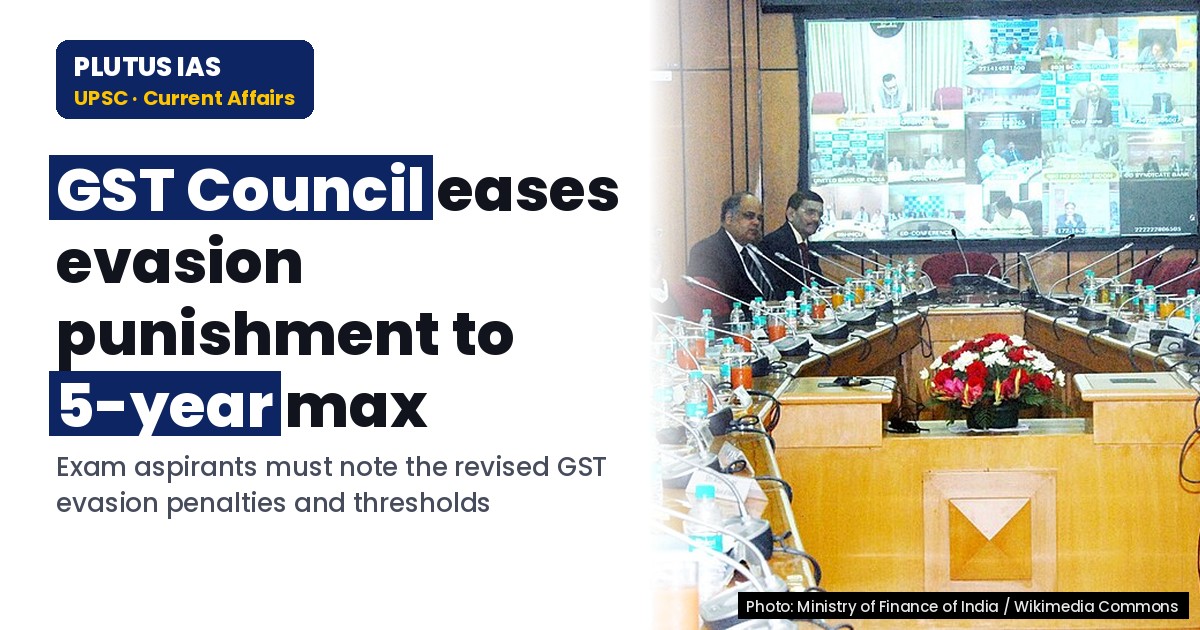
✎ The 57th GST Council meeting rationalised penal provisions by capping imprisonment terms, removing mandatory minimum imprisonment, and decriminalising offences to reduce judicial burden and improve ease of doing business.
Subject Relevance — Where This Topic Fits
- GS Paper II — Constitutional and Statutory Bodies (GST Council) | GS Paper III — Indian Economy (Taxation, Fiscal Policy, Indirect Taxes)
- Prelims: Goods and Services Tax (GST), GST Council, Central Board of Indirect Taxes and Customs (CBIC), Section 132 of CGST Act, 2017, tax evasion thresholds, prosecution thresholds, decriminalisation of offences, imprisonment provisions, fine provisions, GST offences, indirect tax administration
- Essay: Reforms in indirect tax administration: Balancing compliance and ease of doing business, The role of cooperative federalism in economic governance: A case study of GST reforms
Quick Revision: The 57th GST Council meeting rationalised penal provisions by capping imprisonment terms, removing mandatory minimum imprisonment, and decriminalising offences to reduce judicial burden and improve ease of doing business.
Why is this in the news?
The 57th GST Council meeting, held in October 2026, introduced significant reforms to the penal provisions under the Goods and Services Tax (GST) regime. These changes include rationalisation of imprisonment terms, removal of mandatory minimum imprisonment, and decriminalisation of certain offences, aimed at reducing the burden on courts while maintaining deterrence against tax evasion. The reforms are set to be implemented from April 1, 2027, and reflect a broader shift towards procedural ease and compliance facilitation in indirect taxation.
Background
- The Goods and Services Tax (GST) was introduced in India in 2017 as a unified indirect tax system, subsuming multiple central and state taxes to create a seamless national market.
- The GST regime initially prescribed stringent penal provisions, including mandatory imprisonment for certain offences, to deter tax evasion and ensure compliance.
- Over time, concerns emerged regarding the excessive use of penal provisions, leading to judicial delays and undue hardship for taxpayers, particularly small and medium enterprises (SMEs).
- The GST Council, as the apex decision-making body for GST, periodically reviews and rationalises provisions to balance deterrence with ease of doing business.
- The Central Board of Indirect Taxes and Customs (CBIC) is the nodal agency responsible for administering GST and framing procedural guidelines for its implementation.
- The reforms align with the broader policy objective of decriminalising minor offences to reduce litigation and improve the ease of doing business in India.
What are the key reforms in the GST penal provisions?
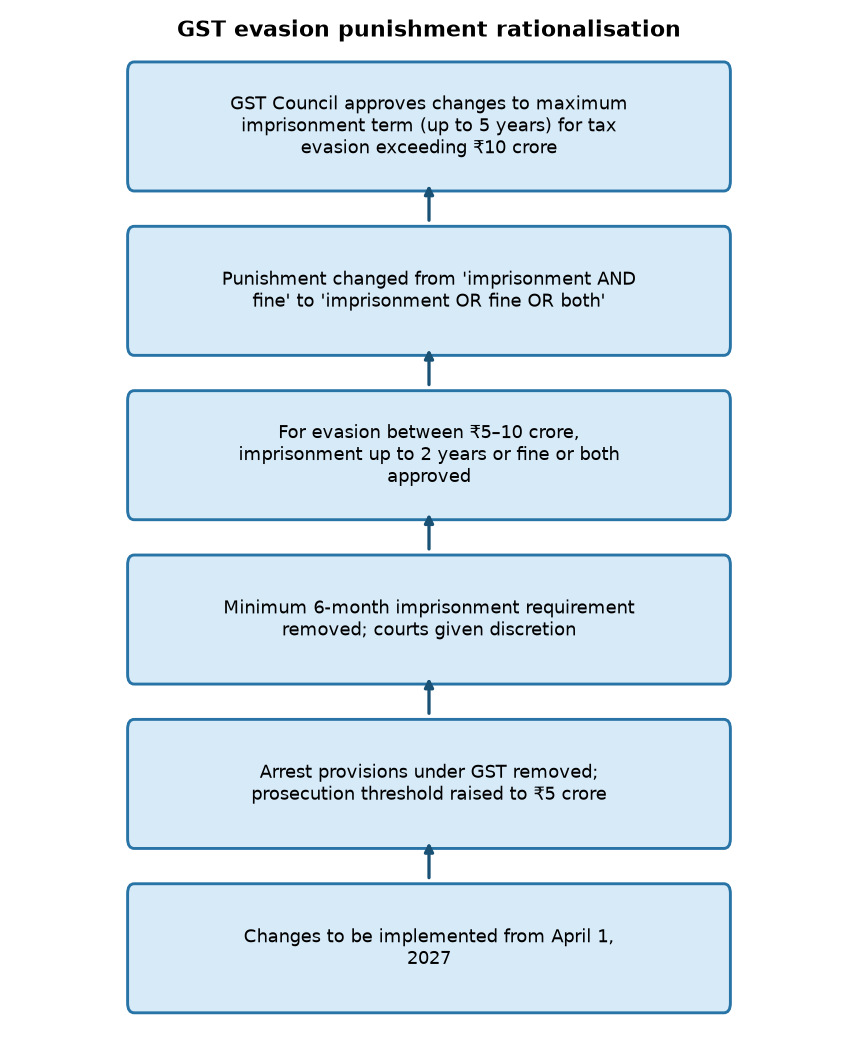
- Rationalisation of imprisonment terms: The maximum term of imprisonment for GST offences has been capped at five years for cases where tax evasion exceeds ₹10 crore, and at two years for cases where evasion is between ₹5 crore and ₹10 crore.
- Discretionary punishment: The punishment structure has been changed from ‘imprisonment and fine’ to ‘imprisonment or a fine or both’, granting courts the flexibility to impose either imprisonment, a fine, or both, based on the severity of the offence and the circumstances of the case.
- Removal of mandatory minimum imprisonment: The requirement of a minimum six-month imprisonment under Section 132(3) of the CGST Act, 2017, has been removed, allowing courts to exercise greater discretion in sentencing.
- Increased prosecution threshold: The threshold for launching prosecution in GST evasion cases has been raised from ₹1 crore to ₹5 crore, reducing the number of cases that proceed to criminal courts.
- Implementation timeline: The reforms are set to be implemented from April 1, 2027, following approval by the GST Council.
- Objective: The reforms aim to reduce judicial burden, minimise litigation, and foster a more business-friendly environment while maintaining deterrence against large-scale tax evasion.
Key Features
| Feature | Significance |
|---|---|
| Rationalisation of imprisonment term for GST evasion | Introduces graduated punishment scales based on tax evasion amount (₹5 crore–₹10 crore: up to 2 years; above ₹10 crore: up to 5 years), replacing uniform maximum term. |
| Shift from ‘imprisonment and fine’ to ‘imprisonment or fine or both’ | Conferring judicial discretion to impose either imprisonment, fine, or both, thereby reducing mandatory punitive rigidity and aligning with principles of proportionality. |
| Removal of minimum imprisonment requirement (Section 132(3)) | Eliminates the statutory minimum of 6 months imprisonment, allowing courts to tailor punishment to case-specific circumstances. |
| Decriminalisation of GST offences: removal of arrest provisions | Prohibits arrest by GST officers for offences under GST law, though prosecution may still be initiated before competent courts for evasion exceeding ₹5 crore. |
| Raised prosecution threshold from ₹1 crore to ₹5 crore | Increases the quantum of tax evasion required to trigger criminal prosecution, reducing the burden on judicial and administrative systems for lower-value cases. |
| Implementation timeline: effective from 1 April 2027 | Provides a clear transition period for stakeholders to align compliance and enforcement practices with the revised legal framework. |
Why it Matters
Fiscal Governance and Revenue Integrity
- Enhances the deterrent effect of GST enforcement by introducing graduated penalties calibrated to the scale of tax evasion, thereby promoting voluntary compliance.
- Balances punitive measures with judicial discretion, reducing the risk of disproportionate punishment while maintaining accountability for serious offences.
- Reduces administrative burden by raising the prosecution threshold, enabling tax authorities to focus resources on high-impact evasion cases.
- Aligns with global best practices in indirect tax administration, where criminalisation is typically reserved for substantial evasion to avoid over-criminalisation of minor procedural lapses.
Judicial and Legal Architecture
- Strengthens the rule of law by ensuring that punishments are proportionate to the gravity of the offence, thereby upholding constitutional principles of justice and fairness.
- Facilitates judicial efficiency by reducing mandatory minimum sentences, allowing courts to consider mitigating factors and case-specific nuances.
- Clarifies the discretionary powers of courts in sentencing, which can contribute to more consistent and predictable adjudication outcomes in GST-related cases.
Economic Efficiency and Compliance Culture
- Promotes a culture of compliance by reducing the fear of arbitrary or excessive penalties, thereby encouraging businesses to adopt transparent accounting and reporting practices.
- Supports ease of doing business by minimising the risk of coercive enforcement actions (e.g., arrests) for minor or unintentional GST irregularities.
- Encourages formalisation of the economy by reducing the perceived costs of compliance relative to the risks of evasion, particularly for small and medium enterprises.
Challenges
1. Discretionary Sentencing and Judicial Consistency
- Risk of inconsistent sentencing across jurisdictions due to the expanded judicial discretion, potentially leading to perceptions of inequity in punishment.
- Need for robust training and guidelines for judicial officers to ensure uniform application of the revised sentencing framework.
UPSC Link: GS2: Judiciary – Judicial Appointments, Training, and Accountability
2. Operational Challenges in Prosecution Threshold Adjustment
- Increased complexity in determining the quantum of evasion for prosecution, particularly in cases involving multiple transactions or jurisdictions.
- Potential for strategic under-reporting to stay below the ₹5 crore threshold, necessitating enhanced data analytics and audit capabilities.
UPSC Link: GS3: Economic Reforms – Indirect Taxation and GST
3. Enforcement Gaps and Tax Evasion Dynamics
- Risk of evasion shifting to non-GST compliant channels or informal sectors, particularly where the threshold for prosecution is high.
- Dependence on robust IT infrastructure and inter-state data sharing to detect and prosecute evasion effectively.
UPSC Link: GS3: Taxation – Direct and Indirect Taxes, Black Money
4. Stakeholder Adaptation and Compliance Costs
- Transition challenges for businesses in aligning accounting systems and compliance processes with the revised legal framework.
- Potential short-term increase in compliance costs for taxpayers, particularly those previously relying on procedural ambiguities.
UPSC Link: GS3: Ease of Doing Business – Compliance Burden
5. Inter-Governmental Coordination in GST Administration
- Need for seamless coordination between the Centre and States in implementing the revised provisions, particularly in cases involving inter-state evasion.
- Ensuring uniformity in interpretation and application of the law across diverse state jurisdictions.
UPSC Link: GS2: Centre-State Relations – Fiscal Federalism
Challenges — UPSC Perspective
| Issue | Concern |
|---|---|
| Judicial discretion in sentencing | Risk of inconsistent punishment across courts, undermining fairness and predictability. |
| Prosecution threshold adjustment (₹1 crore to ₹5 crore) | Potential for strategic evasion to avoid criminal liability, reducing deterrence for mid-value cases. |
| Removal of arrest provisions | May embolden repeat offenders or organised evasion rings to exploit procedural gaps. |
| Graduated punishment scales | Complexity in determining the exact quantum of evasion for sentencing purposes, particularly in multi-jurisdictional cases. |
| Implementation timeline (1 April 2027) | Insufficient time for stakeholders to adapt, leading to transitional compliance challenges. |
| Inter-state coordination in GST administration | Risk of jurisdictional disputes or evasion across state borders due to varying enforcement priorities. |
Way Forward
- Conduct nationwide awareness campaigns to educate taxpayers and tax professionals on the revised GST enforcement framework and its implications.
- Develop standardised sentencing guidelines for judicial officers to ensure consistency in the application of discretionary powers.
- Enhance the GST Network (GSTN) and inter-state data-sharing mechanisms to improve detection and prosecution of evasion, particularly below the ₹5 crore threshold.
- Strengthen audit and investigation capabilities of GST authorities to address procedural lapses and minor evasion cases through administrative penalties rather than criminal prosecution.
- Establish a dedicated GST dispute resolution mechanism to handle appeals and grievances arising from the revised enforcement framework.
- Promote voluntary disclosure schemes to encourage taxpayers to regularise past non-compliance before the implementation date.
- Undertake periodic reviews of the prosecution threshold and sentencing framework to assess their impact on compliance and revenue collection.
- Foster collaboration between the Centre and States to harmonise enforcement practices and address inter-state evasion challenges.
UPSC Value Addition
Keywords for Mains Answer-Writing
Goods and Services Tax (GST), GST Council, GST evasion, decriminalisation of tax offences, tax compliance, indirect tax regime, Central Board of Indirect Taxes and Customs (CBIC), prosecution threshold, imprisonment for tax evasion, discretion of courts in tax matters, fiscal federalism, cooperative federalism, tax administration reforms, fiscal policy, economic governance · Constitution of India, Article 279A, Seventh Schedule, Union List, State List, concurrent jurisdiction, cooperative federalism, fiscal federalism, tax administration, constitutional provisions · Indian Penal Code, 1860, Section 132, tax evasion offences, punishment for economic offences, judicial discretion in sentencing · Union Budget, fiscal consolidation, tax buoyancy, tax-to-GDP ratio, fiscal prudence · Supreme Court of India, judicial review, constitutional interpretation, tax jurisprudence, judicial discretion · World Trade Organization, Agreement on Customs Valuation, trade facilitation, customs administration · International Monetary Fund, fiscal policy, tax administration reforms, global best practices · Economic Survey of India, tax compliance, GST implementation, indirect tax reforms · NITI Aayog, fiscal federalism, cooperative governance, tax administration reforms · Planning Commission (erstwhile), fiscal federalism, tax devolution, cooperative federalism
Constitutional & Policy Linkages
- [“Article 265 – Taxes shall be levied only by authority of law, ensuring GST’s constitutional validity.”]
- [“Article 286 – Restrictions on imposition of tax on inter-State sales, relevant to GST’s integrated structure.”]
- [‘Article 246A – Special provision with respect to GST, conferring concurrent legislative power to Parliament and State Legislatures.’]
Concept Flow
GST Council identifies systemic issues in GST evasion enforcement -> Proposes rationalisation of punishment framework -> Introduces graduated imprisonment terms and judicial discretion -> Removes arrest provisions and raises prosecution threshold -> Legal amendments approved for implementation -> Stakeholders adapt to revised compliance and enforcement regime -> Impact on revenue integrity and compliance culture assessed over time.
Prelims Practice Questions
Q1. Consider the following statements regarding the Goods and Services Tax (GST) regime in India:
1. The GST Council is a constitutional body established under Article 279A of the Constitution of India.
2. The GST Council consists of the Union Finance Minister as Chairperson and the Finance Ministers of all States and Union Territories with Legislatures as Members.
3. The GST Council makes recommendations to the Union and the States on the rates of GST, exemptions, and thresholds for levy of GST.
4. The decisions of the GST Council are binding on the Union and the States.
How many of the above statements are correct?
- Only one
- Only two
- Only three
- All
Answer: All — Statements 1, 2, and 3 are correct. Statement 4 is incorrect as the decisions of the GST Council are recommendatory and not binding on the Union and States, though they are generally followed in the spirit of cooperative federalism.
Q2. Assertion (A): The 57th GST Council meeting rationalised the punishment for GST evasion by replacing the mandatory minimum imprisonment of 6 months with judicial discretion.
Reason (R): The rationalisation aims to reduce the burden on the judicial system by decriminalising minor GST offences and conferring greater discretion on courts in sentencing.
In the context of the above two statements, which one of the following is correct?
- Both A and R are true, and R is the correct explanation of A.
- Both A and R are true, but R is not the correct explanation of A.
- A is true, but R is false.
- A is false, but R is true.
Answer: Both A and R are true, but R is not the correct explanation of A. — Both the Assertion (A) and Reason (R) are true. The 57th GST Council meeting indeed removed the mandatory minimum imprisonment of 6 months under Section 132(3) of the CGST Act, 2017, and conferred discretion on courts to impose imprisonment, fine, or both. The Reason (R) correctly explains the rationale behind this rationalisation.
Q3. Match the following thresholds for prosecution in GST evasion cases with their corresponding amounts of tax evasion as approved by the 57th GST Council meeting:
Column I (Threshold for Prosecution)
A. Rs 5 crore
B. Rs 10 crore
Column II (Amount of Tax Evasion)
1. Exceeds Rs 5 crore but not Rs 10 crore
2. Exceeds Rs 10 crore
Select the correct match from the options below:
- A-1, B-2
- A-2, B-1
- A-1, B-1
- A-2, B-2
Answer: A-1, B-2 — The correct match is A-1 (Rs 5 crore threshold for prosecution) and B-2 (Rs 10 crore threshold for higher punishment). The 57th GST Council raised the threshold for launching prosecution from Rs 1 crore to Rs 5 crore, and the maximum term of imprisonment (up to 5 years) applies when tax evasion exceeds Rs 10 crore.
Mains Practice Question
✍ Critically examine the rationale and implications of the recent rationalisation of punishment for GST evasion by the 57th GST Council meeting. Analyse the shift from mandatory minimum imprisonment to judicial discretion, and the decriminalisation of minor GST offences. Also, discuss the constitutional and fiscal federalism dimensions of this reform. (15 Marks)
Approach: MODEL-ANSWER SKELETON:
1. **Rationale for Rationalisation**
– Over-criminalisation of tax offences and judicial backlog: Cite data on pending tax cases and the need for judicial discretion to reduce pendency.
– Decriminalisation of minor offences: Explain the policy shift towards treating minor GST evasion (below Rs 5 crore) as civil offences rather than criminal ones, aligning with global best practices (e.g., OECD guidelines on tax compliance).
– Judicial efficiency: Highlight how discretionary sentencing can reduce the burden on courts and expedite disposal of cases.
2. **Key Changes Introduced**
– Replacement of ‘imprisonment and fine’ with ‘imprisonment or fine or both’ under Section 132 of the CGST Act, 2017.
– Removal of mandatory minimum imprisonment of 6 months under Section 132(3).
– Raising the prosecution threshold from Rs 1 crore to Rs 5 crore.
– Abolition of arrest provisions for GST offences, though prosecution remains possible for evasion exceeding Rs 5 crore.
3. **Constitutional and Fiscal Federalism Dimensions**
– **Constitutional Framework**: GST Council as a body under Article 279A, functioning within the cooperative federalism framework. Discuss the role of the GST Council in balancing Centre-State interests and the principle of fiscal federalism.
– **Division of Powers**: GST is a concurrent subject under the Seventh Schedule, requiring Centre-State cooperation. Rationalisation of punishment reflects a shift towards administrative flexibility while maintaining fiscal discipline.
– **Judicial Discretion vs. Legislative Framework**: Discuss the balance between legislative intent (punitive measures) and judicial discretion (proportionality and fairness in sentencing).
4. **Implications for Tax Compliance and Governance**
– **Positive Implications**: Reduced judicial burden, focus on recovery and compliance rather than punitive measures, and alignment with global tax administration reforms.
– **Potential Challenges**: Risk of under-enforcement in cases of large-scale evasion, need for robust administrative mechanisms for recovery and audit, and ensuring that discretion does not lead to arbitrariness.
5. **Comparative Perspective**
– Cite examples from other jurisdictions (e.g., Australia’s Taxation Administration Act, UK’s HMRC penalties) where similar rationalisation has been implemented to enhance compliance while reducing criminalisation.
6. **Conclusion**
– Summarise the reform as a progressive step towards balancing punitive measures with administrative efficiency, while ensuring that fiscal federalism and constitutional principles are upheld. Highlight the need for continuous monitoring and evaluation of the reform’s impact on tax compliance and governance.
Source: orissapost.com
Generated by AanyaAi for educational purpose.
Related guides on our sites
- Best economics optional coaching for upsc
- Best economics optional teacher for upsc
- How to prepare for GS paper 1 for UPSC CSE mains exam
- Best UPSC coaching for IFOS exam

- NAMASTE Scheme: Enhancing Sanitation Workers’ Livelihoods & Safety - November 14, 2026
- एमएसएमई का विशेष अभियान 6.0: स्वच्छता और लंबित मामलों का निपटारा - November 14, 2026
- Sea Vigil-26: Coastal Defence Drills Off Visakhapatnam - November 14, 2026

No Comments