


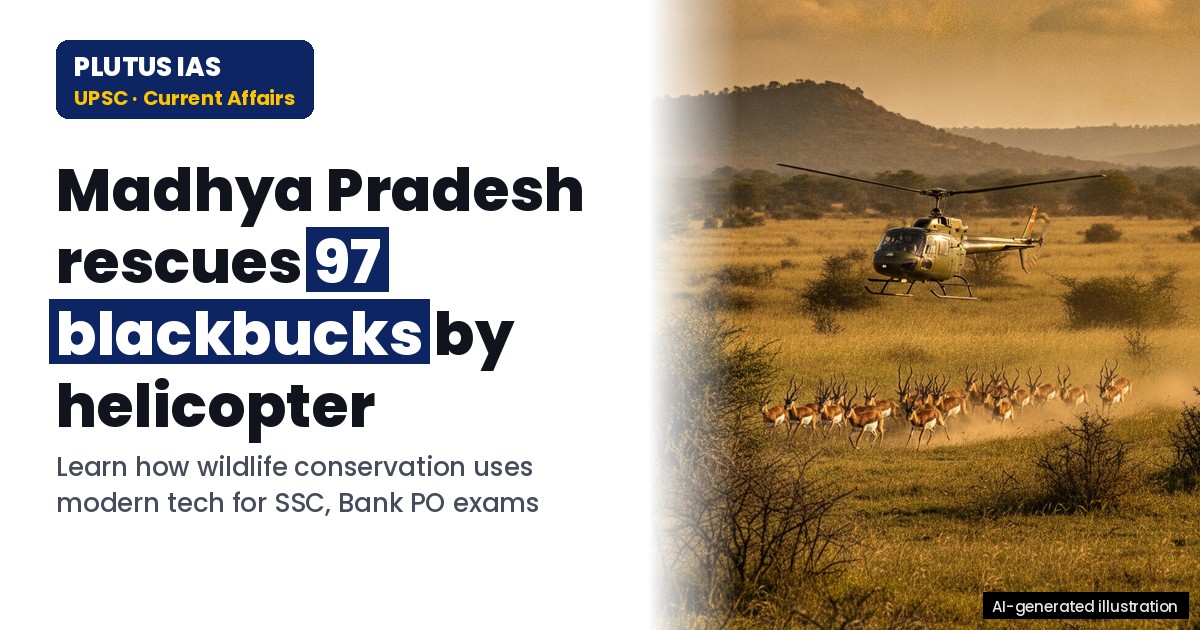
11 Oct Helicopter Rescue: 97 Blackbucks Safely Relocated in MP
✎ The helicopter-assisted boma technique represents a paradigm shift in human-wildlife conflict mitigation, combining international expertise with domestic institutional frameworks to ensure humane, efficient, and legally compliant…
Subject Relevance — Where This Topic Fits
- GS Paper III — Environment, Biodiversity, and Climate Change | GS Paper III — Disaster Management
- Prelims: Human-Wildlife Conflict (HWC), Boma technique, Project Tiger, Wildlife Protection Act, 1972, Madhya Pradesh Forest Department, IUCN Red List, Blackbuck (Antilope cervicapra), Nilgai (Boselaphus tragocamelus), Conservation Solutions International
- Essay: Human-Wildlife Coexistence: Balancing Conservation and Agricultural Livelihoods, Innovative Conservation Strategies: Bridging Traditional Wisdom and Modern Technology
Quick Revision: The helicopter-assisted boma technique represents a paradigm shift in human-wildlife conflict mitigation, combining international expertise with domestic institutional frameworks to ensure humane, efficient, and legally compliant wildlife rescue operations.
Why is this in the news?
The deployment of a helicopter-assisted boma technique for rescuing 97 blackbucks in Shajapur district, Madhya Pradesh, represents a novel intervention in mitigating human-wildlife conflict (HWC) in agricultural landscapes. Conducted under a 23-day operational window (9–31 October 2026), the initiative integrates international expertise with domestic institutional mechanisms to address crop damage by blackbucks and nilgai, thereby underscoring the evolving paradigms in wildlife conservation and rural livelihood protection.
Background
- Human-wildlife conflict (HWC) in India arises from the spatial overlap of wildlife habitats and agricultural lands, particularly in states like Madhya Pradesh, where large herbivores such as blackbucks (Antilope cervicapra) and nilgai (Boselaphus tragocamelus) frequently raid crops, leading to economic losses for farmers.
- The Wildlife Protection Act, 1972, mandates the protection of scheduled species, including blackbucks, which are listed under Schedule I, thereby necessitating humane and legally compliant interventions for conflict mitigation.
- Madhya Pradesh, with its extensive forest cover (15.31% of its geographical area), hosts significant populations of blackbucks and nilgai, particularly in districts like Shajapur, Ujjain, and Neemuch.
- Traditional methods of HWC mitigation, such as fencing, deterrents, and compensation schemes, have proven insufficient in high-conflict zones, prompting the adoption of innovative, science-driven techniques.
- The boma technique, originating in South Africa, involves the use of temporary enclosures (bomas) to safely capture and relocate wildlife, reducing stress and injury to animals while ensuring operational efficiency.
- The involvement of international conservation experts from Conservation Solutions International (CSI) reflects a growing trend of cross-border knowledge exchange in wildlife management, particularly in the context of climate change and habitat fragmentation.
What is the Helicopter-Assisted Boma Technique for Wildlife Rescue?
- The boma technique is a humane wildlife capture method that employs temporary enclosures (bomas) to safely herd and contain animals before relocation, minimising physical stress and injury.
- Helicopter-assisted herding involves the use of low-flying helicopters to guide wildlife into designated boma zones, a technique particularly effective for large, wide-ranging species like blackbucks and nilgai.
- The process requires meticulous planning, including pre-operation surveys, environmental impact assessments, and coordination with local authorities to ensure public safety and animal welfare.
- Operational protocols include real-time monitoring of weather conditions (e.g., temperature thresholds) to prevent heat stress in captured animals, as observed in the Shajapur operation where rescues were paused at temperatures above 29°C.
- The deployment of 200 personnel from the Forest Department, Revenue Department, and Police Administration, alongside international experts, highlights the multi-institutional nature of such operations.
- Post-capture protocols involve veterinary checks, translocation to designated wildlife corridors or sanctuaries, and long-term monitoring to assess the success of relocation and reduce recurrence of conflict.
Key Features
| Feature | Significance |
|---|---|
| Helicopter-assisted herding | Enables precise, low-stress capture of wild herbivores in fragmented habitats, reducing human-wildlife conflict risks |
| Boma technique | Traditional wildlife capture method adapted for modern conservation, ensuring minimal injury to animals during translocation |
| Multi-departmental coordination | Involves forest, revenue, and police departments alongside international experts, demonstrating integrated governance |
| Temperature-sensitive operation | Scheduling rescues during cooler hours (below 29°C) to prioritise animal welfare and operational safety |
| Community engagement | Local villagers informed and involved in safety protocols, fostering participatory conservation |
Why it Matters
Wildlife Conservation
- Demonstrates proactive measures to mitigate human-wildlife conflict in agricultural landscapes
- Highlights the use of advanced, non-lethal techniques for wildlife rescue and relocation
- Showcases international collaboration in conservation practices, enhancing technical expertise
Agricultural Sustainability
- Addresses crop damage caused by blackbuck and nilgai, supporting farmer livelihoods
- Balances conservation goals with agricultural productivity in conflict-prone regions
- Provides a model for sustainable coexistence between wildlife and farming communities
Governance and Administration
- Illustrates inter-departmental coordination under the Forest Department’s leadership
- Demonstrates real-time monitoring and inspection by senior officials to ensure accountability
- Emphasises the role of state-level policy in addressing local ecological challenges
Technological Integration
- Showcases the application of aviation technology in wildlife management for precision operations
- Highlights the adaptation of traditional conservation methods with modern tools
- Serves as a case study for scalable solutions in human-wildlife conflict mitigation
Challenges
1. Human-Wildlife Conflict Escalation
- Increasing encroachment of agricultural lands into wildlife habitats exacerbates crop raiding
- Climate change-induced habitat degradation intensifies competition for resources
- Lack of long-term, region-specific mitigation strategies
UPSC Link: GS3: Environment & Biodiversity
2. Operational Constraints in Rescue Operations
- Limited window for safe capture due to temperature and animal stress thresholds
- Logistical challenges in deploying heavy machinery in rural terrains
- Ensuring minimal disturbance to non-target species during operations
UPSC Link: GS3: Disaster Management
3. Stakeholder Divergence in Conservation Goals
- Conflicting priorities between farmers (livelihood security) and conservationists (habitat preservation)
- Inadequate community awareness about sustainable wildlife management practices
- Absence of structured compensation mechanisms for crop losses
UPSC Link: GS3: Agriculture & Environment
4. Technical and Resource Limitations
- Dependence on external expertise increases operational costs and dependency
- Limited availability of trained personnel for large-scale wildlife rescue operations
- Insufficient infrastructure for post-rescue monitoring and habitat restoration
UPSC Link: GS3: Science & Technology
5. Policy and Regulatory Gaps
- Ambiguity in legal frameworks governing wildlife translocation across state boundaries
- Lack of standardised protocols for human-wildlife conflict resolution
- Inadequate integration of conservation policies with agricultural and land-use planning
UPSC Link: GS2: Governance & Environment
Challenges — UPSC Perspective
| Issue | Concern |
|---|---|
| Habitat fragmentation | Reduces ecological connectivity, increasing human-wildlife interactions |
| Farmer distress | Crop losses lead to economic hardship and retaliatory measures against wildlife |
| Expertise dependency | Over-reliance on foreign specialists limits indigenous capacity-building |
| Monitoring gaps | Post-translocation tracking of animals is often inadequate |
| Policy fragmentation | State-specific approaches hinder cohesive national conservation strategies |
Way Forward
- Formulate a state-specific Human-Wildlife Conflict Mitigation Policy integrating agricultural and conservation objectives
- Establish a dedicated fund for compensating crop losses and promoting alternative livelihoods for farmers
- Develop a capacity-building programme for local forest staff in advanced wildlife rescue techniques
- Strengthen inter-state coordination for wildlife translocation, ensuring genetic diversity and habitat suitability
- Promote community-led conservation initiatives through awareness campaigns and participatory monitoring
- Invest in habitat restoration to reduce encroachment into wildlife corridors
- Integrate climate resilience into conservation strategies to address habitat degradation
UPSC Value Addition
Keywords for Mains Answer-Writing
Human-Wildlife Conflict Resolution · Boma Technique for Wildlife Capture · Helicopter-Assisted Wildlife Rescue · Wildlife Conservation in India · Endangered Species Protection · Wildlife Translocation · Madhya Pradesh Forest Department Initiatives · Conservation Solutions International · Blackbuck Conservation · Wildlife Habitat Management · Protected Area Network in India · Wildlife Protection Act, 1972 · Community-Based Conservation · Wildlife Corridor Management · Transboundary Wildlife Conservation
Concept Flow
Agricultural expansion → Habitat fragmentation → Increased human-wildlife conflict → Crop damage → Farmer distress → Retaliatory measures → Wildlife population decline → Escalation of conflict → Fragmented habitats → Reduced ecological connectivity → Blackbuck and nilgai movement into farmlands → Economic losses for farmers → State intervention required → State-led rescue operation → Use of helicopter and boma technique → Safe translocation of 97 blackbucks → Temporary relief for farmers → Need for long-term mitigation strategies → Multi-departmental coordination → International expertise deployment → Operational challenges (temperature, logistics) → Community engagement → Policy gaps identified → Post-rescue monitoring → Habitat restoration → Policy refinement → Sustainable coexistence model
Prelims Practice Questions
Q1. Consider the following statements regarding the Boma technique used in wildlife rescue operations:
1. The Boma technique involves the use of traditional enclosures to herd and capture wildlife.
2. It is primarily employed to relocate herbivores away from agricultural fields.
3. The technique requires the use of helicopters to guide animals into the enclosure.
4. It is a method exclusively used in India for wildlife conservation.
How many of the above statements are correct?
- Only one
- Only two
- Only three
- All
Answer: Only three — Statements 1 and 2 are correct as the Boma technique involves traditional enclosures and is used for relocating herbivores. Statement 3 is incorrect because helicopters are not mandatory for the Boma technique; they are used in specific cases like the Shajapur operation for efficiency. Statement 4 is incorrect as the technique is used globally, including in South Africa.
Q2. Assertion (A): The Wildlife Protection Act, 1972 empowers the state governments to declare any area as a protected area for wildlife conservation.
Reason (R): The Act provides for the establishment of wildlife sanctuaries and national parks to protect endangered species and their habitats.
Options:
A. Both A and R are true, and R is the correct explanation of A.
B. Both A and R are true, but R is not the correct explanation of A.
C. A is true, but R is false.
D. A is false, but R is true.
Answer: ? — Both the Assertion and Reason are true. The Wildlife Protection Act, 1972, under Section 18, empowers state governments to declare areas as wildlife sanctuaries, and Section 35 allows for the declaration of national parks. The Reason correctly explains the Assertion.
Q3. Match the following pairs related to wildlife conservation efforts in India:
Column I (Technique/Method) Column II (Description)
A. Boma Technique 1. Use of helicopters to herd animals into enclosures
B. Translocation 2. Relocating wildlife from conflict zones to safer habitats
C. Corridor Management 3. Creating pathways for wildlife movement between habitats
D. Community-Based Conservation 4. Involving local communities in conservation initiatives
Options:
A B C D
1. 1 2 3 4
2. 4 3 2 1
3. 2 1 4 3
4. 1 2 4 3
- 1
- 2
- 3
- 4
Answer: 2 — A-1: Boma Technique involves using helicopters to herd animals in specific cases like the Shajapur operation. B-2: Translocation refers to relocating wildlife from conflict zones. C-3: Corridor Management involves creating pathways for wildlife movement. D-4: Community-Based Conservation involves local communities in conservation efforts.
Mains Practice Question
✍ The deployment of advanced techniques such as helicopter-assisted herding and the Boma method for wildlife rescue and translocation represents a significant evolution in India’s approach to mitigating human-wildlife conflict. Critically examine the legal, ecological, and administrative dimensions of such interventions, with particular reference to the Wildlife Protection Act, 1972, and the role of state forest departments. Also, assess the implications of involving international experts in wildlife conservation initiatives in India. (15 Marks)
Approach: MODEL-ANSWER SKELETON:
1. **Legal Framework**:
– Wildlife Protection Act, 1972: Sections 18 (sanctuaries), 35 (national parks), and 38J (translocation). Highlight the statutory basis for translocation and habitat management.
– Constitutional provisions: Entry 17 (forest) and Entry 19 (wildlife) in the State List (7th Schedule). Discuss the division of powers between the Union and states.
– Recent amendments: Wildlife (Protection) Amendment Act, 2022, focusing on human-wildlife conflict mitigation.
2. **Ecological Considerations**:
– Human-wildlife conflict: Causes (habitat fragmentation, encroachment) and consequences (crop damage, retaliatory killings).
– Translocation as a solution: Pros (reducing conflict) and cons (stress on animals, ecological disruption, genetic isolation). Cite studies on translocation outcomes (e.g., blackbuck in Gujarat).
– Boma technique: Benefits (minimizing stress, efficiency) and limitations (cost, scalability, ethical concerns).
3. **Administrative and Institutional Dimensions**:
– Role of state forest departments: Coordination with revenue, police, and local administration. Discuss the Shajapur operation’s multi-departmental approach.
– International collaboration: Role of Conservation Solutions International (South Africa) in providing expertise. Evaluate the benefits (knowledge transfer, capacity building) and challenges (sustainability, dependency on external agencies).
– Community involvement: Importance of local participation in conflict mitigation and habitat management.
4. **Ethical and Contemporary Debates**:
– Animal welfare concerns: Stress induced by helicopter herding vs. long-term ecological benefits.
– Alternative approaches: Non-lethal deterrents (solar fences, chilli fences), habitat enrichment, and payment for ecosystem services (PES) schemes.
– Judicial precedents: Landmark judgments on wildlife conservation (e.g., TN Godavarman Thirumulpad v. Union of India, 1996; and recent orders on human-wildlife conflict).
5. **Conclusion**:
– Balancing conservation and development: Need for integrated approaches combining legal, ecological, and community-based strategies.
– Recommendations: Strengthening state capacities, promoting indigenous techniques, and fostering long-term international partnerships for sustainable conservation.
Source: amarujala.com
Generated by AanyaAi for educational purpose.
Related guides on our sites
- Current affairs for upsc 2026
- Best PSIR optional coaching for upsc
- Best PSIR optional teacher for upsc
- Best teacher of PSIR optional for upsc

- NAMASTE Scheme: Enhancing Sanitation Workers’ Livelihoods & Safety - November 14, 2026
- एमएसएमई का विशेष अभियान 6.0: स्वच्छता और लंबित मामलों का निपटारा - November 14, 2026
- Sea Vigil-26: Coastal Defence Drills Off Visakhapatnam - November 14, 2026

No Comments