


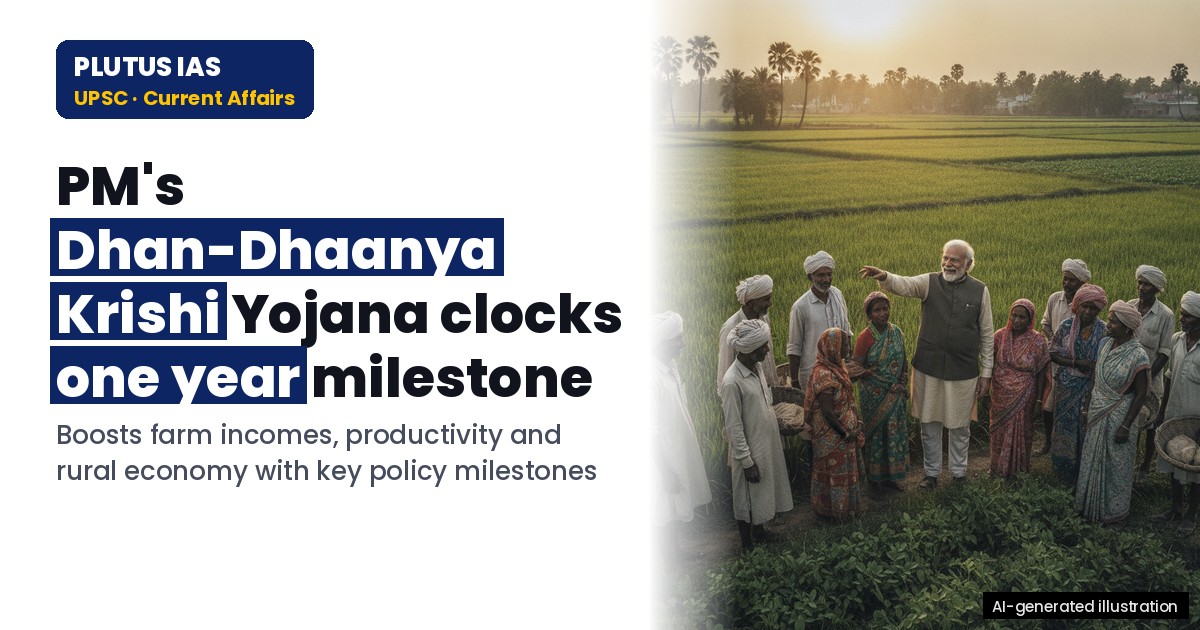
13 Oct PM’s Dhan-Dhaanya Krishi Yojana: One Year Milestones for UPSC & PCS
✎ The Prime Minister Dhan-Dhaanya Krishi Yojana represents a paradigm shift in India’s agricultural policy by integrating productivity enhancement, price assurance, and sustainability through technology-driven, cluster-based…
Subject Relevance — Where This Topic Fits
- GS Paper III — Agriculture, Food Processing and Related Issues | GS Paper III — Government Budgeting and Economic Policies | GS Paper II — Government Policies and Interventions for Development
- Prelims: Agricultural schemes, Direct Benefit Transfer (DBT), Minimum Support Price (MSP), Agri-credit and Kisan Credit Cards, Soil Health Cards, PM-KISAN, Agri-infrastructure fund, Natural farming, Organic farming, Agri-market reforms
- Essay: Agricultural transformation and inclusive growth in India: Challenges and opportunities, Balancing productivity, sustainability, and farmer welfare in India’s agricultural policy
Quick Revision: The Prime Minister Dhan-Dhaanya Krishi Yojana represents a paradigm shift in India’s agricultural policy by integrating productivity enhancement, price assurance, and sustainability through technology-driven, cluster-based interventions.
Why is this in the news?
Its implementation trajectory, achievements, and challenges offer critical insights into India’s evolving agricultural governance framework and the broader discourse on food security and farmer welfare.
Background
- The agricultural sector in India employs approximately 42% of the workforce and contributes around 18% to the national GDP, making it a cornerstone of the economy and a key determinant of rural livelihoods.
- India is the world’s largest producer of milk, pulses, and spices, and the second-largest producer of rice, wheat, fruits, vegetables, and sugarcane, yet faces persistent challenges such as low productivity, fragmented landholdings, and climate vulnerability.
- The Union Budget 2023-24 allocated ₹1.25 lakh crore to the agriculture sector, reflecting a renewed focus on agricultural transformation and resilience-building.
- The Pradhan Mantri Kisan Samman Nidhi (PM-KISAN) and other flagship schemes have laid the groundwork for direct income support and input subsidies, while newer initiatives like natural farming and agri-infrastructure development aim to address systemic bottlenecks.
- The scheme’s design aligns with the broader objectives of the National Mission on Sustainable Agriculture (NMSA) and the Doubling Farmers’ Income (DFI) initiative, which seek to double farm incomes by 2022 (extended to 2025).
- India’s agricultural policy has historically oscillated between food security imperatives and market-oriented reforms, with the current scheme attempting to harmonise these objectives through technology, infrastructure, and institutional support.
What is the Prime Minister Dhan-Dhaanya Krishi Yojana?
- The scheme integrates multiple components such as soil health management, precision agriculture, agri-input subsidies, post-harvest infrastructure, and market linkages to create a holistic support system for farmers.
- It adopts a cluster-based strategy, identifying and developing agricultural clusters with high potential for productivity gains and market integration, particularly in rainfed and tribal regions.
- The scheme leverages digital technologies, including AI-driven advisory services, drone-based soil and crop monitoring, and blockchain for supply chain transparency, to modernise agricultural extension services.
- It introduces a ‘Kisan Credit Card (KCC) Plus’ facility, enabling farmers to access enhanced credit limits for high-value crops and allied activities, thereby addressing liquidity constraints.
- A key feature is the ‘Remunerative Price Assurance’ mechanism, which aims to bridge the gap between Minimum Support Price (MSP) and market prices through direct procurement and price stabilisation funds.
- The scheme mandates the establishment of ‘Agri-Infrastructure Hubs’ at the block level, providing farmers with access to cold storage, processing units, and market platforms within a 50-km radius.
- It emphasises natural farming and agroecological practices, including zero-budget natural farming (ZBNF) and integrated nutrient management, to reduce input costs and enhance soil health.
- The implementation is overseen by a multi-tier governance structure, including district-level committees, state-level nodal agencies, and a central monitoring cell, ensuring real-time tracking of progress and bottlenecks.
Key Features
| Feature | Significance |
|---|---|
| Holistic Agricultural Development | Integrates crop diversification, soil health, water management, and post-harvest infrastructure to enhance farm productivity and resilience. |
| Digital Integration | Leverages AI, IoT, and data analytics for precision farming, real-time monitoring, and targeted interventions to optimize resource use. |
| Financial Inclusion | Facilitates access to formal credit, insurance, and market linkages for small and marginal farmers through digital platforms and institutional partnerships. |
| Sustainable Practices | Promotes climate-smart agriculture, organic farming, and renewable energy adoption to mitigate environmental degradation and adapt to climate change. |
| Skill Development | Provides training and capacity-building programs for farmers, agri-entrepreneurs, and rural youth to enhance technical and managerial competencies. |
| Market Access | Establishes e-NAM (Electronic National Agriculture Market) integration and supply chain reforms to reduce post-harvest losses and improve price realization. |
Why it Matters
Economic Impact
- Augments farm incomes through productivity gains and market efficiency, contributing to rural economic growth and GDP expansion.
Food Security
Climate Resilience
Structural Transformation
Social Equity
Challenges
1. Fragmented Land Holdings
- Small and scattered land parcels hinder mechanization, scale economies, and adoption of modern technologies.
- Limits access to institutional credit and insurance due to lack of collateral security.
UPSC Link: Land Reforms in India
2. Climate Vulnerability
- Extreme weather events (droughts, floods, heatwaves) disrupt agricultural cycles and reduce yield stability.
- Inadequate early warning systems and adaptive infrastructure exacerbate losses.
UPSC Link: Climate Change and Agriculture
3. Market Distortions
- Price volatility and lack of transparent market information reduce farmer bargaining power.
- Post-harvest losses (~15-20%) due to poor storage, transport, and processing infrastructure.
UPSC Link: Agricultural Marketing Reforms
4. Technological Adoption Gaps
- Low digital literacy and high initial costs deter small farmers from adopting precision agriculture tools.
- Limited access to extension services and R&D outputs in rural areas.
UPSC Link: Digital Agriculture in India
5. Credit and Insurance Penetration
- High transaction costs and asymmetric information deter formal credit access for marginal farmers.
- Inadequate crop insurance coverage (PMFBY) due to awareness gaps and claim settlement delays.
UPSC Link: Agricultural Credit Structure
6. Institutional Capacity
- Weak governance at local bodies (Panchayats, KVKs) limits effective implementation of farmer-centric schemes.
- Shortage of skilled personnel in agricultural universities and extension services.
UPSC Link: Institutional Reforms in Agriculture
Challenges — UPSC Perspective
| Issue | Concern |
|---|---|
| Land Fragmentation | Hinders mechanization, scale economies, and access to credit. |
| Climate Shocks | Increases yield variability and reduces farm incomes. |
| Market Inefficiencies | Leads to price volatility and post-harvest losses. |
| Digital Divide | Excludes small farmers from precision agriculture benefits. |
| Credit Constraints | Limits investment in high-yielding varieties and modern inputs. |
| Extension Service Gaps | Delays adoption of best practices and new technologies. |
Government Initiatives — Must-Memorise for Prelims
- Pradhan Mantri Kisan Samman Nidhi (PM-KISAN)
- Pradhan Mantri Fasal Bima Yojana (PMFBY)
- Soil Health Card Scheme
- Per Drop More Crop (PDMC) under PMKSY
- National Mission on Sustainable Agriculture (NMSA)
- Mission for Integrated Development of Horticulture (MIDH)
- Agri-Infrastructure Fund (AIF)
- Sub-Mission on Agricultural Mechanization (SMAM)
Way Forward
- Strengthen land consolidation programs to enable scale economies and mechanization.
- Expand climate-resilient crop varieties and weather-based advisory services.
- Enhance post-harvest infrastructure (cold chains, warehouses) to reduce losses and improve market access.
- Promote digital literacy and subsidized access to precision agriculture tools for small farmers.
- Streamline credit delivery through Kisan Credit Cards (KCC) and digital land records.
- Expand crop insurance coverage with simplified claim processes and transparent data systems.
- Revitalize agricultural extension services via PPP models and mobile-based advisory platforms.
- Integrate FPOs with input supply chains and export markets to enhance bargaining power.
UPSC Value Addition
Keywords for Mains Answer-Writing
Agricultural productivity · Crop diversification · Farmers’ welfare · Agri-input subsidies · Post-harvest infrastructure · Agri-marketing reforms · Climate-resilient agriculture · Agri-credit and insurance · Digital agriculture · Sustainable agriculture · Agri-extension services · Food security · Agri-value chains · Kisan credit cards · PM-KISAN · Agri-infrastructure fund · Natural farming · Agri-export promotion
Constitutional & Policy Linkages
- Article 39(b): Directive Principle of State Policy mandating equitable distribution of resources for agricultural development.
- Article 48: Directive Principle of State Policy promoting modern and scientific agriculture.
- Seventh Schedule, State List (Entry 14): Agriculture is a state subject, necessitating cooperative federalism in implementation.
Concept Flow
Policy Announcement (PM-DKY) → Institutional Framework (Ministry of Agriculture, State Agencies) → Financial Allocation (Budgetary Support) → Implementation (District-level Agencies, KVKs) → Monitoring (Digital Dashboards, Farmer Feedback) → Outcome Assessment (Yield Data, Income Surveys) → Policy Refinement (Feedback Loop)
Prelims Practice Questions
Q1. Consider the following statements regarding the Prime Minister Dhan-Dhaanya Krishi Yojana (PMDDKY):
1. It is a centrally sponsored scheme aimed at doubling farmers’ income by 2025.
2. The scheme includes components for post-harvest infrastructure, agri-input subsidies, and digital agriculture.
3. The scheme mandates the establishment of Krishi Vigyan Kendras in every district.
4. It provides for a 50% subsidy on agricultural machinery for small and marginal farmers.
How many of the above statements are correct?
- Only one
- Only two
- Only three
- All four
Answer: Only two — Statement 1 is incorrect as the scheme does not explicitly aim to double farmers’ income by 2025. Statement 2 is correct as it includes components for post-harvest infrastructure, agri-input subsidies, and digital agriculture. Statement 3 is incorrect as Krishi Vigyan Kendras are not mandated in every district under this scheme. Statement 4 is incorrect as the subsidy on agricultural machinery is not specified as 50% in the scheme.
Q2. Assertion (A): The Prime Minister Dhan-Dhaanya Krishi Yojana (PMDDKY) is designed to enhance the resilience of Indian agriculture to climate change.
Reason (R): The scheme includes provisions for climate-resilient agriculture practices and technologies.
In the context of the above two statements, which one of the following is correct?
- Both A and R are true, and R is the correct explanation of A.
- Both A and R are true, but R is not the correct explanation of A.
- A is true, but R is false.
- A is false, but R is true.
Answer: Both A and R are true, and R is the correct explanation of A. — Both the Assertion (A) and Reason (R) are true. The scheme is indeed designed to enhance agricultural resilience to climate change. The Reason (R) correctly explains the Assertion (A) as the scheme includes provisions for climate-resilient agriculture practices and technologies.
Q3. Match the following components of the Prime Minister Dhan-Dhaanya Krishi Yojana (PMDDKY) with their respective objectives:
Column I (Component) | Column II (Objective)
———————————————–|———————————————–
A. Post-harvest infrastructure | 1. Enhance market access for farmers
B. Agri-input subsidies | 2. Reduce input costs for farmers
C. Digital agriculture | 3. Improve storage and reduce wastage
D. Agri-credit and insurance | 4. Facilitate precision farming and data analytics
Choose the correct match:
- A-3, B-2, C-4, D-1
- A-1, B-2, C-3, D-4
- A-2, B-1, C-4, D-3
- A-4, B-3, C-2, D-1
Answer: A-3, B-2, C-4, D-1 — The correct match is: A (Post-harvest infrastructure) with Objective 3 (Improve storage and reduce wastage), B (Agri-input subsidies) with Objective 2 (Reduce input costs for farmers), C (Digital agriculture) with Objective 4 (Facilitate precision farming and data analytics), and D (Agri-credit and insurance) with Objective 1 (Enhance market access for farmers).
Mains Practice Question
✍ Critically examine the role of the Prime Minister Dhan-Dhaanya Krishi Yojana (PMDDKY) in addressing the structural challenges of Indian agriculture. How far has the scheme succeeded in integrating climate resilience, digital agriculture, and post-harvest infrastructure? Substantiate your answer with relevant examples and data. (15 Marks)
Approach: MODEL-ANSWER SKELETON:
1. **Introduction (2 marks)**: Briefly define PMDDKY, its objectives, and the structural challenges it seeks to address (e.g., low productivity, climate vulnerability, post-harvest losses, digital divide).
2. **Structural Challenges in Indian Agriculture (3 marks)**:
– Low and stagnating agricultural productivity.
– High vulnerability to climate change (e.g., erratic monsoons, droughts, floods).
– Post-harvest losses (~10-15% of total produce).
– Limited access to markets and digital tools.
– Fragmented land holdings and lack of economies of scale.
3. **Role of PMDDKY in Addressing Challenges (5 marks)**:
– **Climate Resilience**: Components like climate-resilient crop varieties, drought/flood-resistant seeds, and weather-based advisories (e.g., Kisan Credit Card-linked insurance schemes).
– **Digital Agriculture**: Use of AI/ML for precision farming, soil health cards, and blockchain for supply chain transparency (e.g., e-NAM integration).
– **Post-Harvest Infrastructure**: Cold storage, warehousing, and processing units to reduce wastage (e.g., Agri-Infrastructure Fund under PMDDKY).
– **Market Integration**: Linking farmers to markets via digital platforms (e.g., e-NAM, Agri-Stack).
4. **Assessment of Success (3 marks)**:
– **Quantitative Impact**: Data on reduced post-harvest losses, increased adoption of climate-resilient practices, or digital tools (e.g., number of farmers using soil health cards or e-NAM).
– **Qualitative Impact**: Case studies (e.g., success of natural farming in Andhra Pradesh, adoption of Kisan Credit Cards in Maharashtra).
– **Challenges**: Implementation gaps, lack of awareness, infrastructure bottlenecks, and digital divide.
5. **Conclusion (2 marks)**: Balanced assessment—highlight successes while acknowledging limitations. Suggest policy recommendations (e.g., strengthening extension services, scaling up digital infrastructure, or integrating PMDDKY with other schemes like PM-KISAN or PM-FME).
Source: PIB (Press Information Bureau)
Generated by AanyaAi for educational purpose.
Related guides on our sites
- Best PSIR optional coaching for upsc
- Best PSIR optional teacher for upsc
- Best teacher of PSIR optional for upsc
- Best PSIR optional coaching in delhi for UPSC

- PM’s Dhan-Dhaanya Krishi Yojana: One Year Milestones for UPSC & PCS - October 13, 2026
- तमिलनाडु सरकार ने पल्लिकारनई दलदल क्षेत्र के लिए अंतरिम प्रभाव क्षेत्र को 36 सर्वेक्षण संख्याओं तक सीमित किया - October 13, 2026
- Karnataka to Probe Illegal Voter Deletion: UPSC & State PCS Analysis - October 13, 2026

No Comments