


13 Oct Karnataka HC strikes down SC/ST reservation enhancement: Legal battle ahead
✎ The 50% reservation ceiling, established by the Supreme Court in *Indra Sawhney v. Union of India*, is a constitutional limit subject to exceptions in extraordinary circumstances, and any breach must be justified by empirical…
Subject Relevance — Where This Topic Fits
- GS Paper II — Constitutional and Non-Constitutional Bodies (Judiciary) | GS Paper II — Functions and Responsibilities of the Union and the States | GS Paper II — Government Policies and Interventions for Development in various sectors | GS Paper II — Issues Relating to Poverty and Hunger | GS Paper III — Indian Economy and Issues Relating to Planning, Mobilisation of Resources
- Prelims: Constitutional provisions on reservation (Articles 15, 16, 341, 342), Ninth Schedule of the Constitution, Indra Sawhney v. Union of India (1992), Total reservation ceiling (50% limit), Judicial review of reservation policies, State List (Entry 41 — Land Revenue), Concurrent List (Entry 23 — Social Security and Social Insurance)
- Essay: The interplay between social justice and constitutional limits: A case study of reservation policies in India, Judicial activism vs. legislative competence in matters of affirmative action
Quick Revision: The 50% reservation ceiling, established by the Supreme Court in *Indra Sawhney v. Union of India*, is a constitutional limit subject to exceptions in extraordinary circumstances, and any breach must be justified by empirical data and a clear nexus with social justice objectives.
Why is this in the news?
The Karnataka High Court has recently struck down the state government’s decision to enhance reservation quotas for Scheduled Castes (SCs) and Scheduled Tribes (STs), citing a breach of the constitutional 50% reservation ceiling. This verdict has significant implications for ongoing recruitment processes and educational admissions in Karnataka, prompting the state government to explore legal recourse, including a potential appeal to the Supreme Court. The episode also raises broader constitutional questions about the limits of state legislative competence in reservation policies and the role of judicial review in such matters.
Background
- The Constitution of India, under Articles 15(4) and 16(4), empowers the state to make special provisions for the advancement of socially and educationally backward classes, including SCs and STs.
- The Supreme Court, in the landmark case *Indra Sawhney v. Union of India* (1992), established the 50% ceiling on total reservations, subject to exceptions in extraordinary circumstances, to prevent the dilution of meritocracy and administrative efficiency.
- Karnataka, like several other states, had enhanced its SC/ST reservation quotas beyond the 50% limit, citing socio-economic backwardness and historical injustices.
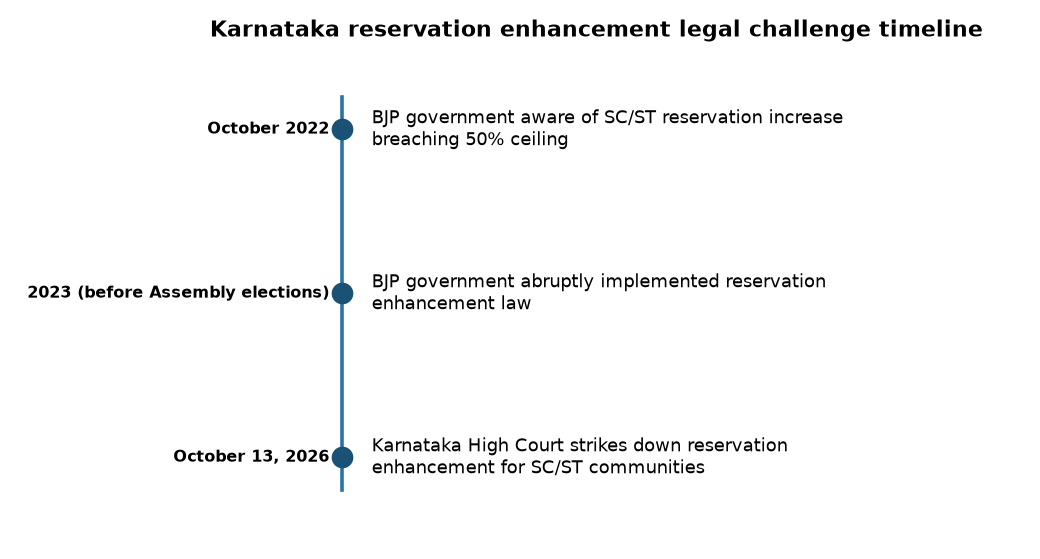
- The state’s decision to enhance reservation quotas was brought in by the previous BJP government in October 2022, raising questions about the procedural and constitutional validity of the move.
- The Ninth Schedule of the Constitution provides immunity to laws included in it from judicial review under Article 31-B, though the Supreme Court has held that even Ninth Schedule laws are subject to judicial scrutiny for violations of basic structure principles (IR Coelho v. State of Tamil Nadu, 2007).
- The Central Government’s reluctance to include Karnataka’s reservation enhancement law in the Ninth Schedule, citing the matter being sub-judice, has added a layer of complexity to the issue.
What is the Karnataka High Court Verdict on SC/ST Reservation Enhancement?
- The Karnataka High Court struck down the state government’s decision to enhance SC reservation from 15% to 17% and ST reservation from 3% to 7%, thereby breaching the 50% total reservation ceiling.
- The verdict underscores the principle that reservation policies must adhere to the constitutional limits, unless justified by exceptional circumstances, as laid down in *Indra Sawhney v. Union of India*.
- The High Court held that the state government failed to provide adequate constitutional or empirical justification for the abrupt enhancement of reservation quotas, particularly in the absence of a proper legislative or executive foundation.
- The judgment highlights the legal principle that reservation policies must be backed by data, socio-economic surveys, and a clear nexus with the objective of social justice, failing which they are liable to be struck down.
- The verdict has implications for ongoing recruitment processes and educational admissions in Karnataka, as the state government may need to revise its reservation policies to comply with the 50% ceiling.
- The state government has indicated that it may explore legal options, including an appeal to the Supreme Court, to challenge the High Court verdict and safeguard the interests of SC/ST communities.
- The episode also raises questions about the role of the judiciary in reviewing reservation policies, particularly in balancing social justice with constitutional limits and administrative efficiency.
- The case exemplifies the tension between legislative intent to address historical injustices and judicial scrutiny to prevent the misuse of reservation policies.
Key Features
| Feature | Significance |
|---|---|
| Reservation enhancement for SCs and STs | Increased reservation percentages aim to address historical social and educational disparities faced by Scheduled Castes (SCs) and Scheduled Tribes (STs) in Karnataka. |
| High Court verdict striking down enhancement | The Karnataka High Court’s decision invalidates the legislative amendment, citing constitutional constraints, particularly the 50% reservation ceiling established by the Supreme Court. |
| Legal recourse by state government | The Karnataka government’s exploration of legal options, including a potential Supreme Court appeal, underscores the state’s commitment to protecting reservation benefits for marginalised communities. |
| Ninth Schedule consideration | Inclusion in the Ninth Schedule could shield the reservation law from judicial review, providing legal immunity against constitutional challenges. |
| Internal reservation adjustments | If the overall reservation ceiling is reduced, proportional adjustments in internal reservation categories may be necessary to balance opportunities across sub-groups within SCs and STs. |
Why it Matters
Constitutional and Legal
- The High Court’s verdict reaffirms the constitutional principle that total reservation cannot exceed 50% without exceptional circumstances, as established in the Indra Sawhney case (1992).
- The case highlights the tension between affirmative action policies and the constitutional mandate to balance reservation with meritocracy and administrative efficiency.
- Legal recourse to the Supreme Court could set a precedent for how states navigate reservation enhancements within constitutional limits.
Social and Political
- Reservation policies are a critical tool for social justice, addressing entrenched inequalities faced by SCs and STs in education and employment.
- The political discourse surrounding reservation reflects broader debates on social equity, governance, and the role of affirmative action in a democratic society.
- The timing of the reservation enhancement, just before the 2023 Assembly elections, raises questions about the political motivations behind policy announcements.
Administrative
- The state’s need to adjust internal reservation categories underscores the administrative complexity of managing reservation policies within constitutional constraints.
- Recruitment and admissions processes may face disruptions if the reservation enhancement is not legally sustained, affecting thousands of aspirants.
Challenges
1. Constitutional Ceiling on Reservation
- The 50% reservation ceiling, as interpreted by the Supreme Court, limits the state’s ability to enhance reservation beyond this threshold without exceptional circumstances.
- The High Court’s reliance on this ceiling restricts Karnataka’s policy flexibility, despite the state’s unique social circumstances.
UPSC Link: Polity: Reservation Policies
2. Legal and Procedural Hurdles
- The state must demonstrate exceptional circumstances to justify exceeding the 50% reservation ceiling, a high bar set by judicial precedents.
- The deferral of the Ninth Schedule inclusion by the Central Government due to the matter being sub-judice delays legal immunity for the reservation law.
UPSC Link: Polity: Judicial Review
3. Administrative Disruptions
- Ongoing recruitment and admissions processes may face uncertainty if the reservation enhancement is not legally sustained, leading to potential delays or cancellations.
- Adjustments in internal reservation categories could create administrative challenges in reallocating opportunities fairly across sub-groups.
UPSC Link: Governance: Policy Implementation
4. Political and Public Perception
- The timing of the reservation enhancement raises questions about the political motivations behind the policy, potentially eroding public trust in governance.
- Balancing the need for affirmative action with perceptions of fairness and meritocracy remains a persistent challenge in policy formulation.
UPSC Link: Polity: Governance and Ethics
5. Inter-State Comparisons and Precedents
- The case invites comparisons with Tamil Nadu’s 69% reservation, which was upheld through a Constitutional amendment, highlighting the need for a national consensus on reservation limits.
- The Supreme Court’s decision in this case could influence future reservation policies in other states facing similar challenges.
UPSC Link: Polity: Federalism and State Powers
Challenges — UPSC Perspective
| Issue | Concern |
|---|---|
| Constitutional Ceiling | The 50% reservation limit restricts Karnataka’s ability to enhance reservation for SCs and STs without judicial approval for exceptional circumstances. |
| Legal Recourse | The state must navigate complex legal processes to challenge the High Court verdict, including the risk of further judicial setbacks. |
| Administrative Adjustments | Internal reservation categories may require proportional reductions, potentially reducing opportunities for specific sub-groups within SCs and STs. |
| Political Timing | The enhancement’s proximity to the 2023 Assembly elections raises questions about the policy’s intent and sustainability. |
| Central Government Role | The deferral of the Ninth Schedule inclusion delays legal immunity for the reservation law, leaving it vulnerable to judicial review. |
| Precedent Setting | The Supreme Court’s decision could influence reservation policies in other states, setting a national precedent. |
Way Forward
- The Karnataka Cabinet should deliberate on the legal and administrative implications of the High Court verdict, including the feasibility of a Supreme Court appeal.
- The state government may explore the possibility of demonstrating exceptional circumstances to justify exceeding the 50% reservation ceiling, drawing parallels with Tamil Nadu’s precedent.
- The Central Government could expedite the consideration of Karnataka’s reservation law for inclusion in the Ninth Schedule to provide legal immunity against future challenges.
- Administrative bodies must prepare contingency plans for ongoing recruitment and admissions processes to mitigate disruptions in case the reservation enhancement is not sustained.
- A comprehensive review of internal reservation categories may be undertaken to ensure proportional adjustments if the overall reservation ceiling is reduced.
- Public consultations and stakeholder engagements should be conducted to address concerns and build consensus on the reservation policy.
- The state government could advocate for a national dialogue on revisiting the 50% reservation ceiling, considering the unique social circumstances of states like Karnataka and Tamil Nadu.
- Monitoring and evaluation mechanisms should be established to assess the impact of reservation policies on social equity and administrative efficiency.
UPSC Value Addition
Keywords for Mains Answer-Writing
Constitutional provisions on reservation · 50% reservation ceiling · Ninth Schedule of the Constitution · Indra Sawhney case · Karnataka High Court judgment on reservation · Judicial review of reservation policies · Constitutional amendments for social justice · Federalism and reservation powers · Special provisions for Scheduled Castes and Scheduled Tribes · Judicial activism in reservation matters · Constitutional morality and reservation · Executive-legislative balance in reservation policy
Constitutional & Policy Linkages
- Article 15(4): Special provisions for the advancement of socially and educationally backward classes.
- Article 16(4): Reservation in public employment for backward classes.
- Article 340: Appointment of a Commission to investigate the conditions of backward classes.
- Ninth Schedule: Provides legal immunity to laws included against judicial review.
- Indra Sawhney Case (1992): Established the 50% reservation ceiling and criteria for backward class identification.
Concept Flow
State government enhances reservation for SCs and STs from 15% to 17% and 3% to 7% respectively, breaching the 50% ceiling. → Karnataka High Court strikes down the enhancement, citing constitutional constraints and the 50% reservation ceiling. → State government explores legal recourse, including a potential Supreme Court appeal, to challenge the High Court verdict. → Central Government defers Ninth Schedule inclusion due to the matter being sub-judice, delaying legal immunity for the reservation law. → State Cabinet deliberates on administrative adjustments, including proportional reductions in internal reservation categories. → Potential Supreme Court decision sets a precedent for reservation policies in other states, influencing future governance decisions.
Prelims Practice Questions
Q1. Consider the following statements regarding the constitutional provisions on reservation in India:
1. The 50% ceiling on reservation was established by the Supreme Court in the Indra Sawhney case (1992).
2. The Ninth Schedule of the Constitution protects laws from judicial review.
3. Reservation for Scheduled Castes and Scheduled Tribes is provided under Articles 15(4) and 16(4) of the Constitution.
4. The President of India can include a state law in the Ninth Schedule without the consent of the state legislature.
How many of the above statements are correct?
- Only one
- Only two
- Only three
- All four
Answer: Only three — Statements 1, 2, and 3 are correct. Statement 4 is incorrect because the President cannot unilaterally include a state law in the Ninth Schedule; it requires parliamentary approval.
Q2. Assertion (A): The Supreme Court of India has consistently upheld the 50% ceiling on reservation as an absolute limit.
Reason (R): The 50% ceiling is based on the principle of balancing social justice and administrative efficiency, as laid down in the Indra Sawhney case (1992).
Options:
A. Both A and R are true, and R is the correct explanation of A.
B. Both A and R are true, but R is NOT the correct explanation of A.
C. A is true, but R is false.
D. A is false, but R is true.
Answer: ? — Both A and R are true, and R correctly explains A. The Indra Sawhney case established the 50% ceiling as a constitutional principle to prevent excessive reservation that could undermine meritocracy.
Q3. Match the following provisions with their correct descriptions:
Column I (Provision) | Column II (Description)
1. Article 15(4) | A. Empowers the State to make special provisions for the advancement of socially and educationally backward classes.
2. Article 16(4) | B. Provides for reservation in public employment for backward classes.
3. Ninth Schedule | C. Protects laws from judicial review if included by the Parliament.
4. Article 340 | D. Relates to the appointment of a Commission to investigate the conditions of backward classes.
Options:
A. 1-A, 2-B, 3-C, 4-D
B. 1-B, 2-A, 3-D, 4-C
C. 1-C, 2-D, 3-A, 4-B
D. 1-D, 2-C, 3-B, 4-A
Answer: ? — Correct match: 1-A, 2-B, 3-C, 4-D. Article 15(4) and 16(4) relate to special provisions for backward classes, the Ninth Schedule protects laws from judicial review, and Article 340 empowers the President to appoint a Commission for backward classes.
Mains Practice Question
✍ The Karnataka High Court has struck down the state government’s enhancement of reservation for Scheduled Castes and Scheduled Tribes, citing violation of the 50% ceiling established by the Supreme Court. Critically examine the constitutional and judicial framework governing reservation policies in India, with particular reference to the Indra Sawhney case, the 50% ceiling, and the role of the Ninth Schedule. Also, analyse the implications of such judicial interventions for federalism and social justice policies in the country. (15 Marks)
Approach: MODEL-ANSWER SKELETON:
1. **Constitutional Basis of Reservation**:
– Articles 15(4) and 16(4) empower the State to make special provisions for the advancement of socially and educationally backward classes, including SCs and STs.
– The Supreme Court in **Indra Sawhney v. Union of India (1992)** established the 50% ceiling on reservation, balancing social justice with administrative efficiency and meritocracy.
2. **Judicial Review and the 50% Ceiling**:
– The 50% ceiling is not absolute but is treated as a rule of prudence to prevent excessive reservation that could undermine the principle of equality (Art. 14).
– Exceptions are permitted in extraordinary circumstances, as seen in the **Tamil Nadu Reservation Act (1994)**, which provides 69% reservation and was upheld by the Supreme Court in **IR Coelho v. State of Tamil Nadu (2007)**.
3. **Role of the Ninth Schedule**:
– The Ninth Schedule was introduced by the Constitution (First Amendment) Act, 1951, to protect laws from judicial review.
– However, the Supreme Court in **IR Coelho (2007)** held that laws placed in the Ninth Schedule after 24 April 1973 are open to judicial review if they violate the basic structure of the Constitution.
– The **Constitution (103rd Amendment) Act, 2019** added Article 15(6) and 16(6) to provide 10% reservation for economically weaker sections (EWS), which is outside the 50% ceiling.
4. **Federalism and Social Justice**:
– Reservation is a state subject under the Concurrent List (Entry 23, List III, Seventh Schedule), allowing states to legislate on the matter.
– Judicial interventions, such as the Karnataka High Court’s ruling, highlight the tension between state autonomy and judicial oversight.
– The Supreme Court’s role in striking down reservation enhancements underscores the need for states to ensure constitutional compliance while pursuing social justice.
5. **Implications for Karnataka and Beyond**:
– The Karnataka government’s decision to explore legal options reflects the broader challenge of balancing social justice goals with constitutional limits.
– Such judicial interventions ensure that reservation policies do not degenerate into populism or undermine the principle of equality.
6. **Conclusion**:
– Reservation policies must be rooted in empirical data, social audits, and constitutional principles.
– The judiciary acts as a check on executive and legislative overreach, ensuring that social justice measures do not violate the basic structure of the Constitution.
Source: The Hindu
Karnataka PCS (KPSC) — State PCS Practice
Prelims: Which constitutional provision empowers the State of Karnataka to explore legal options against a High Court verdict striking down reservation enhancement?
- Article 16(4) of the Constitution of India
- Article 32 of the Constitution of India
- Article 226 of the Constitution of India
- Article 341 of the Constitution of India
Answer: Article 16(4) of the Constitution of India — Article 16(4) empowers the State to make provisions for reservation in matters of public employment, forming the basis for Karnataka’s legal recourse.
Mains: Critically analyze the implications of the Karnataka High Court’s verdict striking down the state government’s decision to enhance reservation quotas. Suggest constitutional and legal pathways the state may explore to address the issue, with a focus on Karnataka’s socio-economic context.
Generated by AanyaAi for educational purpose.
Related guides on our sites
- Current affairs for upsc 2026
- Best PSIR optional coaching for upsc
- Best PSIR optional teacher for upsc
- Best teacher of PSIR optional for upsc

- Why INS Mangrol is a Game-Changer for India’s Coastal Security - October 13, 2026
- बीआईएमएसटीईसी गृह मंत्रियों की पहली बैठक: भारत की अध्यक्षता में नई दिल्ली में आयोजित - October 13, 2026
- NCST Chair Reviews ST Safeguards in Heavy Industries Ministry - October 13, 2026

No Comments