


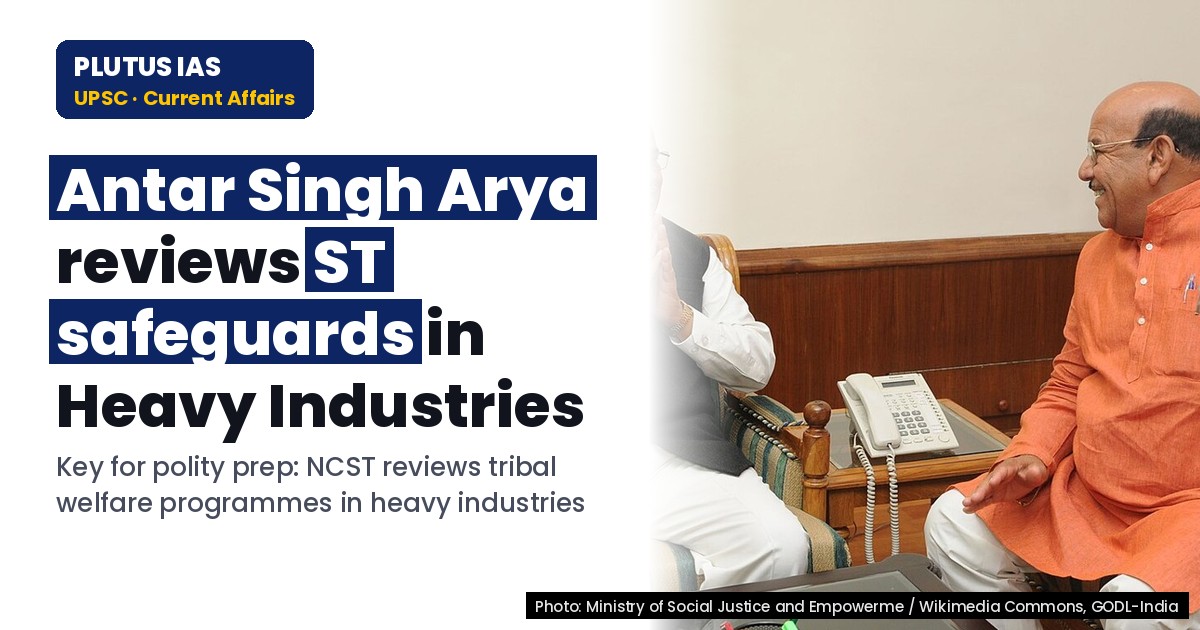
13 Oct NCST Chair Reviews ST Safeguards in Heavy Industries Ministry
✎ The National Commission for Scheduled Tribes (NCST) is a constitutional body mandated to monitor the implementation of safeguards for Scheduled Tribes under Articles 338 and 338A of the Constitution, ensuring their rights are…
Subject Relevance — Where This Topic Fits
- GS Paper II — Constitutional and Non-Constitutional Bodies | GS Paper II — Government Policies and Interventions for Development in various sectors | GS Paper II — Welfare Schemes for Vulnerable Sections of the population by the Centre and States | GS Paper III — Inclusive Growth and Issues Arising from it
- Prelims: Scheduled Tribes (STs) Constitutional Safeguards, National Commission for Scheduled Tribes (NCST), Article 338 and 338A of the Constitution, Ministry of Heavy Industries, Tribal Sub-Plan (TSP), Forest Rights Act, 2006, Scheduled Castes and the Scheduled Tribes (Prevention of Atrocities) Act, 1989
- Essay: The Role of Constitutional and Statutory Bodies in Ensuring Social Justice: A Case Study of Scheduled Tribes, Inclusive Development: Balancing Industrial Growth with Tribal Rights and Livelihoods
Quick Revision: The National Commission for Scheduled Tribes (NCST) is a constitutional body mandated to monitor the implementation of safeguards for Scheduled Tribes under Articles 338 and 338A of the Constitution, ensuring their rights are protected in all sectors, including industrial development.
Why is this in the news?
The National Commission for Scheduled Tribes (NCST), led by its Chairperson Shri Antar Singh Arya, recently reviewed the implementation of constitutional safeguards and various developmental programmes for Scheduled Tribes (STs) by the Ministry of Heavy Industries. This oversight underscores the constitutional mandate of the NCST to monitor the protection of tribal rights and ensure equitable development, particularly in sectors where industrial expansion intersects with tribal habitats and livelihoods. The review highlights the need for robust institutional mechanisms to align industrial policy with constitutional provisions for tribal welfare.
Background
- The Constitution of India, through Articles 338 and 338A, mandates the establishment of the National Commission for Scheduled Castes (NCSC) and the National Commission for Scheduled Tribes (NCST) to safeguard the rights and interests of Scheduled Tribes.
- The NCST functions as a constitutional body under Article 338A, with the constitutional duty to investigate and monitor all matters relating to the constitutional safeguards for STs and to evaluate the effectiveness of their implementation.
- The Ministry of Heavy Industries is primarily responsible for the development of industries such as automobiles, heavy machinery, and capital goods, which often operate in or near tribal-dominated regions.
- Constitutional safeguards for STs include provisions under the Fifth and Sixth Schedules, the Panchayats (Extension to the Scheduled Areas) Act, 1996 (PESA), and the Scheduled Tribes and Other Traditional Forest Dwellers (Recognition of Forest Rights) Act, 2006 (FRA).
- The intersection of industrial development with tribal rights has been a recurring theme in policy discourse, necessitating periodic reviews by constitutional bodies to ensure compliance with safeguards.
- The NCST’s review of the Ministry of Heavy Industries reflects a broader trend of constitutional oversight bodies assessing the alignment of sectoral policies with tribal welfare objectives.
What are the Constitutional Safeguards for Scheduled Tribes (STs) in India?
- The Constitution of India recognises Scheduled Tribes as a distinct socio-economic group requiring special protection due to historical marginalisation and vulnerability.
- Articles 338 and 338A provide for the establishment of the National Commission for Scheduled Castes (NCSC) and the National Commission for Scheduled Tribes (NCST) to monitor the implementation of constitutional safeguards and investigate complaints of violations.
- The Fifth Schedule of the Constitution applies to areas inhabited by Scheduled Tribes and empowers Governors to make regulations for the peace and good governance of such areas, including the control of transfer of land and restoration of alienated land.
- The Sixth Schedule applies to tribal areas in the states of Assam, Meghalaya, Tripura, and Mizoram, providing for autonomous district councils with legislative, executive, and judicial powers to safeguard tribal customs and traditions.
- The Panchayats (Extension to the Scheduled Areas) Act, 1996 (PESA), extends the provisions of the 73rd Constitutional Amendment to Scheduled Areas, ensuring tribal self-governance in local administration and resource management.
- The Scheduled Tribes and Other Traditional Forest Dwellers (Recognition of Forest Rights) Act, 2006 (FRA), recognises the forest rights of tribal communities, including ownership and access to forest resources, and seeks to redress historical injustices.
- The Scheduled Castes and the Scheduled Tribes (Prevention of Atrocities) Act, 1989, provides for stringent penal provisions to prevent atrocities against STs, including discrimination, forced displacement, and denial of economic rights.
- The Tribal Sub-Plan (TSP) was a strategy introduced in the Fifth Five-Year Plan (1974–79) to channelise benefits of development to tribal areas through targeted allocation of funds and resources.
UPSC Value Addition
Keywords for Mains Answer-Writing
Scheduled Tribes · Constitutional Safeguards · National Commission for Scheduled Tribes (NCST) · Ministry of Heavy Industries · Tribal Welfare Programmes · Article 338A · Fifth Schedule · PESA Act 1996 · Tribal Sub-Plan · Inclusive Development · Governance Mechanisms · Implementation Gaps · Policy Review
Prelims Practice Questions
Q1. Consider the following statements regarding the National Commission for Scheduled Tribes (NCST):
1. The NCST is a constitutional body established under Article 338A of the Constitution of India.
2. The Chairperson of the NCST is appointed by the President of India.
3. The NCST has the power to investigate and monitor matters relating to the constitutional safeguards for Scheduled Tribes.
4. The NCST can only recommend measures to the Union Government and cannot issue binding directives.
How many of the above statements are correct?
- Only one
- Only two
- Only three
- All
Answer: Only three — Statements 1, 2, and 3 are correct. The NCST is a constitutional body under Article 338A, its Chairperson is appointed by the President, and it has powers to investigate and monitor safeguards for STs. Statement 4 is incorrect as the NCST can issue recommendations and directives to the government.
Q2. Assertion (A): The Fifth Schedule of the Constitution of India provides for the administration and control of Scheduled Areas and Scheduled Tribes.
Reason (R): The Fifth Schedule empowers the Governor of a State to make regulations for the peace and good government of any area in the State inhabited by Scheduled Tribes.
In the context of the above two statements, which one of the following is correct?
- Both A and R are true and R is the correct explanation of A.
- Both A and R are true but R is NOT the correct explanation of A.
- A is true but R is false.
- A is false but R is true.
Answer: Both A and R are true but R is NOT the correct explanation of A. — Both the Assertion (A) and Reason (R) are true. The Fifth Schedule indeed provides for the administration and control of Scheduled Areas and Scheduled Tribes, and the Governor’s power to make regulations is a key provision under this Schedule.
Mains Practice Question
✍ The National Commission for Scheduled Tribes (NCST) serves as a critical institutional mechanism for safeguarding the constitutional rights of Scheduled Tribes in India. Critically examine the role of the NCST in ensuring the implementation of constitutional safeguards and tribal welfare programmes, with particular reference to its recent review of the Ministry of Heavy Industries. Also, analyse the challenges in translating these safeguards into tangible outcomes on the ground. (15 Marks)
Approach: MODEL-ANSWER SKELETON:
1. **Constitutional and Legal Framework**
– Article 338A: Establishment, composition, and functions of NCST.
– Powers: Investigative, monitoring, and advisory roles; suo motu cognisance.
– Constitutional safeguards: Fifth Schedule (governors’ powers), PESA Act 1996 (tribal self-governance), and Tribal Sub-Plan (convergence of schemes).
2. **Role of NCST in Reviewing Implementation**
– Review of Ministry of Heavy Industries: Focus on tribal inclusion in industrial policies, skill development, and employment.
– Monitoring of constitutional safeguards: Protection of tribal lands, forest rights (FRA 2006), and cultural preservation.
– Case studies: NCST interventions in tribal welfare schemes (e.g., Van Mitra, forest rights compliance).
3. **Challenges in Implementation**
– **Institutional Gaps**: Limited autonomy of NCST; delays in redressal of grievances.
– **Policy-Implementation Divide**: Disconnect between tribal welfare programmes and ground realities (e.g., land alienation, displacement).
– **Governance Bottlenecks**: Lack of convergence among ministries; weak local governance in tribal areas.
– **Legal Ambiguities**: Overlapping jurisdictions (e.g., between Fifth Schedule and PESA); weak enforcement of FRA.
4. **Way Forward**
– Strengthening NCST: Enhanced powers (e.g., binding directives, suo motu powers for grievances).
– Convergence Mechanisms: Integrated tribal development plans with multi-stakeholder participation.
– Capacity Building: Training for tribal communities on legal rights and grievance redressal.
– Data-Driven Monitoring: Real-time tracking of tribal welfare indicators (e.g., health, education, employment).
5. **Conclusion**
– NCST is a vital but underutilised institution. Its effectiveness hinges on political will, institutional autonomy, and grassroots empowerment. Balancing development with tribal rights remains a persistent challenge.
Source: PIB (Press Information Bureau)
Generated by AanyaAi for educational purpose.
Related guides on our sites
- Best PSIR optional coaching for upsc
- Best PSIR optional teacher for upsc
- Best teacher of PSIR optional for upsc
- Best PSIR optional coaching in delhi for UPSC

- NCST Chair Reviews ST Safeguards in Heavy Industries Ministry - October 13, 2026
- महानदी कोलफील्ड्स में ई-कचरा प्रबंधन : छठे विशेष अभियान की प्रमुख पहल - October 13, 2026
- President Appoints Two Additional Judges to Madras High Court - October 13, 2026

No Comments