


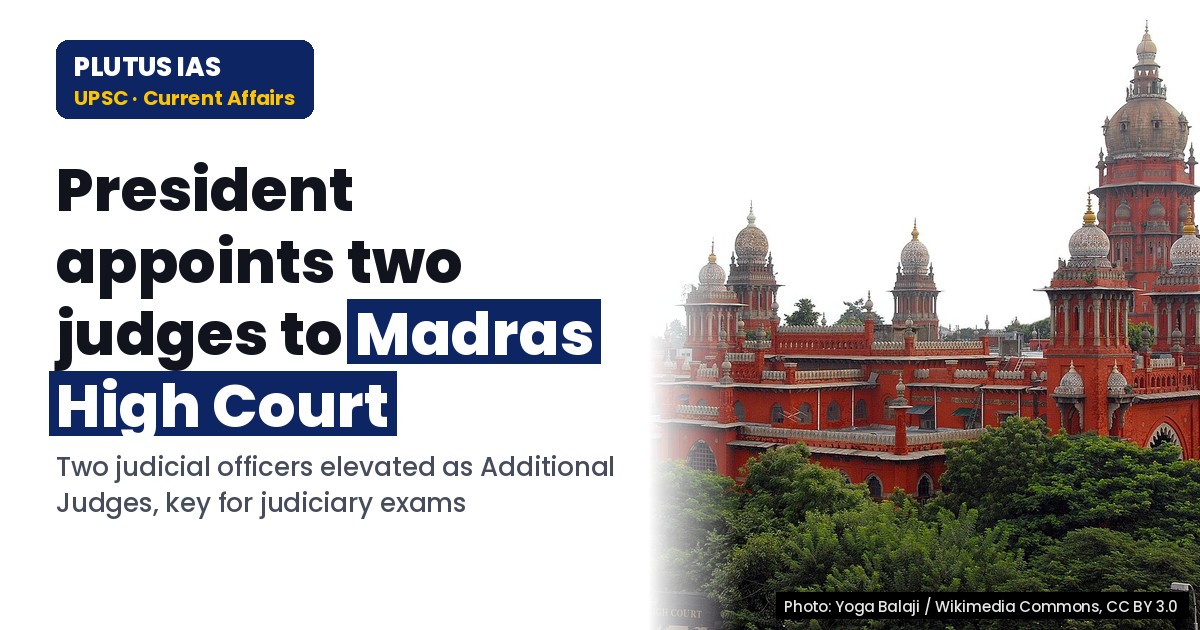
13 Oct President Appoints Two Additional Judges to Madras High Court
✎ Additional Judges to a High Court are appointed under Article 224 of the Constitution for a temporary period (up to 2 years) to manage workload, in consultation with the Chief Justice of India and the state Governor.
Subject Relevance — Where This Topic Fits
- GS Paper II — Polity and Governance (Constitutional provisions, Judiciary, Judicial Appointments)
- Prelims: Madras High Court, Additional Judges, Article 224, Collegium System, Judicial Appointments Commission, Constitutional provisions related to High Court judges, President’s power of appointment
- Essay: Judicial reforms in India: Balancing independence and accountability, The role of the judiciary in upholding constitutional democracy
Quick Revision: Additional Judges to a High Court are appointed under Article 224 of the Constitution for a temporary period (up to 2 years) to manage workload, in consultation with the Chief Justice of India and the state Governor.
Why is this in the news?
The President of India has recently appointed two judicial officers as Additional Judges of the Madras High Court, a development that underscores the constitutional process of judicial appointments and the operational dynamics of High Courts in India. This appointment is significant as it reflects the ongoing efforts to strengthen the judiciary at the state level while adhering to the constitutional mandate for judicial governance.
Background
- The Madras High Court is one of the oldest and most prominent High Courts in India, established under the Indian High Courts Act, 1861, and currently functions under the Constitution of India.
- Article 216 of the Constitution of India provides that every High Court shall consist of a Chief Justice and such other judges as the President may from time to time deem necessary to appoint.
- The appointment of Additional Judges to a High Court is governed by Article 224 of the Constitution, which empowers the President to appoint such judges for a temporary period, not exceeding two years, to meet the workload requirements of the Court.
- The Collegium System, evolved through judicial pronouncements, plays a pivotal role in the appointment and transfer of judges to the Higher Judiciary, including High Courts.
- The Madras High Court has been actively engaged in judicial reforms and digitalisation initiatives to enhance efficiency and access to justice.
What are Additional Judges in a High Court?
- Additional Judges are appointed to a High Court under Article 224 of the Constitution of India to address temporary workload pressures.
- They are appointed for a fixed tenure, not exceeding two years, and their service does not confer any permanent status or rights to future appointments.
- The appointment is made by the President of India in consultation with the Chief Justice of India and the Governor of the state where the High Court is situated.
- Additional Judges possess the same powers, jurisdiction, and authority as permanent judges of the High Court during their tenure.
- The primary objective of appointing Additional Judges is to ensure the timely disposal of cases and to maintain judicial efficiency, particularly in High Courts with a high pendency of cases.
- The practice of appointing Additional Judges is distinct from the appointment of permanent judges, which follows the Collegium System and involves a more elaborate process of selection and consultation.
- This provision is a constitutional mechanism to address immediate judicial needs without compromising the independence or integrity of the judiciary.
Key Features
| Feature | Significance |
|---|---|
| Appointment of Additional Judges | Temporary judicial appointments to address backlog and expedite case disposal in the Madras High Court. |
| Judicial Officer Background | Appointment of serving judicial officers ensures institutional continuity and familiarity with court procedures. |
| Presidential Authority under Article 224(1) | Constitutional power vested in the President to appoint additional judges to High Courts when required. |
| High Court Collegium Recommendation | Judicial appointments are recommended by the High Court Collegium, reflecting the judiciary’s role in self-governance. |
| Temporary Nature of Appointment | Additional judges serve for a fixed tenure, ensuring flexibility in judicial resource allocation. |
Why it Matters
Judicial Administration
- Alleviates the burden of pending cases by augmenting judicial capacity in the Madras High Court.
- Ensures timely dispensation of justice, upholding the constitutional mandate under Article 21 (Right to Life and Personal Liberty).
- Demonstrates the executive-judicial interface in appointments, balancing constitutional roles.
Constitutional Governance
- Reinforces the separation of powers by adhering to the constitutional framework for judicial appointments.
- Highlights the role of the President as a constitutional authority in judicial appointments under Article 224(1).
- Emphasizes the collegium system’s role in maintaining judicial independence and meritocracy.
Institutional Efficiency
- Temporary appointments allow for targeted judicial resource deployment during periods of high caseload.
- Judicial officers with prior court experience ensure seamless integration into the judicial process.
Challenges
1. Judicial Vacancy and Backlog
- Persistent vacancies in High Courts contribute to judicial delays, undermining access to justice.
- Pending cases in the Madras High Court necessitate strategic appointments to reduce pendency.
UPSC Link: Judicial Reforms (Constitutional Provisions)
2. Appointment Process Delays
- Collegium consultations and executive approvals can lead to prolonged vacancies in judicial positions.
- Administrative bottlenecks may delay the appointment of additional judges despite urgent need.
UPSC Link: Collegium System (Supreme Court Advocates-on-Record Assn. Case)
3. Judicial Independence vs. Executive Role
- Balancing the President’s constitutional role with the judiciary’s autonomy in appointments remains a governance challenge.
- Ensuring appointments are merit-based while avoiding perceptions of executive interference.
UPSC Link: Judicial Appointments (Article 224)
Challenges — UPSC Perspective
| Issue | Concern |
|---|---|
| Collegium System Delays | Prolonged consultations may delay critical judicial appointments. |
| Judicial Vacancy Persistence | High court vacancies contribute to case backlog and delayed justice. |
| Executive-Judicial Interface | Balancing constitutional roles without compromising judicial independence. |
| Temporary Appointment Limitations | Fixed tenure may not address long-term judicial capacity needs. |
| Perception of Executive Influence | Ensuring appointments remain meritocratic and free from political bias. |
Way Forward
- Strengthen the collegium system to streamline judicial appointments and reduce delays.
- Explore mechanisms to address long-term judicial vacancies beyond temporary appointments.
- Enhance administrative efficiency in processing appointments to minimize pendency.
- Conduct periodic reviews of judicial capacity in High Courts to identify resource gaps.
- Promote transparency in the appointment process to maintain public trust in the judiciary.
- Invest in judicial infrastructure to support additional judges in managing caseloads effectively.
- Encourage judicial training programs to prepare officers for higher judicial roles.
UPSC Value Addition
Keywords for Mains Answer-Writing
Judicial Appointments · Additional Judges of High Court · Constitutional Provisions under Article 224 · Appointment of Judges in India · Judicial Collegium System · Madras High Court · Judicial Reforms · Constitutional Governance · Separation of Powers · Judicial Independence · Appointment Process for Judges · President’s Constitutional Role · Judicial Vacancies and Appointments
Constitutional & Policy Linkages
- Article 224(1) – Appointment of Additional Judges
- Article 217 – High Court Judges’ Appointments
- Article 50 – Separation of Judiciary from Executive
Concept Flow
Constitutional Provision (Article 224(1)) → Presidential Authority → Judicial Officer Appointment → High Court Collegium Recommendation → Temporary Judicial Role → Case Disposal Efficiency → Access to Justice
Prelims Practice Questions
Q1. Consider the following statements regarding the appointment of Additional Judges to a High Court in India: 1. Additional Judges are appointed under Article 224 of the Constitution of India. 2. The appointment is made by the President of India in consultation with the Chief Justice of India. 3. Additional Judges serve for a fixed term of five years and are not eligible for reappointment. 4. The term of an Additional Judge may be extended by the President beyond the fixed term if recommended by the Supreme Court Collegium. How many of the above statements are correct?
- Only one
- Only two
- Only three
- All four
Answer: Only three — Statements 1 and 2 are correct as Additional Judges are appointed under Article 224 by the President in consultation with the Chief Justice of India. Statement 3 is incorrect because Additional Judges serve for a fixed term not exceeding two years and may be reappointed. Statement 4 is incorrect as extension beyond the fixed term is not automatic and requires Collegium recommendation, but the term itself is not fixed at five years.
Q2. Assertion (A): The appointment of Additional Judges to a High Court is a temporary measure to address judicial vacancies. Reason (R): The Constitution of India mandates that the number of judges in a High Court shall not exceed the sanctioned strength as per Article 216. Which of the following is correct?
- Both A and R are true, and R is the correct explanation of A
- Both A and R are true, but R is not the correct explanation of A
- A is true but R is false
- A is false but R is true
Answer: A is true but R is false — Assertion (A) is true as Additional Judges are appointed temporarily to address vacancies. Reason (R) is also true as Article 216 specifies the maximum number of judges in a High Court, but R does not directly explain why Additional Judges are appointed temporarily.
Q3. Match the following provisions of the Constitution of India with their respective Articles: Column I — Column II 1. Appointment of Additional Judges — A. Article 124 2. Appointment of Judges of the Supreme Court — B. Article 217 3. Appointment of Judges of a High Court — C. Article 224 4. Oath or affirmation by a Judge — D. Article 216
- 1-C, 2-A, 3-B, 4-D; 1-D, 2-B, 3-A, 4-C; 1-B, 2-A, 3-C, 4-D; 1-A, 2-D, 3-B, 3-C
- answer_string_map_indexed_1_correct
- explain_match_pairs_1C_2A_3B_4D
- format_match
Answer: ? — Article 224 governs the appointment of Additional Judges to High Courts, Article 124 governs the appointment of Supreme Court Judges, Article 217 governs the appointment of High Court Judges, and Article 216 specifies the maximum number of judges in a High Court.
Mains Practice Question
✍ The Constitution of India provides for the appointment of Additional Judges to High Courts under Article 224 to address temporary vacancies. In this context, critically examine the constitutional and institutional framework governing such appointments. Also, elucidate the role of the President, the Supreme Court Collegium, and the Chief Justice of India in this process. (15 Marks)
Approach: MODEL-ANSWER SKELETON:
1. **Constitutional Framework**:
– Article 224(1) of the Constitution empowers the President to appoint Additional Judges to a High Court when the number of judges is inadequate to dispose of judicial work.
– The term of an Additional Judge is not to exceed two years, and the appointment is temporary in nature.
2. **Institutional Roles**:
– **President**: The President acts on the advice of the Council of Ministers, but the appointment is made in consultation with the Chief Justice of India (CJI) and the Governor of the State.
– **Supreme Court Collegium**: The Collegium, headed by the CJI, recommends the names of Additional Judges based on merit, seniority, and the need for judicial capacity.
– **Chief Justice of India**: Plays a pivotal role in the Collegium’s recommendations and ensures judicial independence.
3. **Judicial Independence and Collegium System**:
– The Collegium system, evolved through judicial pronouncements (e.g., Second and Third Judges Cases), ensures that judicial appointments are insulated from executive interference.
– The system emphasizes seniority, merit, and integrity as key criteria for appointment.
4. **Temporary Nature and Reappointment**:
– Additional Judges serve for a fixed term and may be reappointed if the need persists, but they are not permanent judges.
– The temporary nature ensures that the system does not dilute the constitutional mandate of permanent judges.
5. **Balancing Judicial Vacancies and Governance**:
– The appointment of Additional Judges is a pragmatic solution to address backlog and ensure timely justice delivery.
– It reflects the balance between constitutional provisions and the practical exigencies of the judiciary.
6. **Critique and Challenges**:
– Delays in the Collegium process can lead to prolonged vacancies.
– The temporary nature may not always align with the long-term needs of the judiciary.
7. **Conclusion**:
– The framework under Article 224 is a constitutional safeguard to maintain judicial efficiency while upholding the principles of separation of powers and judicial independence.
Source: PIB (Press Information Bureau)
Generated by AanyaAi for educational purpose.
Related guides on our sites
- Best PSIR optional coaching for upsc
- Best PSIR optional teacher for upsc
- Best teacher of PSIR optional for upsc
- Best PSIR optional coaching in delhi for UPSC

- महानदी कोलफील्ड्स में ई-कचरा प्रबंधन : छठे विशेष अभियान की प्रमुख पहल - October 13, 2026
- President Appoints Two Additional Judges to Madras High Court - October 13, 2026
- भारतीय नौसेना में शामिल होगा स्वदेशी युद्धपोत ‘समर्थक’: जानिए इसकी खासियतें - October 13, 2026

No Comments