


14 Oct Karnataka SIR: 29,000 Form-7 records missing online, UPSC relevance
✎ The Special Intensive Revision (SIR) is a statutory process to update electoral rolls, and Form-7 applications for deletion must be publicly accessible to ensure transparency and integrity in voter registration.
Subject Relevance — Where This Topic Fits
- GS Paper II — Constitutional and Statutory Bodies (Election Commission of India) | GS Paper II — Fundamental Rights and DPSP (Electoral Participation and Transparency) | GS Paper III — Governance (Electoral Reforms and Digital Governance)
- Prelims: Form-7 (Application for deletion of name from electoral roll), Special Intensive Revision (SIR), Electoral Roll Transparency, Chief Electoral Officer (CEO), Election Commission of India (ECI), Voter Registration Process, Digital Public Access to Electoral Data
- Essay: Electoral integrity and the role of transparency in democratic governance, Balancing privacy and public scrutiny in electoral administration
Quick Revision: The Special Intensive Revision (SIR) is a statutory process to update electoral rolls, and Form-7 applications for deletion must be publicly accessible to ensure transparency and integrity in voter registration.
Why is this in the news?
The disclosure of approximately 29,000 Form-7 applications—submitted during Karnataka’s Special Intensive Revision (SIR) process for the deletion of names from electoral rolls—being unavailable for public scrutiny on the official portals of the State’s Chief Electoral Officer (CEO) and the Election Commission of India (ECI) has raised concerns regarding transparency and accountability in electoral roll management. This anomaly, reported amid the ongoing SIR process, underscores the challenges in maintaining the integrity and accessibility of electoral data in India’s digital governance framework.
Background
- The Special Intensive Revision (SIR) is a periodic exercise conducted by the Election Commission of India (ECI) to ensure the accuracy and completeness of electoral rolls, typically before general elections or major state polls.
- Form-7 is a prescribed application format under the Registration of Electors Rules, 1960, used by electors to request the deletion of their names from the electoral roll, often due to migration, death, or duplication.
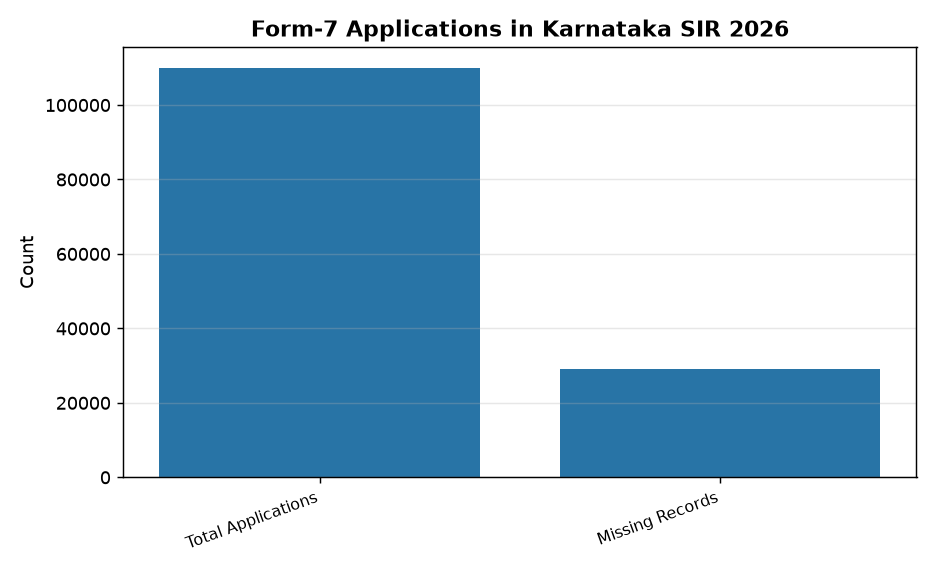
- Karnataka is currently undergoing the SIR process for the 2026 electoral roll revision, with a reported 1.10 lakh Form-7 applications submitted by October 8, 2026.
- The ECI and State CEOs are mandated to publish details of Form-7 applications on their official websites to facilitate public scrutiny and prevent malpractices such as bogus deletions or suppression of voter data.
- Transparency in electoral rolls is a cornerstone of free and fair elections, as it enables citizens to verify their inclusion or exclusion and report discrepancies.
- The absence of 29,000 Form-7 records online, despite ECI directives, highlights systemic gaps in digital governance and data management within electoral administration.
What is the Special Intensive Revision (SIR) and the Role of Form-7?
- The Special Intensive Revision (SIR) is a statutory process conducted by the Election Commission of India (ECI) under Section 21 of the Representation of the People Act, 1950 and the Registration of Electors Rules, 1960, to update and purify electoral rolls before elections.
- The SIR process involves field verification, door-to-door enumeration, and public display of draft electoral rolls to ensure accuracy and inclusivity.
- Form-7 is a key application used to request the deletion of a name from the electoral roll, typically due to reasons such as death, migration, or duplication of entries.
- The ECI mandates that all Form-7 applications be made available for public scrutiny on the official websites of the State CEO and the ECI to ensure transparency and prevent electoral fraud.
- Public scrutiny of Form-7 applications allows citizens to verify whether their requests for deletion have been processed correctly and to report any discrepancies or malpractices.
- The unavailability of 29,000 Form-7 records in Karnataka’s SIR process raises concerns about data integrity, digital governance, and the effectiveness of public oversight mechanisms.
- Electoral roll transparency is essential for maintaining the credibility of the electoral process, as it enables citizens to participate meaningfully in the democratic process.
- The ECI’s directives on digital transparency in electoral rolls are aligned with broader initiatives such as the Digital India programme, which aims to enhance governance through technology.
UPSC Value Addition
Keywords for Mains Answer-Writing
Electoral Reforms · Special Intensive Revision (SIR) · Form 7 Applications · Electoral Rolls · Transparency in Elections · Right to Information (RTI) · Election Commission of India (ECI) · Chief Electoral Officer (CEO) · Voter Registration · Public Scrutiny · Electoral Integrity · Digital Governance · Accountability in Administration
Prelims Practice Questions
Q1. Consider the following statements regarding the Special Intensive Revision (SIR) of electoral rolls in India:
1. The SIR is conducted annually to update the electoral rolls before every general election.
2. Form 7 is used by electors to apply for the deletion of their names from the electoral rolls.
3. The Election Commission of India (ECI) mandates that all Form 7 applications must be made publicly available for scrutiny on its official website.
How many of the above statements are correct?
- Only one
- Only two
- All three
- None
Answer: All three — Statement 1 is incorrect: The SIR is not conducted annually but as a special exercise to update electoral rolls, typically before elections. Statements 2 and 3 are correct: Form 7 is indeed used for deletion requests, and the ECI mandates public scrutiny of these applications.
Q2. Assertion (A): The Election Commission of India (ECI) is a constitutional body with the power to superintend, direct, and control the preparation of electoral rolls and the conduct of elections.
Reason (R): The ECI derives its authority from Article 324 of the Constitution of India, which vests it with these powers.
In the context of the above statements, which of the following is correct?
- Both A and R are true, and R is the correct explanation of A
- Both A and R are true, but R is not the correct explanation of A
- A is true, but R is false
- A is false, but R is true
Answer: Both A and R are true, and R is the correct explanation of A — Both the Assertion and Reason are correct. The ECI is indeed a constitutional body under Article 324, which empowers it to superintend, direct, and control elections, including the preparation of electoral rolls.
Mains Practice Question
✍ The transparency and accountability of the electoral process are fundamental to democratic governance. In light of the recent observations regarding the non-availability of approximately 29,000 Form 7 applications on the official portals of the Chief Electoral Officer (CEO) and the Election Commission of India (ECI) during the Special Intensive Revision (SIR) in Karnataka, critically examine the challenges to electoral transparency in India. (15 Marks)
Approach: MODEL-ANSWER SKELETON:
1. **Introduction (2 marks)**: Define the Special Intensive Revision (SIR) and its significance in maintaining accurate electoral rolls. Highlight the role of Form 7 applications in the deletion of names from electoral rolls and the legal/constitutional mandate for transparency.
2. **Legal and Constitutional Framework (3 marks)**:
– Article 324 of the Constitution: Powers and functions of the ECI.
– Representation of the People Act, 1950: Provisions related to electoral rolls and their revision.
– ECI guidelines on transparency and public scrutiny of Form 7 applications.
3. **Challenges to Transparency (4 marks)**:
– **Digital Divide and Accessibility**: Gaps in digital infrastructure, particularly in rural areas, affecting public access to Form 7 data.
– **Data Management Issues**: Inadequacies in the backend systems of the CEO and ECI portals leading to missing records.
– **Lack of Proactive Disclosure**: Failure to adhere to the principle of proactive disclosure under the RTI Act, 2005.
– **Accountability Mechanisms**: Weaknesses in grievance redressal and audit mechanisms to ensure timely and complete disclosure.
4. **Comparative Perspective (3 marks)**:
– Contrast with best practices in other democracies (e.g., Australia’s electoral roll transparency or the UK’s open electoral data initiatives).
– Reference to the ECI’s own initiatives like the Suvidha Portal and Voter Helpline App, and their limitations in ensuring end-to-end transparency.
5. **Way Forward (3 marks)**:
– Strengthening digital governance: Integration of blockchain or AI-driven verification systems for real-time tracking of Form 7 applications.
– Institutional Reforms: Establishing an independent audit body to oversee the SIR process and ensure compliance with transparency norms.
– Public Awareness Campaigns: Educating citizens on their rights to access and verify electoral data.
– Legal Reforms: Amending the Representation of the People Act to explicitly mandate the public availability of all Form 7 applications within a stipulated timeframe.
6. **Conclusion (2 marks)**: Emphasize that electoral transparency is not merely a procedural requirement but a cornerstone of democratic legitimacy. Conclude with a balanced view that while the ECI has made strides in digitization, systemic gaps persist and require urgent redressal to uphold the integrity of the electoral process.
Source: The Hindu
Karnataka PCS (KPSC) — State PCS Practice
Prelims: As per recent reports, Karnataka’s SIR (State Information Repository) portal has reported 1.10 lakh Form-7 applications, but how many records are missing online?
- 29,000 records
- 35,000 records
- 42,000 records
- 50,000 records
Answer: 29,000 records — The Karnataka SIR portal has reported 1.10 lakh Form-7 applications, with 29,000 records missing online as per the latest data.
Mains: Analyze the implications of the missing records in Karnataka’s SIR portal for Form-7 applications on governance, transparency, and citizen services. Suggest measures to address the issue and ensure data integrity in the State Information Repository.
Generated by AanyaAi for educational purpose.
Related guides on our sites
- Best PSIR optional coaching for upsc
- Best economics optional coaching for upsc
- Best PSIR optional teacher for upsc
- Best teacher of PSIR optional for upsc

- एससीओ बैठक में भारत का आतंकवाद विरोध: क्षेत्रीय सहयोग पर जोर - October 22, 2026
- SEC Directs Strict SC Order Compliance for Andhra ULB Polls - October 22, 2026
- आंध्र प्रदेश: 100 नगर निकाय चुनाव प्रक्रिया पर रोक, सर्वोच्च न्यायालय के आदेश के बाद SEC ने रोकी प्रक्रिया - October 22, 2026

No Comments