


14 Oct WPI Inflation Rises to 13.9% in September 2026: Key Trends & Analysis
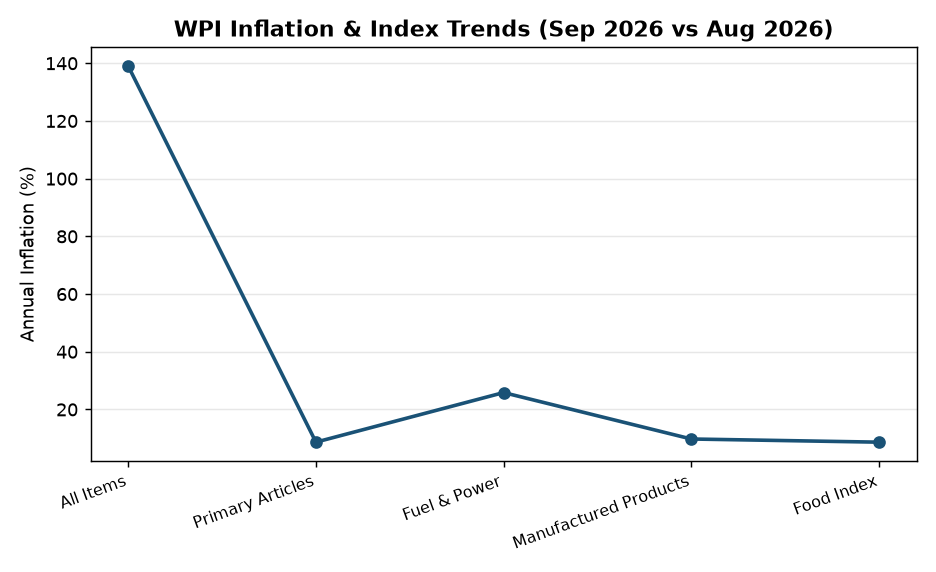
✎ WPI inflation for September 2026 was driven by primary articles (8.67%), fuel & power (25.85%), and manufactured products (9.76%), highlighting supply-side pressures and the need for calibrated policy responses.
Subject Relevance — Where This Topic Fits
- GS Paper III — Indian Economy: Issues relating to Planning, Mobilisation of Resources, Growth, Development and Employment | GS Paper III — Effects of Liberalisation on the Economy, Changes in Industrial Policy and their Effects on Industrial Growth
- Prelims: Wholesale Price Index (WPI), Base Year 2022-23, Primary Articles, Fuel & Power, Manufactured Products, WPI Food Index, Producer Price Index (PPI), Input Producer Price Index (IPPI), Weighted Response Rate, Inflationary Pressures, Monetary Policy Transmission, Index of Industrial Production (IIP)
- Essay: Inflation as a Barometer of Economic Stability: Balancing Growth and Price Stability, The Role of Producer Price Indices in Shaping Industrial and Trade Policies
Quick Revision: WPI inflation for September 2026 was driven by primary articles (8.67%), fuel & power (25.85%), and manufactured products (9.76%), highlighting supply-side pressures and the need for calibrated policy responses.
Why is this in the news?
The Ministry of Commerce and Industry, Government of India, released the provisional Wholesale Price Index (WPI), Output Producer Price Index (OPPI), and experimental Input Producer Price Index (IPPI) for September 2026, along with the final WPI for July 2026. This development is critical for UPSC aspirants as it reflects underlying inflationary trends, supply-side pressures, and the efficacy of macroeconomic policies in managing price stability.
Background
- The Wholesale Price Index (WPI) is a key economic indicator that measures the average change in wholesale prices of goods in the economy, excluding services. It is published monthly by the Office of the Economic Adviser, Ministry of Commerce and Industry.
- WPI serves as an early indicator of inflationary trends, influencing monetary policy decisions, trade agreements, and fiscal measures. It is also used in the calculation of Gross Domestic Product (GDP) deflators.
- Producer Price Indices (PPIs), including OPPI and IPPI, are experimental indices introduced to provide a more comprehensive view of price dynamics at different stages of production, from inputs to final outputs.
- Inflationary pressures in WPI are influenced by global commodity prices, supply chain disruptions, domestic production constraints, and policy interventions such as subsidies or taxes on essential goods.
- The WPI is distinct from the Consumer Price Index (CPI), which measures retail price changes and is used for determining the cost of living adjustments for various welfare schemes.
Understanding the Wholesale Price Index (WPI) and Related Producer Price Indices
- The WPI is a price index that measures the average change in wholesale prices of goods traded in the domestic market. It is compiled with a base year of 2022-23 and covers three major groups: Primary Articles, Fuel & Power, and Manufactured Products.
- The WPI Food Index is a sub-component of the WPI, combining primary food articles and manufactured food products. It has a weight of 29.9% in the WPI and is a critical indicator for monitoring food inflation, which directly impacts household budgets and nutritional security.
- The Output Producer Price Index (OPPI) measures the change in prices of goods at the point of sale by producers. It provides insights into the pricing power of producers and the competitiveness of domestic industries in global markets.
- The Input Producer Price Index (IPPI) is an experimental index that tracks the change in prices of raw materials and intermediate goods used in production. It helps identify cost-push inflationary pressures at the input stage, which can later translate into higher output prices.
- The WPI inflation rate is calculated as the percentage change in the WPI over a specific period (e.g., year-on-year or month-on-month). A rising WPI inflation rate indicates increasing wholesale prices, which may signal future retail inflation or supply-side constraints.
- The WPI is used by policymakers to design anti-inflationary measures, such as adjusting excise duties, import tariffs, or subsidies on essential commodities. It also informs the Reserve Bank of India (RBI) in its monetary policy decisions, particularly regarding liquidity management and interest rate adjustments.
- The WPI is compiled using a weighted Laspeyres formula, where weights are assigned based on the relative importance of commodities in the economy. The index is published monthly, with provisional data released on the 14th of the following month and final data released after two months.
- The WPI is distinct from the Consumer Price Index (CPI), which measures retail price changes and is used for determining the cost of living adjustments for welfare schemes. While WPI focuses on wholesale transactions, CPI reflects the prices paid by end consumers.
Key Features
| Feature | Significance |
|---|---|
| WPI Inflation (September 2026) | Annual WPI inflation surged to 13.90%, indicating persistent cost-push pressures across the economy, with significant month-on-month acceleration from 9.92% in August 2026. |
| Sub-group Inflation Trends | Fuel & power inflation peaked at 25.85% (vs 29.30% in August 2026), while manufactured products and primary articles recorded 9.76% and 8.67% respectively, reflecting sectoral supply-side constraints. |
| Food Price Dynamics | WPI Food Index inflation rose to 8.66% in September 2026 from 7.05% in August 2026, underscoring the structural vulnerability of food supply chains to climatic and logistical disruptions. |
| Index Movement | The all-commodities WPI index reached 112.5 in September 2026 (vs 110.8 in August 2026), signaling sustained upward pressure on wholesale prices across the economy. |
| Revised Data Integration | July 2026 WPI inflation was finalized at 9.78%, unchanged from the provisional estimate, ensuring methodological consistency in price tracking. |
Why it Matters
Macroeconomic Stability
- Elevated WPI inflation (13.90%) suggests persistent cost-push inflationary pressures, which may transmit to retail inflation if sustained, complicating monetary policy calibration by the Reserve Bank of India.
- Sectoral divergence—fuel and power (25.85%) vs. manufactured goods (9.76%)—highlights the need for targeted interventions in energy-intensive industries to mitigate supply-side bottlenecks.
- Food price inflation (8.66%) remains a critical concern for food security and inflation targeting, warranting policy measures to enhance agricultural productivity and reduce post-harvest losses.
Policy and Governance
- The WPI serves as an early-warning indicator for inflationary trends, enabling the government to deploy fiscal measures (e.g., subsidies, buffer stock management) or adjust tariffs to stabilize prices.
- The provisional-to-final reconciliation process ensures data integrity, reinforcing the credibility of India’s official price statistics for policymakers and market participants.
- The inclusion of experimental Input Producer Price Index (IPPI) and Output Producer Price Index (OPPI) provides granular insights into producer-side cost structures, aiding industrial policy formulation.
Data-Driven Governance
- The release schedule (14th of each month) aligns with global best practices, ensuring timely data dissemination for economic analysis and decision-making.
- Weighted response rates (83.4% for September 2026 WPI) reflect the robustness of data collection, though gaps in sectoral coverage may require targeted surveys to improve representativeness.
Challenges
1. Supply-Side Inflation Pressures
- Persistent inflation in fuel and power (25.85%) stems from global energy market volatility, domestic refining capacity constraints, and geopolitical risks, necessitating energy diversification strategies.
- Primary articles inflation (8.67%) is driven by climatic anomalies (e.g., erratic monsoons) and logistical inefficiencies, requiring investments in agricultural resilience and rural infrastructure.
- Manufactured goods inflation (9.76%) reflects rising input costs (e.g., metals, chemicals) and supply chain disruptions, highlighting the need for industrial policy reforms to enhance competitiveness.
UPSC Link: GS-III: Inflation & Price Stabilization
2. Data Gaps in Price Statistics
- Low response rates in certain sub-sectors (e.g., experimental IPPI at 83.4%) may introduce sampling bias, necessitating periodic reviews of data collection methodologies.
- The absence of a comprehensive Producer Price Index (PPI) system limits the granularity of cost-push inflation analysis, delaying targeted policy interventions.
UPSC Link: GS-III: Statistical Systems & Governance
3. Policy Transmission Lag
- The lag between WPI and retail inflation (CPI) complicates monetary policy synchronization, as cost-push pressures may take 3–6 months to reflect in consumer prices, delaying corrective actions.
- Fiscal measures (e.g., fuel subsidies) to curb WPI inflation may have unintended consequences, such as fiscal slippage or market distortions, requiring careful balancing.
UPSC Link: GS-III: Monetary-Fiscal Interface
4. Structural Vulnerabilities in Food Supply
- Food price inflation (8.66%) is exacerbated by fragmented supply chains, inadequate storage infrastructure, and climate-induced production shocks, necessitating a multi-pronged approach (e.g., cold storage expansion, crop diversification).
- The WPI Food Index’s reliance on wholesale prices may understate retail price pressures, particularly in remote or underserved regions.
UPSC Link: GS-III: Food Security & Agricultural Reforms
Challenges — UPSC Perspective
| Issue | Concern |
|---|---|
| Fuel & Power Inflation (25.85%) | Exposure to global energy price volatility and domestic refining constraints. |
| Primary Articles Inflation (8.67%) | Climatic shocks and logistical inefficiencies in agricultural supply chains. |
| Manufactured Goods Inflation (9.76%) | Rising input costs (metals, chemicals) and supply chain disruptions. |
| Food Index Inflation (8.66%) | Structural vulnerabilities in post-harvest management and retail price transmission. |
| Data Response Gaps (83.4%) | Potential sampling bias in WPI/IPPI data collection affecting accuracy. |
Way Forward
- Enhance energy security through diversification (e.g., renewable integration, strategic petroleum reserves) to mitigate fuel price volatility.
- Strengthen agricultural resilience by expanding irrigation, promoting climate-smart practices, and improving post-harvest infrastructure (e.g., cold storage, food processing zones).
- Accelerate industrial policy reforms to address input cost escalations, such as rationalizing import duties on critical raw materials and incentivizing domestic manufacturing.
- Improve the Producer Price Index (PPI) framework by integrating experimental IPPI/OPPI data into mainstream policy frameworks for granular inflation analysis.
- Streamline data collection methodologies to address response rate gaps, including sector-specific surveys and digital monitoring of price movements.
- Align fiscal and monetary policies to address cost-push inflation, ensuring that subsidies or tariff adjustments are calibrated to avoid fiscal slippage or market distortions.
- Promote public-private partnerships in logistics and storage to reduce supply chain inefficiencies, particularly for perishable goods.
- Conduct periodic reviews of the WPI basket and weights to reflect structural changes in the economy, ensuring the index remains representative of current price dynamics.
UPSC Value Addition
Keywords for Mains Answer-Writing
Wholesale Price Index (WPI) · Producer Price Index (PPI) · Inflation measurement · Price stability · Monetary policy · Fiscal policy · Commodity price trends · Economic indicators · Index-based policy · Price monitoring · Industrial production · Food inflation · Fuel inflation · Manufacturing inflation · Base year revision · Price control mechanisms · Supply-side economics · Macroeconomic stability · Price indices in India · Inflation targeting
Concept Flow
Global energy market volatility → Domestic fuel & power price inflation (25.85%) → Transmission to manufactured goods (9.76%) via input costs. → Climatic anomalies (e.g., erratic monsoons) → Primary articles inflation (8.67%) → Food price pressures (8.66%) via supply chain disruptions. → Wholesale price inflation (WPI: 13.90%) → Lagged transmission to retail prices (CPI) → Monetary policy tightening risks. → Data collection gaps (83.4% response rate) → Potential sampling bias → Policy interventions based on incomplete data. → Inflationary pressures → Fiscal measures (subsidies/tariffs) → Fiscal slippage or market distortions → Need for calibrated policy responses.
Prelims Practice Questions
Q1. Consider the following statements regarding the Wholesale Price Index (WPI) in India:
1. The WPI is used as an indicator of the price of goods traded and produced in the wholesale market.
2. The base year for the current WPI series is 2011-12.
3. The WPI includes services such as banking, insurance, and telecommunication.
4. The WPI is published by the Ministry of Commerce and Industry, Government of India.
How many of the above statements are correct?
- Only one
- Only two
- Only three
- All
Answer: Only three — Statements 1 and 4 are correct. The WPI measures the price of goods traded in the wholesale market and is published by the Ministry of Commerce and Industry. Statement 2 is incorrect as the base year for the current WPI series is 2022-23, not 2011-12. Statement 3 is incorrect as the WPI does not include services.
Q2. Assertion (A): The Wholesale Price Index (WPI) is a more comprehensive measure of inflation compared to the Consumer Price Index (CPI).
Reason (R): The WPI includes prices of goods at the wholesale level, which are less affected by retail margins and taxes.
In the context of the above two statements, which one of the following is correct?
- Both A and R are true, and R is the correct explanation of A.
- Both A and R are true, but R is not the correct explanation of A.
- A is true but R is false.
- A is false but R is true.
Answer: A is true but R is false. — Both the assertion and reason are true. However, the WPI is not necessarily a more comprehensive measure of inflation compared to the CPI, as the CPI reflects the price changes faced by consumers at the retail level, which is more relevant for assessing the cost of living. Hence, R is not the correct explanation of A.
Q3. Match the following price indices with their respective base years:
Column I (Price Index) Column II (Base Year)
a. Wholesale Price Index (WPI) 1. 2016-17
b. Consumer Price Index (CPI) – Rural 2. 2022-23
c. Consumer Price Index (CPI) – Urban 3. 2012
d. Producer Price Index (PPI) – Experimental 4. 2011-12
- a-2, b-1, c-3, d-4
- a-4, b-3, c-1, d-2
- a-2, b-4, c-1, d-3
- a-3, b-2, c-4, d-1
Answer: a-4, b-3, c-1, d-2 — The correct matching is: a. WPI – Base year 2022-23, b. CPI Rural – Base year 2016-17, c. CPI Urban – Base year 2012, d. Experimental PPI – Base year 2011-12.
Mains Practice Question
✍ The Wholesale Price Index (WPI) serves as a critical macroeconomic indicator for policy formulation and price stability in India. Critically examine the role of WPI in shaping monetary and fiscal policy, with reference to its components and recent trends in inflation. Also, discuss the limitations of WPI as a measure of inflation and its implications for economic governance. (15 Marks)
Approach: 1. **Definition and Purpose of WPI**: Define WPI as a price index that measures the average change in wholesale prices of goods traded in the wholesale market. Explain its role in tracking price movements, identifying inflationary pressures, and guiding policy decisions.
2. **Components of WPI**: Break down the WPI into its three major components: Primary Articles, Fuel and Power, and Manufactured Products. Provide the recent annual inflation rates for September 2026 (Primary Articles: 8.67%, Fuel and Power: 25.85%, Manufactured Products: 9.76%) and explain their significance in the context of supply-side and demand-side inflation.
3. **Role in Monetary and Fiscal Policy**:
– **Monetary Policy**: Discuss how WPI trends influence the Reserve Bank of India’s (RBI) monetary policy decisions, including interest rate adjustments and liquidity management. Highlight the relationship between WPI inflation and the RBI’s inflation targeting framework.
– **Fiscal Policy**: Explain how the government uses WPI data to design fiscal measures such as subsidies, price stabilization funds, and import/export duties to mitigate inflationary pressures.
4. **Recent Trends and Policy Challenges**:
– Analyze the sharp increase in WPI inflation from 9.92% in August 2026 to 13.9% in September 2026, with a focus on the surge in Fuel and Power inflation (25.85%). Discuss the potential causes, such as global oil price volatility, supply chain disruptions, or domestic production constraints.
– Highlight the role of food inflation (8.66% in September 2026) and its impact on household budgets and poverty alleviation programs.
5. **Limitations of WPI**:
– **Exclusion of Services**: Explain that WPI does not include services, which form a significant part of the economy and consumer expenditure.
– **Weightage and Representativeness**: Discuss how the fixed weightage of commodities in WPI may not reflect current consumption patterns or structural changes in the economy.
– **Retail vs. Wholesale Prices**: Highlight the difference between wholesale and retail prices, noting that retail prices (CPI) are more relevant for assessing the cost of living.
– **Base Year Revision**: Mention the need for periodic revision of the base year to ensure relevance and accuracy.
6. **Implications for Economic Governance**:
– Discuss how the limitations of WPI necessitate the use of complementary indicators like CPI and PPI for a holistic assessment of inflation.
– Emphasize the importance of data transparency, timely dissemination, and inter-ministerial coordination (e.g., between the Ministry of Commerce and Industry, RBI, and NITI Aayog) for effective policy formulation.
7. **Conclusion**: Summarize the critical role of WPI in economic governance while acknowledging its limitations. Stress the need for a multi-indicator approach to inflation measurement and policy-making.
Source: PIB (Press Information Bureau)
Generated by AanyaAi for educational purpose.
Related guides on our sites
- Current affairs for upsc 2026
- Best PSIR optional coaching for upsc
- Best economics optional coaching for upsc
- Best PSIR optional teacher for upsc


No Comments