


14 Oct Cabinet approves ₹53,428 crore for PM Samajik Sahayata Yojana
✎ The Pradhan Mantri Samajik Sahayata Yojana (PMSSY) represents a recalibration of India’s social security framework under Article 41 of the Constitution, expanding disability pension coverage by lowering the benchmark disability…
Subject Relevance — Where This Topic Fits
- GS Paper II — Welfare Schemes for Vulnerable Sections of the Population | GS Paper III — Issues Relating to Poverty and Hunger
- Prelims: National Social Assistance Programme (NSAP), Pradhan Mantri Samajik Sahayata Yojana, Rights of Persons with Disabilities Act 2016, Directive Principles of State Policy (Article 41), Indira Gandhi National Old Age Pension Scheme, Indira Gandhi National Widow Pension Scheme, Indira Gandhi National Disability Pension Scheme, National Family Benefit Scheme
- Essay: The role of social security in achieving inclusive growth and reducing inequality, Challenges in the implementation of welfare schemes in India: A case study of NSAP
Quick Revision: The Pradhan Mantri Samajik Sahayata Yojana (PMSSY) represents a recalibration of India’s social security framework under Article 41 of the Constitution, expanding disability pension coverage by lowering the benchmark disability threshold to 40% and removing age restrictions, while ensuring 100% central funding for uniform implementation across the country.
Why is this in the news?
The Union Cabinet’s approval of ₹53,428 crore for the continuation of the National Social Assistance Programme (NSAP) for five years (2026–31) and the revision of disability pension norms marks a significant governance intervention aimed at broadening social security coverage. The scheme’s renaming to the ‘Pradhan Mantri Samajik Sahayata Yojana’ and the recalibration of eligibility criteria—particularly for disability pensions—reflects an attempt to align India’s social welfare architecture with constitutional directives and contemporary legal frameworks, while addressing gaps in coverage and adequacy.
Background
- The National Social Assistance Programme (NSAP) was launched on 15 August 1995 as a centrally sponsored scheme to provide financial assistance to the elderly, widows, and persons with disabilities living below the poverty line.
- NSAP operates under the constitutional mandate of Article 41 of the Directive Principles of State Policy, which directs the State to provide public assistance to citizens in cases of unemployment, old age, sickness, and disablement.
- The scheme is fully funded by the Central Government, ensuring uniform support across all States and Union Territories without fiscal burden on sub-national governments.
- Prior to this revision, the disability pension under NSAP required a benchmark disability of 80%, which excluded a significant portion of persons with disabilities from accessing benefits.
- The Rights of Persons with Disabilities Act, 2016, mandates that disability-related assistance must be at least 25% higher than comparable schemes for other categories, a provision now reflected in the revised norms.
What is the Pradhan Mantri Samajik Sahayata Yojana (PMSSY)?
- The PMSSY is the renamed and expanded version of the National Social Assistance Programme (NSAP), encompassing four key components: old-age pension, widow pension, disability pension, and family benefit scheme.
- The scheme provides 100% central assistance to beneficiaries, ensuring uniformity in support across all States and Union Territories, thereby reducing inter-state disparities in welfare delivery.
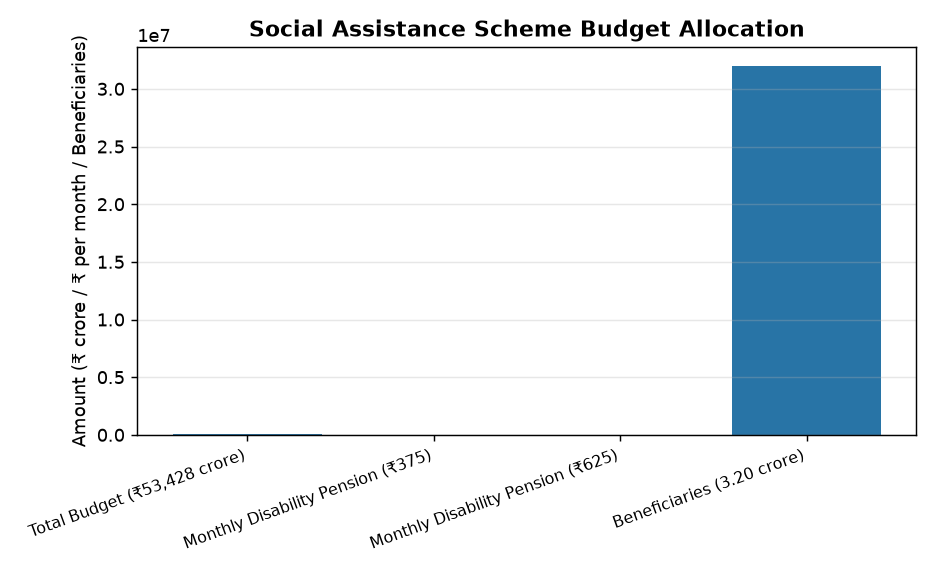
- Under the revised norms, the monthly disability pension has been increased to ₹375 for beneficiaries aged up to 79 years and ₹625 for those aged 80 and above, aligning with the cost-of-living adjustments and inflation trends.
- The eligibility criterion for disability pension has been reduced from 80% benchmark disability to 40%, in compliance with the Rights of Persons with Disabilities Act, 2016, thereby expanding coverage to a larger population of persons with disabilities.
- The minimum age criterion for disability pension has been removed, making persons with disabilities eligible for assistance from birth, addressing the needs of children with disabilities who require long-term support.
- The revised scheme is expected to benefit approximately 3.20 crore beneficiaries across all 36 States and Union Territories, enhancing the reach and impact of social security measures in India.
- The pension schemes for the elderly and widows, as well as the National Family Benefit Scheme, will continue in their existing form, ensuring continuity for existing beneficiaries while only the disability pension is revised.
- Implementation of the revised norms is expected within three months of the issuance of guidelines, demonstrating a commitment to timely and efficient governance.
Key Features
| Feature | Significance |
|---|---|
| Renaming of NSAP to ‘Pradhan Mantri Samajik Sahayata Yojana’ | Enhances visibility, centralisation, and national branding of the social assistance programme, aligning with the government’s flagship schemes nomenclature. |
| Revised disability pension norms (₹375 for <80 years, ₹625 for ≥80 years) | Increases financial assistance for elderly persons with disabilities, addressing inflation and cost-of-living adjustments while maintaining progressive benefit structure. |
| Reduction of benchmark disability from 80% to 40% | Broadens eligibility to align with the Rights of Persons with Disabilities Act, 2016, ensuring greater inclusion of persons with moderate disabilities. |
| Removal of minimum age criterion for disability pension | Expands coverage to include children with disabilities from birth, addressing early-life vulnerabilities and aligning with child welfare principles. |
| Centralised funding (100% central assistance) under NSAP | Ensures uniform benefit delivery across states, mitigating regional disparities in social security coverage. |
Why it Matters
Economic
- The ₹53,428 crore allocation over five years (2026-31) represents a substantial fiscal commitment to social welfare, reflecting prioritisation of inclusive growth and poverty alleviation.
- Increased pension outlays for persons with disabilities and the elderly may stimulate local demand in rural and semi-urban economies, supporting microeconomic resilience.
- Centralised funding reduces fiscal burden on state governments, enabling them to reallocate resources to other developmental priorities such as health and education.
Social
- The revised norms enhance the dignity and financial security of 3.2 crore beneficiaries, particularly persons with disabilities and elderly women, who are often marginalised in socio-economic terms.
- Alignment with the Rights of Persons with Disabilities Act, 2016, reinforces India’s commitment to the United Nations Convention on the Rights of Persons with Disabilities (UNCRPD).
- Removal of age barriers for disability pensions addresses intergenerational poverty and ensures lifelong support for vulnerable populations.
Administrative
- Renaming and restructuring of sub-schemes (e.g., ‘Pradhan Mantri Divyangjan Pension Yojana’) standardises nomenclature across flagship programmes, aiding in monitoring, evaluation, and public awareness.
- Centralised implementation under NSAP ensures uniformity in eligibility criteria and benefit disbursement, reducing administrative fragmentation and leakages.
- Three-month timeline for implementation reflects a structured rollout, balancing urgency with procedural rigour.
Legal
- The revised eligibility criteria for disability pensions are legally anchored in the Rights of Persons with Disabilities Act, 2016, which mandates benchmark disability recognition at 40% and enhanced assistance for persons with disabilities.
- The programme operationalises Article 41 of the Directive Principles of State Policy (DPSP), which directs the State to provide public assistance in cases of unemployment, old age, sickness, and disablement.
Challenges
1. Implementation Gaps and Beneficiary Identification
- Ensuring accurate and inclusive beneficiary identification, particularly for persons with disabilities, requires robust data systems and inter-departmental coordination to avoid exclusion errors.
- Delays in Aadhaar seeding, bank account linkages, and digital infrastructure in remote areas may hinder timely disbursement of benefits.
UPSC Link: GS-II: Welfare Schemes for Vulnerable Sections
2. Fiscal Sustainability and Inflation Adjustment
- The long-term fiscal viability of the ₹53,428 crore outlay must be monitored against inflationary pressures, demographic shifts, and potential expansion of beneficiary base.
- Static pension amounts (₹375/₹625) risk erosion in real value over time, necessitating periodic indexation mechanisms.
UPSC Link: GS-III: Indian Economy and Issues Relating to Planning
3. State-Level Coordination and Administrative Capacity
- While central funding is assured, state governments must ensure seamless integration with local governance structures to prevent duplication or gaps in service delivery.
- Capacity constraints in state social welfare departments may impede effective implementation, particularly in states with weaker administrative frameworks.
UPSC Link: GS-II: Government Policies and Interventions
4. Stigma and Social Barriers
- Persons with disabilities and elderly women may face social stigma or lack awareness about eligibility, necessitating targeted awareness campaigns and community engagement.
- Cultural barriers in rural areas could deter eligible beneficiaries from availing pensions, requiring grassroots-level outreach.
UPSC Link: GS-I: Social Empowerment
5. Monitoring and Evaluation Framework
- The absence of a robust grievance redressal mechanism and real-time monitoring tools may lead to inefficiencies in tracking benefit utilisation and addressing grievances.
- Lack of outcome-based evaluation (e.g., impact on poverty reduction, disability inclusion) may hinder evidence-based policy refinement.
UPSC Link: GS-IV: Ethics and Governance
Challenges — UPSC Perspective
| Issue | Concern |
|---|---|
| Beneficiary Identification | Risk of exclusion of eligible persons due to inadequate data systems or procedural bottlenecks. |
| Inflation Erosion | Static pension amounts may lose real value over time, reducing purchasing power. |
| State Capacity | Variations in administrative efficiency across states may lead to uneven implementation. |
| Awareness and Stigma | Lack of awareness among marginalised groups may limit scheme utilisation. |
| Monitoring Gaps | Inadequate tracking of benefit utilisation and grievance redressal may reduce programme effectiveness. |
Government Initiatives — Must-Memorise for Prelims
- Pradhan Mantri Samajik Sahayata Yojana (formerly National Social Assistance Programme – NSAP)
- Pradhan Mantri Vridhavastha Pension Yojana (formerly Indira Gandhi National Old Age Pension Scheme)
- Pradhan Mantri Vidhawa Pension Yojana (formerly Indira Gandhi National Widow Pension Scheme)
- Pradhan Mantri Divyangjan Pension Yojana (formerly Indira Gandhi National Disability Pension Scheme)
- Pradhan Mantri Parivar Labh Yojana (formerly National Family Benefit Scheme)
Way Forward
- Establish a real-time monitoring dashboard integrating Aadhaar, bank accounts, and disability certificates to track beneficiary enrolment and benefit disbursement.
- Introduce periodic inflation-indexed adjustments to pension amounts to maintain real value, with a transparent methodology for revisions.
- Strengthen state-level capacity through training programmes for social welfare officials, focusing on beneficiary identification and grievance redressal.
- Launch targeted awareness campaigns in regional languages, leveraging ASHA workers, Anganwadi centres, and local self-help groups to reach marginalised communities.
- Develop a grievance redressal portal with multi-level escalation (district, state, central) to address delays or denials in benefit disbursement.
- Conduct impact assessments every two years to evaluate the scheme’s effectiveness in reducing poverty and enhancing disability inclusion, with findings shared publicly.
- Explore convergence with other welfare schemes (e.g., Ayushman Bharat, PM-KISAN) to reduce duplication and improve holistic support for beneficiaries.
UPSC Value Addition
Keywords for Mains Answer-Writing
National Social Assistance Programme (NSAP) · Pradhan Mantri Samajik Sahayata Yojana · Disability pension norms · Rights of Persons with Disabilities Act, 2016 · Directive Principles of State Policy (Article 41) · Social security architecture in India · Benchmark disability threshold · Central sector schemes · Pension reforms in India · Inclusive social welfare policy
Constitutional & Policy Linkages
- [‘Article 41 (DPSP) – Public Assistance’]
- [‘Article 46 (DPSP) – Promotion of Educational and Economic Interests of SCs, STs, and Weaker Sections’]
Concept Flow
Constitutional Directive (Article 41) → Enactment of National Social Assistance Programme (1995) → Expansion of Coverage (Old Age, Widow, Disability, Family Benefit) → Legal Alignment (Rights of Persons with Disabilities Act, 2016) → Cabinet Approval (₹53,428 crore, 2026-31) → Revised Eligibility and Benefit Norms → Implementation and Monitoring → Impact Assessment and Refinement
Prelims Practice Questions
Q1. Consider the following statements regarding the National Social Assistance Programme (NSAP):
1. NSAP is a centrally sponsored scheme providing 100% central assistance.
2. The programme was launched on 15 August 1995.
3. The revised disability pension norms under NSAP now require a benchmark disability of 80%.
4. The scheme includes components for old-age pension, widow pension, disability pension, and family benefit.
How many of the above statements are correct?
- Only one
- Only two
- Only three
- All four
Answer: Only three — Statements 1, 2, and 4 are correct. Statement 3 is incorrect as the revised norms reduce the benchmark disability requirement from 80% to 40%.
Q2. Assertion (A): The Rights of Persons with Disabilities Act, 2016 mandates that disability-related assistance under social security schemes must be at least 25% higher than comparable assistance for other categories.
Reason (R): The Act recognises a benchmark disability threshold of 40% for eligibility under social security schemes.
Options:
A. Both A and R are true, and R is the correct explanation of A.
B. Both A and R are true, but R is not the correct explanation of A.
C. A is true, but R is false.
D. A is false, but R is true.
Answer: ? — Both A and R are true. The Act does mandate a 25% higher assistance for disability-related schemes (A) and recognises a 40% benchmark disability threshold (R). However, R does not directly explain the higher assistance rate.
Q3. Match the following components of the revamped NSAP with their new names:
Column I
1. Indira Gandhi National Old Age Pension Scheme
2. Indira Gandhi National Widow Pension Scheme
3. Indira Gandhi National Disability Pension Scheme
4. National Family Benefit Scheme
Column II
A. Pradhan Mantri Vidhawa Pension Yojana
B. Pradhan Mantri Parivar Labh Yojana
C. Pradhan Mantri Divyangjan Pension Yojana
D. Pradhan Mantri Vridhavastha Pension Yojana
Options:
1. 1-D, 2-A, 3-C, 4-B
2. 1-A, 2-B, 3-C, 4-D
3. 1-D, 2-B, 3-A, 4-C
4. 1-C, 2-A, 3-D, 4-B
Answer: ? — The correct matches are: 1-D (Pradhan Mantri Vridhavastha Pension Yojana), 2-A (Pradhan Mantri Vidhawa Pension Yojana), 3-C (Pradhan Mantri Divyangjan Pension Yojana), and 4-B (Pradhan Mantri Parivar Labh Yojana).
Mains Practice Question
✍ The Union Cabinet has approved a ₹53,428 crore outlay for the continuation of the National Social Assistance Programme (NSAP) for five years (2026-27 to 2030-31) with revised eligibility criteria and assistance rates for disability pension beneficiaries. Critically analyse the significance of these reforms in the context of India’s social security architecture and the Rights of Persons with Disabilities Act, 2016. (15 Marks)
Approach: MODEL-ANSWER SKELETON:
1. **Context and Background (3 Marks)**
– NSAP as a central sector scheme under Article 41 (Directive Principles of State Policy) providing 100% central assistance.
– Evolution: Launched in 1995, covering old-age pension, widow pension, disability pension, and family benefit.
– Recent reforms: Renaming to ‘Pradhan Mantri Samajik Sahayata Yojana’ and revised disability pension norms (₹375 for <80 years, ₹625 for ≥80 years; benchmark disability reduced to 40%; no minimum age criterion).
2. **Key Reforms and Legal Alignment (4 Marks)**
– Alignment with Rights of Persons with Disabilities Act, 2016: Benchmark disability threshold reduced to 40% (Section 2(r) of the Act).
– Removal of minimum age criterion: Ensures coverage from birth, addressing lifelong disability needs.
– Increased assistance rates: Reflects the Act’s mandate for disability-related assistance to be at least 25% higher than other categories.
3. **Strengths of the Reforms (4 Marks)**
– **Inclusivity**: Expanded coverage to persons with disabilities from birth, addressing early intervention needs.
– **Financial Adequacy**: Enhanced assistance rates for elderly disabled persons (≥80 years) to ₹625/month.
– **Uniformity**: 100% central assistance ensures uniform support across states/UTs, reducing regional disparities.
– **Legal Compliance**: Harmonises with constitutional obligations (Article 41) and statutory provisions (RPwD Act, 2016).
4. **Challenges and Criticisms (3 Marks)**
– **Coverage Gaps**: Despite reforms, India’s pension coverage remains low (~24% of elderly population; World Bank, 2023).
– **Implementation Lag**: Three-month timeline for revised norms may face delays in state-level rollout.
– **Sustainability**: ₹53,428 crore over five years (~₹10,686 crore/year) may be insufficient for long-term scalability given demographic pressures.
– **Exclusion Risks**: Persons with disabilities below 40% benchmark may still face exclusion despite RPwD Act’s progressive intent.
5. **Way Forward (1 Mark)**
– Strengthen state-level mechanisms for real-time beneficiary identification (e.g., Aadhaar-linked databases).
– Periodic review of assistance rates to account for inflation and cost-of-living adjustments.
– Integration with other welfare schemes (e.g., Ayushman Bharat, PM-KISAN) for holistic social security.
Source: The Hindu
Generated by AanyaAi for educational purpose.
Related guides on our sites
- Best PSIR optional coaching for upsc
- Best sociology optional coaching for upsc
- Which is best sociology optional coaching for upsc
- Best PSIR optional teacher for upsc

- NAMASTE Scheme: Enhancing Sanitation Workers’ Livelihoods & Safety - November 14, 2026
- एमएसएमई का विशेष अभियान 6.0: स्वच्छता और लंबित मामलों का निपटारा - November 14, 2026
- Sea Vigil-26: Coastal Defence Drills Off Visakhapatnam - November 14, 2026

No Comments